

Will Textbooks Change With GCSE Reform?
Will textbooks change with GCSE reform? Understand England’s reform timetable, when to replace maths books, and how to support your child’s revision now.
Yes, textbooks are likely to change as GCSE reform reaches new specifications, but that does not mean you should replace your child’s maths books now. If you are asking, “will textbooks change with GCSE reform?”, the useful distinction is between resources for a future course and the books your child needs for the course they are actually taking.
Policy baseline: 5 November 2025. Next annual review due: November 2026, or sooner if implementation details change. This article explains the Department for Education’s published response to the Curriculum and Assessment Review. Future dates below are the timetable set out in that response, rather than confirmation of a final GCSE maths specification or textbook release schedule.
For parents, the immediate decision is reassuringly practical: check your child’s specification before buying anything. A reform announcement alone is not a reason to empty the bookshelf.
The answer at a glance
Before spending money, establish these four things:
- Which GCSE maths specification is your child following?
- When will they take their exams?
- Does their teacher recommend the existing textbook for that course?
- Is a proposed replacement aligned with their course, rather than simply labelled “new”?
The reform discussed here concerns England. Do not assume its timetable applies to qualifications in Wales or Northern Ireland.
What has actually been announced about GCSE reform?
The independent Curriculum and Assessment Review published its final report in November 2025. The government’s response set out plans to refresh the national curriculum and update qualifications.
Its implementation timetable distinguishes several stages:
| Stage | Timetable in the November 2025 government response |
|---|---|
| Revised national curriculum published | 2027 |
| First teaching of the revised national curriculum | September 2028 |
| Updated GCSEs introduced for first teaching | A phased introduction in 2029 and 2030 |
These dates describe different events. Publishing a curriculum is not the same as starting a GCSE course, and first teaching is not the same as the first examination.
The DfE response also says it will work with Ofqual and awarding organisations on updating GCSEs. Parents should therefore distinguish the Review’s recommendations, government policy, qualification requirements and the eventual exam-board specifications. They are connected, but they are not interchangeable documents.
The published timetable does not establish a release date for your child’s next maths textbook. Nor should a general reform announcement be treated as confirmation of every future maths topic or assessment detail.
Will textbooks change with GCSE reform in every classroom?
New specifications are likely to lead to revised teaching resources. However, that is a practical expectation, not a confirmed commitment from every publisher to replace every book.
A revised textbook might change its topic coverage, chapter order, explanations or exam practice. The extent of any changes will depend on the final requirements. Until those requirements and the relevant book details are available, nobody can reliably tell you that a particular edition will cover everything a future course needs.
A clear explanation of fractions may still help a child who finds fractions difficult. That does not establish that the same book covers an entire revised specification. Think of usefulness at two levels: support for an individual skill, and coverage of the whole qualification.
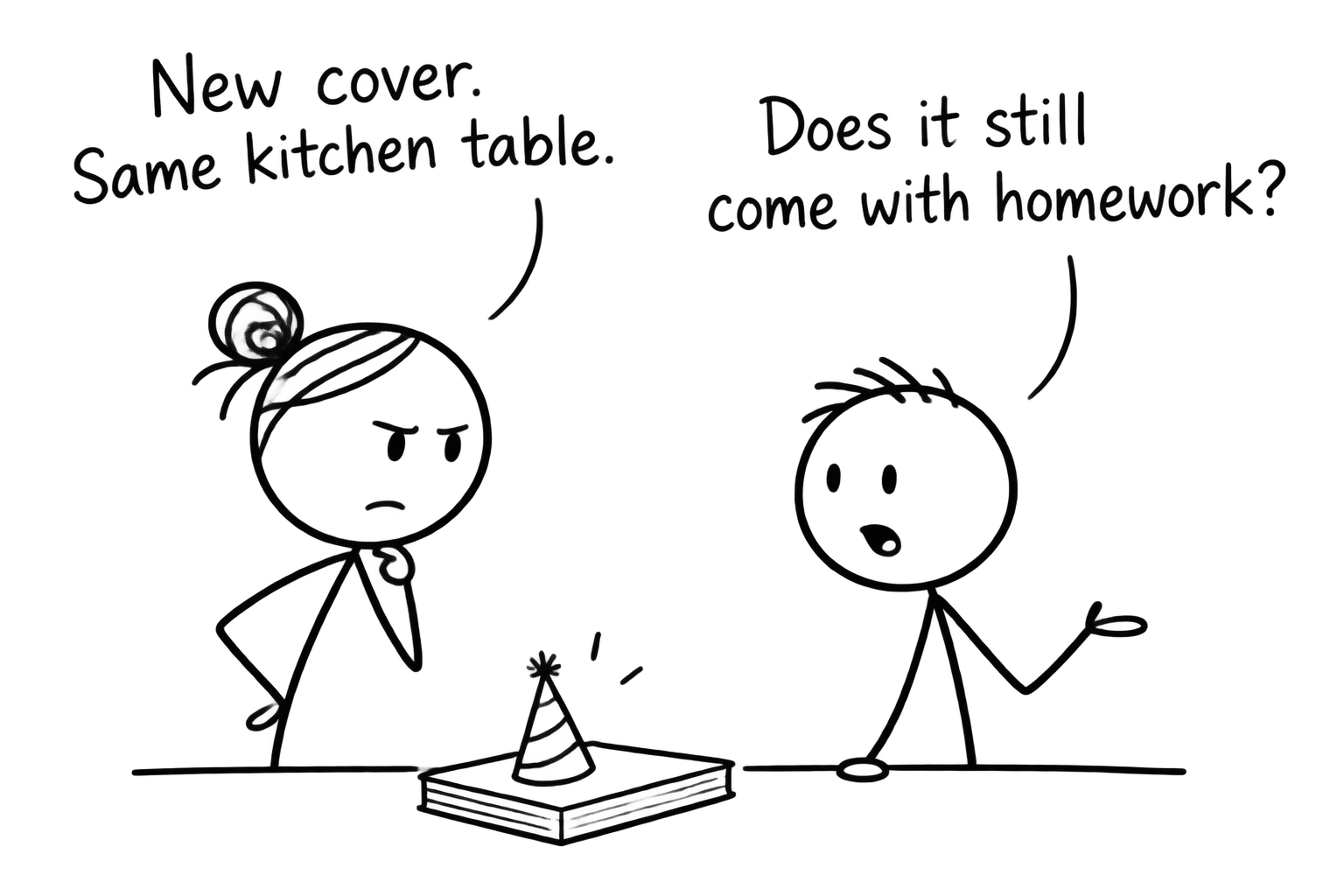 A parent and teenager joke about a textbook wearing a party hat
A buying plan you can use now
Start with the course your child is taking
Ask the school for the exam board, specification code and intended examination year. Confirm the foundation or higher tier when the school has made that decision.
Check the book against that course
Look at the edition, qualification details and contents page. Then ask the maths teacher a direct question: “Is this suitable as our main home reference for the specification my child is following?”
If the answer is yes, a reform headline does not itself create a reason to replace it. If the answer is “useful, but incomplete”, ask which areas need supplementing before buying another full textbook.
Buy for a specific gap
Decide what the purchase needs to do. Does your child need clearer explanations, more questions on one topic, or a complete course reference?
You can inspect the topic coverage in MathsGenie’s GCSE maths revision resources to make that conversation more concrete. The linked collection is for Edexcel, so check your child’s board before treating it as their course guide.
Start with MathsGenie’s GCSE Maths Lessons for current-course topic support while you confirm whether a replacement textbook is necessary.
What should parents do about GCSE maths changes?
For a child already preparing for an identified specification, keep revision focused on that course unless the school advises otherwise. Ask about announced changes through the lens of their examination year, rather than assuming every policy development affects them immediately.
For a younger child whose GCSE course is further away, postpone buying a complete future-course textbook until the school can identify the appropriate specification and resources. Meanwhile, support the maths they are learning now.
That can be quite targeted. If homework reveals difficulty with fractions, begin there. If the teacher identifies ratio or percentages, use that information to choose the next lesson.
Common mistakes when choosing textbooks
Treating “new edition” as proof of suitability
A cover cannot establish alignment with your child’s specification. Check the course details and ask the school before purchasing.
Confusing first teaching with examination dates
A qualification introduced for first teaching in a particular year does not mean every pupil takes that qualification’s examination that year. Use the school’s confirmed course information.
Assuming all existing material becomes useless
Assess individual chapters for learning support and the whole book for specification coverage. Those are separate judgements.
Buying early to feel prepared
Identify a current learning need before spending money on a speculative future-course book.
Keep revision moving while policy develops
Your goal is to support your child’s current maths course without buying resources they do not need. Once you have confirmed the specification, the remaining task is turning that information into regular practice on the topics causing difficulty. Start with MathsGenie’s GCSE Maths Lessons, checking the exam board against your child’s current specification before choosing their next topic.















