Will the New GCSE Maths Have a New Name?
Will the new GCSE Maths have a new name? No change has been announced in England. Here is what parents need to know about the planned reforms.
Updated: 3 November 2026
No. As of 3 November 2026, the government has not announced a new name for GCSE Mathematics in England. If your child is preparing for the current qualification, it remains GCSE Mathematics, usually called GCSE Maths.
That is the short answer to the question many parents are asking: will the new GCSE Maths have a new name? The nuance is that GCSE reform is under way, and changes to content and assessment are expected. A reformed qualification, however, does not automatically need a different title.
This article reflects the Department for Education's response to the Curriculum and Assessment Review, Ofqual publications available by the update date, and the Review's final report. It covers England first, because education and qualifications policy differs across the UK.
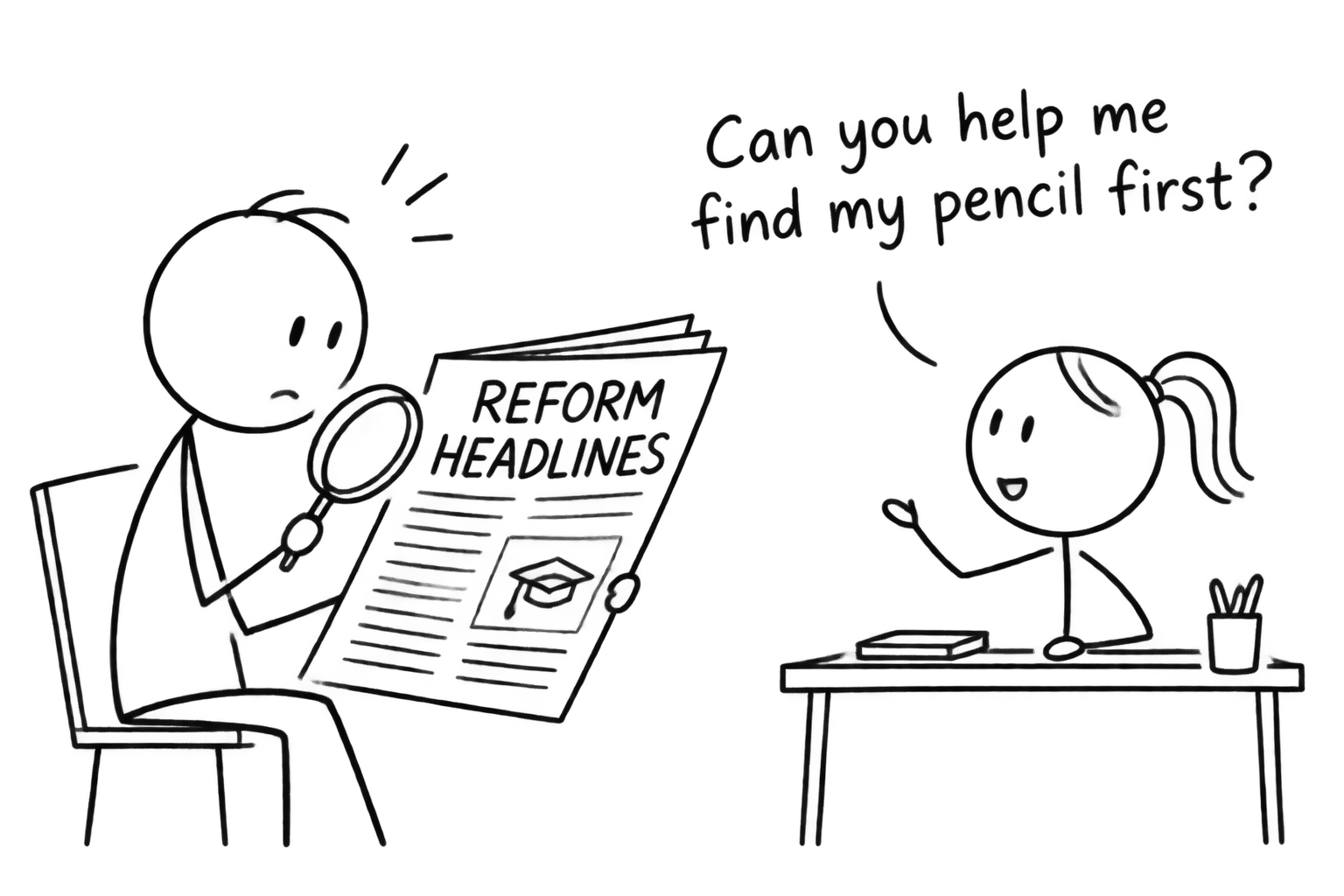 A parent searches alarming reform headlines while their child looks for a pencil
The answer at a glance
For parents trying to separate confirmed information from speculation, these are the important points:
- No replacement name for GCSE Mathematics has been announced in England.
- The Curriculum and Assessment Review recommended changes to curriculum and assessment, not the abolition of the GCSE Maths title.
- The Department for Education is developing revised curriculum and GCSE subject content.
- The final revised national curriculum is expected in spring 2027, with schools beginning to teach it from September 2028.
- Ofqual has indicated that new qualifications in relevant subjects are intended to be first taught in 2029 or 2030, but detailed arrangements still depend on later development and consultation.
- Current students should continue revising their existing exam board specification.
- Wales has a separate reform programme and is introducing a qualification called GCSE Mathematics and Numeracy (Double Award). That is not the announced model for England.
If your child is following the present English specification, keep their preparation anchored to the current GCSE Maths revision hub rather than trying to anticipate an unfinished future course.
Why parents are expecting a new name
Large education reforms often create a language problem. Headlines use phrases such as “new GCSEs”, “reformed maths” and “new curriculum”. It is understandable to assume that a new course must arrive with a new title.
But qualifications can change substantially while keeping familiar names. Content may be reorganised, assessment may be adjusted and specifications may be rewritten without GCSE Mathematics becoming a differently named qualification.
The current evidence supports that more ordinary interpretation. Official publications discuss revised mathematics content and future qualifications, but they do not announce a new title for GCSE Mathematics in England.
This distinction matters. A parent who hears “new GCSE Maths” may imagine that their child is revising for an obsolete qualification. In reality, a specification remains the correct specification until a replacement is formally approved, published and introduced for a defined teaching cohort.
What GCSE Maths changes are actually planned?
The Curriculum and Assessment Review published its final report in November 2025. The government then accepted or responded to recommendations across the curriculum and qualifications system.
For maths, the direction is refinement rather than a sudden renaming exercise. The Department for Education is responsible for developing the subject content. Ofqual regulates qualification and assessment arrangements, while exam boards use those requirements to create specifications and papers.
That process takes time. Parents should expect several stages:
| Stage | What it means for families |
|---|---|
| Curriculum development | The Department for Education determines what pupils should learn. |
| Subject content publication | The required knowledge and skills for the GCSE become clearer. |
| Ofqual consultation | Proposed assessment rules are examined publicly. |
| Exam board specifications | Edexcel, AQA, OCR and Eduqas publish course details where applicable. |
| First teaching date | Schools begin teaching the approved replacement qualification. |
| First examinations | The first cohort sits papers after completing the course. |
A name would normally become definitive through this formal process. Until that happens, unofficial labels such as “new Maths GCSE” are descriptions, not qualification titles.
For now, a student taking Edexcel can continue using the current Edexcel GCSE Maths lessons to follow the course they are actually being taught.
What about formula sheets from 2028?
This is one confirmed assessment development that could easily be mistaken for the arrival of an entirely new GCSE.
Following a Department for Education policy decision and an Ofqual consultation, students taking the current GCSE Mathematics qualification from 2028 will continue to receive a formula sheet for the lifetime of the current specification. This includes relevant November examinations.
That decision applies to the existing qualification. It does not rename it. It also demonstrates why parents should distinguish between three different things:
- a change to an examination arrangement;
- a revised specification;
- a new qualification title.
They are not interchangeable. An exam can change in a specific way while the qualification name and much of its structure remain familiar.
Does this affect a child already at secondary school?
It depends on the child's year group and the eventual first-teaching timetable.
Students already preparing for GCSE examinations should work from the specification named by their school. They should not switch resources because of a proposal, a consultation or a newspaper headline. The exam board's current specification determines what can be assessed.
If your child is younger, their school may eventually explain how the revised curriculum affects their cohort. Until final subject content, specifications and transition dates are published, nobody should claim certainty about every topic or paper structure.
A sensible parent checklist is:
- ask the school which exam board and specification your child follows;
- confirm whether they are entered for foundation or higher tier;
- use resources matched to that board and tier;
- treat consultations as proposals until decisions are published;
- check official updates annually rather than changing revision plans after every headline.
That is enough. You do not need to predict the future course to help effectively today.
England and Wales should not be confused
The answer changes when the country changes.
In Wales, GCSE reform is governed separately. Qualifications Wales has introduced GCSE Mathematics and Numeracy (Double Award), replacing the previous separate Mathematics and Mathematics-Numeracy GCSEs. Teaching of that reformed qualification began in September 2025.
England has not announced that title or the same double-award structure. The Curriculum and Assessment Review discussed in most English news coverage concerns England. A family moving between nations should therefore check the qualification offered by the destination school rather than assuming that “GCSE reform” means one UK-wide change.
Maths Genie organises material by qualification and exam board, allowing families in England to begin with the GCSE Maths board selector and move to the lessons that match the school's course.
Common mistakes parents should avoid
Assuming reform means an immediate change
A policy announcement does not alter the paper your child will sit next summer. Implementation normally follows curriculum development, consultation, specification publication and first teaching.
Buying resources for an unconfirmed course
A book or course labelled “new GCSE” may simply be using marketing language. Check its exam board, specification and publication context before relying on it.
Revising every possible future topic
Children gain more from secure understanding of their current course. For example, they can strengthen core skills through the fractions, decimals and percentages lesson or work through GCSE Maths video lessons matched to current topics.
Confusing England with Wales
The new Welsh title is real, but it does not establish the future name of GCSE Mathematics in England.
Keep revision tied to the qualification that exists
The useful answer is reassuringly simple. No new English name has been announced, and knowing that prevents reform headlines from pulling your child's revision away from the current specification. The remaining challenge is turning that clarity into steady, topic-by-topic work.
Start the Maths Genie Lessons for the current GCSE Maths specification and help your child practise the course they will actually be examined on.