

Will Mock Exams Change After Reform? A Parent’s Guide
Will mock exams change after reform? Understand England’s GCSE maths plans, what schools must clarify, and how to support your child’s current revision.
2026 edition. Policy baseline: the November 2025 Curriculum and Assessment Review and government response, alongside Ofqual’s March 2025 evidence-collection guidance. Review annually and when implementation details change.
Yes, mock exams can change as reformed GCSEs are introduced, but reform does not automatically change your child’s next mocks. If you are asking, “Will mock exams change after reform?”, the decisive detail is which specification your child follows, rather than when an announcement appears.
A headline about GCSE maths changes can unsettle a familiar revision routine. Should you replace the revision guide? Are older questions still useful?
Keep preparing for your child’s current qualification unless their school confirms a change affecting their cohort. Here is how to separate published plans from decisions that matter at home.
The answer parents need first
Here, GCSE reform means the changes planned for England following the Curriculum and Assessment Review. Education reforms elsewhere in the UK have separate arrangements.
Keep these distinctions in mind:
- A review recommendation is a proposal, rather than a finished exam specification.
- Curriculum changes and qualification changes have different implementation milestones.
- A school mock prepares pupils for a particular course. Confirm its specification and coverage.
- Revision should follow the confirmed course, including the exam board and foundation or higher tier.
The useful question becomes: “What is changing for my child’s year group?”
What has actually been announced?
The Department for Education’s November 2025 response sets out a staged timetable. It plans to publish the revised national curriculum in 2027, with first teaching from September 2028. Updated GCSEs are planned for first teaching in phases from 2029 onwards.
First teaching means the start of teaching a new course, rather than its first examination. An announcement therefore does not mean every GCSE pupil immediately moves to new papers.
| Published milestone | What it means for parents |
|---|---|
| Revised national curriculum planned for publication in 2027 | Schools receive the updated curriculum before implementation. |
| First teaching planned from September 2028 | Curriculum implementation begins, separately from GCSE qualification rollout. |
| Updated GCSEs planned for first teaching from 2029 onwards | Families need the subject timetable and their child’s confirmed specification. |
The Review also recommended reducing overall GCSE examination time by at least one tenth through assessment design. The government committed to working with Ofqual and awarding organisations to reduce examination time overall.
That does not establish a particular reduction for GCSE maths or a new duration for your child’s next mock. An overall ambition is not a completed maths paper design.
Will mock exams change after reform reaches a cohort?
Mocks may need to change when the qualification they prepare pupils for changes. Schools would be expected to align preparation with the relevant specification and assessment arrangements. Your child’s school must still confirm its papers, dates and coverage.
Schools also change assessments independently of national reform. Different questions, additional topics or a revised timetable may reflect ordinary assessment planning.
Ofqual’s March 2025 evidence-collection guidance asks schools and colleges to ensure pupils sit mock exams in examination conditions before formal examinations. This concerns resilience if examinations cannot go ahead; it does not announce a reformed mock paper.
Ask: “Does this change affect my child’s mock content, conditions or format, and why?”
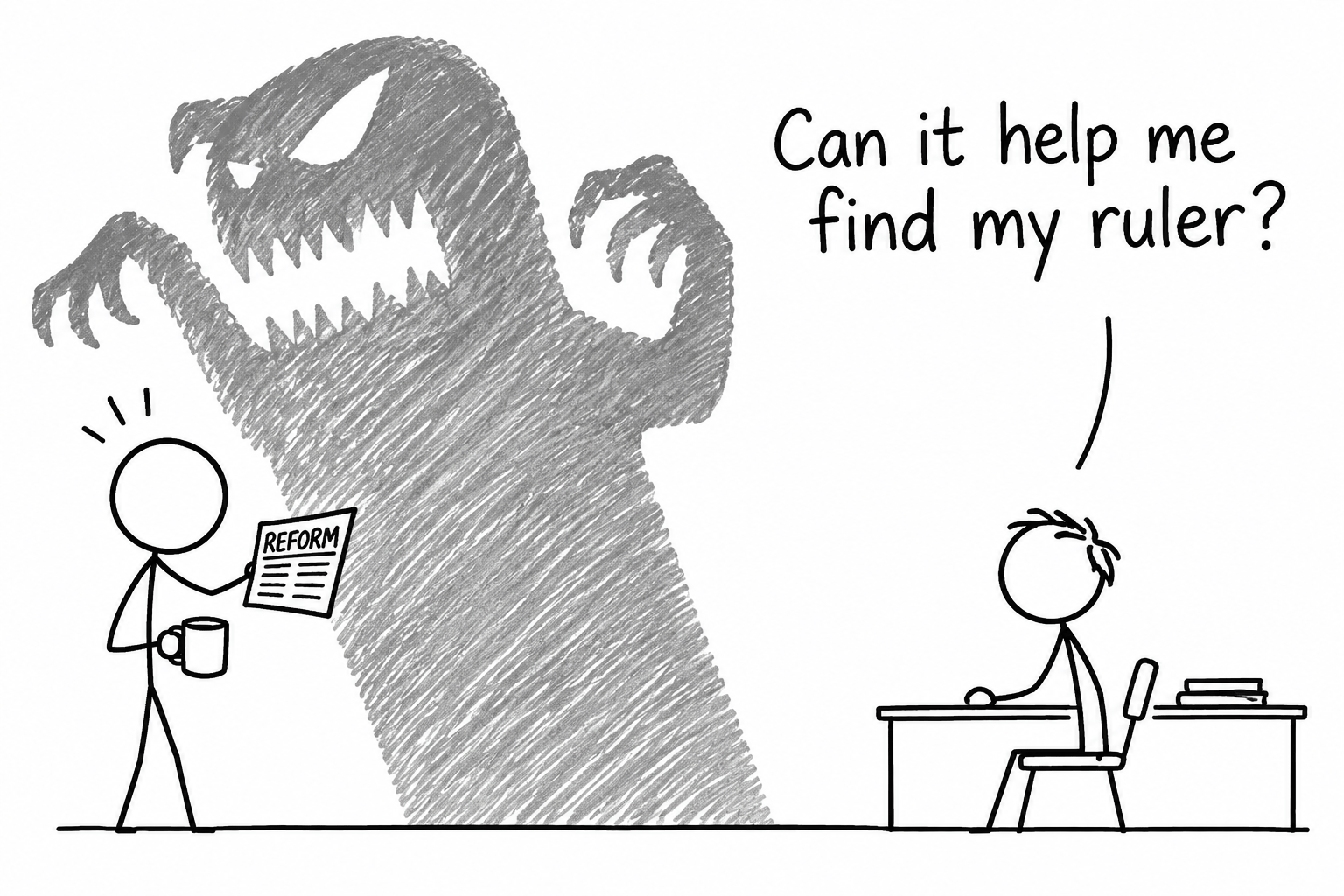 A parent’s reform newspaper casts a huge monster-shaped shadow while their child calmly asks for help finding a ruler.
A practical plan before the next maths mock
You need a reliable description of the next assessment and a manageable revision list. Those two things make uncertainty easier to handle.
Confirm the course and mock coverage
Ask the maths department for your child’s exam board, specification, intended tier and mock topic list. Confirm paper length, calculator arrangements and permitted support materials too.
The GCSE maths revision overview helps you locate resources by exam board. A topic and tier checklist can organise your questions, but the school’s confirmed coverage should determine mock preparation.
Turn feedback into a small revision list
Use the latest marked assessment to identify three priorities. Separate misunderstood topics from questions where your child knew the method but misread an instruction or made an arithmetic error.
For each priority, revisit the explanation, attempt questions independently, check answers and return to the topic later. Record what still needs help, so the next session has a clear starting point.
Use Maths Genie Lessons for the current GCSE specification, following the school’s topic list. Let marked work guide the choice rather than repeatedly revising comfortable topics.
Match resources before replacing them
Check the exam board, specification and tier on existing materials. Ask the teacher whether anything needs supplementing before buying replacements.
For an Edexcel pupil, the Edexcel GCSE Maths lessons and Edexcel topic revision guides offer identifiable resources to compare with the school’s list. Aim for materials your child can use consistently.
Common mistakes when reading GCSE reform news
Confusing announcements with implementation. Check whether a date means publication, first teaching or first examinations.
Assuming shorter examinations mean less content. Assessment time and subject content are separate questions. Wait for confirmed requirements before removing topics.
Discarding older resources immediately. Judge materials against the specification and mock coverage. Publication date alone cannot establish relevance.
Treating a changed mock as proof of reform. Ask whether changes reflect national policy, teaching coverage or school assessment planning.
Postponing revision while awaiting clarity. Continue with confirmed topics while future arrangements are clarified.
Keep the next mock in focus
The timetable describes published plans, rather than guaranteed final subject arrangements. At each annual update, check DfE implementation dates, Ofqual decisions and confirmed GCSE maths specifications. Ask the school whether developments affect your child’s cohort.
For now, turn assessment feedback into revision priorities. Start with Maths Genie Lessons for your child’s current specification and use the confirmed mock topic list to choose the first lesson together.















