

What to Revise in April of Year 13 Maths
What to revise in April of Year 13 Maths: prioritise weak topics, use past papers effectively and follow a practical weekly plan before exams begin in May.
April creates a strange feeling in Year 13. The course may not be completely finished, yet the first A Level exams are close enough to make every unfinished topic feel urgent. A student can spend an evening making a beautiful timetable and still wake up unsure what to revise.
The short answer to what to revise in April of Year 13 Maths is this: identify your weakest high-value topics, repair them with focused questions, connect Pure Maths to Statistics and Mechanics, and gradually move towards timed papers. April is not the month to reread the entire course. It is the month to turn gaps into marks.
This plan follows a hypothetical Year 13 student through the month. Their exact topics will differ from yours, but the decision-making process should not.
Your April revision checklist
By the end of April, aim to have:
- checked your exam board specification and paper structure;
- ranked topics by confidence rather than revising in textbook order;
- repaired several important weaknesses from Years 12 and 13;
- practised Pure, Statistics and Mechanics every week;
- completed timed sections before attempting full papers regularly;
- marked your work and kept a short error log;
- revisited corrected questions after a few days;
- built a realistic plan for the remaining weeks.
The MathsGenie Edexcel A Level Maths revision hub brings together topic resources, exam-style questions, past papers and mark schemes. If you study AQA, OCR or Eduqas, use your own specification to check coverage and paper arrangements.
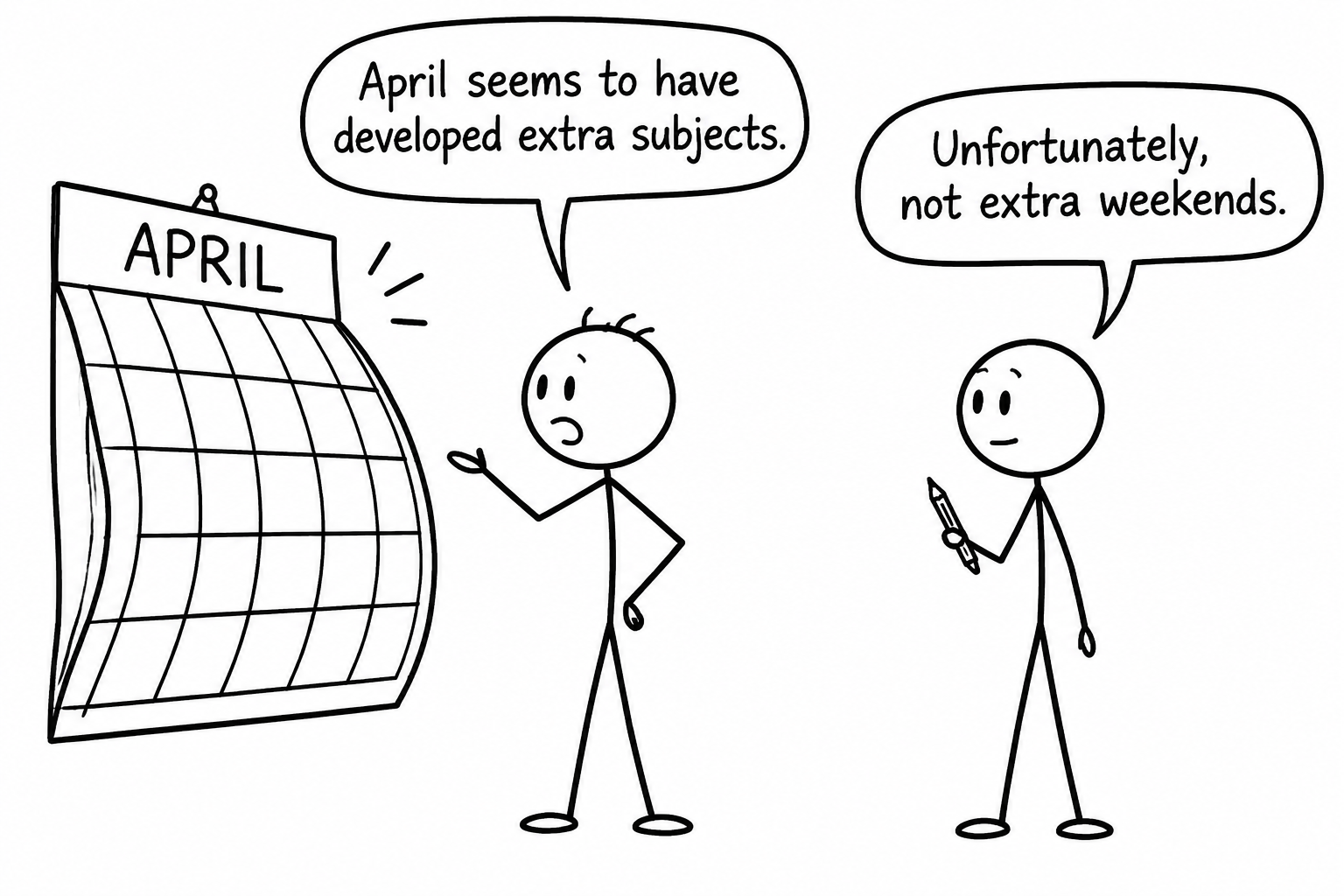 A Year 13 student discovers that April has more subjects but not more weekends
Where April fits into Year 13 maths revision
Earlier in Year 13, revision often supports whatever is being taught. Later, close to the exams, full papers and exam technique become more important. April sits between those phases.
That makes it a transition month. You are still rebuilding knowledge, but you should also begin retrieving several ideas without being told which method to use. A mixed set might require differentiation, logarithms and trigonometric identities in quick succession. The difficulty is not always performing the method. It is recognising it.
Imagine our student opening a full paper on the first day of the Easter holiday. They struggle, score it, and conclude that they are “bad at papers”. But the paper has only revealed several smaller problems: an uncertain integration method, weak hypothesis-test language and an incorrect mechanics diagram. Those are repairable.
The lesson is important. Treat each lost mark as information, not a verdict.
What to prioritise at the start of April
Diagnose before you schedule
Begin with recent assessments, homework and one mixed set of exam questions. Sort mistakes into four categories:
- Knowledge gap: you did not know the fact, definition or method.
- Recognition gap: you knew the method but did not spot when to use it.
- Execution error: the method was correct, but algebra, arithmetic or notation failed.
- Exam error: you misread the question, omitted reasoning or used time poorly.
This creates a better Year 13 maths revision list than highlighting every topic you dislike. A topic that feels uncomfortable may already be accurate. Another may feel familiar because you have read it repeatedly, even though you cannot answer questions independently.
Repair connected Pure Maths topics
Pure Maths supports a large part of the course, including techniques used within applied questions. Priorities commonly include algebra and functions, trigonometry, exponentials and logarithms, differentiation, integration, numerical methods, vectors, sequences and proof.
Do not revise these as completely separate islands. Differentiation connects to curve sketching and optimisation. Trigonometric identities may appear inside integration. Exponentials and logarithms connect to modelling.
Choose a weak topic, review the method briefly, answer exam-style questions without notes, mark them, and then retry the questions you missed. The A Level topic resources and exam questions can support this repair stage without forcing you straight into another full paper.
Keep Statistics and Mechanics visible
Students sometimes spend most of April on Pure Maths because it appears larger and more varied. The applied content then becomes an unpleasant surprise later.
Schedule Statistics and Mechanics every week. In Statistics, check both calculation and interpretation. You may be able to obtain a numerical result but still lose marks by failing to write a conclusion in context. In Mechanics, practise modelling assumptions, clear diagrams, signs, units and the translation from words into equations.
Use your specification as the final checklist. Paper combinations and assessment arrangements vary between exam boards, so revise for the course you are actually taking.
A weekly April revision plan
Our student now has a ranked weakness list. Instead of assigning vague sessions such as “revise calculus”, they give every session an observable outcome.
| Session | Main purpose | Suggested task |
|---|---|---|
| Monday | Repair | Review one weak Pure topic and complete focused questions |
| Tuesday | Applied maths | Alternate Statistics and Mechanics questions |
| Wednesday | Retrieval | Complete a mixed set without notes |
| Thursday | Repair | Correct errors and practise a second weak topic |
| Friday | Light review | Revisit definitions, assumptions and earlier corrections |
| Saturday | Timed work | Complete a timed paper section or, later in April, a full paper |
| Sunday | Review and plan | Mark work, update the error log and choose next week’s priorities |
School commitments and other A Levels will affect the number and length of sessions. Consistency matters more than building a timetable that only works in an imaginary week. The broader revision timetable planning guide explains how to balance topic learning, practice and paper work, although its examples focus on GCSE revision.
If setting up this weekly rotation already feels like another revision task, build the April structure in the Revision Planner rather than repeatedly redrawing it on paper.
How the plan should change through April
Early April: find and repair gaps
Spend most sessions on diagnosis and focused topic practice. Work without notes early enough to expose what you cannot yet retrieve. Keep timed work relatively short so that each problem can lead quickly to a targeted repair session.
Mid-April: mix topics deliberately
Begin combining topics and alternating between Pure and applied maths. Return to questions you corrected earlier without looking at the solution. A correction copied from a mark scheme is not yet a learned method.
Use mark schemes to understand required reasoning and notation, not merely to count marks. Where available, video solutions can help you compare the structure of your approach with a complete solution.
Late April: increase timed paper practice
Move towards longer timed sections and full papers. Work under realistic conditions, but do not chase paper totals. One carefully reviewed paper can teach more than several rushed attempts.
After marking, record the topic, type of error and next action. Then use the MathsGenie A Level past-paper resources to test whether the correction survives in a different question.
Common April revision mistakes
Revising only comfortable topics
Familiar questions create a reassuring sense of progress. Keep some confidence-building work, but allocate more time to weaknesses that repeatedly cost marks.
Starting full papers too early and too often
Full papers diagnose weaknesses, but they do not automatically repair them. Move between papers, focused practice and retesting.
Treating marking as the end
Writing down a score does not improve the underlying skill. Correct the question, identify why the error happened and attempt a similar problem later.
Ignoring Year 12 content
A Level Maths is cumulative. Weak algebra, trigonometry or coordinate geometry can damage performance on a Year 13 technique even when that newer technique is understood.
Planning every available hour
A timetable with no flexibility tends to collapse after one busy school day. Leave space for unfinished teaching, other subjects and rest. A plan should guide the week, not punish you for living through it.
Build the April plan you can follow
Our hypothetical student did not need a more colourful timetable. They needed a schedule built around weak topics, mixed retrieval and increasingly timed practice. Knowing that structure is useful, but following it while school continues is the harder part, and every unplanned week before fixed exam dates is revision time you cannot recover.















