

Unit Conversions GCSE Maths Resit: Grade 4 Guide
Unit conversions GCSE maths resit revision for grade 4: learn a clear method, follow two worked examples, avoid common mistakes and build a practice paper.
You can understand a question perfectly and still lose your way when metres become centimetres. During a resit, that can feel particularly frustrating: the arithmetic seems manageable, yet the answer comes out implausibly large. For unit conversions GCSE maths resit revision, the dependable method is to write the conversion fact, choose multiplication or division, then check whether the new number should be bigger or smaller.
Conversions deserve attention when you are aiming for grade 4. They appear inside questions about measurement, shopping, recipes and other practical situations. Learning a repeatable method helps you handle both direct conversions and longer problems.
Your conversion checklist
Before calculating, ask:
- What unit have I been given?
- What unit does the question require?
- What conversion fact connects them?
- Should the numerical answer increase or decrease?
- Have I written the final unit?
Start with the conversion facts
Picture a student returning to maths alongside college, work or other responsibilities. They recognise the units, but under time pressure they cannot remember which way to move the decimal point. Writing the conversion fact gives them something reliable to work from.
These are the essential relationships:
| Measurement | Conversion facts |
|---|---|
| Length | 1 cm=10 mm1\text{ cm}=10\text{ mm}1 cm=10 mm; 1 m=100 cm1\text{ m}=100\text{ cm}1 m=100 cm; 1 km=1000 m1\text{ km}=1000\text{ m}1 km=1000 m |
| Mass | 1 kg=1000 g1\text{ kg}=1000\text{ g}1 kg=1000 g; 1 tonne=1000 kg1\text{ tonne}=1000\text{ kg}1 tonne=1000 kg |
| Capacity | 1 litre=1000 ml1\text{ litre}=1000\text{ ml}1 litre=1000 ml |
| Time | 1 hour=60 minutes1\text{ hour}=60\text{ minutes}1 hour=60 minutes; 1 minute=60 seconds1\text{ minute}=60\text{ seconds}1 minute=60 seconds |
Metric conversion factors for length, area, volume and capacity are part of GCSE foundation content. If these facts are uncertain, start with MathsGenie’s metric conversions revision lesson, then attempt practice questions without the table beside you.
Choose the direction before calculating
When converting to a smaller unit, you need more of those units to describe the same amount, so multiply. When converting to a larger unit, you need fewer, so divide.
The object itself has not changed. Only the way you measure it has changed. Keeping that distinction in mind makes a quick size check possible before you commit to an answer.
Worked example: metres to centimetres
Exam-style question: A cable is 2.35 m2.35\text{ m}2.35 m long. Write its length in centimetres.
First write the conversion fact:
1 m=100 cm1\text{ m}=100\text{ cm}1 m=100 cmCentimetres are smaller than metres, so the numerical value must increase. Multiply by 100100100:
2.35×100=2352.35\times100=2352.35×100=235Therefore, the cable measures:
235 cm\boxed{235\text{ cm}}235 cmThe check matters. A cable longer than 2 m2\text{ m}2 m must be longer than 200 cm200\text{ cm}200 cm. Our answer fits.
Show the multiplication in your working. It records your method and makes it easier to spot an error when checking. Simply writing “move the decimal point” leaves the conversion factor unclear.
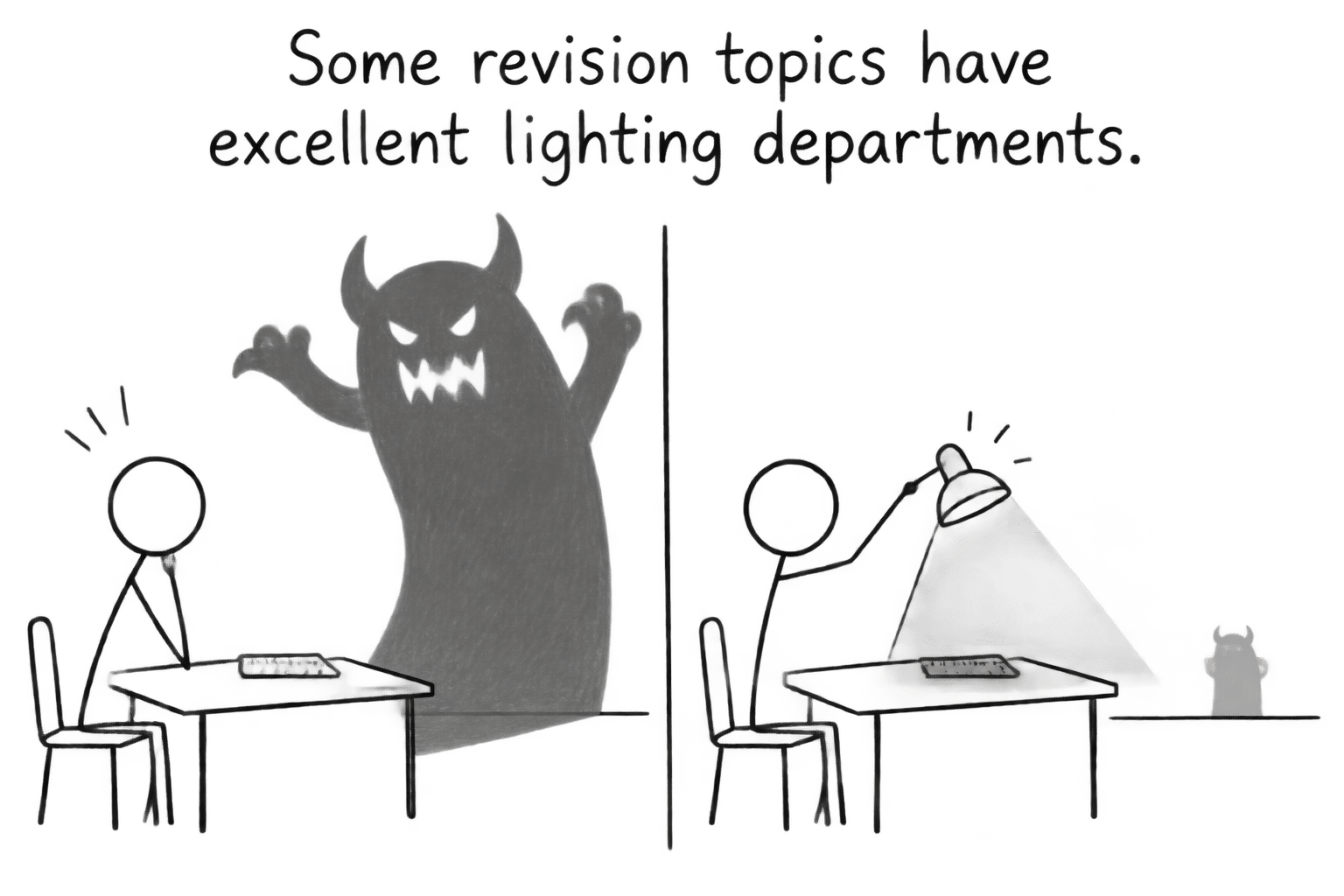 A stick figure discovers that an intimidating ruler shadow is only a trick of the desk lamp
Worked example: convert before comparing
Exam-style question: A café has 1.5 kg1.5\text{ kg}1.5 kg of coffee beans. Each bag contains 250 g250\text{ g}250 g. How many full bags can the café fill?
The quantities use different units. Convert the total mass into grams so both measurements match:
1.5×1000=1500 g1.5\times1000=1500\text{ g}1.5×1000=1500 gNow divide the total mass by the mass in each bag:
1500÷250=61500\div250=61500÷250=6The café can fill 666 bags.
Check by multiplying back:
6×250 g=1500 g=1.5 kg6\times250\text{ g}=1500\text{ g}=1.5\text{ kg}6×250 g=1500 g=1.5 kgThis is where conversions often matter most: they prepare the quantities for the main calculation. Dividing the original numbers without matching their units would answer a different calculation and produce the wrong result.
MathsGenie’s conversions and units revision guide provides a useful next step once direct conversions feel secure.
The traps: time, area and volume
For unit conversions grade 4 practice, build beyond ordinary metric length and mass questions. Two details deserve particular care.
Time follows its own relationships. Hours and minutes use a conversion factor of 606060, so a decimal part of an hour must be multiplied by 606060 to express it in minutes. Decimal digits do not automatically represent minutes.
Area and volume require different factors from length. Because area involves two dimensions, square the length conversion factor:
1 m2=1002 cm2=10,000 cm21\text{ m}^2=100^2\text{ cm}^2=10{,}000\text{ cm}^21 m2=1002 cm2=10,000 cm2Volume involves three dimensions, so cube it:
1 m3=1003 cm3=1,000,000 cm31\text{ m}^3=100^3\text{ cm}^3=1{,}000{,}000\text{ cm}^31 m3=1003 cm3=1,000,000 cm3Look closely at the unit before choosing a factor. The small power changes the calculation substantially.
Common mistakes that cost marks
Multiplying or dividing in the wrong direction. Predict the size first. Converting to smaller units should increase the numerical value.
Using the same factor for every conversion. Write the relationship you need. Metric units do not all differ by 101010, and time needs separate facts.
Combining quantities with different units. Convert them into a common unit before adding, subtracting or comparing them, or calculating how many portions fit into a total.
Overlooking squared or cubed units. Check whether the measurement is length, area or volume before doing the arithmetic.
Leaving the answer unfinished. Include the requested unit and answer the actual question. A mass calculation might be an intermediate step towards finding a number of bags.
Turn GCSE maths resit revision into targeted practice
A useful practice session begins with a small diagnosis. Try several conversion questions independently, then identify the cause of each error: a forgotten fact, the wrong direction, arithmetic or a missed unit.
Use MathsGenie’s GCSE maths revision resources to choose your exam board. Revisit the relevant lesson or video solution, practise that specific weakness, then try a fresh question without help. Use mark schemes to check your method as well as your answer.
After a short focused session, return to mixed questions in mini tests, past papers or predicted papers. That checks whether you can recognise a conversion when the topic is not announced. Schedule another attempt in your revision planner so the method has to survive a gap between sessions.
Your next step is concrete: use Mock Exam Builder to build a targeted practice paper around conversions and related measurement questions. The Mock Exam Builder feature guide explains the tool. Complete your paper independently, review the errors, and choose the next practice session from what they reveal.















