Trial and Improvement Exam Questions: GCSE Guide
Trial and improvement exam questions explained through three GCSE examples, with rounding checks, method marks, common mistakes and clear practice tips.

Trial and improvement exam questions can look like an invitation to press random buttons until the calculator behaves. They are not. The method is a controlled search: substitute sensible values, bracket the solution, then test the midpoint to justify rounding.
The challenge is presenting enough organised working to show why your answer is correct. These three GCSE examples demonstrate the method and the working that could earn method marks. Exact marks depend on the paper and its mark scheme.
Coverage and wording vary between specifications. Use the GCSE Maths revision hub to find your board's resources. CCEA papers, for example, have explicitly assessed trial and improvement.
The trial and improvement method
Use this checklist:
- Identify the expression and target value.
- Start inside the interval given.
- Record each trial and its result.
- Decide whether the result is too high or too low.
- Find consecutive values at the required accuracy that bracket the solution.
- Test their midpoint and state the rounded answer.
For a solution between 3.63.63.6 and 3.73.73.7, test 3.653.653.65 to decide the answer to one decimal place.
Use the Maths Genie GCSE lessons and Question Bank to practise this decision process.
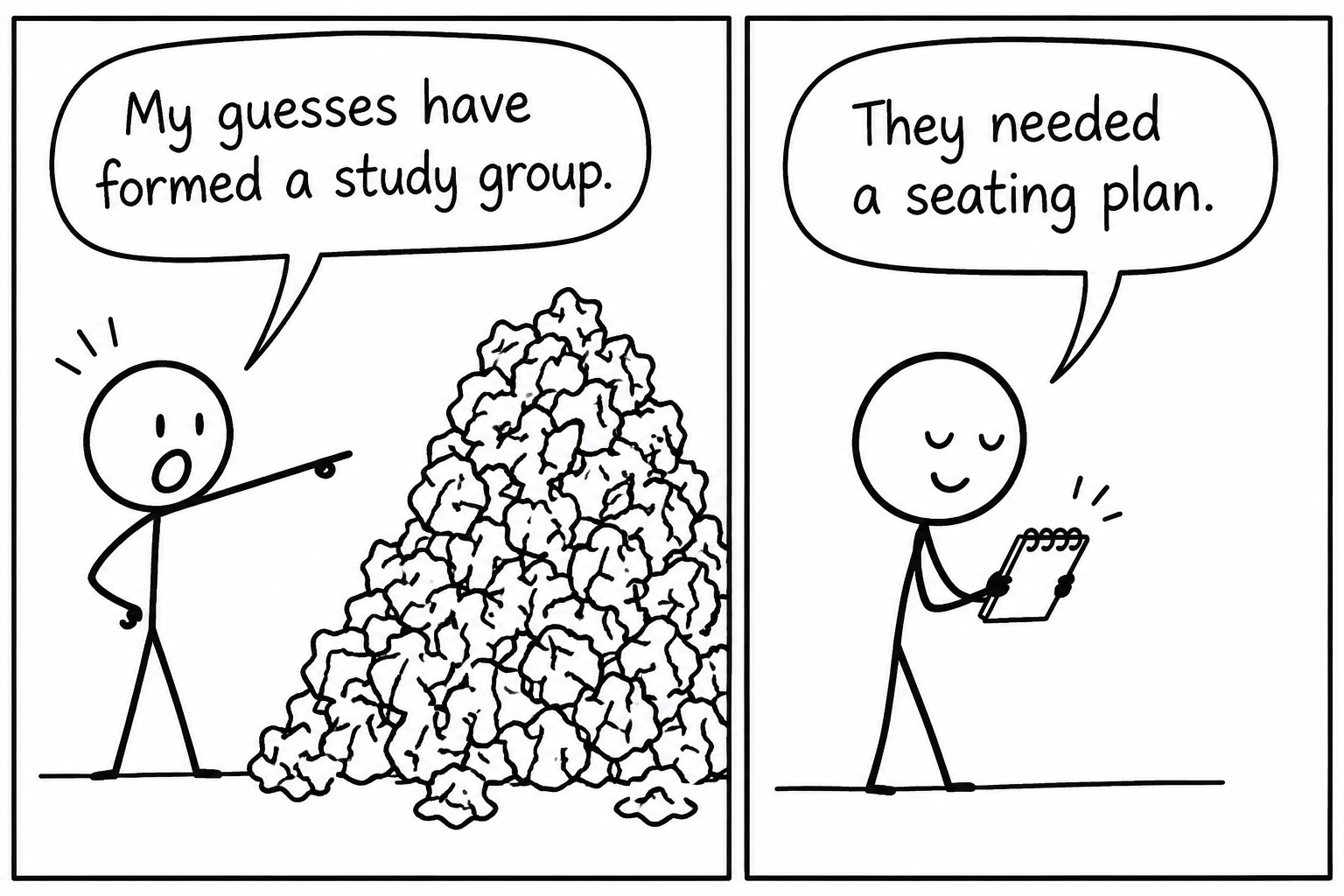 XKCD-style comic showing a student organising a chaotic pile of guesses
How to choose efficient trial values
Good trial values are not random. Begin with numbers that split the stated interval, then let each output guide the next choice. If one result is below the target and another is above it, the solution is bracketed. Every later trial should sit inside that smaller interval.
Accuracy controls the final bracket. For an answer to one decimal place, you need consecutive tenths, such as 3.63.63.6 and 3.73.73.7, followed by the halfway value 3.653.653.65. For two decimal places, use consecutive hundredths and test the third-decimal midpoint. Locating a root and rounding it are separate jobs. The bracket locates the root; the midpoint justifies the rounded answer.
Question one: one decimal place
The equation x2+x=17x^2+x=17x2+x=17 has a solution between 333 and 444. Use trial and improvement to find it correct to one decimal place.
Evaluate x2+xx^2+xx2+x and compare each result with 171717. This expression increases throughout the given interval, so a result below the target means the input is too small.
Start with sensible tenths
Try x=3.5x=3.5x=3.5:
3.52+3.5=12.25+3.5=15.753.5^2+3.5=12.25+3.5=15.753.52+3.5=12.25+3.5=15.75This is below 171717, so the solution is greater than 3.53.53.5.
Try x=3.7x=3.7x=3.7:
3.72+3.7=13.69+3.7=17.393.7^2+3.7=13.69+3.7=17.393.72+3.7=13.69+3.7=17.39This is above 171717. Try x=3.6x=3.6x=3.6:
3.62+3.6=12.96+3.6=16.563.6^2+3.6=12.96+3.6=16.563.62+3.6=12.96+3.6=16.56The solution lies between 3.63.63.6 and 3.73.73.7, but its rounded value is not yet justified.
Test the midpoint
3.6+3.72=3.65\frac{3.6+3.7}{2}=3.6523.6+3.7=3.65Substitute x=3.65x=3.65x=3.65:
3.652+3.65=13.3225+3.65=16.97253.65^2+3.65=13.3225+3.65=16.97253.652+3.65=13.3225+3.65=16.9725This is below 171717, so the solution is greater than 3.653.653.65 and rounds up:
x=3.7\boxed{x=3.7}x=3.7Useful evidence includes trials on both sides of the target, the midpoint check and the rounded conclusion. An unsupported answer may lose method marks.
Question two: a cubic equation
The equation x3+x=35x^3+x=35x3+x=35 has a solution between 333 and 444. Find it correct to one decimal place using trial and improvement.
The expression changes, but the method stays the same. Again, the expression increases over the given interval.
Try x=3.1x=3.1x=3.1:
3.13+3.1=29.791+3.1=32.8913.1^3+3.1=29.791+3.1=32.8913.13+3.1=29.791+3.1=32.891This is below 353535. Try x=3.2x=3.2x=3.2:
3.23+3.2=32.768+3.2=35.9683.2^3+3.2=32.768+3.2=35.9683.23+3.2=32.768+3.2=35.968This is above 353535, placing the solution between 3.13.13.1 and 3.23.23.2.
Test their midpoint:
3.1+3.22=3.15\frac{3.1+3.2}{2}=3.1523.1+3.2=3.15 3.153+3.15=31.255875+3.15=34.4058753.15^3+3.15=31.255875+3.15=34.4058753.153+3.15=31.255875+3.15=34.405875The result is below 353535, so the solution is greater than 3.153.153.15. It rounds to:
x=3.2\boxed{x=3.2}x=3.2Entering the complete expression in one calculator line reduces transcription errors. Still record the result: the examiner cannot see your calculator display.
The Edexcel GCSE Maths page and Edexcel scheme of learning help organise revision alongside surrounding GCSE topics.
Question three: two decimal places
The equation x3−2x=5x^3-2x=5x3−2x=5 has a solution between 222 and 333. Use trial and improvement to find it correct to two decimal places.
This expression also increases over the stated interval. For two decimal places, bracket the solution between consecutive hundredths, then test their midpoint.
Start by narrowing the interval:
2.03−2(2.0)=8−4=42.0^3-2(2.0)=8-4=42.03−2(2.0)=8−4=4 2.13−2(2.1)=9.261−4.2=5.0612.1^3-2(2.1)=9.261-4.2=5.0612.13−2(2.1)=9.261−4.2=5.061The solution lies between 2.02.02.0 and 2.12.12.1. Now test hundredths.
For x=2.09x=2.09x=2.09:
2.093−2(2.09)=9.128329−4.18=4.9483292.09^3-2(2.09)=9.128329-4.18=4.9483292.093−2(2.09)=9.128329−4.18=4.948329This is below 555. For x=2.10x=2.10x=2.10:
2.103−2(2.10)=9.261−4.2=5.0612.10^3-2(2.10)=9.261-4.2=5.0612.103−2(2.10)=9.261−4.2=5.061This is above 555. The solution lies between 2.092.092.09 and 2.102.102.10.
Their midpoint is:
2.09+2.102=2.095\frac{2.09+2.10}{2}=2.09522.09+2.10=2.095Test it carefully:
2.0953−2(2.095)=9.195007375−4.19=5.0050073752.095^3-2(2.095)=9.195007375-4.19=5.0050073752.0953−2(2.095)=9.195007375−4.19=5.005007375This is above 555, so the solution lies below 2.0952.0952.095 and rounds down:
x=2.09\boxed{x=2.09}x=2.09Show both consecutive hundredths and the midpoint trial. The exact allocation of marks depends on the question's mark scheme.
The GCSE iteration exam booklet covers a related numerical method. Iteration follows a different process, so check which method the question requires.
Presenting your working
For each trial, record the input, substitution result and whether it is above or below the target. Keep full calculator values: premature rounding can put a result on the wrong side of the target.
For authentic wording, try the 2022 CCEA trial and improvement paper and 2024 CCEA calculator paper. Check your working against the mark scheme for that exact paper.
Common mistakes in trial and improvement exam questions
Stopping too soon
An interval between consecutive tenths does not establish rounding. Test the midpoint before concluding.
Choosing the nearest output
Do not choose whichever trial produces the output closest to the target. You are rounding the input, so use the midpoint between possible inputs.
Hiding calculator working
Record substitutions. A final answer alone does not demonstrate trial and improvement.
Using the wrong midpoint
Between 2.092.092.09 and 2.102.102.10, the rounding boundary is 2.0952.0952.095. Match your test to the requested accuracy.
Ignoring the instruction
Use the stated method. An alternative approach may not demonstrate the skills being assessed.
A focused practice routine
Begin without a time limit and concentrate on a clean list of trials. Once the process feels secure, practise under timed conditions. After each question, compare more than the boxed answer. Check whether your first values were efficient, whether you found results on both sides of the target, and whether your midpoint matched the requested accuracy.
Mix familiar equations with less comfortable ones, including expressions containing squares and cubes. The arithmetic changes, but the decision pattern remains stable. Keep a short error log with headings such as calculator entry, bracketing and rounding. Before your next attempt, read the relevant heading and make that behaviour your focus. This turns each mistake into a specific revision instruction rather than a vague reason to lose confidence.
Turn the method into reliable practice
Every trial should serve a purpose: narrow the interval, check the rounding boundary or confirm the conclusion. That makes this a repeatable routine rather than guesswork.
Choose a question from the Maths Genie lessons and Question Bank, attempt it independently, then check your substitutions and rounding against the available answers and mark schemes.