Tracking Revision Progress for GCSE English
Tracking revision progress GCSE English Language and Literature can guide better practice, but only when your spreadsheet leads to writing, feedback and retesting.
There is a particular kind of revision session that ends with a beautiful spreadsheet and very little revision. The colours are balanced. Every text has a dropdown menu. A progress bar glows green. Yet no paragraph has been written and no quotation has been recalled.
So, does tracking revision progress GCSE English Language and Literature in a spreadsheet genuinely help? Yes, but only indirectly. A tracker can help you plan, monitor weaknesses and choose your next task. It cannot build knowledge or improve exam writing by itself. If maintaining it begins to replace retrieval, timed writing and feedback, it has become productive procrastination.
That distinction matters for students balancing English with GCSE maths. Both subjects benefit from a clear record of weak areas, but progress ultimately comes from attempting demanding tasks, checking the result and responding to what went wrong.
The short answer: when tracking helps
A spreadsheet or revision app is useful when it helps you:
- separate English Language skills from Literature texts and themes;
- record evidence from marked questions rather than vague feelings;
- identify the assessment objective behind a weakness;
- schedule another attempt after a gap;
- choose a specific next action quickly;
- protect enough time for maths and your other GCSE subjects.
It is not useful when you spend longer recording revision than doing it, mark topics as complete after passive reading, or treat hours logged as proof of improvement.
The best test is simple: does opening the tracker lead quickly to an exam-relevant action? If it leads to a timed paragraph, quotation retrieval, text comparison or corrected response, it is doing its job.
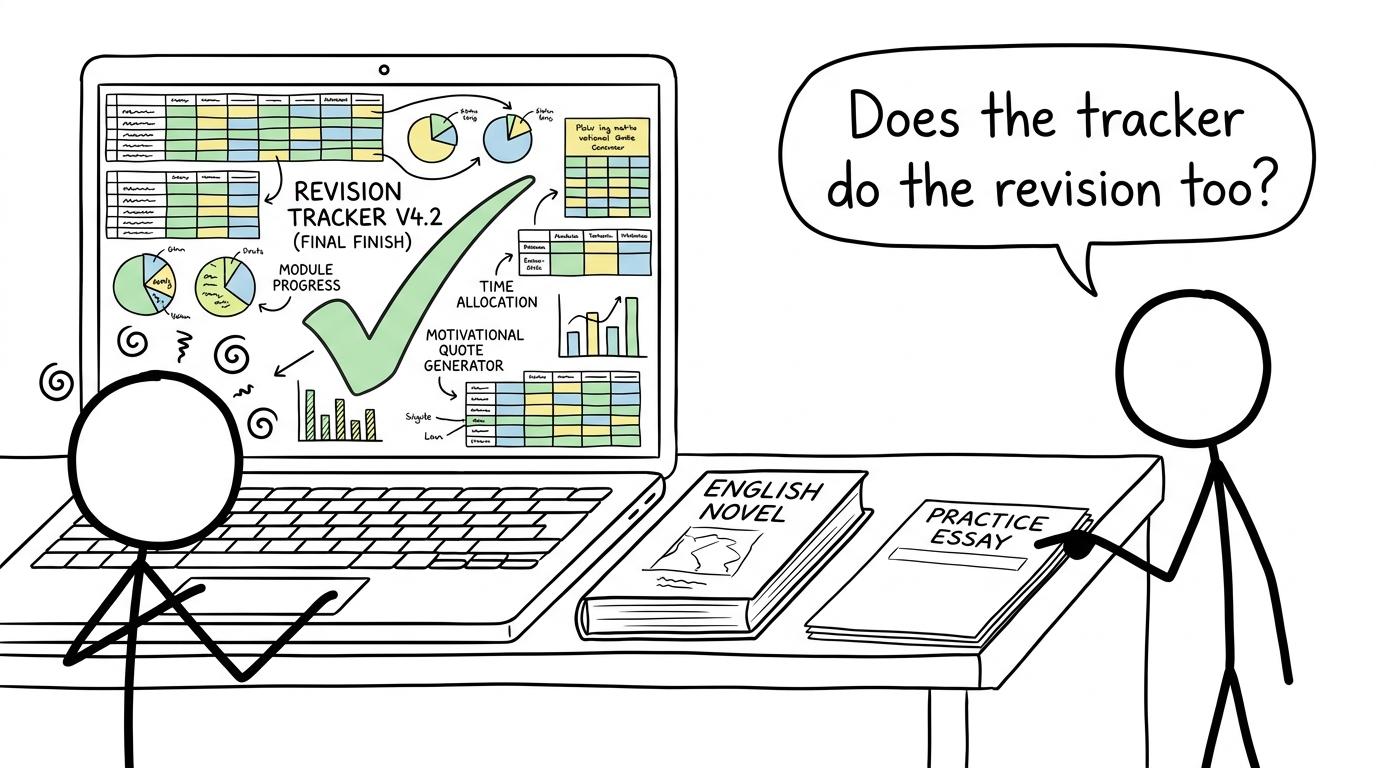 A student wonders whether an elaborate tracker can do the revision
Why a spreadsheet can support better revision
Research supports planning, monitoring and evaluating learning as parts of metacognition and self-regulated learning. The Education Endowment Foundation advises that these strategies work best when taught and connected to meaningful learning activities.
That final phrase is crucial. The evidence is not that spreadsheets independently raise GCSE grades. It is that students can benefit from thinking accurately about what they know, checking performance and adapting what they do next.
Retrieval practice also has substantial support in classroom research. Recalling knowledge, attempting questions and receiving feedback are generally more useful than repeatedly rereading material. A tracker can organise that process, but the active attempt remains the important part.
Think of the spreadsheet as a compass. A compass can stop you walking in the wrong direction. It cannot walk for you.
What should you track for GCSE English?
English Language and English Literature require related but different evidence. Combining everything into one row labelled “English” hides the information you actually need.
English Language
Track skills and question types connected to your exam board's specification. These may include:
- identifying explicit and implicit information;
- analysing language and structure;
- comparing ideas or perspectives;
- evaluating a text;
- writing for a particular form, audience and purpose;
- organising ideas coherently;
- spelling, punctuation, grammar and vocabulary;
- completing responses within the available time.
Ofqual sets common English Language assessment objectives, although Edexcel, AQA, OCR and Eduqas package them into different papers and questions. Use the wording and paper structure for your own board rather than copying a generic online checklist.
English Literature
Your rows might cover:
- each set text;
- character, theme and relationship knowledge;
- accurate quotation recall;
- analysis of language, form and structure;
- relevant contextual understanding;
- comparison skills where required;
- unseen poetry or prose skills;
- planning and completing analytical responses under time pressure.
Official GCSE English Literature requirements emphasise informed responses, textual evidence, analysis and relevant understanding of context. A quotation list alone therefore gives an incomplete picture. You also need evidence that you can use textual references to develop an interpretation.
Build a tracker that records evidence, not activity
A useful tracker can remain small. Include only columns that affect your next decision.
| Column | What to record |
|---|---|
| Area | A precise skill, question type, text, character or theme |
| Last attempted | The date of genuine recall or written practice |
| Evidence | Teacher feedback, marks, missing knowledge or timing issue |
| Confidence | A simple low, developing or secure judgement |
| Error pattern | What specifically prevented a stronger response |
| Next action | One clear task that can be completed in a revision session |
| Retest date | When you will attempt the skill again without support |
Avoid turning confidence into the main measure. A topic can feel familiar because you have reread it several times. Familiarity is not the same as being able to produce a clear answer under examination conditions.
Base updates on something observable: a closed-book quotation check, an essay plan, a timed paragraph, a complete response, teacher feedback or careful self-assessment against the relevant mark scheme.
Use statuses carefully
“Done” is usually a poor label. English skills are not permanently completed, and even secure knowledge can become less accessible over time.
More useful labels are:
- Not yet attempted
- Needs teaching
- Needs supported practice
- Needs timed practice
- Ready to retest
- Secure for now
The words “for now” keep the system honest. They remind you that revision includes returning to knowledge, not colouring it green forever.
Spreadsheet or app: which is better?
Neither format has a built-in academic advantage. Choose the tool with the least friction.
A spreadsheet is helpful if you want custom categories, filtering and a single view across English and maths. An app may be better if it makes reminders and repeated review easier. Paper can work equally well if opening another screen usually becomes a distraction.
Your choice should depend on behaviour rather than appearance. Ask:
- Can I update it in less than a minute?
- Can I see my weakest areas immediately?
- Does it tell me exactly what to do next?
- Will it remind me to retest rather than merely revisit?
- Can I use it consistently without redesigning it?
If the answer to those questions is yes, the tool is sufficient. Stop optimising it and begin practising.
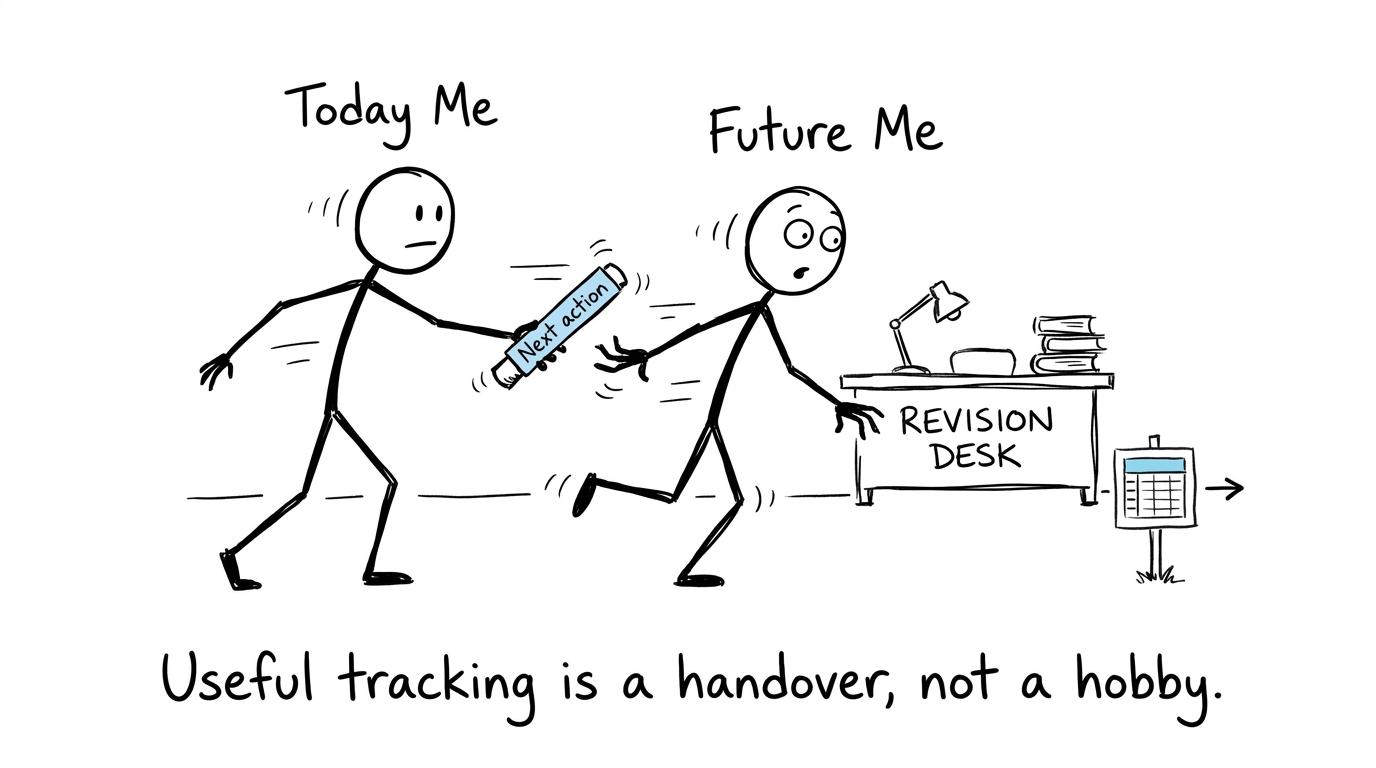 Useful tracking passes one clear action from today to the next session
Turn each entry into an active revision cycle
The most useful tracker follows a repeatable loop:
- Diagnose: attempt a question or recall task without relying on notes.
- Record: identify the exact weakness revealed by the attempt.
- Repair: review the relevant knowledge or technique.
- Practise: apply it in another paragraph, plan or question.
- Check: use feedback, a mark scheme or teacher guidance.
- Retest: return after a gap and attempt it independently.
This is also an effective structure for GCSE maths. Start with a GCSE maths revision lesson and practice questions, mark the work, record the precise error and test the skill again later. MathsGenie's revision planner can reduce the time spent deciding what to do next.
For quicker diagnostic evidence, Edexcel students can use GCSE maths mini tests. A short test that exposes a misconception is more valuable than a long session that merely feels comfortable.
How to balance English tracking with GCSE maths
Students preparing for maths exams should not allow an English tracker to become a separate daily project. Use one brief weekly review for all subjects, then spend the majority of your available time completing the work it identifies.
For maths, log topics rather than broad headings. “Algebra” is too vague; the underlying issue might involve rearranging formulae, factorising or interpreting graphs. The guide to finding your weakest GCSE topics explains how to turn lost marks into targeted revision.
Use board-appropriate evidence too. You can diagnose weaknesses with Edexcel GCSE maths past papers, AQA GCSE maths past papers or the OCR GCSE maths revision hub. Mark schemes and worked or video solutions help you distinguish a knowledge gap from an execution error or timing problem.
The same principle applies across both subjects: record less, act more. Your English row should lead to writing. Your maths row should lead to solving questions.
How to tell whether tracking is changing outcomes
Do not judge the system by how complete the spreadsheet looks. Judge it by changes in performance over several attempts.
Look for evidence such as:
- fewer repeated errors;
- stronger use of textual evidence;
- clearer explanations of writers' methods;
- more controlled writing within the time available;
- better recall after a delay;
- fewer prompts needed to begin a task;
- improved marks on comparable questions.
Marks from different tasks are not always directly comparable, particularly in English. Question difficulty and marking conditions vary. Keep brief qualitative evidence alongside marks, such as “analysis became descriptive” or “comparison started too late”. That note often gives you a better next action than the total alone.
For maths, past-paper tracking tools can help preserve attempts and scores. Nearer the exams, Edexcel GCSE predicted papers can provide fresh exam-style practice, although predicted papers should support rather than replace official past papers.
Common mistakes when tracking revision progress
Logging time instead of learning
A long session may produce little improvement. Record what you attempted, what the evidence showed and what must happen next. Time can help with planning, but it is not proof of learning.
Colour-coding by feeling
A green cell based on confidence can hide a weakness. Require evidence before changing a status: independent recall, a marked paragraph or a timed question.
Using categories that are too broad
“Macbeth” or “Language Paper” does not identify the problem. Narrow it to a theme, analytical skill, question type or timing issue.
Tracking without retesting
Recording an error is only diagnosis. Schedule another independent attempt so you can find out whether the repair lasted.
Perfecting the system
Extra formulas, charts and formatting are worthwhile only if they improve a decision. If the choice is between redesigning the dashboard and writing a timed paragraph, choose the paragraph.
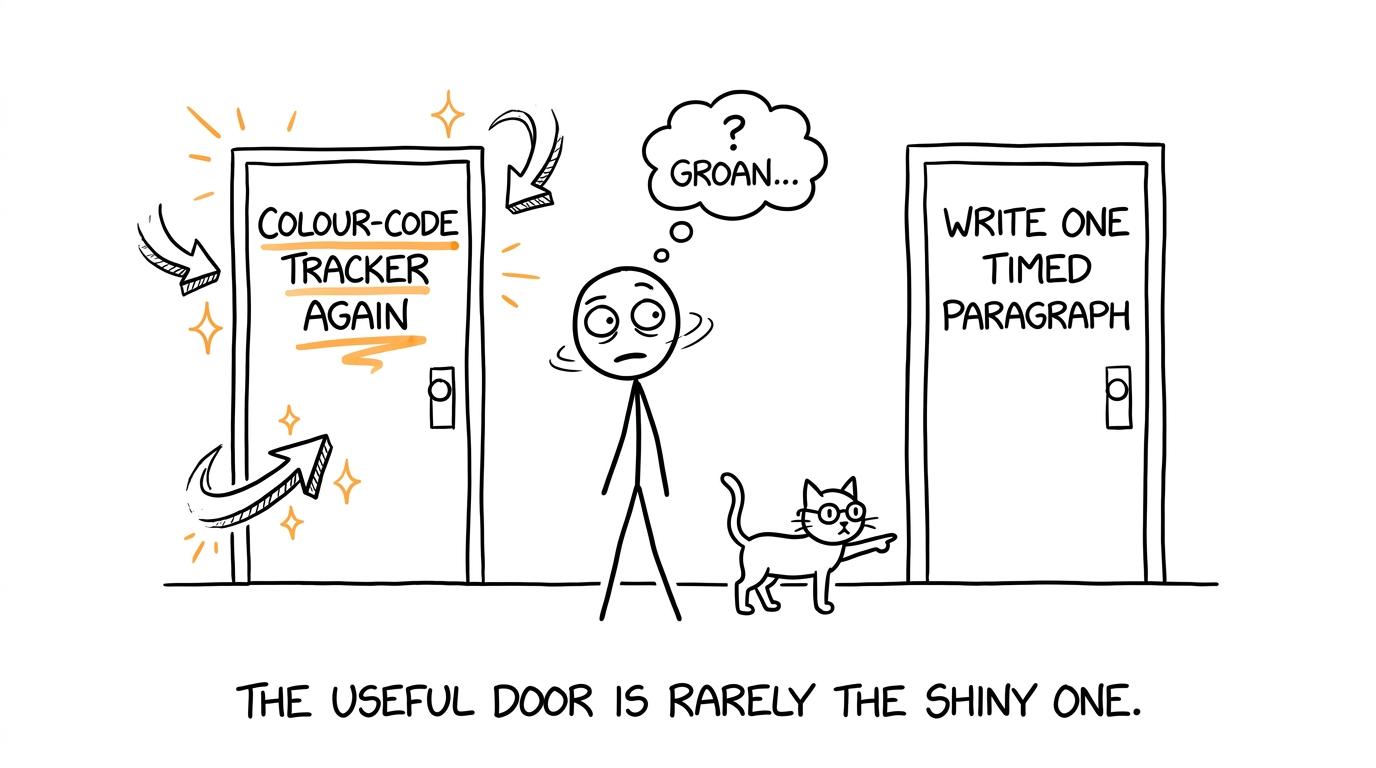 A student faces the shiny tracker door and the useful practice door
Make the tracker serve the work
Tracking GCSE English revision can help because it turns scattered practice into a feedback loop. It shows where knowledge is fragile, stops comfortable topics consuming every session and gives your future self a clear starting point.
But the spreadsheet is not the achievement. The achievement is recalling the quotation, shaping the interpretation, finishing the response, solving the unfamiliar maths problem and correcting the mistake that used to cost you marks.
Keep your tracker small and evidence-led. Then let MathsGenie handle the practical maths work: open the GCSE maths revision hub, choose your board and tier, and move from free revision lessons to practice questions, mini tests, past papers and predicted papers. Use the mark schemes and video solutions, record the next gap, and return to it.
A good tracker should make that cycle easier. Then it should get out of the way.