Surds (A-Level) A-Level Maths Explained
Surds (A-Level) A-Level Maths explained with clear rules, worked examples, rationalising methods, common mistakes and exam-style practice.
A surd can feel like an answer that has refused to finish. Your calculator offers a long decimal, the question asks for an exact value, and neither form seems especially helpful.
For a sixth-form student mastering surds (A-Level) A-Level Maths, the turning point is recognising that a surd is not an awkward decimal waiting to happen. It is an exact number that can be simplified and manipulated using a small set of dependable rules. At A Level, you need to simplify surds, perform arithmetic with them and rationalise denominators, including expressions with two terms.
This guide explains those techniques through worked examples and ends with exam-style practice you can attempt independently.
Your surds checklist
Before tackling harder questions, make sure you can:
- identify when a root is a surd;
- simplify roots by extracting square factors;
- add and subtract like surds;
- multiply and expand expressions containing surds;
- rationalise a denominator containing one surd;
- use a conjugate to rationalise a two-term denominator;
- keep answers exact rather than changing them into decimals.
These skills form part of algebra and functions in A Level Mathematics. They also connect closely to rational indices, because x=x12\sqrt{x}=x^{\frac{1}{2}}x=x21.
What is a surd?
A surd is an irrational root written in exact form. For example, 2\sqrt{2}2 is a surd because it cannot be written as a fraction of two integers and its decimal expansion does not terminate or recur.
By contrast, 49\sqrt{49}49 is not a surd because:
49=7\sqrt{49}=749=7The distinction matters because exam questions often instruct you to give an answer in exact form. If the exact answer is 353\sqrt{5}35, replacing it with a rounded decimal loses accuracy and may not satisfy the instruction.
The two rules used most often are:
ab=ab\sqrt{ab}=\sqrt{a}\sqrt{b}ab=aband
(a)2=a(\sqrt{a})^2=a(a)2=aFor real-number work, the first rule is applied when the relevant values are non-negative.
Simplifying surds
To simplify a surd, look for the largest square number that divides the value inside the root. This is more efficient than repeatedly extracting smaller factors.
Worked example: simplify a numerical surd
Simplify 72\sqrt{72}72.
The largest square factor of 727272 is 363636:
72=36×2\sqrt{72}=\sqrt{36\times 2}72=36×2Split the root and evaluate the square number:
72=362=62\sqrt{72}=\sqrt{36}\sqrt{2}=6\sqrt{2}72=362=62The simplified answer is therefore:
62\boxed{6\sqrt{2}}62A useful check is to square both forms:
(62)2=36×2=72(6\sqrt{2})^2=36\times 2=72(62)2=36×2=72Worked example: simplify an algebraic surd
Assuming x≥0x\geq 0x≥0, simplify 48x2\sqrt{48x^2}48x2.
Separate the square factors:
48x2=16×3×x2\sqrt{48x^2}=\sqrt{16\times 3\times x^2}48x2=16×3×x2Then simplify:
48x2=4x3\sqrt{48x^2}=4x\sqrt{3}48x2=4x3The condition x≥0x\geq 0x≥0 matters. Without it, x2=∣x∣\sqrt{x^2}=|x|x2=∣x∣, not automatically xxx.
Adding, subtracting and multiplying surds
Like surds work in the same way as like algebraic terms. You may combine aba\sqrt{b}ab and cbc\sqrt{b}cb because the irrational part is identical:
ab+cb=(a+c)ba\sqrt{b}+c\sqrt{b}=(a+c)\sqrt{b}ab+cb=(a+c)bYou cannot immediately combine 2\sqrt{2}2 and 3\sqrt{3}3. Sometimes, however, apparently different surds become like terms after simplification.
Worked example: collect like surds
Simplify 38+18−503\sqrt{8}+\sqrt{18}-\sqrt{50}38+18−50.
Simplify each surd first:
38=34×2=623\sqrt{8}=3\sqrt{4\times 2}=6\sqrt{2}38=34×2=62 18=9×2=32\sqrt{18}=\sqrt{9\times 2}=3\sqrt{2}18=9×2=32 50=25×2=52\sqrt{50}=\sqrt{25\times 2}=5\sqrt{2}50=25×2=52Now collect the coefficients:
62+32−52=426\sqrt{2}+3\sqrt{2}-5\sqrt{2}=4\sqrt{2}62+32−52=42Worked example: expand surd brackets
Expand and simplify (2+3)(4−3)(2+\sqrt{3})(4-\sqrt{3})(2+3)(4−3).
Multiply every term:
(2+3)(4−3)=8−23+43−(3)2(2+\sqrt{3})(4-\sqrt{3}) =8-2\sqrt{3}+4\sqrt{3}-(\sqrt{3})^2(2+3)(4−3)=8−23+43−(3)2Since (3)2=3(\sqrt{3})^2=3(3)2=3:
8−23+43−3=5+238-2\sqrt{3}+4\sqrt{3}-3=5+2\sqrt{3}8−23+43−3=5+23Notice that surd brackets follow ordinary algebraic expansion. The unfamiliar notation does not change the underlying method.
You can now use the matching Maths Genie A Level Maths lessons and Question Bank to turn each method into deliberate practice rather than relying on recognition alone.
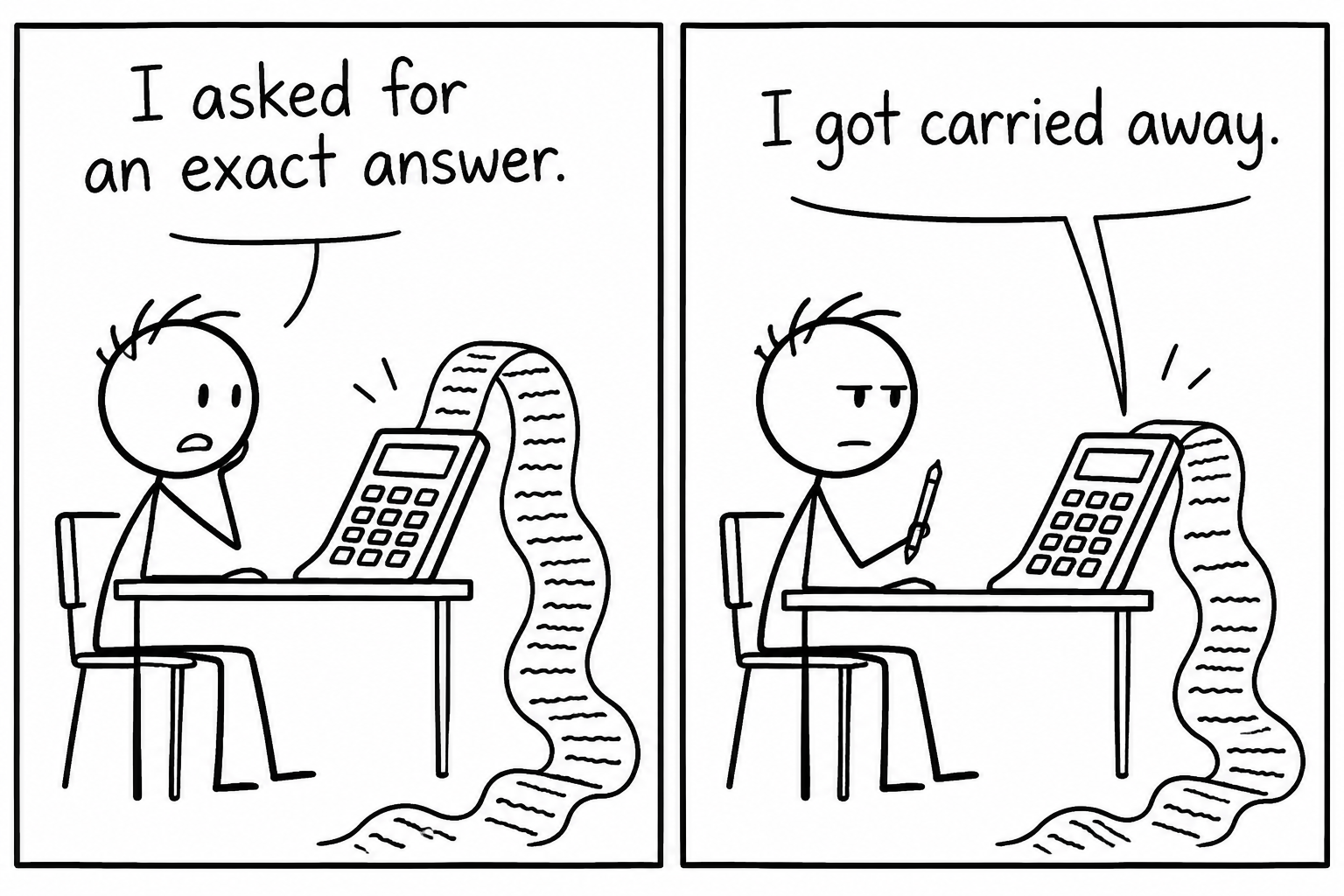 A sixth-form student asks a calculator for an exact answer while it produces an absurdly long decimal
Rationalising a denominator with one surd
A rationalised denominator contains no surd. If a denominator consists of a single surd, multiply the numerator and denominator by that surd.
Worked example: one-term denominator
Rationalise and simplify:
53\frac{5}{\sqrt{3}}35Multiply by 33\frac{\sqrt{3}}{\sqrt{3}}33, which is equal to 111:
53×33=533\frac{5}{\sqrt{3}}\times\frac{\sqrt{3}}{\sqrt{3}} =\frac{5\sqrt{3}}{3}35×33=353Therefore:
533\boxed{\frac{5\sqrt{3}}{3}}353The value has not changed. Only its form has changed.
Rationalising with a conjugate
If the denominator has two terms, multiplying by one surd is not enough. Instead, use the conjugate.
The conjugate of a+ba+\sqrt{b}a+b is a−ba-\sqrt{b}a−b, and vice versa. Their product is rational because the middle terms cancel:
(a+b)(a−b)=a2−b(a+\sqrt{b})(a-\sqrt{b})=a^2-b(a+b)(a−b)=a2−bThis is the difference of two squares.
Worked example: two-term denominator
Rationalise and simplify:
32+5\frac{3}{2+\sqrt{5}}2+53The conjugate of 2+52+\sqrt{5}2+5 is 2−52-\sqrt{5}2−5. Multiply both numerator and denominator by it:
32+5×2−52−5\frac{3}{2+\sqrt{5}}\times\frac{2-\sqrt{5}}{2-\sqrt{5}}2+53×2−52−5Expand the numerator:
3(2−5)=6−353(2-\sqrt{5})=6-3\sqrt{5}3(2−5)=6−35Use the difference of two squares in the denominator:
(2+5)(2−5)=22−(5)2=4−5=−1(2+\sqrt{5})(2-\sqrt{5})=2^2-(\sqrt{5})^2=4-5=-1(2+5)(2−5)=22−(5)2=4−5=−1Therefore:
6−35−1=35−6\frac{6-3\sqrt{5}}{-1}=3\sqrt{5}-6−16−35=35−6So the rationalised form is:
35−6\boxed{3\sqrt{5}-6}35−6A negative denominator is not an error, but the final expression should normally be rearranged so that the negative sign is handled cleanly.
Common mistakes with A Level surds
Splitting a sum inside a root
In general:
a+b≠a+b\sqrt{a+b}\neq\sqrt{a}+\sqrt{b}a+b=a+bFor example, 9+16=5\sqrt{9+16}=59+16=5, whereas 9+16=7\sqrt{9}+\sqrt{16}=79+16=7. The product rule for roots does not become an addition rule.
Combining unlike surds
The expression 2+3\sqrt{2}+\sqrt{3}2+3 cannot be simplified to 5\sqrt{5}5. Addition does not work inside roots in that way.
Expanding only part of a product
When multiplying two brackets, every term in one bracket must multiply every term in the other. Write the intermediate line rather than trying to complete the expansion mentally.
Using the wrong conjugate
The conjugate changes the sign between the terms, not the signs of both terms. The conjugate of 3−73-\sqrt{7}3−7 is 3+73+\sqrt{7}3+7.
Rounding too early
Keep the surd form throughout an exact calculation. A decimal approximation should appear only when the question requests one, usually to a stated degree of accuracy.
Forgetting to simplify the final answer
Rationalising the denominator may leave common factors or reducible surds. Check the numerator, denominator and any surd coefficients before finishing.
Surds (A-Level) exam questions to practise
Try these without a calculator where possible. Show each algebraic step clearly.
- Simplify 180\sqrt{180}180.
- Simplify 245−20+352\sqrt{45}-\sqrt{20}+3\sqrt{5}245−20+35.
- Expand and simplify (3+2)(5−22)(3+\sqrt{2})(5-2\sqrt{2})(3+2)(5−22).
- Rationalise 76\frac{7}{\sqrt{6}}67.
- Rationalise and simplify 43−5\frac{4}{3-\sqrt{5}}3−54.
- Given x>0x>0x>0, simplify 75x4\sqrt{75x^4}75x4.
Answers:
- 656\sqrt{5}65
- 757\sqrt{5}75
- 11−211-\sqrt{2}11−2
- 766\frac{7\sqrt{6}}{6}676
- 3+53+\sqrt{5}3+5
- 5x235x^2\sqrt{3}5x23
If an answer is wrong, classify the cause before trying again: square-factor recognition, collecting like terms, expansion or rationalisation. That diagnosis tells you which method needs practice.
Turn the method into marks
Understanding a worked example is only the first step. The real gap is being able to choose and carry out the method independently when a surd appears inside a longer Pure Maths question. Use Maths Genie’s A Level Maths Lessons and Question Bank to practise simplification, conjugates and exact forms while your exam preparation time still counts. Start the surds lesson and complete its Question Bank questions.