Substitution GCSE Maths: Examples and Practice
Substitution GCSE maths explained with worked examples, negative numbers, common mistakes and practice questions to help you calculate with confidence.
Substitution GCSE maths questions ask you to replace letters with their given values, then calculate using the correct order of operations. The most useful habit is simple: write a replacement line before doing any arithmetic, putting negative values in brackets.
Imagine a student called Alex who understands that explanation but keeps losing marks. Sometimes a minus sign disappears. Sometimes a square gets applied to the wrong number. The topic feels unpredictable, even though each mistake has a clear cause.
The turning point comes when Alex stops trying to do everything mentally. Replacing the letters and calculating become separate steps. That small change makes the working easier to follow and the mistakes easier to catch.
Substitution GCSE maths: the basic method
An expression is a mathematical statement such as 3x+23x+23x+2. Substitution means replacing a letter with a number. If you know the value of xxx, you can find the value of the expression.
Remember that letters beside numbers usually indicate multiplication:
3x=3×x3x=3\times x3x=3×xLikewise, ababab means a×ba\times ba×b, while x2x^2x2 means x×xx\times xx×x.
Use this checklist whenever you substitute:
- Copy the expression or formula accurately.
- Replace every letter with its given value.
- Put negative values in brackets.
- Follow the order of operations.
- Check signs, arithmetic and any required units.
Brackets and powers come before multiplication and division, followed by addition and subtraction. Operations with equal priority are worked from left to right. If that order feels uncertain, the BIDMAS lesson explains it.
You can follow this replacement-line method in MathsGenie’s substitution lesson and practice resources, then use the Question Bank to practise it independently.
What substitution questions may look like
At GCSE, substitution can appear as a direct instruction, inside a formula or as one step within a longer problem. You might substitute one value into an expression, several values into a formula, or negative and decimal values into an expression containing powers.
The surface details change, but the process does not. First identify every given value and the expression or formula you need. Then make one complete replacement line. This matters when a letter appears more than once. For example, if x=−2x=-2x=−2, every occurrence of xxx must become (−2)(-2)(−2).
Formula questions may also require units. Substituting into an area formula produces square units, while a formula for length produces ordinary units. The calculation and the unit are separate checks, and both can matter in an exam.
Substitution worked examples
Starting with a positive value
Find the value of 4x+74x+74x+7 when x=3x=3x=3.
Replace the letter:
4×3+74\times3+74×3+7Multiply first:
12+712+712+7Add:
19\boxed{19}19Alex’s earlier mistake might have been treating 4x4x4x as 4+x4+x4+x. Writing the multiplication sign removes that ambiguity. Algebra often leaves multiplication signs out; your working can put them back in.
Substituting a negative number
Find the value of 2a2−3b2a^2-3b2a2−3b when a=−4a=-4a=−4 and b=5b=5b=5.
Replace both letters, keeping the negative value together:
2×(−4)2−3×52\times(-4)^2-3\times52×(−4)2−3×5Calculate the power:
2×16−3×52\times16-3\times52×16−3×5Complete the multiplications:
32−1532-1532−15Subtract:
17\boxed{17}17This is where the method starts to click for Alex. The square applies to the whole substituted value, including its negative sign:
(−4)2=(−4)×(−4)=16(-4)^2=(-4)\times(-4)=16(−4)2=(−4)×(−4)=16Without brackets, −42-4^2−42 means −(42)-(4^2)−(42), which equals −16-16−16. Those expressions look similar but have different values.
If the difficulty is multiplying signed numbers, revisit negative numbers revision before attempting another set.
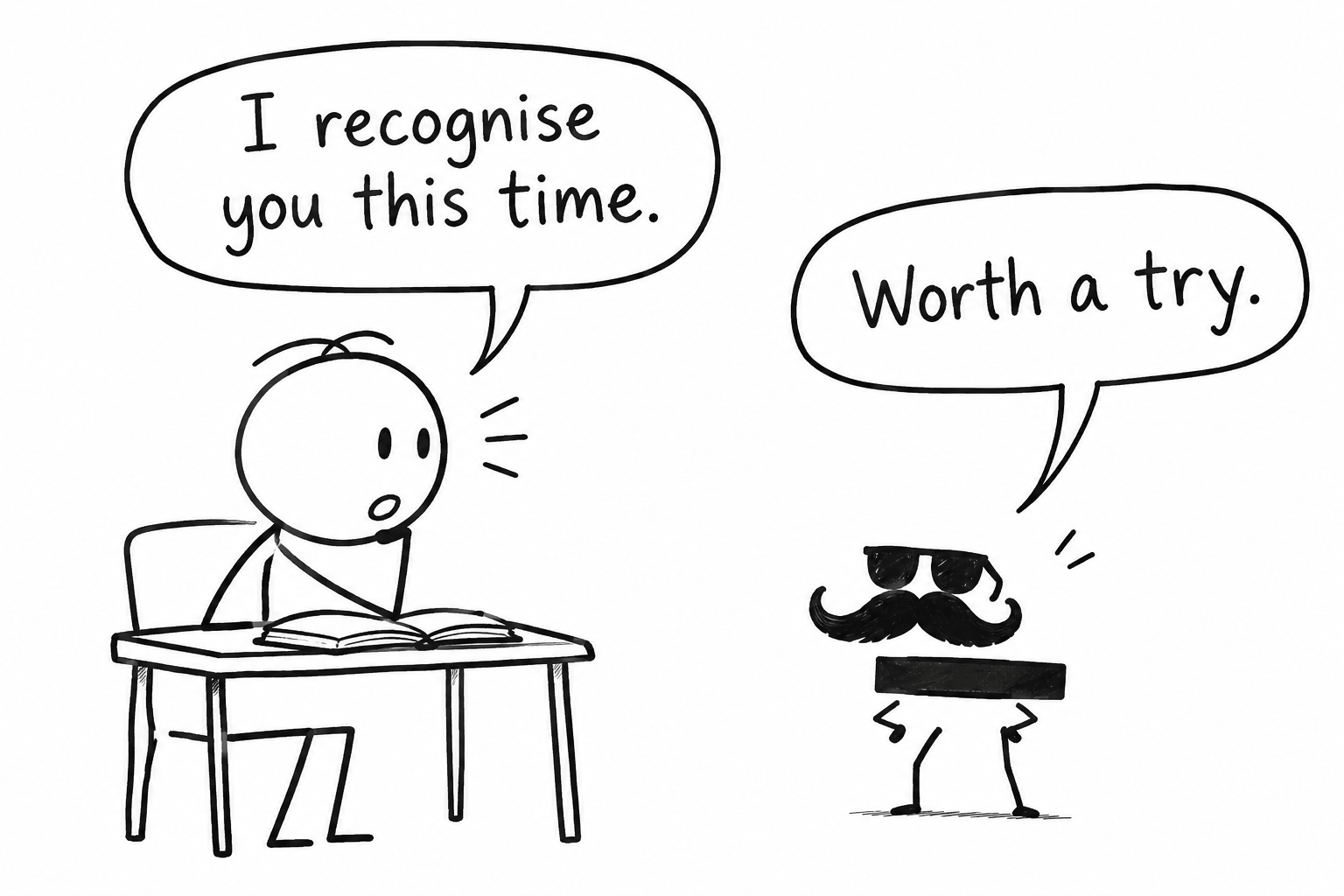 A stick-figure student recognises a minus sign trying to sneak past in disguise
Substituting into a formula with a fraction
Calculate vvv when u=3u=3u=3, a=5a=5a=5 and t=4t=4t=4, using:
v=u+at2v=\frac{u+at}{2}v=2u+atReplace every letter on the right-hand side:
v=3+5×42v=\frac{3+5\times4}{2}v=23+5×4Multiply within the numerator:
v=3+202v=\frac{3+20}{2}v=23+20Complete the numerator, then divide:
v=232=11.5v=\frac{23}{2}=11.5v=223=11.5The fraction bar groups the entire numerator. On a calculator, enter the numerator in brackets before dividing, or use the fraction template.
Notice that the formula was already arranged to find vvv. Substitution alone was enough; there was no need to rearrange it.
How to check a substitution answer
A good check follows the same order as the method. Compare the original expression with your replacement line and confirm that every letter has been replaced correctly. Check that negative values have brackets and that repeated letters use the same value.
Next, estimate whether the result is sensible. If 4x+74x+74x+7 uses x=3x=3x=3, the answer should be a little more than 121212. An answer such as 404040 should prompt another look. Estimation will not prove that an answer is correct, but it can expose an incorrect operation or calculator entry quickly.
Finally, check whether the question requested units, rounding or a particular degree of accuracy.
Common mistakes and how to catch them
Adding when the expression means multiply. In 5p5p5p, the number and letter are multiplied. Write 5×p5\times p5×p before replacing ppp if you keep forgetting this.
Losing a negative sign. Replace the letter with its complete value. If x=−3x=-3x=−3, write (−3)(-3)(−3), especially beside multiplication signs or powers.
Subtracting a negative incorrectly. If an expression contains 7−x7-x7−x and x=−2x=-2x=−2, the replacement line is 7−(−2)7-(-2)7−(−2), giving 999. Keeping both signs visible helps you see the operation correctly.
Working straight from left to right. Substitution does not change the order of operations. Calculate powers before multiplication, and multiplication before addition.
Replacing only one occurrence of a letter. A letter keeps the same given value everywhere in the expression. Scan the original expression again before calculating.
Rounding too early. Keep exact values or full calculator values during the calculation. Round the final answer only when the question requires it.
For Alex, checking becomes more useful once it has a purpose: compare each letter with its replacement, then inspect the arithmetic separately.
Exam-style substitution questions
Try these without looking back at the examples. Show a replacement line for each question, even if you can calculate the answer mentally.
- Question A: Find 5x−45x-45x−4 when x=6x=6x=6.
- Question B: Find 3a+2b3a+2b3a+2b when a=−2a=-2a=−2 and b=7b=7b=7.
- Question C: Find 2y2+12y^2+12y2+1 when y=−3y=-3y=−3.
- Question D: Calculate A=12bhA=\frac{1}{2}bhA=21bh when b=7 cmb=7\text{ cm}b=7 cm and h=4 cmh=4\text{ cm}h=4 cm.
Answers: A: 262626; B: 888; C: 191919; D: 14 cm214\text{ cm}^214 cm2.
If an answer differs, find the first line where your working went wrong. Was the value copied incorrectly, was a sign lost, or was an operation performed too soon? Correct that line, then attempt the question again without copying the solution.
These examples use the Edexcel resource links, but the substitution method is the same across GCSE exam boards. MathsGenie also has an AQA substitution topic page.
Turn the method into a habit
Alex’s turning point is a repeatable routine: replace carefully, calculate in order, then check the signs. You now have that routine; the next step is applying it when nobody is showing you the working. Start with substitution in GCSE revision lessons, then practise independently in the GCSE Question Bank.