Simultaneous Equations (Substitution) GCSE Maths
Simultaneous equations (substitution) GCSE maths explained with clear worked examples, common mistakes and exam-style questions to build your confidence.
You rearrange an equation, substitute something, and somehow finish with an answer that fails the check. For simultaneous equations (substitution) GCSE maths questions, the central idea is simple: replace one variable with an equal expression, solve the resulting equation, then find the other variable. Your final pair must satisfy both original equations.
Imagine a student who keeps getting these questions wrong. They understand ordinary equations, but substitution feels like juggling two calculations. The turning point comes when they realise that substitution leaves them with just one unknown to solve.
Here is the method, followed by worked examples and practice you can check yourself.
The substitution method at a glance
- Choose an equation and make one variable the subject.
- Substitute that expression into the other equation.
- Use brackets around the substituted expression.
- Solve the equation containing one unknown.
- Substitute your answer back to find the other variable.
- Check the pair in both original equations.
The MathsGenie simultaneous equations topic page brings the topic’s revision resources together.
What substitution actually means
Simultaneous equations share the same unknowns. You need values that make both statements true at the same time.
Suppose one equation tells you:
y=2x+1y=2x+1y=2x+1Wherever the other equation contains yyy, you can replace it with 2x+12x+12x+1. These expressions have the same value, so the replacement preserves the equation.
For our hypothetical student, this is the first useful shift: stop thinking “move letters between equations” and start thinking “replace something with its equal”.
Substitution is particularly convenient when one variable is already the subject, or can become the subject without introducing fractions. Elimination is another valid method, but substitution gives you a clear route when an equation already tells you what one variable equals.
Choose a route before calculating
Before writing several lines of algebra, scan both equations. Which variable can you isolate with the fewest operations? Choosing that variable reduces the amount of arithmetic you must manage and makes your working easier to check. You can rearrange either equation, and you do not have to find the variables in the order they appear.
If your chosen route introduces fractions, pause and inspect the other options. Fractions are mathematically valid, but a simpler rearrangement may save time. Once you have chosen, write the rearranged equation on its own line so the expression you will substitute is unmistakable.
Simultaneous equations (substitution) worked examples
When a variable is already the subject
Solve:
y=2x+1y=2x+1y=2x+1 3x+y=163x+y=163x+y=16Substitute into the other equation. Replace yyy in the second equation with the whole expression 2x+12x+12x+1:
3x+(2x+1)=163x+(2x+1)=163x+(2x+1)=16Collect like terms and solve.
5x+1=165x+1=165x+1=16 5x=155x=155x=15 x=3x=3x=3Find the other variable. Use the original equation that already has yyy as its subject:
y=2(3)+1=7y=2(3)+1=7y=2(3)+1=7Your answer is:
x=3,y=7x=3,\qquad y=7x=3,y=7Check both original equations.
7=2(3)+17=2(3)+17=2(3)+1 3(3)+7=163(3)+7=163(3)+7=16Both statements are true. That check matters: finding a value for one letter is only part of solving simultaneous equations.
Build confidence with this replacement step using the MathsGenie Lessons before attempting the next question independently.
When you must rearrange first
Solve:
2x+y=72x+y=72x+y=7 3x−2y=03x-2y=03x−2y=0Our hypothetical student might hesitate because neither equation begins with an isolated variable. Look for the easiest rearrangement: the first equation contains a single yyy.
Make yyy the subject. Subtract 2x2x2x from both sides:
y=7−2xy=7-2xy=7−2xSubstitute into the second equation.
3x−2(7−2x)=03x-2(7-2x)=03x−2(7−2x)=0The brackets are essential. You are replacing yyy with the entire expression 7−2x7-2x7−2x.
Expand carefully.
3x−14+4x=03x-14+4x=03x−14+4x=0The positive 4x4x4x comes from multiplying −2-2−2 by −2x-2x−2x.
Solve for xxx.
7x−14=07x-14=07x−14=0 7x=147x=147x=14 x=2x=2x=2Find yyy.
y=7−2(2)=3y=7-2(2)=3y=7−2(2)=3Check the pair in the original equations.
2(2)+3=72(2)+3=72(2)+3=7 3(2)−2(3)=03(2)-2(3)=03(2)−2(3)=0So the solution is:
x=2,y=3x=2,\qquad y=3x=2,y=3The method has stayed the same. The extra demands were rearranging first and handling a negative multiplier.
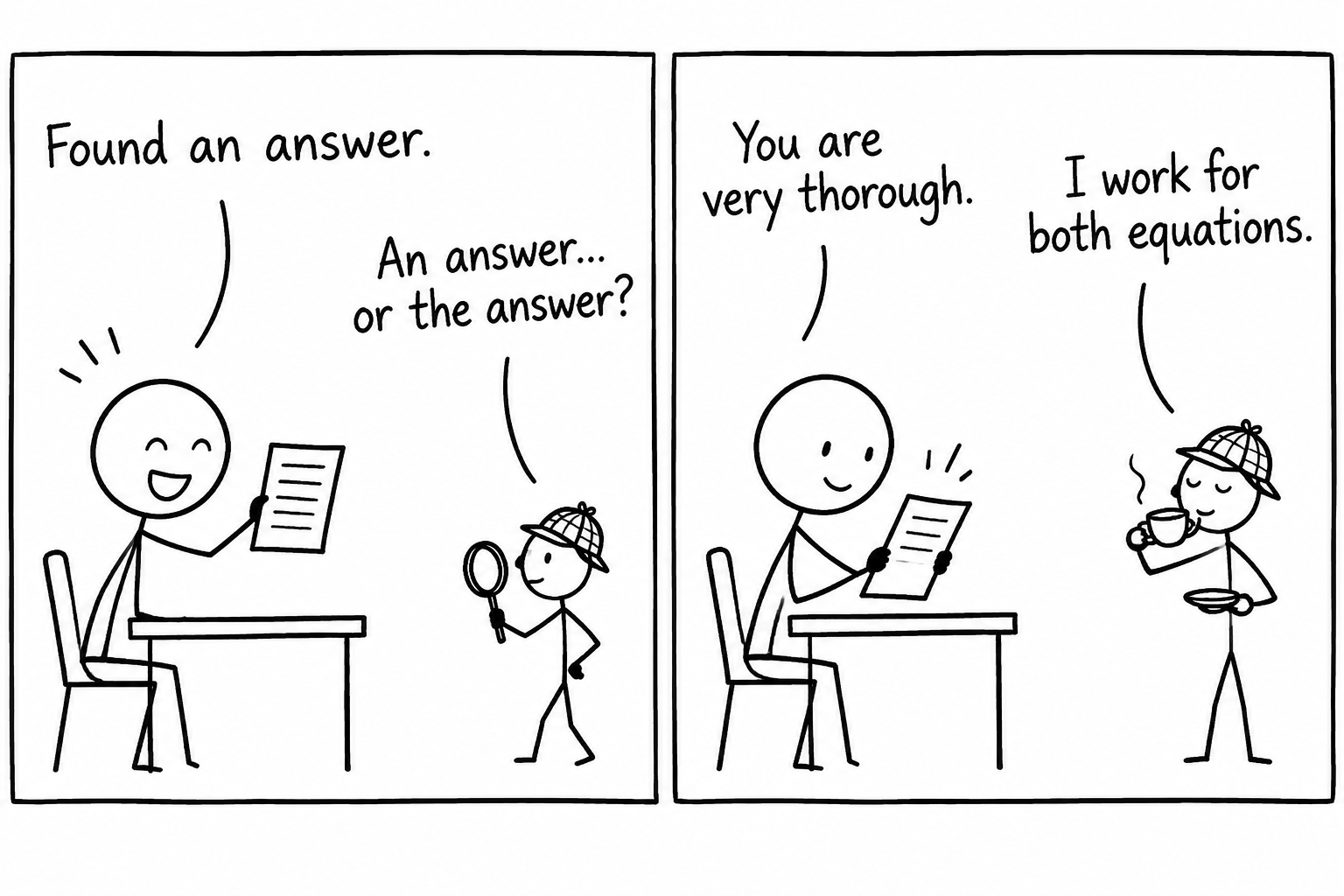 A stick-figure detective insists that a student's answer must satisfy both equations.
Common mistakes and how to catch them
Substituting into the same equation
Putting y=7−2xy=7-2xy=7−2x back into 2x+y=72x+y=72x+y=7 simply recreates the relationship you already know. It will not determine a unique value for xxx.
Substitute into the other original equation so that both pieces of information contribute.
Dropping brackets
Writing 3x−2(7−2x)3x-2(7-2x)3x−2(7−2x) makes clear that the multiplier applies to both terms. Missing those brackets often causes a sign error.
Keep the brackets until you have multiplied every term inside them. If replacing expressions still feels uncertain, revisit the substitution revision lesson.
Stopping after finding one unknown
An answer containing only xxx is incomplete when the question asks you to solve for both variables. Leave space beneath your working for the second substitution and label both final values.
Checking only a rearranged equation
A rearrangement might contain your original mistake. Checking both original equations gives you a better chance of spotting it.
This is where the hypothetical student’s routine changes: checking becomes part of solving, rather than something to attempt only when time remains.
Simultaneous equations (substitution) questions
Try these exam-style practice questions without looking at the answers. Show your rearrangement, substitution and working for both unknowns.
Question A
x+y=9,y=2xx+y=9,\qquad y=2xx+y=9,y=2xQuestion B
y=3x−4,2x+y=11y=3x-4,\qquad 2x+y=11y=3x−4,2x+y=11Question C
2x+y=4,x−3y=92x+y=4,\qquad x-3y=92x+y=4,x−3y=9Answers and useful checks
| Question | Solution | Check in one original equation |
|---|---|---|
| A | x=3, y=6x=3,\ y=6x=3, y=6 | 3+6=93+6=93+6=9 |
| B | x=3, y=5x=3,\ y=5x=3, y=5 | 2(3)+5=112(3)+5=112(3)+5=11 |
| C | x=3, y=−2x=3,\ y=-2x=3, y=−2 | 3−3(−2)=93-3(-2)=93−3(−2)=9 |
Complete the second check yourself. If an answer differs, find the first line where your working stops being equivalent to the previous line. That identifies the skill to repair more precisely than restarting everything.
The simultaneous equations exam booklet provides further topic practice.
For GCSE revision, distinguish linear pairs like these from linear and quadratic pairs. Linear simultaneous equations appear at foundation and higher tier; higher tier also includes linear and quadratic combinations. Substitution remains useful, but the resulting equation may be quadratic.
Turn practice into a revision routine
After marking your work, record the specific cause of any error: rearranging, replacing an expression, expanding brackets or solving the remaining equation. Then practise that step before attempting another complete question. This gives your next revision session a clear purpose.
Return to a question you previously missed after a short gap, with the solution covered. Explain aloud why each substitution is allowed. If you can complete the question and justify the replacement, you have stronger evidence of understanding than recognition alone provides. Finally, mix substitution questions with other algebra topics so you also practise choosing a method independently.
Make the method stick
Our hypothetical student’s breakthrough comes from following a repeatable sequence: replace, solve, substitute back and check. You now have that sequence; the next step is applying it without copying a worked solution. Start with MathsGenie Lessons, then practise the substitution method independently in the Question Bank.