

Regret Picking GCSE Arabic? What to Check First
Regret picking GCSE Arabic? Explore the workload, language demands and warning signs before choosing, while protecting your valuable maths revision time.

Choosing a GCSE option can feel strangely permanent. A subject that sounded manageable in Year 9 may look very different once vocabulary tests, speaking preparation and written assessments begin competing for space beside maths revision.
If you already regret picking GCSE Arabic, the short answer is this: the subject is not necessarily the wrong choice, but students can underestimate the difference between speaking some Arabic and preparing for a formal language qualification. The course may test listening, speaking, reading and writing, often using Modern Standard Arabic rather than the dialect heard at home.
That creates a particular kind of surprise. Familiarity helps, but it does not remove the need to learn accurate spelling, grammar, vocabulary and examination technique.
This guide explains the recurring reasons students wish they had investigated the subject more carefully, what to check before committing and how to stop one demanding option from weakening your GCSE maths preparation.
A quick GCSE Arabic option checklist
Before choosing or changing an option, find clear answers to these questions:
- Which exam board and specification does your school use?
- Which language skills will be formally assessed?
- Will lessons and examinations use Modern Standard Arabic?
- How confident are you at reading and writing Arabic without help?
- How much vocabulary will you need to learn independently?
- What speaking practice and teacher support are available?
- Is the subject offered at foundation tier, higher tier or both?
- What are your school's deadlines and rules for changing options?
- How will the workload fit beside English, science and maths?
- Have you looked at an actual specification and sample assessment?
Do not make the decision from the subject name alone. Ask to see the course as it is really taught and assessed.
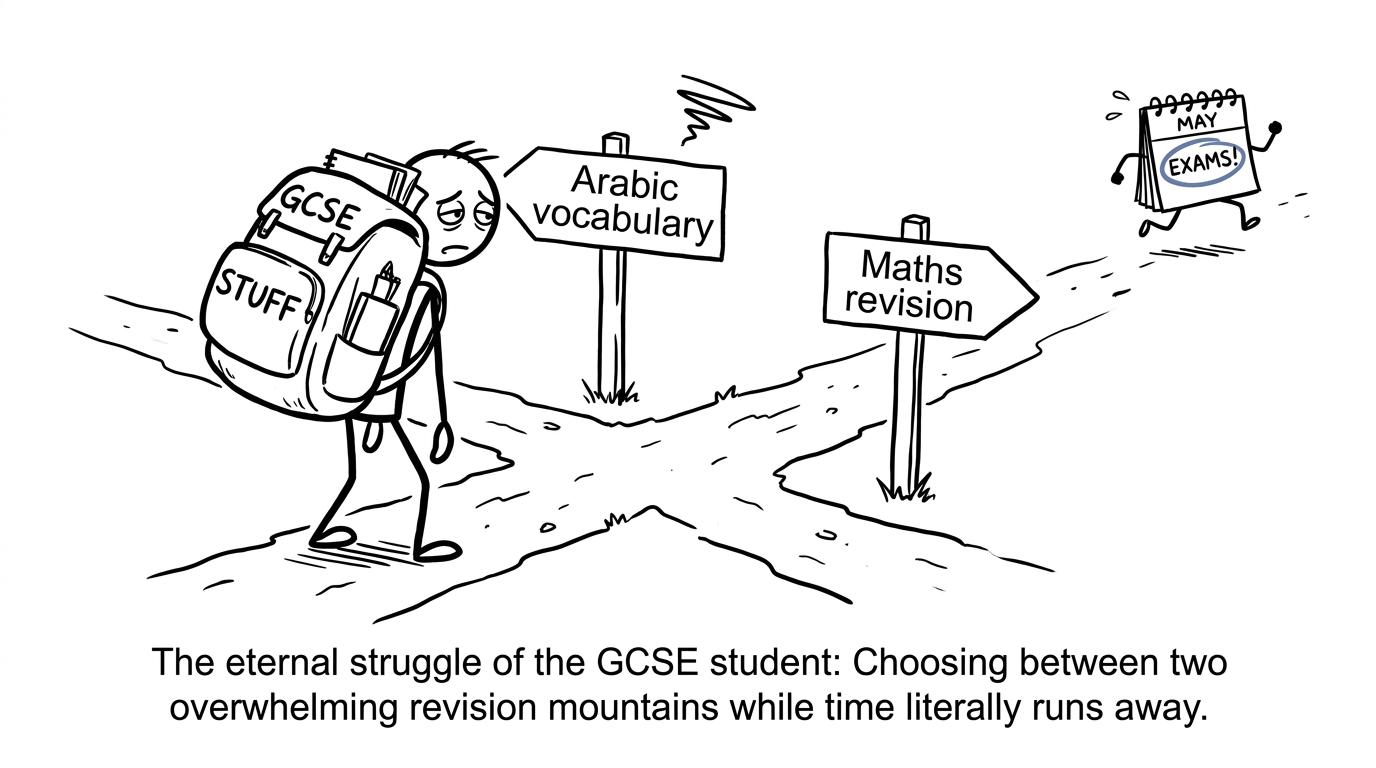 A student choosing between Arabic vocabulary and maths revision while an overloaded school bag looks on
Why some students regret picking GCSE Arabic
There is no reliable national ranking of students' reasons for regretting an option, and experiences vary between schools. However, several concerns recur because they arise from the structure of language learning itself.
Speaking Arabic is not the same as taking the GCSE
A student may communicate confidently with relatives yet find formal reading and writing much harder. Home conversations can involve a regional dialect, borrowed words and expressions understood through context. A GCSE course may require Modern Standard Arabic, controlled vocabulary, accurate written forms and responses shaped for the mark scheme.
This does not mean home speakers have no advantage. Listening experience, pronunciation and cultural familiarity can be extremely valuable. The mistake is assuming that conversational fluency makes every assessed skill automatic.
Before committing, try reading a specimen text and writing a short formal response without translation software. This is not a test of whether you are "good enough". It reveals where the actual work will be.
The script demands sustained accuracy
Arabic is written from right to left, and letter forms can change according to their position within a word. Vowel marks may also be absent from everyday texts, so readers often rely on vocabulary and grammatical context.
Students who recognise spoken words can therefore need substantial practice to produce accurate written Arabic under timed conditions. Small uncertainties accumulate: spelling, agreement, verb forms, sentence structure and the choice of formal vocabulary all require attention.
This is similar to maths in one useful respect. Recognition is not the same as independent recall. Watching someone solve an equation can feel easy; producing the method alone in an examination is different. Language knowledge also has to be retrieved, not merely recognised.
Four skills create four different revision jobs
Language qualifications usually involve listening, speaking, reading and writing. Each skill needs a different form of preparation:
- listening requires repeated exposure at examination speed;
- speaking requires recall, pronunciation and flexible responses;
- reading depends on vocabulary and inference;
- writing requires grammar, spelling and organised ideas.
A student can be strong in one area and much less secure in another. That unevenness is normal, but it can make the course feel larger than expected.
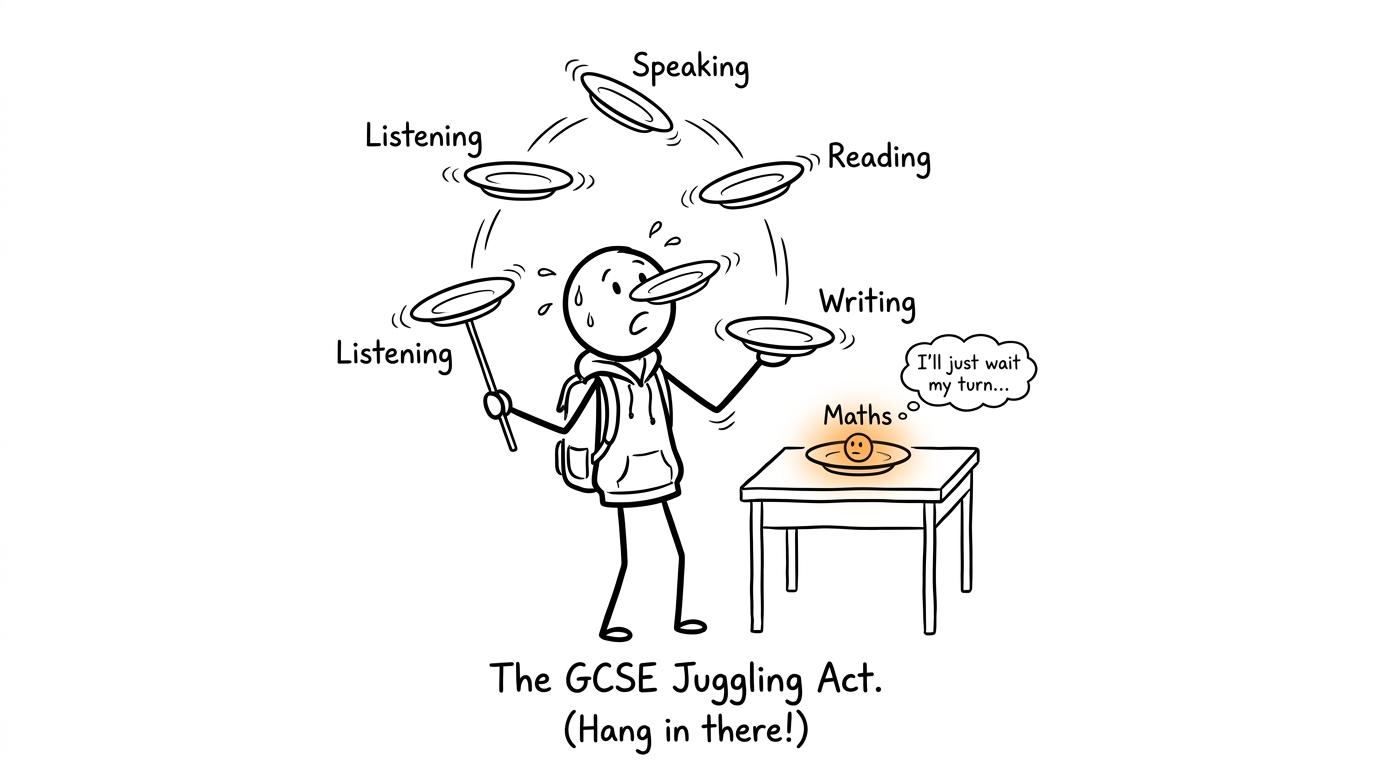 A student balancing listening, speaking, reading, writing and maths revision plates
Speaking assessments can feel uncomfortable
Some students choose a language because they enjoy quiet written work, then discover that speaking preparation causes anxiety. Knowing vocabulary does not always make spontaneous answers comfortable, particularly when a student is being recorded or assessed.
The sensible question is not whether you ever feel nervous. Most students do. Ask whether your school provides regular speaking practice, clear feedback and enough opportunities to rehearse the assessment format. A predictable routine can make speaking far less intimidating.
The independent workload was not obvious
Vocabulary is built through frequent retrieval over time. A large revision session once a fortnight is usually less useful than short, repeated practice. That means GCSE Arabic can create a steady background workload even when no major assessment is approaching.
This becomes a problem when the same evenings are needed for algebra, science recall and English essays. Maths, in particular, deteriorates when practice becomes irregular. Skills that once felt secure can become slow under examination pressure.
Use the free GCSE maths revision lessons to identify how much maths work you already need. If several topics require attention, include that honestly when judging whether another demanding option is manageable.
The decision was based on other people's expectations
Students sometimes choose a subject because a friend is taking it, because relatives expect it or because they have been told it should be easy for them. None of these reasons says much about the specification, available teaching or the student's current literacy.
An option should not be chosen solely because it appears impressive or familiar. Equally, it should not be abandoned merely because it is challenging. The better question is whether the challenge is understood, supported and compatible with your wider GCSE plan.
What to check before you commit
Confirm the exact specification
Ask your teacher for the exam board, qualification code and current specification. Pearson Edexcel offers a GCSE Arabic qualification, but students should never assume that every school follows identical arrangements. Entry decisions, tier availability, teaching time and internal deadlines are controlled locally.
Read the assessment overview rather than relying on memories from an options presentation. Check the weighting and format of each paper, the permitted preparation and how speaking is conducted. Specifications can change, so use the current documents supplied by your school and exam board.
Compare your four language skills honestly
Give each skill one of three labels: secure, developing or unfamiliar. Base this on evidence rather than confidence alone.
For reading and writing, consider whether you can work independently in formal Arabic. For listening, ask whether you understand unfamiliar speakers rather than only familiar voices. For speaking, consider whether you can adapt answers instead of reciting one memorised paragraph.
The aim is not to reject the subject if one area is weak. It is to estimate the work required before the timetable becomes crowded.
Investigate the support available
A demanding subject can be manageable with strong support. Ask about class size, speaking sessions, intervention, vocabulary resources, feedback and access to past or specimen papers. Find out what happens if you miss a lesson and whether your school expects significant home study.
Teacher availability matters because feedback on pronunciation and extended writing is difficult to replace with passive revision. Digital tools can support recall, but they cannot always explain why a phrase is unsuitable for a particular context.
Protect maths before pressure builds
Maths revision should not begin when examinations are only a few weeks away. Start by locating your gaps on the MathsGenie GCSE revision page, then use GCSE maths mini tests to check whether topics can be recalled without prompts.
A practical weekly plan might contain several short language sessions and several focused maths sessions. Build it around specific tasks, not vague promises such as "revise Arabic" or "do maths". A useful task names the skill and the resource: practise a speaking theme, retrieve vocabulary or complete questions on simultaneous equations.
As examinations approach, use GCSE maths past papers under timed conditions. Mark schemes and video solutions help you distinguish a knowledge gap from an avoidable examination mistake.
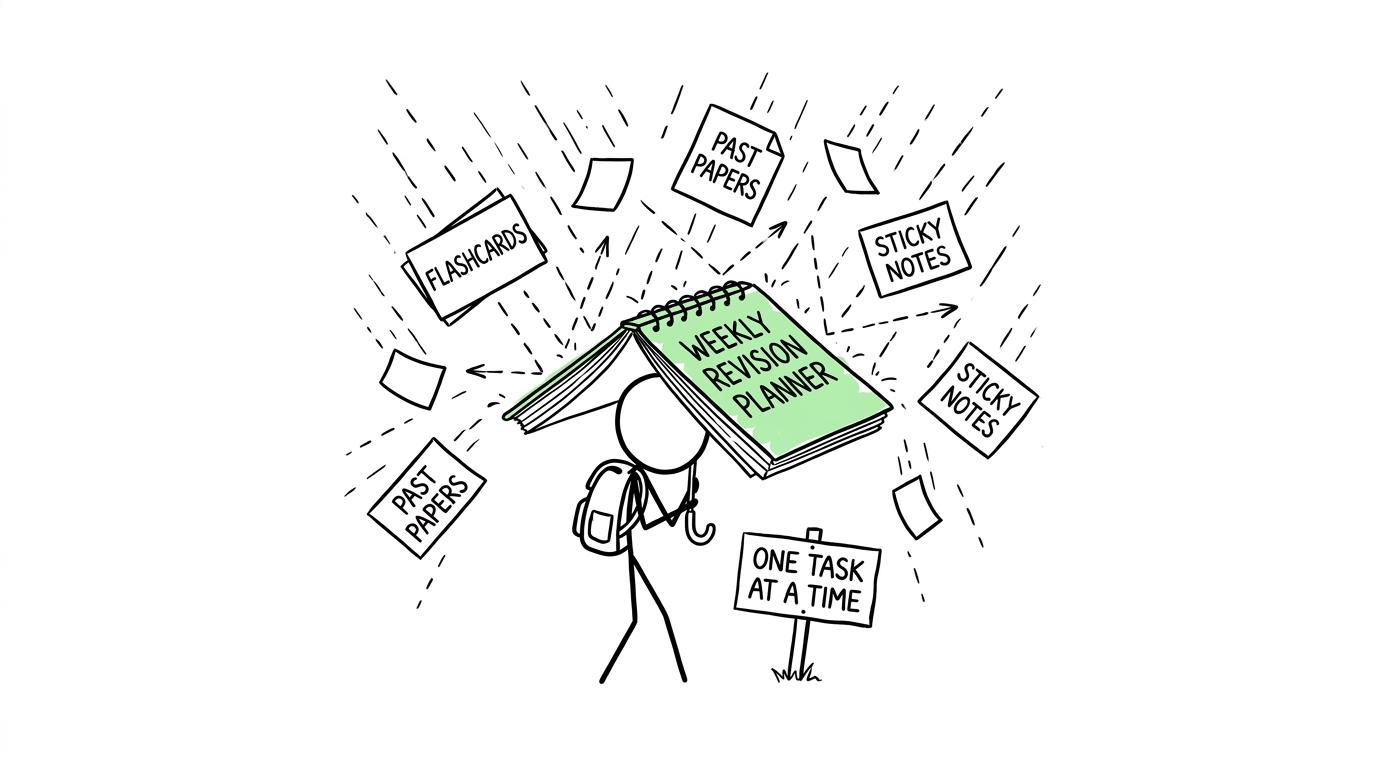 A weekly revision planner protecting a student from a storm of flashcards and papers
What to do if you already regret picking GCSE Arabic
First, identify the precise problem. "I hate it" may conceal several different issues: difficulty reading, anxiety about speaking, a heavy homework load, weak teaching support or simple tiredness. Each problem has a different solution.
Speak to your Arabic teacher, form tutor or head of year before assuming that nothing can change. Schools set their own option-change procedures and deadlines. Changing may be possible early in the course, but it can become difficult once substantial teaching has been missed in the replacement subject.
If changing is not possible, ask for a recovery plan. It should identify the weakest skill, the smallest useful daily action and the next assessment milestone. Avoid trying to repair everything in one weekend.
Meanwhile, keep maths stable with regular practice. The MathsGenie revision planner can help turn a large course into scheduled topics. Later, MathsGenie predicted papers can supplement past-paper practice, although no predicted paper can guarantee the questions that will appear.
Common mistakes when making the decision
Assuming a heritage speaker will find every paper easy
Speaking experience is useful, but formal literacy and examination technique still need to be checked. Compare your skills with the specification rather than with other students.
Choosing because friends are choosing it
Friends can make lessons enjoyable, but they cannot complete the listening, speaking, reading and writing preparation for you. Choose according to your interests, evidence and workload.
Ignoring the effect on compulsory subjects
Option subjects matter, but English, maths and science already require consistent revision. A crowded timetable should not repeatedly push maths practice aside.
Waiting too long to ask about changing
Silence removes options. If you are seriously concerned, speak to school staff promptly and involve a parent or carer where appropriate. Do not stop attending lessons while waiting for a decision.
Treating resources as a substitute for practice
Collecting flashcards, videos and papers can feel productive without producing much recall. Use resources actively. For maths, complete questions before checking the solution, then revisit errors through the free MathsGenie revision resources.
Make the choice with evidence, not panic
It is possible to regret picking GCSE Arabic and still complete the course successfully. It is also reasonable to investigate a change if the subject, support or workload is genuinely unsuitable. The important step is to replace a vague feeling with specific evidence.
Check the current specification. Assess your reading, writing, listening and speaking separately. Ask what support your school provides. Then place the expected workload beside the revision already required for your compulsory subjects.
Whatever you decide, protect steady maths practice. MathsGenie gives you free revision lessons, practice questions, mini tests, past papers, mark schemes, video solutions, predicted papers and a revision planner. Begin with one weak topic today, complete the questions without looking ahead and let your next revision decision be guided by what the marks show.










