

Can You Redo GCSE Food and Nutrition Coursework?
Redo GCSE Food and Nutrition coursework? Learn when redrafting is allowed, what final submission means, and how resits and marking reviews work in the UK.

A disappointing dish can be remade. A sentence can be rewritten. But GCSE assessment rules are less forgiving once work becomes final.
If you want to redo GCSE Food and Nutrition coursework, the short answer is: you may be able to improve it before final submission, within your school’s controlled assessment arrangements, but you cannot normally change it after submitting it for final assessment. If you later retake the whole qualification, you may be able to complete new non-exam assessment instead of carrying forward your previous mark.
The exact route depends on your exam board, the stage your work has reached and your school’s internal deadlines. Speak to your Food Preparation and Nutrition teacher or exams officer before editing, replacing or removing anything.
The rules at a glance
Use this checklist before taking action:
- Find out whether your work is still a draft or has been submitted for final assessment.
- Ask which awarding body and specification you are following.
- Check whether your school’s internal deadline has passed.
- Do not alter assessed work without your teacher’s permission.
- If marks have been issued, ask about the centre’s review-of-marking procedure.
- If you are considering a retake, ask whether you can carry forward your NEA mark or take a new assessment.
- Keep every source properly referenced and follow the current rules concerning AI-generated material.
The important distinction is not simply whether you are unhappy. It is whether the assessment is still in progress, has become a final submission, or belongs to a completed qualification.
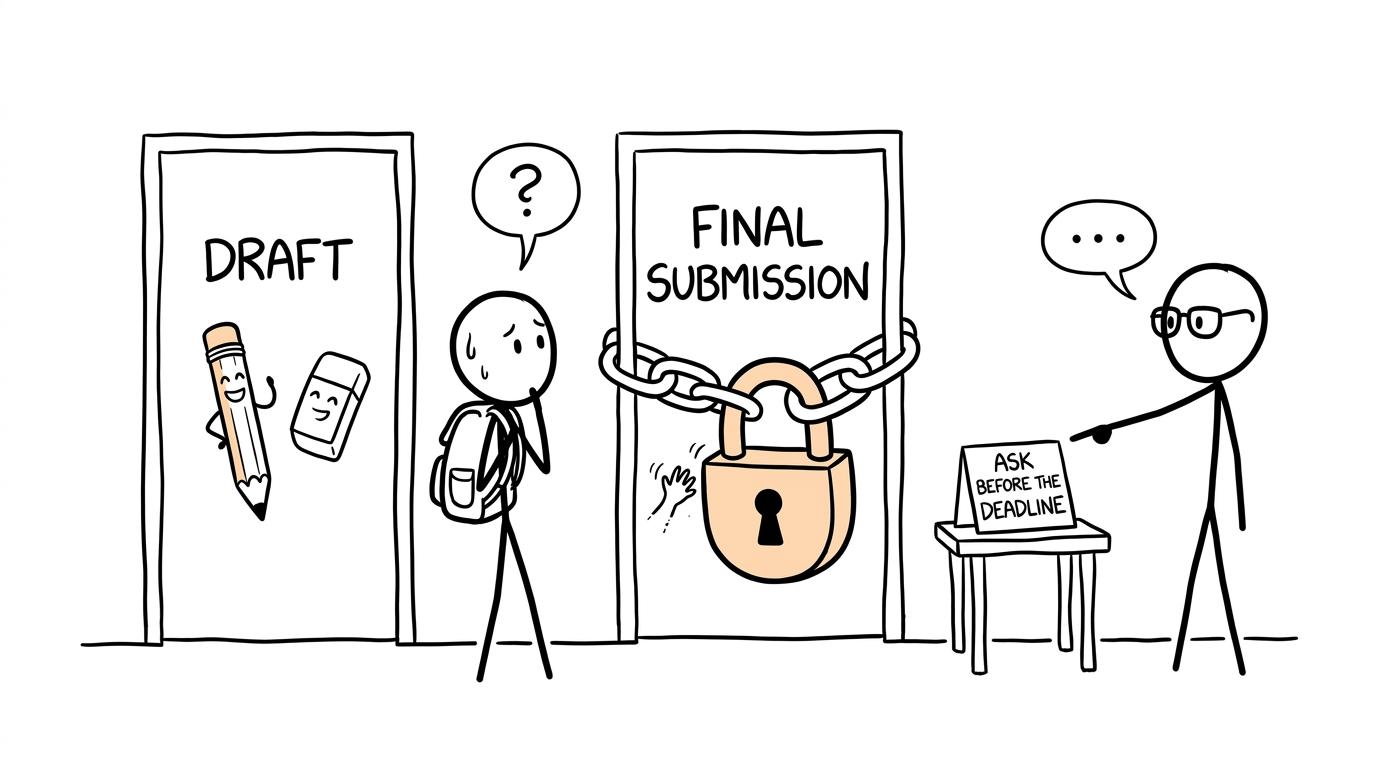 A student choosing between an editable draft and a locked final submission
Is it coursework or non-exam assessment?
Students often call the project “coursework”, but the official term used by the main awarding bodies is non-exam assessment, usually shortened to NEA.
For GCSE Food Preparation and Nutrition, AQA, OCR and Eduqas currently assess part of the qualification through NEA and part through a written examination. Although the structures differ, NEA accounts for 50%50\%50% of the qualification on these specifications.
| Awarding body | Typical current structure | What to check |
|---|---|---|
| AQA | Two NEA tasks worth a combined 50%50\%50% | Whether either task has been submitted as final |
| OCR | A food investigation worth 15%15\%15% and a food preparation task worth 35%35\%35% | Which separate component you may carry forward or retake |
| Eduqas | Food Preparation and Nutrition in Action worth 50%50\%50% | Whether the complete NEA component is still live |
Pearson Edexcel does not currently offer a GCSE titled Food Preparation and Nutrition. If your course is described as “Edexcel Food”, check the qualification title with your teacher because it may be a different vocational or technical award with different resubmission rules.
Can you redo work before final submission?
Potentially, yes, but only under the permitted assessment conditions.
While your NEA remains in progress, your school may provide scheduled opportunities to develop and refine it. The work may have to remain secure between sessions, and practical activity may need direct or informal supervision. You should not assume that being able to access a file means you are allowed to edit it at home.
Teacher guidance is also limited. A teacher can explain the task, assessment criteria and general weaknesses, but cannot rewrite passages, supply a model response for you to copy or repeatedly direct you towards every improvement. The final evidence must demonstrate your own achievement.
Ask your teacher these precise questions:
- Is this still a draft or is it my final submission?
- Which sections am I permitted to edit?
- Must the changes be completed in a supervised session?
- Can I repeat any practical investigation or cooking evidence?
- What is the internal deadline?
That conversation is more useful than asking only, “Can I redo it?” A written report, practical investigation and final cooking session may each be subject to different controls.
What happens after final submission?
Once work has been presented for final assessment, it must not normally be revised. Adding, replacing or removing material after that stage can be treated as malpractice under JCQ rules.
This applies even if you suddenly notice a weak evaluation, missing photograph or incorrect conclusion. A final submission is not simply the latest version of a document. It is the version your teacher must authenticate and assess.
Do not quietly upload a replacement, change a shared file or ask a classmate to help rewrite part of it. Tell your teacher if you discover a genuine problem. The school can then decide whether the work was actually final and whether any formal procedure applies.
A technical failure, lost file or work accidentally destroyed by the centre is different from dissatisfaction with quality. Schools have formal procedures for reporting lost or damaged assessed work. You should report such a problem immediately rather than attempting to reconstruct evidence without permission.
Can you redo it after receiving your mark?
Usually, receiving a centre-assessed mark does not reopen the task for editing.
Schools must tell candidates their centre-assessed marks before submitting them to the awarding body and must provide a way to request a review of the centre’s marking. A review asks whether the existing work was marked correctly according to the assessment criteria. It is not permission to improve the work and submit a stronger version.
Your school will set its own written procedure and deadline. If you believe a section has been overlooked or the criteria have been applied inconsistently, ask for that procedure promptly. Remember that a review concerns the mark awarded to the evidence already submitted. A mark can potentially remain unchanged, rise or fall following a proper review.
The mark communicated by your school may also be subject to external moderation. Moderation checks whether the centre has applied the awarding body’s standard correctly, so the final moderated mark may differ from the original centre mark.
Can you submit new coursework when retaking the GCSE?
A retake is the main situation in which genuinely new NEA may be possible.
For a linear GCSE, you must normally retake the required written examination components. Depending on the awarding body and specification, you can generally choose between carrying forward an eligible previous NEA result and completing new NEA under the current task and assessment arrangements.
There are important consequences:
- Carry-forward arrangements normally use the most recent eligible non-absent NEA result, not whichever historical mark is highest.
- If you retake an NEA component, the new mark normally counts even if it is lower.
- Current tasks may differ from those used in your original examination series.
- Your centre must make the correct entry and follow the awarding body’s administrative rules.
- A private candidate will need a centre capable of supervising, authenticating and marking the practical assessment.
OCR’s specification allows retaking learners to choose whether to retake or carry forward their NEA components, using the appropriate entry option. AQA and Eduqas also publish carry-forward arrangements for candidates retaking their linear qualifications.
This is not something a student can arrange by editing an old document and emailing it to an exam board. Start with your school’s exams officer or the centre entering you for the retake.
Protect the authenticity of your work
Food NEA assesses more than polished writing. It records your research, decisions, investigation, technical skills, practical outcomes, analysis and evaluation. Your teacher must be able to confirm that the work is yours and that it was completed under the required conditions.
Reference books, websites and other sources precisely. If material is quoted, paraphrased or adapted, acknowledge it. Current JCQ instructions also require candidates to identify permitted computer-generated content, retain a non-editable copy of relevant prompts and outputs, and explain how it was used. However, the conditions of your particular task may restrict such tools further.
Never use an AI tool, another student’s work or an online model answer to rewrite assessed material unless your teacher has confirmed what is permitted. Undeclared copying can lead to serious malpractice penalties.
Make space for maths while coursework is demanding
Coursework often feels urgent because its deadline is visible. Maths revision can become the quieter task that keeps being moved to tomorrow.
A better response is to reduce the size of the decision. Use the free MathsGenie revision planner to protect short, regular sessions around your NEA schedule. On busy days, one focused topic is more realistic than promising yourself an entire paper.
There is useful overlap between food and GCSE maths. Recipe scaling depends on ratio and direct proportion, while nutritional comparisons and survey findings often involve percentages, averages, tables and graphs. You can strengthen those skills through:
- Proportion revision and practice
- Ratio revision guidance
- Percentages revision
- Averages lessons and questions
These resources support Foundation and Higher tier revision, but they do not replace your Food specification or your teacher’s NEA instructions.
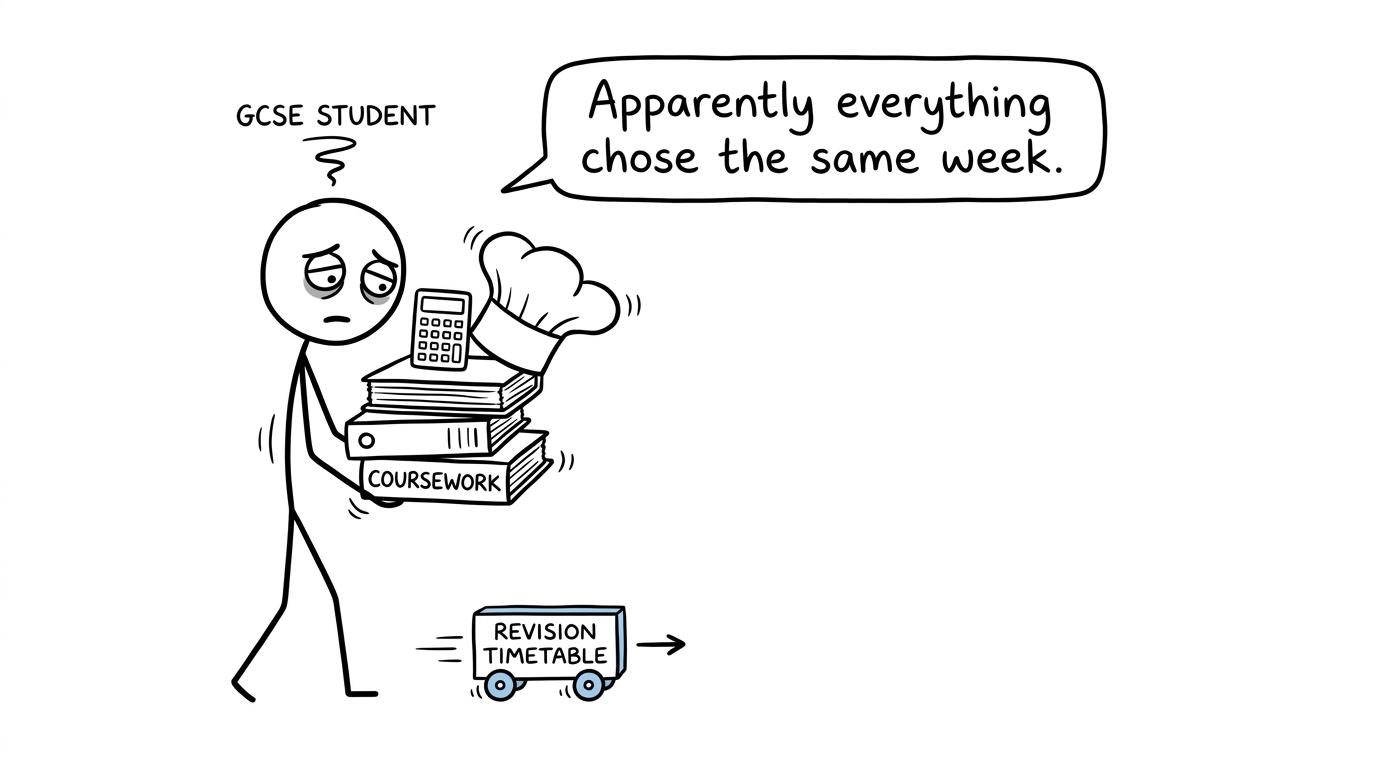 A student balancing coursework, cooking and maths revision
Common mistakes when asking to redo Food coursework
Assuming an internal deadline is optional
Schools set deadlines early enough to mark work, standardise teachers’ judgements, hear marking reviews and submit marks. Missing the awarding body’s final deadline is not the only risk.
Editing after final submission
Do not make “one tiny correction” unless your teacher confirms that the work has not yet been submitted for final assessment. Unauthorised changes may breach assessment rules.
Confusing a marking review with resubmission
A review checks the marking of existing evidence. It does not let you add better photographs, repeat a dish or rewrite your evaluation.
Assuming a retake keeps the best mark
If you choose new NEA, the new result normally replaces the carried-forward result even when it is lower. Ask the exams officer to explain the consequence before the entry is made.
Letting coursework remove maths from the timetable
A demanding NEA week does not need to become a zero-maths week. Use short topic sessions, then return to Edexcel GCSE Maths past papers when you have enough time for sustained practice. Closer to the exams, GCSE predicted papers can add fresh timed practice, but should complement rather than replace official past papers.
What to do next
First, establish the status of your work. Ask your teacher whether it is still live, has been submitted for final assessment, or has already been marked. Then request the relevant school policy if you are considering a marking review or retake.
The rule is simple even when the administration is not: improve work only while improvement is permitted. Once it is final, use the formal review or retake route rather than changing it yourself.
Then turn back to the rest of your GCSE preparation. MathsGenie gives you free revision lessons, practice questions, mini tests, mark schemes, video solutions, past papers and predicted papers for Foundation and Higher tier maths. Choose one weak topic today, practise it properly, and let a clear routine carry some of the weight.










