

Ready for GCSE English Language and Literature Early?
Ready for GCSE English Language and Literature early? Use this checklist to judge exam skills, timing, rules and your wider GCSE revision workload.
The idea of finishing two GCSEs early can feel wonderfully efficient. One exam season cleared. More time for maths. Proof that you are ahead. But wanting that outcome is not the same as being prepared for it.
If your search is “ready for GCSE English Language and Literature early sitting”, the short answer is this: you need consistent evidence from full, independently completed assessments in both subjects, not simply strong classwork or enthusiasm. You should have covered your specification, perform securely under timed conditions and understand how an early entry would affect your wider GCSE workload.
English Language and English Literature are separate qualifications. Readiness for one does not automatically prove readiness for the other. The decision should therefore be made with your teachers, exams officer and parent or carer; using marked evidence rather than hope.
Your early-sitting readiness checklist
You are more likely to be genuinely ready when you can:
- explain which exam board and specification you are following;
- demonstrate that the full course content has been taught;
- complete several unseen, timed papers without prompts;
- produce stable results rather than one unusually high mock grade;
- meet the different demands of Language and Literature;
- recall Literature texts accurately and respond flexibly to questions;
- manage handwriting, concentration and decision-making across full papers;
- accept detailed teacher feedback and improve your next response;
- protect enough time for maths and your other GCSE subjects;
- explain why sitting early benefits you beyond simply finishing sooner.
The key word is several. One good paper is encouraging. A repeated pattern is evidence.
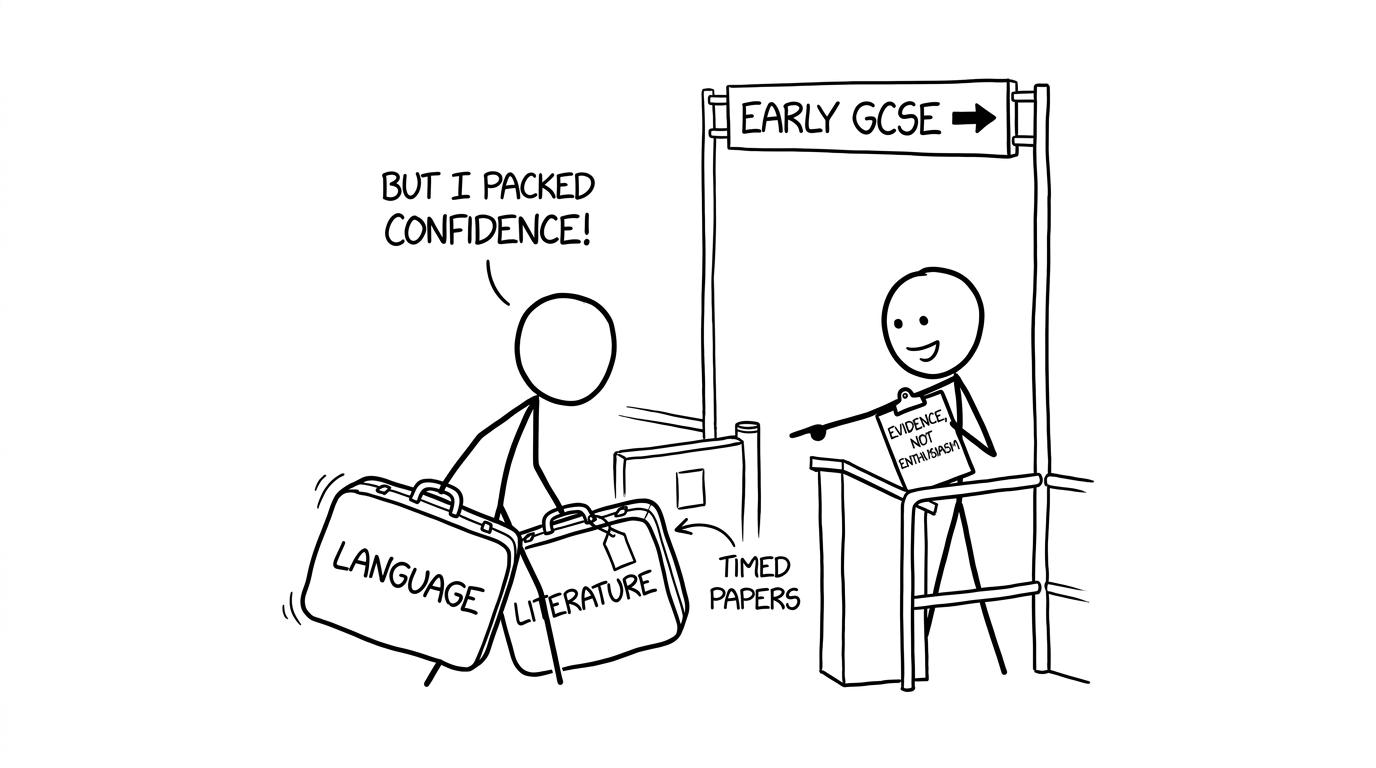 A student arrives at the early GCSE gate with confidence but no timed-paper evidence
Know what you are entering
Before judging readiness, confirm the exact qualification. AQA, Pearson Edexcel, OCR and Eduqas specifications do not all use the same paper structures, set texts, timings or question styles.
GCSE English Language assesses reading and writing. Across regulated specifications in England, students must interpret explicit and implicit ideas, analyse language and structure, compare perspectives, evaluate texts and write effectively for different audiences and purposes. The examined extracts are unseen. Spoken Language is separately reported and does not contribute to the numerical English Language grade.
GCSE English Literature requires secure knowledge of the set texts named by your specification. Depending on the board, these may include Shakespeare, a nineteenth-century novel, modern prose or drama and poetry. Knowing the plot is only the beginning. You must construct an argument, select precise evidence, analyse the writer’s methods and address the question actually asked.
Check the current specification rather than relying on an older revision guide, a sibling’s course or a paper from another board. If you cannot name your components, texts and assessment objectives, it is too early to make an entry decision.
Signs you are ready for English Language early
Language readiness is easy to overestimate because there is no fixed novel to “finish”. The real test is whether your reading and writing skills transfer to unfamiliar material.
You can handle genuinely unseen texts
A familiar practice extract can create borrowed confidence. In the exam, you must read challenging material, locate useful evidence and build an interpretation under pressure.
You are approaching readiness if you can tackle extracts from different periods and genres without needing a teacher to explain the central idea first. Your analysis should move beyond identifying techniques. It should explain how choices shape meaning, tone and the reader’s response.
Your writing is controlled as well as creative
Strong vocabulary alone is not enough. Examiners reward writing that fits its form, purpose and audience, with coherent organisation and accurate spelling, punctuation and grammar.
A ready student can make deliberate choices. A speech sounds like a speech. An article addresses its readers. A narrative has structure rather than a collection of dramatic sentences. Most importantly, quality remains reasonably stable when the clock is running.
Your marks survive exam conditions
Complete more than one full paper using the correct timing and permitted materials. Have your work marked against the current board’s mark scheme, preferably by a teacher familiar with the specification.
Do not rely on a universal raw-mark target. Grade boundaries can change between exam series, and different papers have different totals. Look instead for a secure pattern around or above your target grade, supported by similar performance across reading and writing.
Signs you are ready for English Literature early
Literature rewards accumulated knowledge. This makes early entry possible for some students, but risky when the course has been compressed too aggressively.
You know every required text as a whole
Memorising several famous quotations is not complete preparation. You need a secure grasp of character development, themes, relationships, structure and relevant context across each required text.
You should also be able to adapt what you know. If every practice essay uses the same argument regardless of the question, your knowledge is rehearsed but not yet flexible.
You can build an argument independently
A useful Literature response has a clear line of thought. Evidence supports that argument rather than replacing it. Analysis explains how the writer’s choices create meaning, while context is integrated only where it illuminates the text.
Readiness becomes visible when you can plan and write without sentence starters, paragraph frames, pre-selected quotations or live teacher reassurance.
Your weaker component is still secure
Students often have a favourite text or section. The early-entry decision must be based on the whole qualification, not the paper you enjoy most.
Review performance by component. Poetry comparison, unseen poetry, Shakespeare or the nineteenth-century novel may expose different weaknesses. A high overall mock can conceal one fragile area that happened not to be tested deeply.
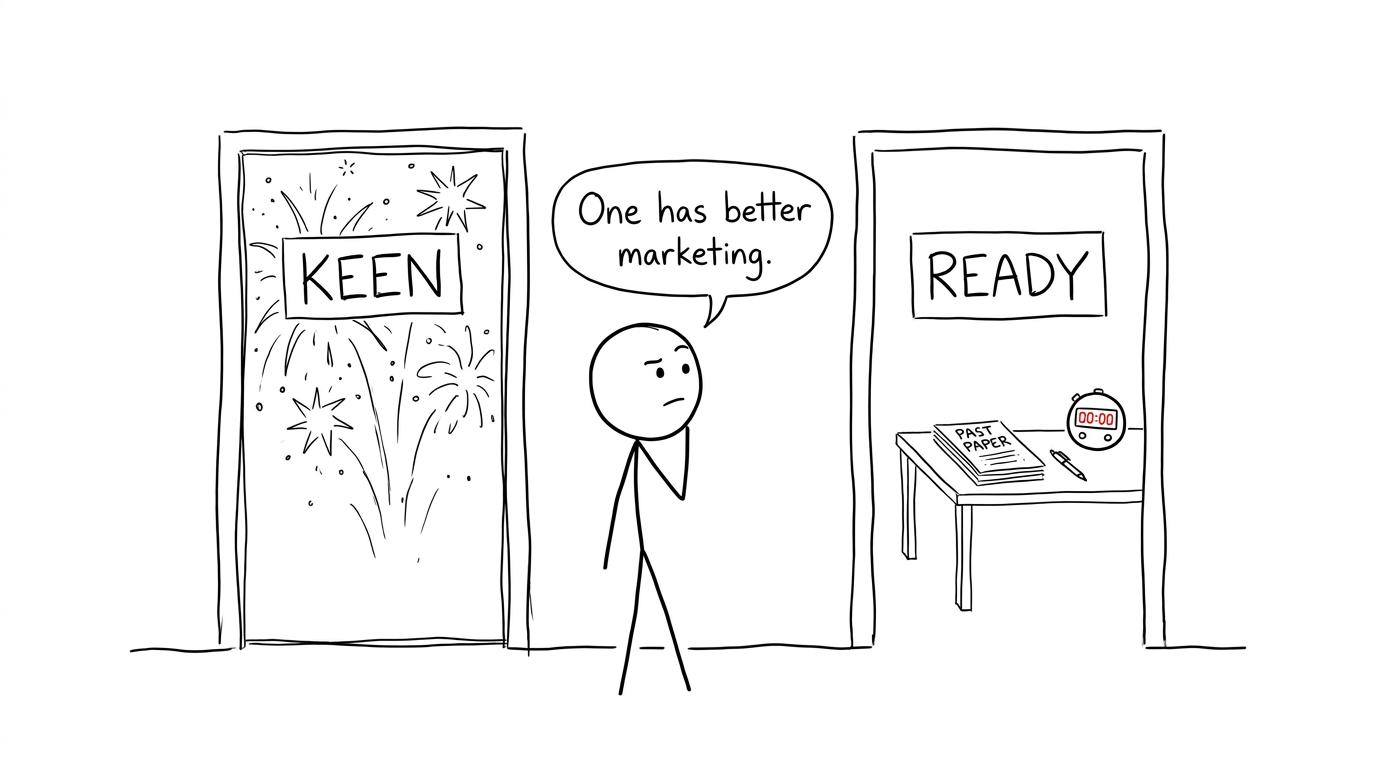 A student chooses between the exciting keen door and the quieter ready door
Use an evidence portfolio, not a feeling
A calm decision can be built from a small portfolio:
| Evidence | What it should show |
|---|---|
| Specification audit | Every required component and text has been taught |
| Timed Language papers | Secure reading and writing without support |
| Timed Literature papers | Flexible knowledge across all components |
| Teacher assessment | Marking against current assessment objectives |
| Error log | Weaknesses are identified, corrected and retested |
| Workload plan | Early preparation will not damage other subjects |
Ask your teacher to distinguish between your current grade and your potential grade. Potential matters, but an entry decision concerns what you can produce on the scheduled exam day.
It is also sensible to use papers from different series. Repeating a paper whose mark scheme you have seen tests memory partly, not independent performance.
Check the rules and practical arrangements
Early entry is not simply a personal booking choice for most school students. Your school or approved exam centre must make the entry and follow the awarding organisation’s requirements and deadlines.
In England, the routine November GCSE English Language series is restricted under current Ofqual rules to students who were at least age 161616 on the preceding 31 August, apart from limited exceptional arrangements. GCSE English Literature is ordinarily available in the summer series. For a younger student, an “early sitting” will therefore usually mean a summer series before the end of Year 11, not using November as an extra attempt.
Schools must also consider early-entry and discounting rules within Key Stage 4 performance measures. Those rules can affect which entry counts in a school’s published measures. Ask your exams officer how your proposed series, possible re-entry and certification would be handled; do not assume that a later attempt makes an early result strategically harmless.
You should confirm:
- the board, specification and entry code;
- the exam series and entry deadline;
- whether your school supports the entry;
- completion of any required Spoken Language endorsement;
- approved access arrangements, where applicable;
- what would happen if you wanted or needed to retake.
Protect your maths and wider GCSE preparation
An English early sitting may remove pressure later, but it concentrates work now. That trade-off matters particularly if you are also preparing for foundation or higher tier maths.
Build a realistic weekly plan. Include English essays, quotation retrieval and timed papers alongside maths topic work, homework and rest. If early English preparation repeatedly displaces maths, science or other unfinished courses, the timing may not be beneficial.
MathsGenie can keep the maths side organised while you evaluate that balance. Start with the GCSE Maths revision hub, then choose the correct board pathway, such as AQA GCSE Maths revision or OCR GCSE Maths revision.
A useful weekly rhythm is to combine short topic sessions with one longer assessment session. The GCSE one-month maths revision plan shows how to diagnose weak areas, practise them and return to timed work. You can record both English and maths commitments in your revision planner so that an ambitious decision does not create an invisible timetable problem.
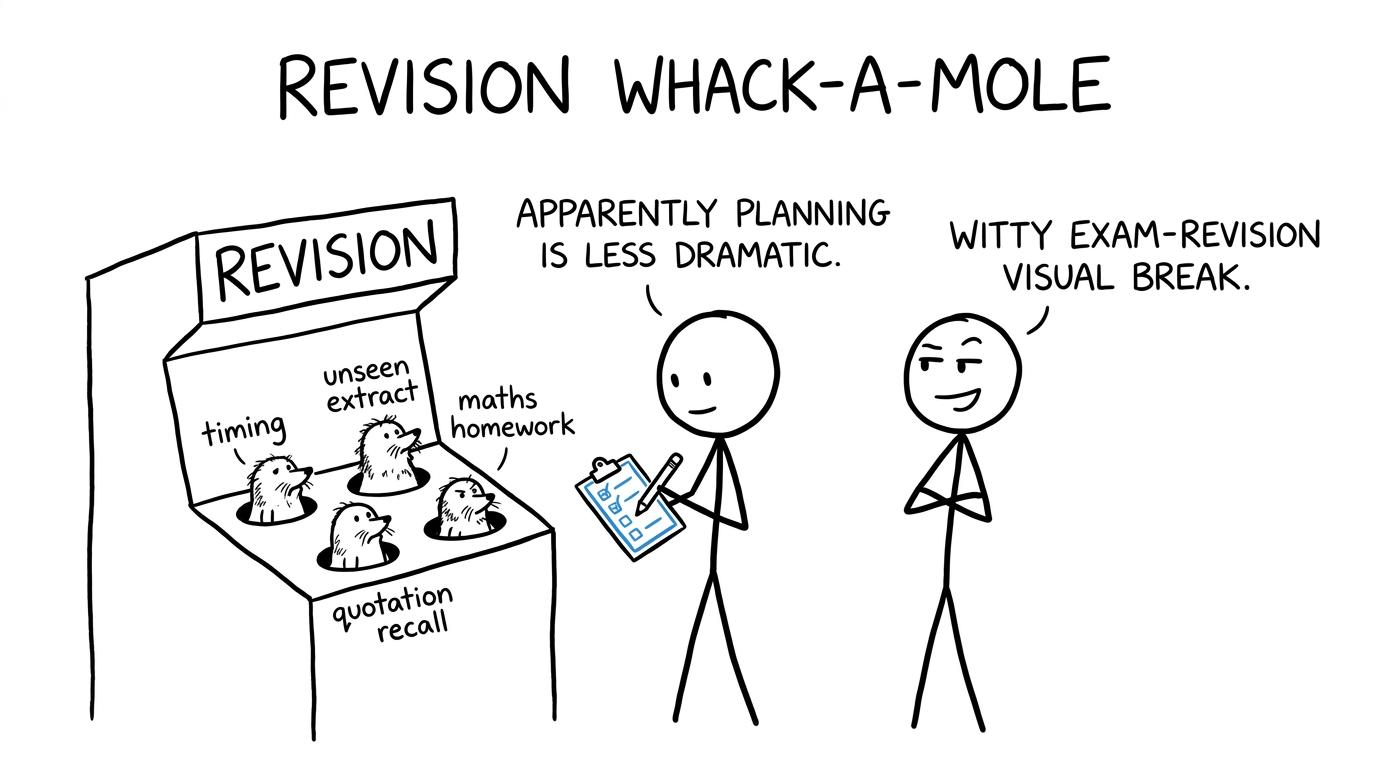 A student calmly tackles a chaotic revision arcade with a checklist
Common mistakes when deciding to sit early
Treating enthusiasm as exam evidence
Enjoying English, reading widely or working above your year group are positive signs. They do not replace complete, timed assessments marked against the correct criteria.
Using one mock result
A single paper may suit your strengths. Look for consistency across different texts, tasks and days, including occasions when the question is awkward.
Assuming Language and Literature readiness are identical
Language tests transferable reading and writing skills. Literature depends heavily on complete, flexible knowledge of prescribed texts. Evaluate them separately, even if you hope to sit both early.
Practising with too much support
Annotations, model paragraphs and teacher prompts are learning tools. They should gradually disappear. Your final readiness evidence must come from work completed independently.
Ignoring the opportunity cost
Every early Literature paper has a revision cost. If it weakens your preparation elsewhere, finishing early may not move you forward overall. Use MathsGenie past papers to monitor whether your maths performance remains stable, rather than relying on how busy or productive you feel.
Using predicted material as proof
Predictions cannot establish readiness because the live questions may take a different direction. In maths, Edexcel GCSE predicted papers are best used alongside official papers, not instead of them. Apply the same principle to English: broad specification coverage must come before prediction.
Make the decision from evidence
A genuinely ready student is not merely keen to enter. They have completed the course, produced stable work under pressure, responded to unfamiliar questions and shown that the accelerated timetable will not undermine other GCSEs.
If the evidence is mixed, waiting is not failure. Extra time can deepen textual knowledge, improve writing control and protect your wider grades. If the evidence is consistently strong, take it to your teachers and exams officer and agree the practical next steps together.
Then keep the rest of your revision steady. Use MathsGenie’s free revision lessons and practice questions to repair weak maths topics, Edexcel GCSE past papers for realistic assessment, and predicted papers, mini tests, mark schemes and video solutions for focused preparation. Ambition helps you begin. A repeatable system is what makes you ready.










