

Ready for GCSE Bengali Early Sitting? Key Signs
Ready for GCSE Bengali early sitting? Test all four skills, choose the right tier and decide without sacrificing the rest of your GCSE revision plan.

The temptation to enter early often begins with a simple thought: “I already speak Bengali, so why wait?” That confidence matters, but speaking Bengali at home is not the same as being ready for gcse bengali early sitting. The qualification tests listening, speaking, reading and writing under specific assessment conditions. Genuine readiness means producing consistent evidence across all four skills while keeping the rest of your GCSE revision on track.
The short answer is this: you are probably ready when several properly timed assessments place you securely at your target grade, no individual skill is hiding a serious weakness, and your teacher and exams officer agree that early entry is sensible. Being keen is a good beginning. It is not, by itself, a readiness test.
Your early-entry readiness checklist
Before asking to be entered, you should be able to say yes to most of these statements:
- I know the exact qualification, specification and tier I would be entered for.
- I have covered the full specification rather than only familiar home-life topics.
- I can read and write Bengali accurately, not merely speak it fluently.
- I have completed several assessment sets in realistic conditions.
- My results are consistent across listening, speaking, reading and writing.
- My weakest skill is still close to my target standard.
- I can respond to unfamiliar language without relying on family or a teacher.
- My Bengali preparation is not damaging my maths, English or science revision.
- My school can organise the speaking assessment and examination entry.
- My teacher recommends early entry on the basis of evidence.
One uncertain answer does not automatically mean “no”. Several uncertain answers usually mean “not yet”.
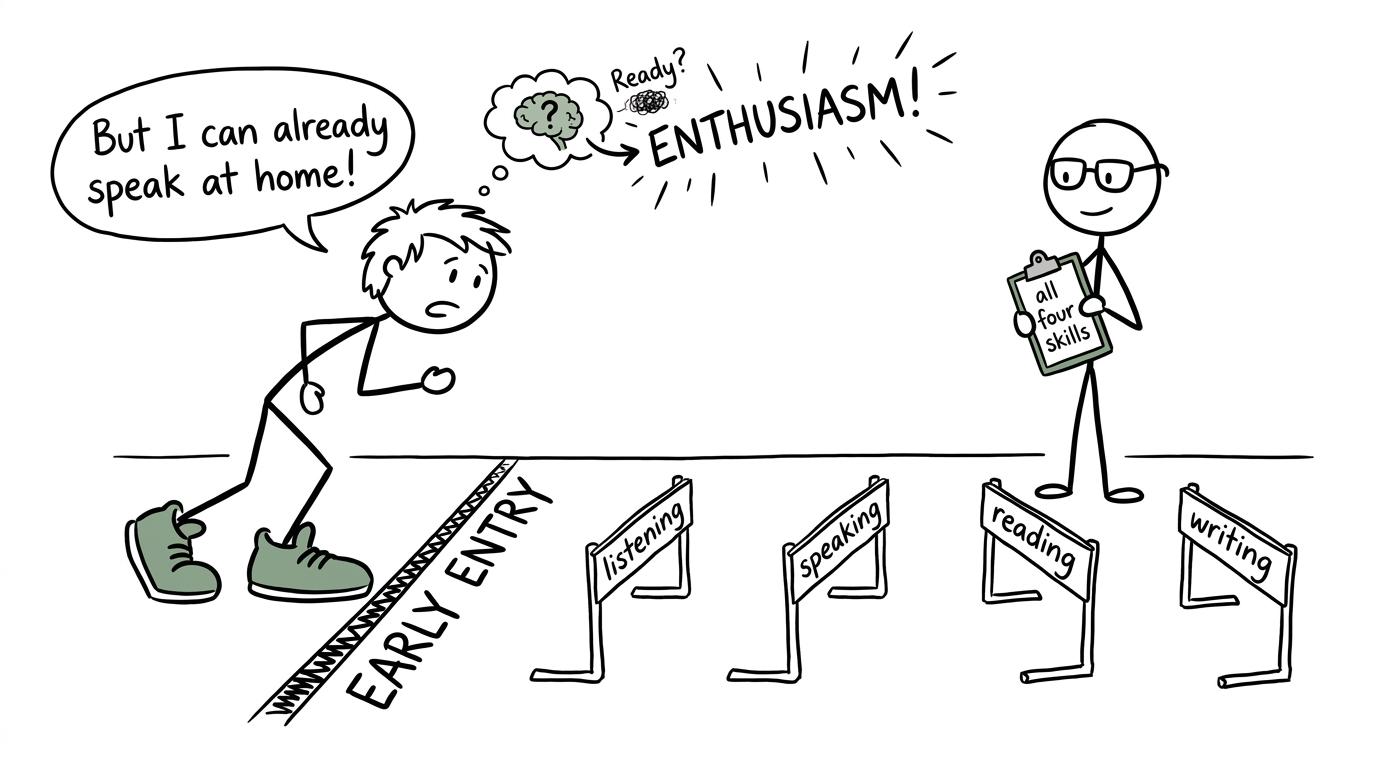 A keen student discovers that early GCSE entry involves four different skills
Know what GCSE Bengali actually assesses
For students following AQA GCSE Bengali, specification code 8638, the qualification assesses four language skills: listening, speaking, reading and writing. Each contributes approximately 25%25\%25% of the final qualification.
This balance matters. A fluent speaker who struggles to read unfamiliar passages or write accurately cannot rely on conversation skills to carry the entire grade. Equally, a student who writes carefully but freezes during spontaneous conversation has an important gap to close.
The qualification is tiered. Foundation tier covers grades 111 to 555, while Higher tier primarily covers grades 444 to 999. Students take all four components at the same tier and in the same examination series. Tier choice therefore needs to reflect your overall profile, not simply your strongest paper.
The current AQA assessment structure includes:
- a listening examination;
- a speaking assessment involving tasks such as role-play, a photo card and general conversation;
- a reading examination;
- a writing examination.
The specification was designed as a full course, so an early entrant still needs command of its complete content. Always ask your school to confirm the current specification, entry code, assessment arrangements and deadlines before making plans. Do not confuse AQA GCSE Bengali with an International GCSE in Bengali or Bangla, which can have a different structure and status in school performance measures.
Signs that you are genuinely ready
Your literacy matches your spoken fluency
Home speakers sometimes understand fast, natural Bengali very well but have had less formal experience of spelling, grammar, handwriting and extended reading. That is normal. It is also why speaking confidence alone is weak evidence for early entry.
A genuinely ready student can read unfamiliar material without needing every word explained. They can write for different purposes, organise ideas, use an appropriate register and check language accurately. Their answers are not limited to memorised paragraphs about family, hobbies or school.
A useful question is: if the familiar topic disappeared, would the language skill remain?
Your results are consistent, not occasional
One excellent paper can be encouraging, but it may reflect familiar vocabulary, favourable questions or generous self-marking. Readiness should survive changes in topic, paper and mood.
Complete several full or substantial assessment sets on different days. Use the correct time limits, permitted materials and tier. Apply the mark scheme honestly and ask a teacher or qualified Bengali specialist to assess productive work, especially speaking and writing.
Look for a stable pattern. If your total mark moves dramatically between assessments, investigate why before entering. You want a target grade that remains plausible on an ordinary day, not one that requires everything to go perfectly.
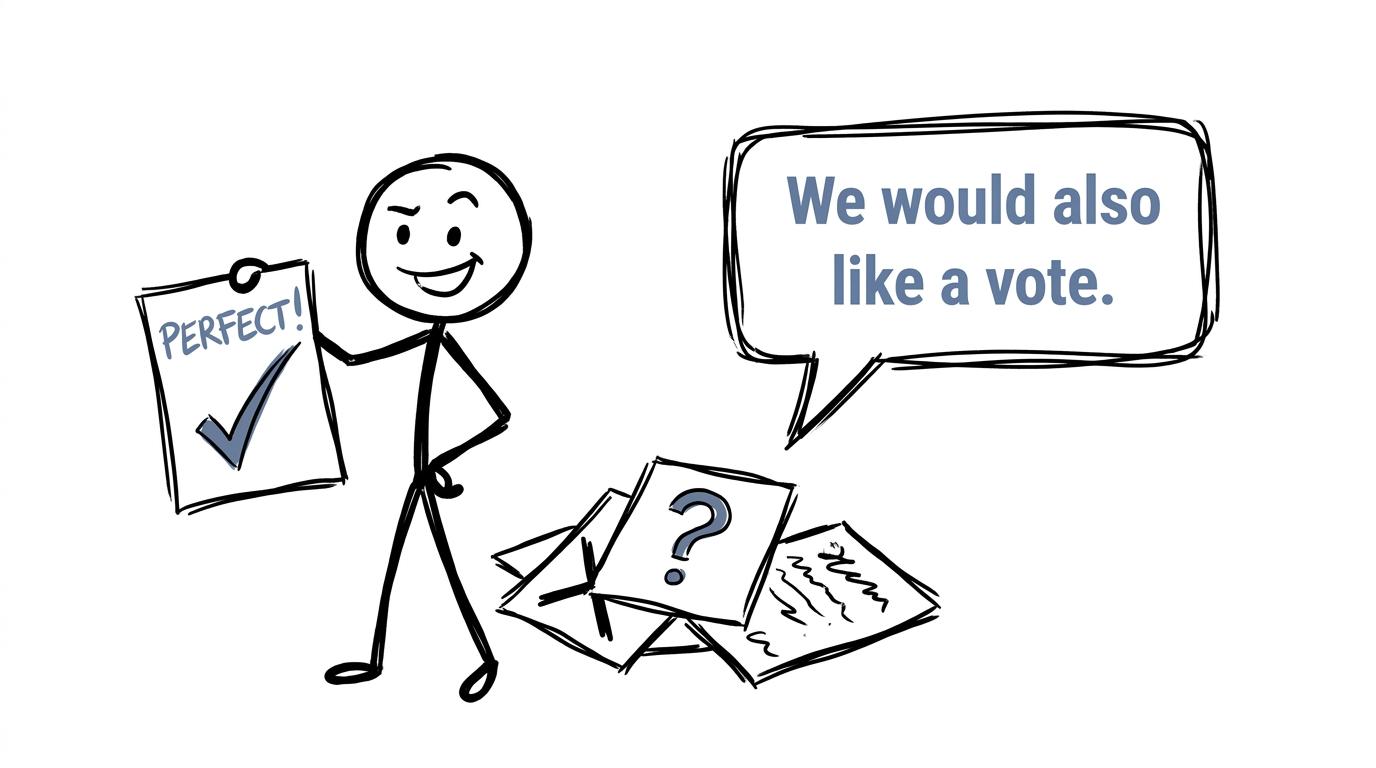 One successful paper is reminded that the other assessments also get a vote
No component is being concealed by a strong average
An overall percentage can hide a weak skill. Record each component separately, because four scores tell you more than one total.
You might use a simple readiness record:
| Evidence to record | What you are looking for |
|---|---|
| Listening | Accurate understanding of unfamiliar recordings under time pressure |
| Speaking | Spontaneous, relevant responses rather than entirely memorised scripts |
| Reading | Secure comprehension across short and extended texts |
| Writing | Accurate, developed responses that meet the task precisely |
| Timing | Completion without unofficial pauses or extra help |
| Consistency | Similar performance across several assessment sets |
Because each skill contributes about 25%25\%25%, none should be treated as optional. Your teacher can help interpret raw marks because grade boundaries vary by examination series. A fixed percentage copied from a previous year is not a guaranteed grade boundary.
You can handle the examination format independently
Knowing Bengali and knowing how to demonstrate Bengali in an examination are related but different abilities. Ready students understand command words, allocate time sensibly and answer in the required language. They know when a question permits an English or non-verbal response and when Bengali is required.
For speaking, readiness includes responding when the wording is not exactly what you rehearsed. For listening, it means recovering after missing a phrase rather than losing concentration for the rest of the recording. For writing, it means addressing every bullet point and leaving time to check accuracy.
Your teacher supports the decision
Teacher judgement is valuable because teachers see patterns that a single score misses: hesitation, dependence on prompts, narrow vocabulary, rushed writing and uneven preparation.
Ask a specific question rather than “Am I good enough?” Try: “What evidence would you need to recommend that I sit early, and which component currently presents the greatest risk?” This turns a hopeful conversation into a practical plan.
Your school must also confirm that it can enter you and arrange the speaking assessment correctly. Private candidates need an entering centre willing and able to supervise and authenticate the relevant arrangements. Availability should be checked before months of preparation are built around an assumed entry.
Keen versus ready
Enthusiasm tends to sound like this:
- “I speak Bengali with my family.”
- “I want an extra GCSE now.”
- “I did well on one practice paper.”
- “My friend is entering early.”
- “I can always resit later.”
Readiness sounds different:
- “I have completed the whole specification.”
- “My teacher has assessed all four components.”
- “My results are stable under timed conditions.”
- “I know why this tier suits my current performance.”
- “My weakest component has a defined improvement plan.”
- “The entry fits alongside my other GCSE commitments.”
The difference is not confidence versus doubt. It is desire versus evidence.
Consider the cost to your wider GCSE revision
An early qualification is useful only if preparing for it does not weaken subjects you will sit later. Time is finite. Every additional speaking session or writing paper occupies time that might otherwise go towards algebra, English essays or science recall.
Create a realistic weekly timetable before agreeing to entry. Include lessons, homework, sleep and ordinary commitments. Then add Bengali preparation without quietly removing essential maths practice.
MathsGenie's free revision planner can help you see whether the plan fits. For maths, use GCSE mini tests to maintain retrieval without needing a full paper every evening. If longer assessments are crowding the week, Edexcel GCSE Maths 45 minute tests offer a more contained way to preserve exam stamina.
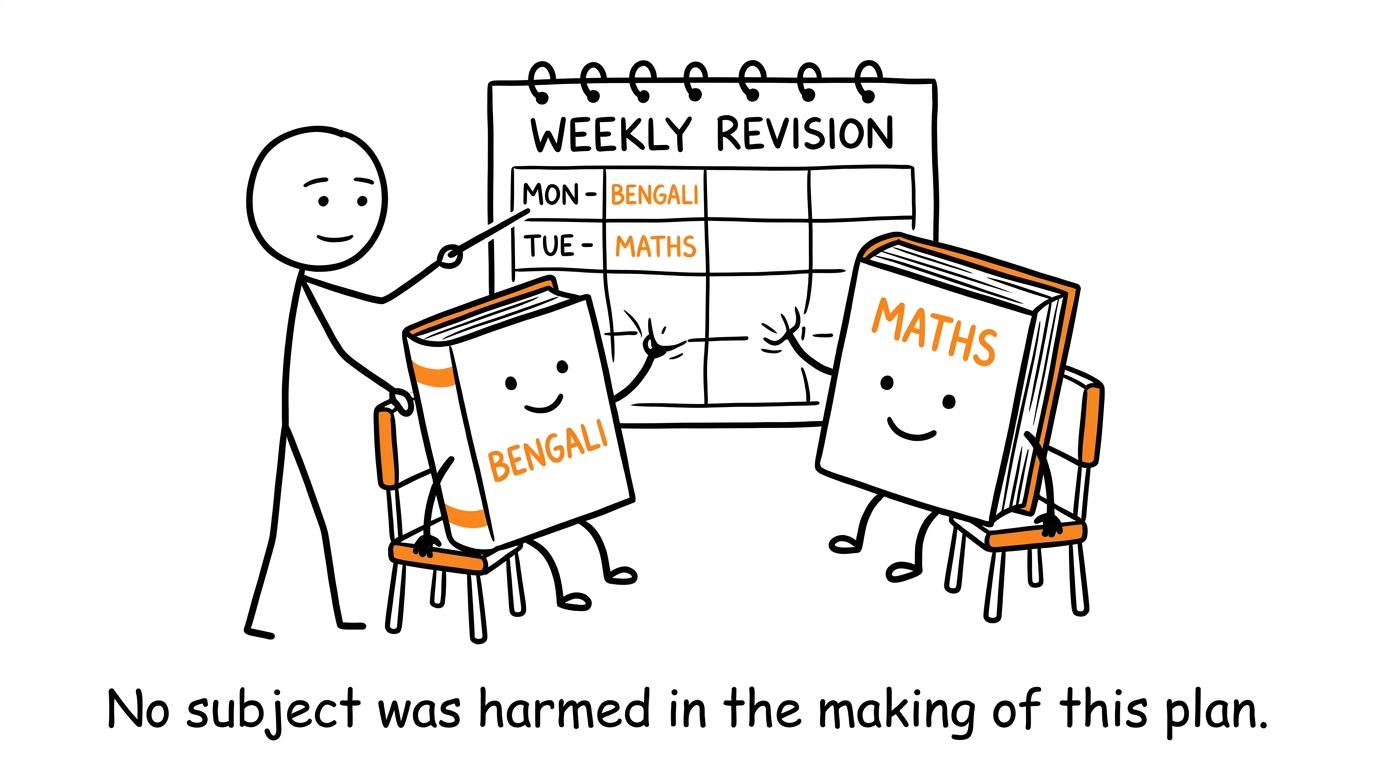 A student gives Bengali and maths separate places in a balanced revision timetable
Your plan should be sustainable during a difficult week, not merely an ideal one. The GCSE one-month revision plan provides a useful model: diagnose gaps, practise them, test again and review mistakes. The subject may change, but the evidence cycle does not.
Make the decision with a readiness review
Arrange a review with your Bengali teacher, head of languages or exams officer. Bring evidence rather than impressions:
- marks from several timed assessments;
- separate results for all four skills;
- teacher feedback on speaking and writing;
- your proposed tier and target grade;
- a list of incomplete specification areas;
- your wider GCSE timetable;
- a plan for the weeks before the assessment.
Agree a decision date and clear conditions. For example, your school may want to see consistently secure performance, completion of the specification and a speaking assessment conducted without extra prompting. These should be school-specific professional judgements, not universal percentage rules.
Remember that Department for Education early-entry rules can affect which result counts in a school's performance measures if a student takes qualifications in the same subject more than once. That does not automatically prevent a later resit, but it is another reason to involve the school rather than treating the first sitting as a consequence-free trial.
Common mistakes when considering an early sitting
Treating spoken Bengali as complete preparation
Conversation at home can create an excellent foundation, but the GCSE also examines formal literacy, unfamiliar contexts and controlled assessment tasks. Test every skill separately.
Memorising answers instead of building language
Prepared material can support confidence, particularly for speaking themes. It becomes risky when you cannot adapt it to a different tense, question or context. Examinations reward communication that answers the task actually set.
Choosing Higher tier for status
Higher tier is not automatically the braver choice. The correct tier is the one that gives you the best opportunity to demonstrate your current attainment. Discuss the complete evidence profile with your teacher.
Using one paper as proof
Do not let one high mark make the decision. Use several assessments, unfamiliar content and realistic timing. The same principle applies to maths: AQA GCSE Maths past papers and Edexcel GCSE Maths past papers become useful only when repeated performance and careful marking reveal a dependable pattern.
Ignoring other subjects
Early entry should create space or recognise existing strength, not generate months of panic. Keep maths secure through board-specific resources such as OCR GCSE Maths revision, and use Edexcel GCSE Maths predicted papers only after topic gaps have been addressed.
Make an evidence-led choice
Sitting GCSE Bengali early can be appropriate for a student whose literacy, speaking and examination technique are already secure. But the best signal is not eagerness, family fluency or one impressive result. It is consistent performance across listening, speaking, reading and writing, supported by informed teacher judgement and a workable revision timetable.
Take a diagnostic assessment. Identify the weakest component. Ask your teacher what evidence is still missing. Then decide from the pattern, not the excitement of finishing early.
While you prepare, keep the rest of your GCSE programme steady with MathsGenie. Build a plan using the revision planner, maintain skills through revision lessons and practice questions, and test yourself with mini tests, past papers, mark schemes, video solutions and predicted papers. Early entry should be a calm decision backed by preparation, not a race to reach the examination room first.










