Proof by Contradiction A-Level Exam Questions
Proof by contradiction exam questions A-Level Maths, with three worked examples, method marks, common mistakes and focused practice advice.
A proof can go wrong in a strangely convincing way. Every individual line may look sensible, yet the argument never quite reaches the statement it was meant to establish.
That is why proof by contradiction exam questions A-Level Maths students meet are less about lengthy algebra and more about logical direction. You assume the opposite of what you want to prove, follow that assumption carefully and expose an impossibility. This guide follows a student through three exam-style questions, including likely method marks and the details a mark scheme rewards.
The questions are original exam-style practice rather than questions reproduced from a particular paper. Exact marking varies by exam board and series, but the underlying reasoning is part of A-Level Maths proof. In particular, the Pearson Edexcel specification explicitly includes the irrationality of 2\sqrt{2}2, the infinity of primes and unfamiliar applications.
The proof by contradiction checklist
Before attempting a question, remember this structure:
- State the opposite of the required conclusion.
- Translate that assumption into precise mathematical language.
- Work logically from the assumption.
- Identify a genuine contradiction.
- State that the assumption is false and give the required conclusion.
The opening and closing matter. An unexplained contradiction in the middle of some algebra is not yet a complete proof.
For broader preparation alongside this topic, use the Maths Genie A-Level Maths revision resources to organise your pure maths practice.
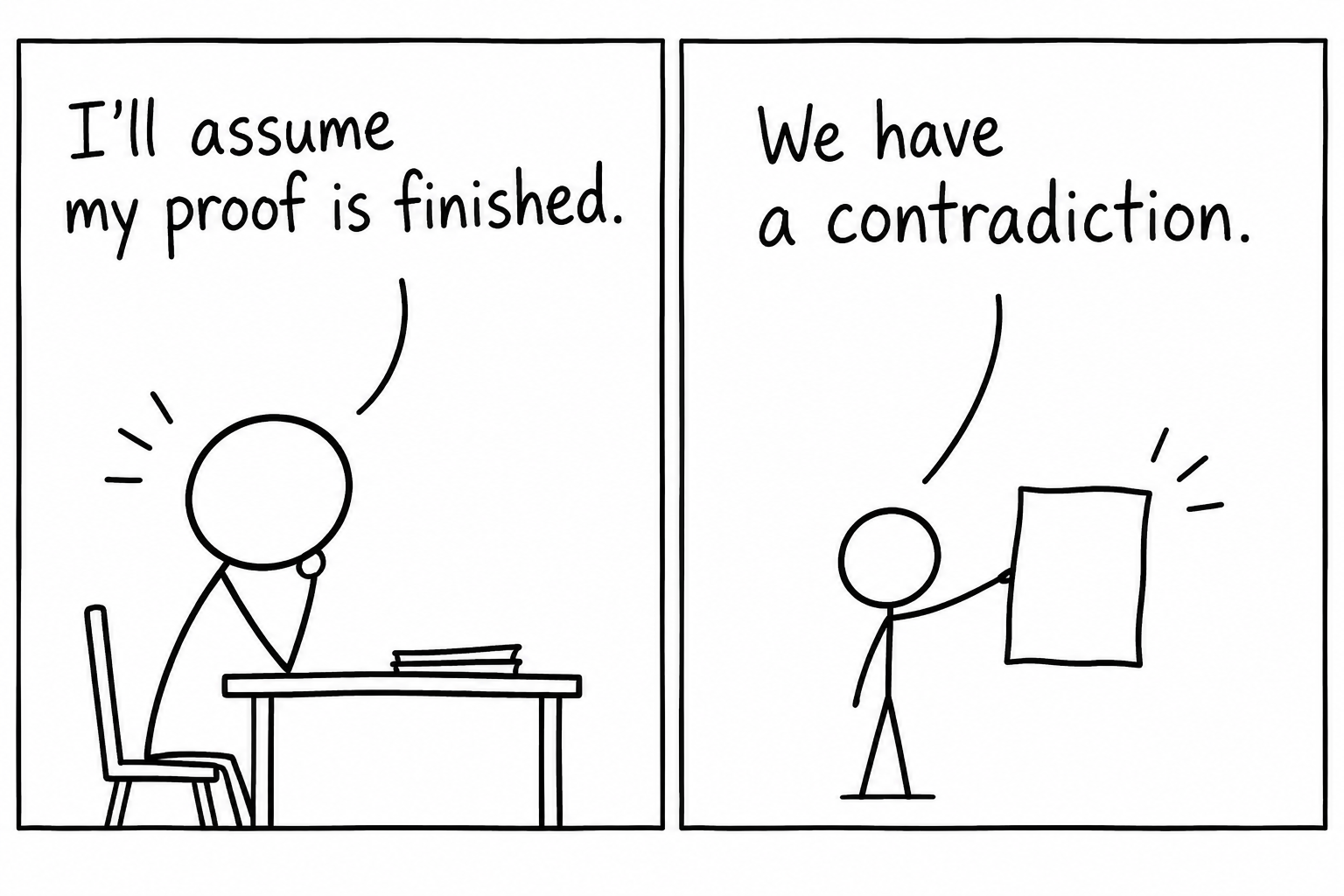 A student discovers that assuming a proof is finished produces an awkward contradiction
How contradiction earns marks
Imagine a student, Maya, opening a proof question in a timed paper. Her first instinct is to search for a formula. There is not one. Instead, she writes four prompts in the margin:
Opposite. Translate. Contradict. Conclude.
That small routine gives the proof a direction. It also reflects the way method marks are commonly distributed: credit for a valid assumption, credit for developing it correctly and credit for a logically complete conclusion.
After learning the routine, you can use the Maths Genie A-Level Lessons and Question Bank to move from guided proofs to independent exam-style questions.
Exam-style question: proving 3\sqrt{3}3 is irrational
Question: Use proof by contradiction to prove that 3\sqrt{3}3 is irrational. 555 marks
Maya begins with the opposite statement.
Step-by-step solution
Assume, for a contradiction, that 3\sqrt{3}3 is rational. Then it can be written as
3=ab,\sqrt{3}=\frac{a}{b},3=ba,where a,b∈Za,b\in\mathbb{Z}a,b∈Z, b≠0b\ne 0b=0, and aaa and bbb have no common factor. [M1]
Squaring gives
3=a2b2,3=\frac{a^2}{b^2},3=b2a2,so
a2=3b2.a^2=3b^2.a2=3b2.Therefore a2a^2a2 is divisible by 333, which means aaa is divisible by 333. [A1]
Write a=3ka=3ka=3k for some integer kkk. Substituting gives
(3k)2=3b2,(3k)^2=3b^2,(3k)2=3b2,and hence
9k2=3b2.9k^2=3b^2.9k2=3b2.Therefore
b2=3k2,b^2=3k^2,b2=3k2,so bbb is also divisible by 333. [M1]
Both aaa and bbb are divisible by 333. This contradicts the assumption that aaa and bbb have no common factor. [A1]
Therefore the original assumption is false, so 3\sqrt{3}3 is irrational. [A1]
The important detail is not merely writing 3=ab\sqrt{3}=\frac{a}{b}3=ba. The fraction must be assumed to be in lowest terms. Otherwise, finding a common factor creates no contradiction.
Exam-style question: infinitely many primes
Question: Prove by contradiction that there are infinitely many prime numbers. 555 marks
This time Maya knows the famous construction, but she still needs to explain why it works.
Step-by-step solution
Assume, for a contradiction, that there are finitely many primes. List all of them as
p1,p2,…,pn.p_1,p_2,\ldots,p_n.p1,p2,…,pn.[M1]
Now define
N=p1p2⋯pn+1.N=p_1p_2\cdots p_n+1.N=p1p2⋯pn+1.[M1]
For each listed prime pip_ipi, division of NNN by pip_ipi leaves remainder 111. Therefore none of p1,p2,…,pnp_1,p_2,\ldots,p_np1,p2,…,pn divides NNN. [A1]
However, every integer greater than 111 is either prime or has a prime factor. Consequently, NNN is prime or has a prime factor not contained in the supposedly complete list. [A1]
This contradicts the assumption that p1,p2,…,pnp_1,p_2,\ldots,p_np1,p2,…,pn are all the primes. Therefore there are infinitely many prime numbers. [A1]
A subtle mistake is to claim that NNN must itself be prime. That is unnecessary and is not always true. The contradiction only requires NNN to have a prime factor absent from the list.
This is the point where Maya stops copying a proof and starts seeing its architecture: the new number is designed to avoid every prime in the assumed finite list.
Exam-style question: rational plus irrational
Question: Given that rrr is rational and xxx is irrational, prove by contradiction that r+xr+xr+x is irrational. 444 marks
This is shorter, but unfamiliar-looking questions often test whether a student can adapt the method rather than recall a standard proof.
Step-by-step solution
Assume, for a contradiction, that r+xr+xr+x is rational. [M1]
Then there is a rational number qqq such that
r+x=q.r+x=q.r+x=q.Rearranging gives
x=q−r.x=q-r.x=q−r.[M1]
Since qqq and rrr are rational, their difference q−rq-rq−r is rational. Therefore xxx is rational. [A1]
This contradicts the given information that xxx is irrational. Hence r+xr+xr+x is irrational. [A1]
The proof is brief because the contradiction is structural. Once r+xr+xr+x is assumed rational, subtracting the known rational number rrr forces xxx to be rational.
What a proof by contradiction mark scheme rewards
A useful proof by contradiction markscheme is not simply checking whether the final sentence is correct. It follows the logical chain.
| Stage | What the examiner needs to see |
|---|---|
| Assumption | The precise negation of the required result |
| Definitions | Terms such as rational, even or divisible translated correctly |
| Development | Valid algebra or number reasoning based on the assumption |
| Contradiction | Two statements that cannot both be true |
| Conclusion | Rejection of the assumption and statement of the result |
Method marks may still be available after a minor algebraic slip if the intended process is clear. However, proof is especially sensitive to unsupported claims. Write the reason for each decisive implication.
When reviewing a proof by contradiction past paper, compare your reasoning with the official mark scheme for that exam series. Do not only count matching final statements. Look for the exact line on which the contradiction becomes unavoidable.
Common mistakes in contradiction proofs
Assuming the result instead of its opposite
To prove that 3\sqrt{3}3 is irrational, begin by assuming it is rational. Contradiction tests what happens if the required conclusion is false.
Forgetting the lowest-terms condition
In irrationality proofs, write that aaa and bbb are coprime. Discovering that both share a factor then contradicts something explicitly assumed.
Naming something surprising as a contradiction
A large number, an awkward fraction or an unexpected expression is not a contradiction. You need incompatible facts, such as a number being both rational and irrational.
Making an implication without justification
If 3∣a23\mid a^23∣a2, then 3∣a3\mid a3∣a. At A-Level, the statement may be accepted as a known property of primes, but it must still appear in the argument rather than being silently skipped.
Ending too early
After finding the contradiction, complete the logic: the assumption is false, so the original claim is true.
Exam-style practice
Try these without looking back at the worked solutions:
- Prove by contradiction that 5\sqrt{5}5 is irrational.
- Given rational aaa and irrational bbb, prove that a−ba-ba−b is irrational.
- Prove that there is no greatest even integer.
- Prove that if n2n^2n2 is even, then nnn is even.
For each proof, label your own lines assumption, development, contradiction and conclusion. Then remove the labels and read the argument as an examiner would. If one sentence does not follow from the previous one, that is where the proof needs repair.
Turn the method into exam practice
Maya's improvement is modest but important: she no longer waits for inspiration. She has a repeatable structure, yet that structure only becomes dependable through varied questions under exam conditions. Your turn: use the Maths Genie A-Level Lessons and Question Bank to practise proof by contradiction with the lesson beside you, then repeat the questions without support.