Proof by Contradiction A-Level Maths Guide
Proof by contradiction A-Level Maths: learn the method through clear worked examples, common mistakes and focused exam-style practice for stronger proofs.
Proof can feel unlike the rest of A Level Maths. There is no familiar calculation to begin, and sometimes the first instruction seems backwards: assume that the statement is false.
That is the central idea behind proof by contradiction A-Level Maths questions. Assume the opposite of what you want to prove. If careful reasoning leads to something impossible, that assumption must be false, so the original statement must be true.
The method becomes less mysterious when you treat it as a logical structure rather than a trick. Every line has a purpose: testing an assumption until it cannot stand.
The proof by contradiction checklist
A complete proof follows four stages:
- State that you are using proof by contradiction.
- Assume the exact logical opposite of the required result.
- Use definitions, algebra or established facts to develop that assumption.
- Identify the contradiction and conclude that the original statement is true.
The MathsGenie proof by contradiction lesson connects this structure with guided questions and worked solutions.
What counts as a contradiction?
A contradiction is not merely an unexpected answer. It is something incompatible with a definition, a given condition or an established fact.
Examples include an integer being both odd and even, a lowest-terms fraction having a common factor, or a supposedly largest value being exceeded by another valid value.
Choosing the correct opposite statement matters. The negation of “there is no largest prime” is “there is a largest prime”, not “there are few primes”. Precision at the opening controls everything that follows.
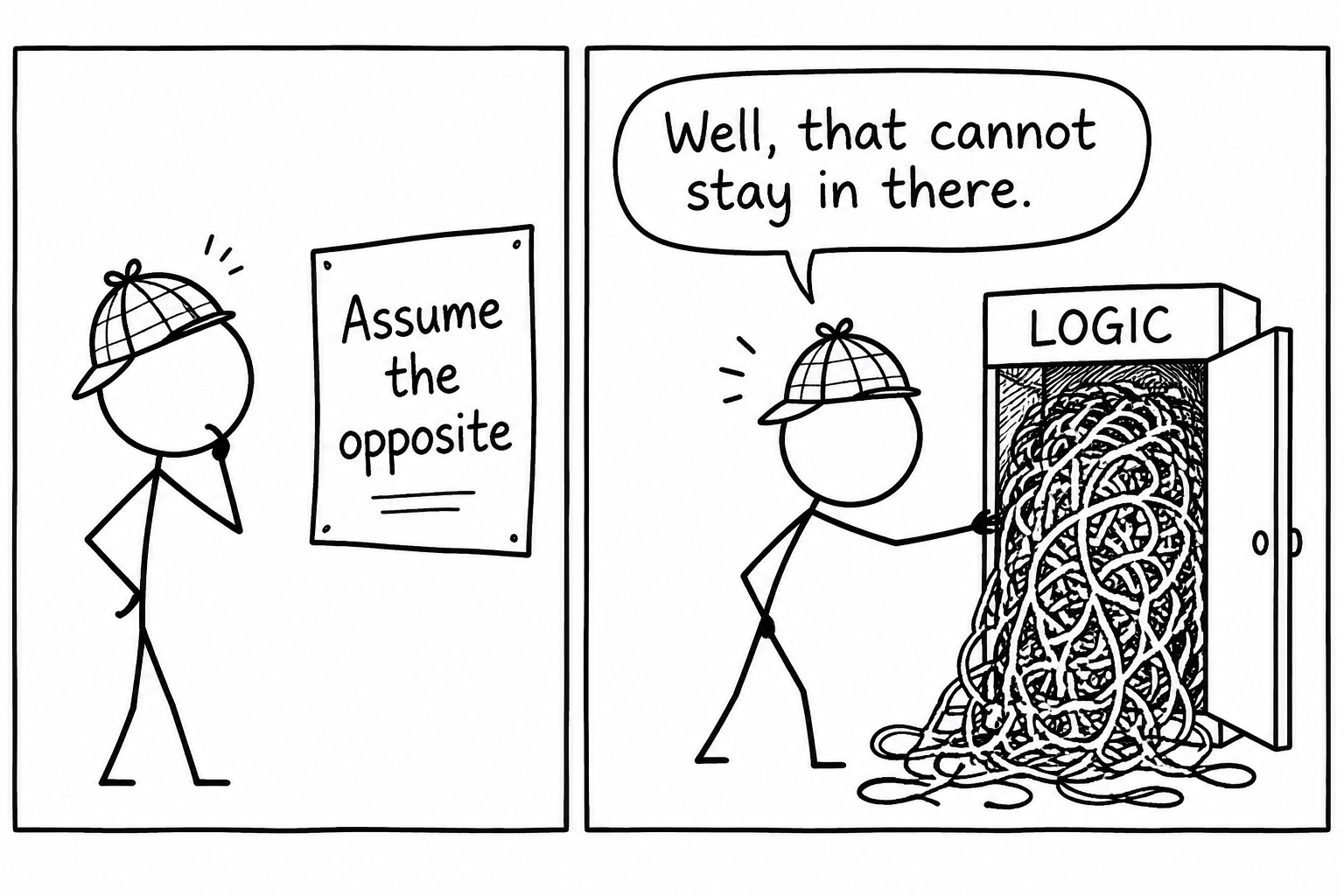 A stick-figure detective discovers that an assumption creates a logically impossible tangle
Proof by contradiction worked examples
Proving that 2\sqrt{2}2 is irrational
Assume, for a contradiction, that 2\sqrt{2}2 is rational. Then integers aaa and bbb, with b≠0b\ne 0b=0, exist such that
2=ab,\sqrt{2}=\frac{a}{b},2=ba,where the fraction is in its lowest terms. Squaring and rearranging gives
a2=2b2.a^2=2b^2.a2=2b2.Therefore, a2a^2a2 is even. An odd integer has an odd square, so aaa must be even. Write a=2ka=2ka=2k for some integer kkk. Substituting gives
4k2=2b2,4k^2=2b^2,4k2=2b2,so
b2=2k2.b^2=2k^2.b2=2k2.Thus b2b^2b2 is even, meaning bbb is also even. Both aaa and bbb are divisible by 222, contradicting the condition that the fraction was in its lowest terms.
The assumption that 2\sqrt{2}2 is rational must therefore be false. Hence 2\sqrt{2}2 is irrational.
Notice the essential detail: two even integers are not themselves impossible. The contradiction arises because they were chosen to have no common factor greater than 111.
Proving that there are infinitely many primes
Assume, for a contradiction, that there are finitely many prime numbers. List all of them as
p1,p2,…,pn.p_1,p_2,\ldots,p_n.p1,p2,…,pn.Construct the integer
N=p1p2⋯pn+1.N=p_1p_2\cdots p_n+1.N=p1p2⋯pn+1.Dividing NNN by any listed prime leaves a remainder of 111. None of the listed primes therefore divides NNN.
However, every integer greater than 111 has a prime factor. Consequently, NNN has a prime factor missing from the supposedly complete list. This contradicts the assumption that the list contains every prime.
Therefore, there are infinitely many prime numbers.
You do not need to claim that NNN itself is prime. Only its possession of a prime factor outside the list matters.
Use the proof by contradiction question bank to practise identifying both the assumption and the contradiction.
How to approach exam questions
Translate the claim first
Before doing algebra, write the exact opposite of the claim.
| Claim | Assumption for contradiction |
|---|---|
| xxx is irrational | xxx is rational |
| There are infinitely many objects | There are finitely many objects |
| No integer satisfies a condition | Some integer satisfies the condition |
| There is no largest value | There is a largest value |
Look for useful definitions
Words such as integer, odd, even, prime, rational and coprime suggest properties that can drive your reasoning.
For instance, if integers xxx and yyy supposedly satisfy
6x+9y=1,6x+9y=1,6x+9y=1,the left-hand side is divisible by 333, but the right-hand side is not. That is the contradiction. Explore similar reasoning through the OCR contradiction questions.
Finish in words
Explain what has become impossible, reject the assumption and return to the original claim. The structure and methods of proof guide connects this conclusion with the wider language of proof.
Check every implication
Read your proof backwards after writing it. At each line, ask which earlier statement justifies the conclusion. If you cannot answer, add the missing reason rather than hoping the algebra speaks for itself. In particular, distinguish an assumption made for contradiction from a fact you already know. The assumption is temporary; the definitions and established results supporting your deductions must remain valid throughout.
A useful revision exercise is to cover the final paragraph of a worked solution and explain the contradiction aloud. Name both conflicting statements precisely. Then uncover the ending and compare the logic, not just the wording. This helps you recognise a proof in an unfamiliar setting instead of relying on memorised sentences. When checking your own attempt, also make sure every introduced letter has a stated meaning and that any divisibility claim applies to integers, not arbitrary real numbers.
Focused exam-style practice
Try these prompts before revisiting the worked examples:
- Prove that there is no largest odd integer. Assume a largest odd integer nnn exists, then consider n+2n+2n+2.
- Prove that 3\sqrt{3}3 is irrational. Begin with a fraction in lowest terms and investigate divisibility by 333.
- Prove that no integers xxx and yyy satisfy 4x+8y=144x+8y=144x+8y=14. Consider divisibility by 444.
Check explanations through the Edexcel proof video walkthroughs, AQA contradiction videos or OCR MEI proof lessons.
Common mistakes in contradiction proofs
Assuming the result itself. You must assume its opposite. Otherwise, your argument risks circular reasoning.
Using an incomplete negation. The opposite of “all integers have property PPP” is “at least one integer does not have property PPP”, not “no integers have property PPP”.
Forgetting a condition. In an irrationality proof, state that the fraction is in lowest terms. Otherwise, discovering a common factor creates no contradiction.
Overclaiming about primes. The constructed number need not be prime; it must have a prime factor absent from the list.
Stopping too early. A final calculation needs an explanation of why the original claim follows.
Make the structure dependable
Revise proof as a sequence of decisions: negate the claim, use definitions, locate the impossibility and conclude. Start with MathsGenie's free revision lesson, attempt practice questions independently, then compare your reasoning with the video solutions. The aim is not to memorise every proof, but to recognise why each one works.