

Probability GCSE Maths Resit: Secure Grade 4
Probability GCSE maths resit revision made clear. Learn core Grade 4 methods, avoid common errors and practise with two exam-style examples.
A probability question can look almost too short. A bag, a spinner, perhaps a table of results. Yet these questions often expose a familiar problem: you know the idea, but one missing denominator or unlisted outcome costs the mark.
For a probability GCSE maths resit, the priority is not learning every advanced technique. It is becoming reliable with the core Foundation methods that can contribute towards a grade 4: probabilities on a scale, equally likely outcomes, complementary events, expected frequency, relative frequency and organised sample spaces.
This is manageable. Probability becomes much calmer when you stop guessing and start accounting for every possible outcome.
Your probability grade 4 checklist
Use this as a focused revision list:
- place probabilities between 000 and 111;
- calculate probability as a fraction of all equally likely outcomes;
- use the fact that probabilities for all possible outcomes total 111;
- find the probability of an event not happening;
- estimate how often an event will happen;
- calculate and interpret relative frequency;
- list combined outcomes systematically in a sample space;
- show enough working to make your method visible.
These skills appear across GCSE specifications, although wording and question style vary between Edexcel, AQA, OCR and Eduqas. Use GCSE topics organised by exam board and tier to check what applies to your course.
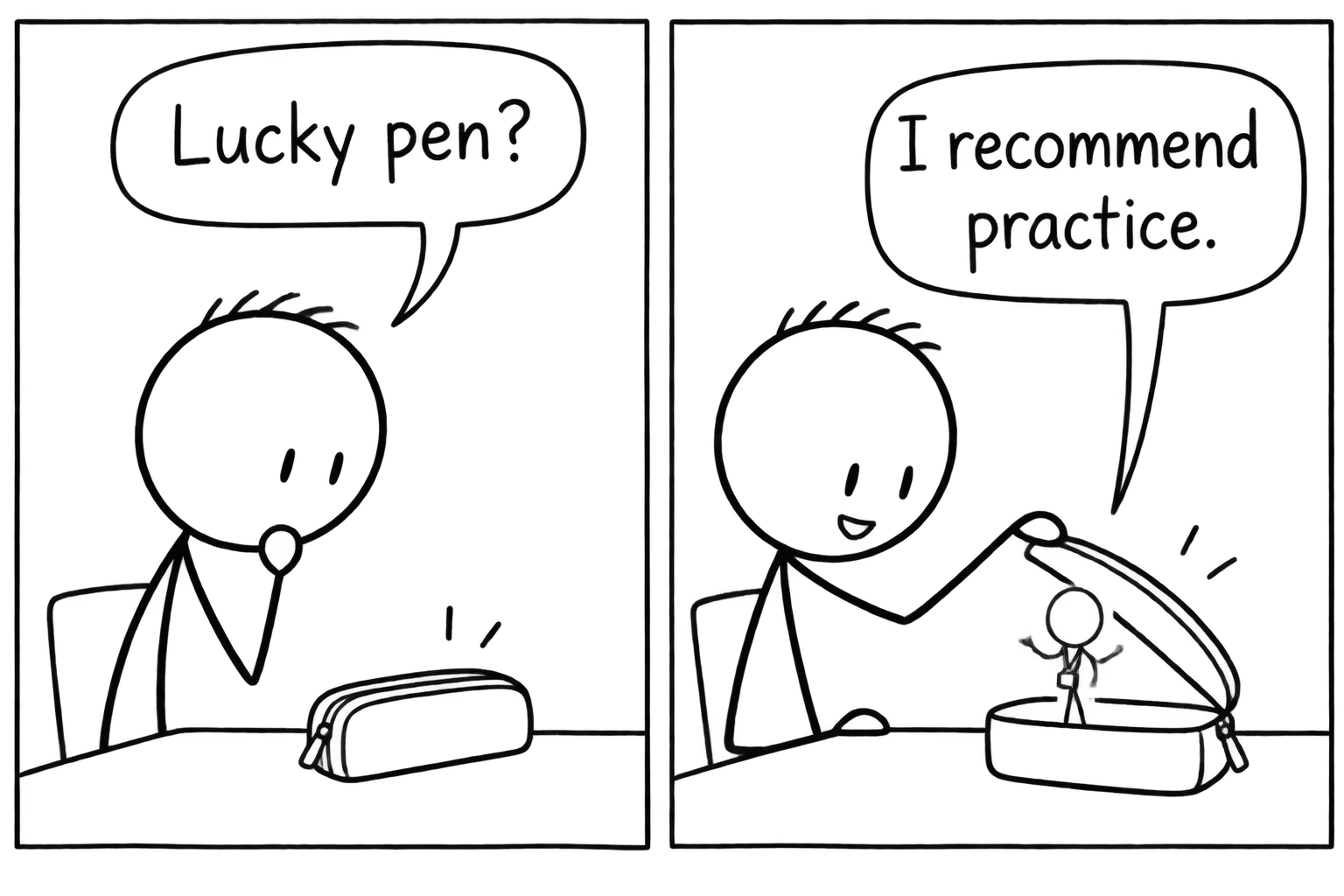 A post-16 student discovers that practice is more dependable than a lucky exam pen
The foundations of probability
Probability measures how likely an event is. Every probability lies from 000 to 111 inclusive:
- 000 means impossible;
- 111 means certain;
- values nearer 111 represent more likely events.
A probability can be written as a fraction, decimal or percentage. For example,
14=0.25=25%.\frac{1}{4}=0.25=25\%.41=0.25=25%.When outcomes are equally likely, use:
P(event)=number of favourable outcomestotal number of possible outcomes.P(\text{event})=\frac{\text{number of favourable outcomes}}{\text{total number of possible outcomes}}.P(event)=total number of possible outcomesnumber of favourable outcomes.The word equally matters. If a spinner has unequal sections, you cannot simply count colours unless the question tells you that each section has the same chance.
Complements: the quickest route through some questions
All probabilities in a complete set of outcomes add to 111. Therefore,
P(not A)=1−P(A).P(\text{not }A)=1-P(A).P(not A)=1−P(A).If the probability that a bus is late is 0.180.180.18, the probability that it is not late is
1−0.18=0.82.1-0.18=0.82.1−0.18=0.82.This is called the complement of an event. It is particularly useful when a question asks for “not”, “does not”, “at least one” or “none”. Read carefully, because the complement must cover everything outside the stated event.
Worked example: probability from coloured counters
A bag contains 555 red counters, 333 blue counters and 222 yellow counters. One counter is selected at random.
Find the probability that the counter is not blue.
First find the total number of counters:
5+3+2=10.5+3+2=10.5+3+2=10.There are two sound methods.
Method 1: count the favourable outcomes
There are 5+2=75+2=75+2=7 counters that are not blue, so
P(not blue)=710.P(\text{not blue})=\frac{7}{10}.P(not blue)=107.Method 2: use the complement
P(blue)=310,P(\text{blue})=\frac{3}{10},P(blue)=103,so
P(not blue)=1−310=710.P(\text{not blue})=1-\frac{3}{10}=\frac{7}{10}.P(not blue)=1−103=107.Both methods are valid. In an exam, choose the one that you can execute accurately. Writing the total of 101010 before forming the fraction also makes the denominator easier to check.
Expected frequency and relative frequency
These ideas sound similar but answer different questions.
Expected frequency
Expected frequency estimates how many times an event should occur:
expected frequency=probability×number of trials.\text{expected frequency}=\text{probability}\times\text{number of trials}.expected frequency=probability×number of trials.If the probability of winning a game is 0.30.30.3 and it is played 808080 times, the expected number of wins is
0.3×80=24.0.3\times80=24.0.3×80=24.This is an estimate, not a promise. Random results vary.
Relative frequency
Relative frequency uses experimental results:
relative frequency=number of times the event occurstotal number of trials.\text{relative frequency}=\frac{\text{number of times the event occurs}}{\text{total number of trials}}.relative frequency=total number of trialsnumber of times the event occurs.If a drawing pin lands point-up 424242 times in 606060 trials, its relative frequency is
4260=0.7.\frac{42}{60}=0.7.6042=0.7.A question may then ask you to use this experimental probability to estimate future results. Follow the same expected-frequency structure: multiply the relative frequency by the new number of trials.
Worked example: sample space and combined events
A fair coin is tossed and a fair spinner numbered 111, 222 and 333 is spun. Find the probability of getting tails and an even number.
List every combined outcome:
(H,1), (H,2), (H,3), (T,1), (T,2), (T,3).(H,1),\ (H,2),\ (H,3),\ (T,1),\ (T,2),\ (T,3).(H,1), (H,2), (H,3), (T,1), (T,2), (T,3).There are 666 equally likely outcomes. Only (T,2)(T,2)(T,2) gives tails and an even number. Therefore,
P(tails and even)=16.P(\text{tails and even})=\frac{1}{6}.P(tails and even)=61.The important habit is organisation. Writing a sample space prevents outcomes from disappearing in your head. For two numerical events, a grid can do the same job. For data presented in categories, practise reading two-way tables with questions and answers.
Mistakes that cost probability marks
Using the wrong denominator
The denominator is the total number of possible equally likely outcomes, not merely the outcomes you want. In the counter example, “not blue” has 777 favourable outcomes, but the denominator remains 101010.
Forgetting an outcome
Combined-event questions become unreliable when you list outcomes randomly. Use a grid or hold the first result fixed while cycling through every second result.
Treating experimental probability as certainty
A relative frequency of 0.70.70.7 does not mean the event must happen exactly 777 times in the next 101010 trials. It gives an estimate based on available evidence.
Confusing expected frequency with probability
Probability lies between 000 and 111. Expected frequency is a number of occurrences and can be greater than 111. If a question expects a count and your answer is 0.40.40.4, check whether you forgot to multiply by the number of trials.
Ignoring words such as “not” and “and”
Tiny words change the event. Underline the event before calculating. “Red” and “not red” are complements; “heads and 222” describes one combined outcome.
Showing no method
Even when a calculator produces the answer, write the fraction or multiplication that led to it. Clear working gives the examiner something to credit and gives you something to check.
A focused GCSE maths resit revision routine
Post-16 resit revision has to compete with a full timetable, work or another course. That makes focus more valuable than long, unfocused sessions.
Start with one probability lesson and a short set of practice questions. Mark them immediately. Classify each error: misunderstanding, arithmetic, reading or missing working. Then repeat the weak question type after a gap.
Next, use past papers and mark schemes to meet probability inside real exam language. Video solutions can help when a mark scheme is too compressed to reveal the reasoning. Mini tests are useful for checking whether the method still works without prompts, while predicted papers can provide broader exam practice closer to the assessment.
Do not judge progress only by how familiar a page looks. Recognition feels comfortable, but retrieval is the test. Close the notes, answer the question, mark it honestly and return to the exact step that failed.
Turn probability into dependable marks
A resit can make familiar topics feel heavier than they are. Probability is a good place to reset that feeling because its central rules are few and visible: count all outcomes, identify the event, form the correct fraction and use 111 when the complement is easier.
MathsGenie brings free revision lessons, practice questions, past papers, predicted papers, mark schemes, video solutions, mini tests and planning tools into one place. When you are ready to move beyond isolated questions, use the Mock Exam Builder to build a targeted practice paper around probability and your other weak areas. Complete it under timed conditions, mark it, then let the errors choose your next revision session. That is how a topic stops depending on luck and starts becoming part of a grade 4 plan.















