Pressure Force Area GCSE Maths: Examples and Questions
Pressure force area GCSE maths explained with clear worked examples, unit conversions and exam-style questions to help you choose the right calculation.
A formula can look familiar and still produce the wrong answer. Imagine Sam, a GCSE student who remembers that pressure involves force and area, but keeps dividing the wrong way round. For pressure force area GCSE maths, the starting point is simple: pressure equals force divided by contact area. Write that relationship first, match the units, then rearrange it for the quantity you need.
Sam’s breakthrough will come from understanding what the division means. Once that clicks, the formula becomes something to reason with, rather than something to guess.
Pressure, force and area: the essentials
Before calculating, identify these three quantities:
- Pressure: how much force acts per unit area.
- Force: the push acting perpendicular to the surface, usually measured in newtons.
- Contact area: the area over which that force acts.
The relationship is:
Pressure=ForceArea\text{Pressure} = \frac{\text{Force}}{\text{Area}}Pressure=AreaForceUsing letters:
P=FAP = \frac{F}{A}P=AFFor a fixed force, spreading it over a larger area reduces the pressure. Concentrating it onto a smaller area increases the pressure. That explains why snowshoes help someone avoid sinking into snow: they spread the force over a larger contact area.
The topic belongs to compound measures. MathsGenie groups these relationships within its Speed and Density revision resources, which also cover pressure.
Why the formula starts to make sense
Suppose a question describes a force of 120 N120\text{ N}120 N spread evenly across 6 cm26\text{ cm}^26 cm2. Pressure asks how much force acts on each square centimetre. Sharing 120120120 between 666 gives 202020, so the pressure is 20 N/cm220\text{ N/cm}^220 N/cm2.
Sam had been treating the numbers as instructions to press calculator buttons. Now there is a question behind the calculation: “How much force per unit area?”
That word per matters. Just as speed measures distance per unit time, pressure measures force per unit area.
Rearranging for force or area
Start from the same equation each time:
P=FAP = \frac{F}{A}P=AFMultiply both sides by AAA to find force:
F=PAF = PAF=PAThen divide by PPP to find area:
A=FPA = \frac{F}{P}A=PFA reliable routine is to identify the unknown, write the correct formula, substitute the values and finish with units. Before accepting the answer, check whether its size makes sense.
Use MathsGenie’s compound measures lessons to practise that same routine when choosing between multiplication and division still feels uncertain.
Pressure force area worked examples
Finding pressure from a rectangular base
A block exerts a force of 240 N240\text{ N}240 N on a table. Its rectangular base measures 8 cm8\text{ cm}8 cm by 5 cm5\text{ cm}5 cm. Calculate the pressure in N/cm2\text{N/cm}^2N/cm2.
First, calculate the contact area. The denominator must be an area, so neither side length is enough on its own.
A=8×5=40 cm2A = 8 \times 5 = 40\text{ cm}^2A=8×5=40 cm2Next, write the pressure formula and substitute.
P=FA=24040P = \frac{F}{A} = \frac{240}{40}P=AF=40240 P=6 N/cm2\boxed{P = 6\text{ N/cm}^2}P=6 N/cm2Sam checks the meaning: every square centimetre supports 6 N6\text{ N}6 N. Across 40 cm240\text{ cm}^240 cm2, that accounts for the full 240 N240\text{ N}240 N.
Finding force from pressure
A machine applies a pressure of 35 N/cm235\text{ N/cm}^235 N/cm2 over an area of 12 cm212\text{ cm}^212 cm2. Calculate the force.
Write the rearranged formula.
F=PAF = PAF=PASubstitute and multiply.
F=35×12F = 35 \times 12F=35×12 F=420 N\boxed{F = 420\text{ N}}F=420 NThis time, division would make the force smaller than the force acting on just one square centimetre. Multiplication fits the situation: there are 121212 square centimetres, each experiencing 35 N35\text{ N}35 N.
Finding contact area
A support carries a force of 900 N900\text{ N}900 N. The pressure on the ground is 30 N/cm230\text{ N/cm}^230 N/cm2. Find the contact area.
Choose the formula for area.
A=FPA = \frac{F}{P}A=PFSubstitute and calculate.
A=90030A = \frac{900}{30}A=30900 A=30 cm2\boxed{A = 30\text{ cm}^2}A=30 cm2Sam can now explain the operation: the question asks how many square centimetres are needed if each carries 30 N30\text{ N}30 N.
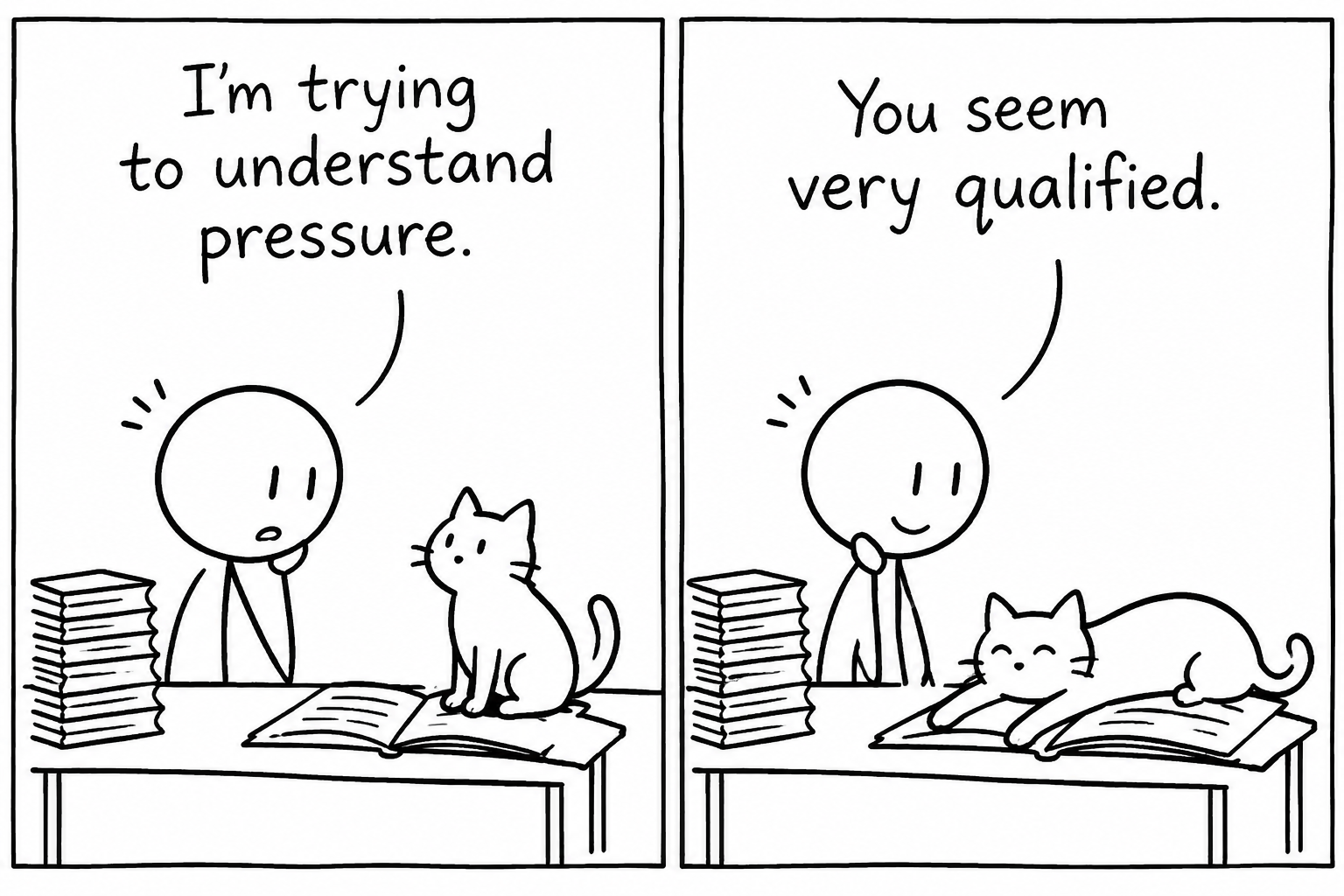 A stick-figure student revising pressure while a cat occupies the workbook
Units: where correct methods can lose marks
The units of pressure depend on the units used for force and area:
Ncm2=N/cm2\frac{\text{N}}{\text{cm}^2} = \text{N/cm}^2cm2N=N/cm2 Nm2=N/m2\frac{\text{N}}{\text{m}^2} = \text{N/m}^2m2N=N/m2One pascal is one newton per square metre:
1 Pa=1 N/m21\text{ Pa} = 1\text{ N/m}^21 Pa=1 N/m2Read the requested units before calculating. If force is given in newtons and the answer is required in pascals, use an area in square metres.
The common trap is converting square units as though they were lengths:
1 m=100 cm1\text{ m} = 100\text{ cm}1 m=100 cmbut
1 m2=100×100=10 000 cm21\text{ m}^2 = 100 \times 100 = 10\,000\text{ cm}^21 m2=100×100=10000 cm2Therefore, divide an area in square centimetres by 10 00010\,00010000 to express it in square metres. If this step causes difficulty, revisit conversions and units before attempting mixed-unit pressure questions.
Common mistakes and how to catch them
Dividing area by force. Write P=FAP = \frac{F}{A}P=AF before entering numbers. The phrase “force per unit area” helps preserve the correct order.
Using a length instead of an area. For a rectangular contact surface, multiply its length by its width first.
Using the wrong face of a block. Identify which face touches the surface. For the same force, the smallest contact area produces the greatest pressure.
Automatically dividing in every question. Finding force requires multiplication: F=PAF = PAF=PA. Name the unknown before choosing an operation.
Ignoring multiple supports. If a load is shared equally between identical feet, either divide the total force by the total contact area or use one foot’s share of the force with that foot’s area. Keep the pairing consistent.
Giving an answer without units. Force, area and pressure describe different quantities. Your units should show which quantity you found.
Pressure force area questions: exam-style practice
Try these without looking back at the examples. Write a formula and show your substitution for each calculation.
- Question A: A force of 360 N360\text{ N}360 N acts over 45 cm245\text{ cm}^245 cm2. Calculate the pressure.
- Question B: A pressure of 18 N/cm218\text{ N/cm}^218 N/cm2 acts over 25 cm225\text{ cm}^225 cm2. Calculate the force.
- Question C: A force of 840 N840\text{ N}840 N produces a pressure of 28 N/cm228\text{ N/cm}^228 N/cm2. Calculate the contact area.
- Question D: A force of 500 N500\text{ N}500 N acts over 250 cm2250\text{ cm}^2250 cm2. Calculate the pressure in pascals.
- Question E: A brick rests on its smallest face. Explain what happens to its pressure when it is placed on its largest face.
Check your answers
A: 8 N/cm28\text{ N/cm}^28 N/cm2.
B: 450 N450\text{ N}450 N.
C: 30 cm230\text{ cm}^230 cm2.
D: First convert the area to 0.025 m20.025\text{ m}^20.025 m2. The pressure is 20 000 Pa20\,000\text{ Pa}20000 Pa.
E: The pressure decreases because the same force acts over a larger contact area.
If an answer differs, locate the first incorrect step: identifying the contact area, rearranging, converting units or calculating. The compound measures revision guide offers another explanation of the underlying relationships.
Turn understanding into reliable answers
In our hypothetical example, Sam’s change is modest but useful: each answer now starts with a quantity, a formula and compatible units. Your goal is to make that routine reliable when the question changes its wording. Your turn: start with MathsGenie’s Lessons, then practise choosing the correct calculation in the topic’s Question Bank.