Polar Coordinates Exam Questions A-Level Further Maths
Explore polar coordinates exam questions A-Level Further Maths through three worked solutions, method marks, common errors and focused practice for exams.
Polar coordinates often feel manageable in a lesson and strangely unfamiliar in an exam. The formulae are short, but each question asks you to make several decisions: find the correct interval, interpret the curve, choose a derivative or integral, and preserve exact values.
The best way to improve at polar coordinates exam questions A-Level Further Maths is to practise that decision-making. In this guide, we follow a hypothetical student, Maya, through three exam-style questions covering Cartesian conversion, tangents and enclosed areas. Each solution includes indicative method marks, so you can see where a correct process earns credit even when the final answer goes wrong.
Before starting, use the Edexcel Further Maths revision hub to locate the matching polar coordinates lesson and refresh any part of the topic that feels uncertain.
Your polar coordinates checklist
For most exam questions, you need five connected skills:
- convert using x=rcosθx=r\cos\thetax=rcosθ, y=rsinθy=r\sin\thetay=rsinθ and r2=x2+y2r^2=x^2+y^2r2=x2+y2;
- sketch a curve by checking symmetry, intercepts and the sign of rrr;
- find intersections by equating two expressions for rrr;
- differentiate parametrically to find dydx\frac{\mathrm{d}y}{\mathrm{d}x}dxdy;
- calculate area using
Pearson's current Edexcel specification includes conversion between polar and Cartesian coordinates, sketching polar curves and finding enclosed areas. It also expects students to find tangents parallel or perpendicular to the initial line. Other exam boards organise their content differently, so always check your own specification.
The marks shown below are indicative rather than copied from an official mark scheme. An M1M1M1 represents a likely method mark and an A1A1A1 represents accuracy following a valid method.
Question one: converting to Cartesian form
Maya begins with a question that looks routine.
The curve CCC has polar equation
r=4cosθ.r=4\cos\theta.r=4cosθ.Find its Cartesian equation and describe the curve.
She remembers that multiplying by rrr creates expressions that can be converted directly:
r2=4rcosθ.r^2=4r\cos\theta.r2=4rcosθ.Using r2=x2+y2r^2=x^2+y^2r2=x2+y2 and rcosθ=xr\cos\theta=xrcosθ=x gives
x2+y2=4x.x^2+y^2=4x.x2+y2=4x.Completing the square:
x2−4x+y2=0,x^2-4x+y^2=0,x2−4x+y2=0, (x−2)2+y2=4.(x-2)^2+y^2=4.(x−2)2+y2=4.This is a circle with centre (2,0)(2,0)(2,0) and radius 222.
Indicative method marks
- M1M1M1: multiply the polar equation by rrr.
- A1A1A1: obtain x2+y2=4xx^2+y^2=4xx2+y2=4x.
- M1M1M1: complete the square correctly.
- A1A1A1: identify the centre and radius.
The important move was not algebraic complexity. It was recognising which identity would remove θ\thetaθ. If you need to strengthen that underlying algebra, the A-Level Maths lessons collection provides topic-by-topic revision before you return to Further Maths.
Question two: finding a tangent
The next question changes the demand. Maya now needs to treat xxx and yyy as functions of θ\thetaθ.
The curve CCC has equation
r=2(1+cosθ).r=2(1+\cos\theta).r=2(1+cosθ).Find the equation of the tangent when θ=π2\theta=\frac{\pi}{2}θ=2π.
First, she differentiates rrr:
drdθ=−2sinθ.\frac{\mathrm{d}r}{\mathrm{d}\theta}=-2\sin\theta.dθdr=−2sinθ.Since
x=rcosθandy=rsinθ,x=r\cos\theta \quad \text{and} \quad y=r\sin\theta,x=rcosθandy=rsinθ,differentiating with respect to θ\thetaθ gives
dxdθ=drdθcosθ−rsinθ,\frac{\mathrm{d}x}{\mathrm{d}\theta} =\frac{\mathrm{d}r}{\mathrm{d}\theta}\cos\theta-r\sin\theta,dθdx=dθdrcosθ−rsinθ,and
dydθ=drdθsinθ+rcosθ.\frac{\mathrm{d}y}{\mathrm{d}\theta} =\frac{\mathrm{d}r}{\mathrm{d}\theta}\sin\theta+r\cos\theta.dθdy=dθdrsinθ+rcosθ.Therefore,
dydx=drdθsinθ+rcosθdrdθcosθ−rsinθ.\frac{\mathrm{d}y}{\mathrm{d}x} = \frac{\frac{\mathrm{d}r}{\mathrm{d}\theta}\sin\theta+r\cos\theta} {\frac{\mathrm{d}r}{\mathrm{d}\theta}\cos\theta-r\sin\theta}.dxdy=dθdrcosθ−rsinθdθdrsinθ+rcosθ.At θ=π2\theta=\frac{\pi}{2}θ=2π,
r=2,drdθ=−2.r=2, \qquad \frac{\mathrm{d}r}{\mathrm{d}\theta}=-2.r=2,dθdr=−2.So the gradient is
dydx=(−2)(1)+2(0)(−2)(0)−2(1)=1.\frac{\mathrm{d}y}{\mathrm{d}x} = \frac{(-2)(1)+2(0)}{(-2)(0)-2(1)}=1.dxdy=(−2)(0)−2(1)(−2)(1)+2(0)=1.The point on the curve is
x=2cosπ2=0,x=2\cos\frac{\pi}{2}=0,x=2cos2π=0, y=2sinπ2=2.y=2\sin\frac{\pi}{2}=2.y=2sin2π=2.Using the point (0,2)(0,2)(0,2) and gradient 111, the tangent is
y−2=x,y-2=x,y−2=x,or
y=x+2.y=x+2.y=x+2.Indicative method marks
- M1M1M1: find drdθ\frac{\mathrm{d}r}{\mathrm{d}\theta}dθdr.
- M1M1M1: use the polar parametric derivative formula.
- A1A1A1: obtain the gradient 111.
- A1A1A1: use the correct point and find y=x+2y=x+2y=x+2.
If the differentiation feels less secure than the polar coordinates, revisit the A-Level differentiation lesson.
You now have the full method, so use the Maths Genie Lessons and Question Bank to place this process beside focused polar-coordinate practice rather than assembling questions by hand.
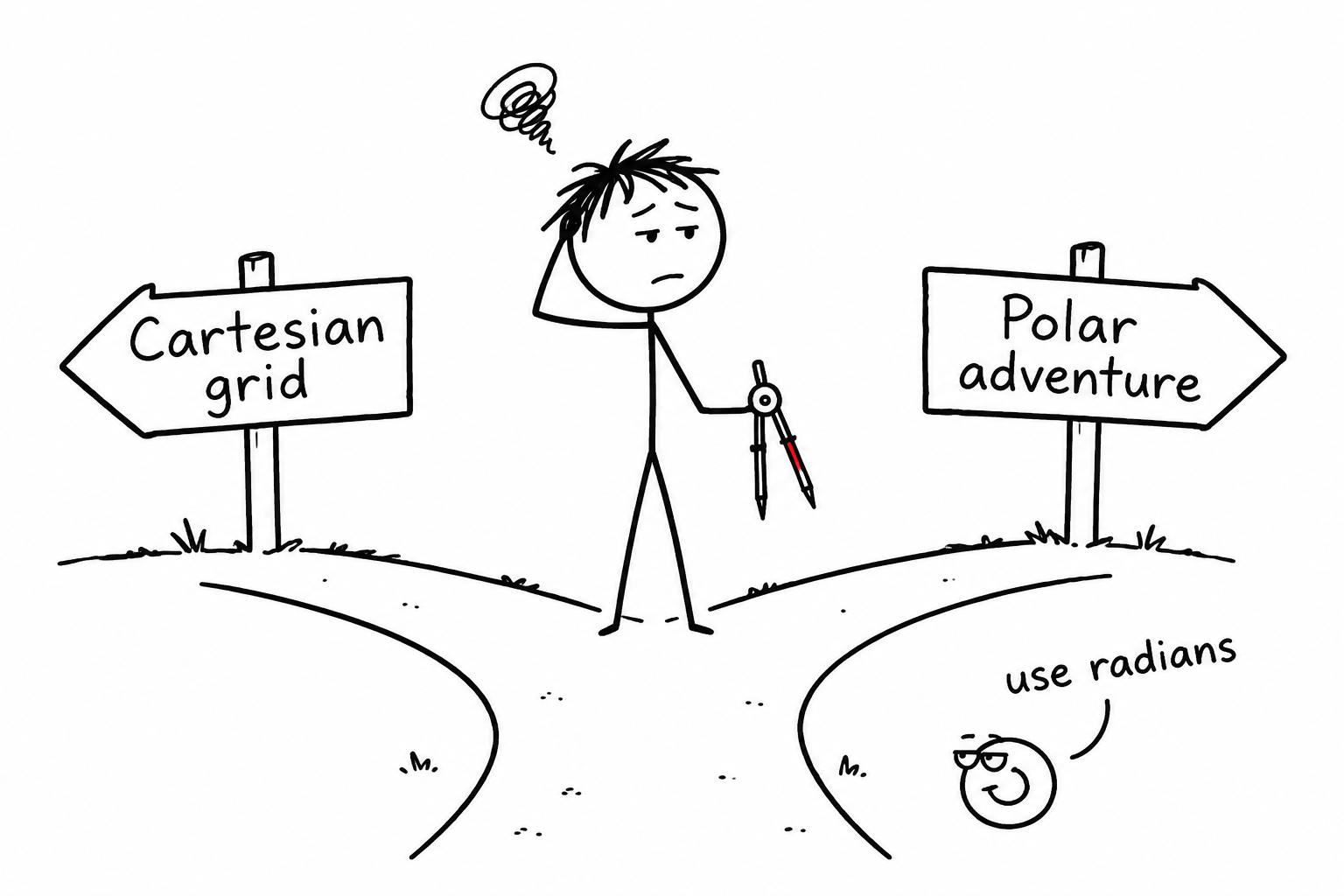 A stick-figure student choosing between a Cartesian grid and a polar adventure while a spiral reminds them to use radians
Question three: area between polar curves
Area questions are often lost before the integration begins. The difficult step is deciding what the limits and integrand represent.
The curves have equations
r=2cosθr=2\cos\thetar=2cosθand
r=1.r=1.r=1.Find the exact area inside r=2cosθr=2\cos\thetar=2cosθ but outside r=1r=1r=1.
Maya first finds the intersections:
2cosθ=1,2\cos\theta=1,2cosθ=1,so
cosθ=12.\cos\theta=\frac{1}{2}.cosθ=21.For the required region, the limits are
−π3≤θ≤π3.-\frac{\pi}{3}\leq\theta\leq\frac{\pi}{3}.−3π≤θ≤3π.The outer radius is 2cosθ2\cos\theta2cosθ and the inner radius is 111. Therefore,
A=12∫−π3π3((2cosθ)2−12) dθ.A=\frac{1}{2}\int_{-\frac{\pi}{3}}^{\frac{\pi}{3}} \left((2\cos\theta)^2-1^2\right)\,\mathrm{d}\theta.A=21∫−3π3π((2cosθ)2−12)dθ.Using 4cos2θ=2+2cos2θ4\cos^2\theta=2+2\cos 2\theta4cos2θ=2+2cos2θ,
A=12∫−π3π3(1+2cos2θ) dθ.A=\frac{1}{2}\int_{-\frac{\pi}{3}}^{\frac{\pi}{3}} (1+2\cos 2\theta)\,\mathrm{d}\theta.A=21∫−3π3π(1+2cos2θ)dθ.Hence
A=12[θ+sin2θ]−π3π3.A=\frac{1}{2} \left[\theta+\sin 2\theta\right]_{-\frac{\pi}{3}}^{\frac{\pi}{3}}.A=21[θ+sin2θ]−3π3π.Evaluating the limits gives
A=π3+32.A=\frac{\pi}{3}+\frac{\sqrt{3}}{2}.A=3π+23.Indicative method marks
- M1M1M1: equate the radii to find the intersections.
- A1A1A1: obtain the limits −π3-\frac{\pi}{3}−3π and π3\frac{\pi}{3}3π.
- M1M1M1: form the outer-area-minus-inner-area integral.
- M1M1M1: integrate using a correct trigonometric identity.
- A1A1A1: reach the exact area π3+32\frac{\pi}{3}+\frac{\sqrt{3}}{2}3π+23.
The A-Level integration lesson is useful if trigonometric integration, rather than setting up the polar area, caused the difficulty.
Common mistakes in polar coordinates exam questions
Using degrees instead of radians
Calculus formulae for polar coordinates assume that θ\thetaθ is measured in radians. Check your calculator mode before evaluating limits or trigonometric values.
Squaring only part of the radius
If r=2(1+cosθ)r=2(1+\cos\theta)r=2(1+cosθ), then
r2=4(1+cosθ)2,r^2=4(1+\cos\theta)^2,r2=4(1+cosθ)2,not 4(1+cos2θ)4(1+\cos^2\theta)4(1+cos2θ).
Guessing area limits from memory
Find intersections algebraically and then check which curve is outside. A quick sketch is evidence for your decision, not a replacement for it.
Finding the gradient but not the tangent
A question asking for an equation needs a point as well as a gradient. Calculate x=rcosθx=r\cos\thetax=rcosθ and y=rsinθy=r\sin\thetay=rsinθ at the stated value of θ\thetaθ.
Treating a mark scheme as a model answer
A polar coordinates markscheme may show only enough working to justify each mark. Your revision solution should include the reasoning between those lines. That makes mistakes easier to diagnose.
How to practise with past papers
Start with isolated questions until you can identify the required method without notes. Then attempt a polar coordinates past paper question under timed conditions. Mark it in a different colour and label each lost mark as one of three types: knowledge, setup or accuracy.
Use the Edexcel A-Level Further Maths past papers for full-paper practice and official mark schemes. If you are earlier in the course, the Edexcel AS Further Maths past papers can help you build confidence with core techniques before attempting longer synoptic questions.
Turn the method into marks
Maya's progress came from separating each question into decisions: identify the curve, choose the formula, justify the limits and preserve exact values. Knowing that sequence is useful, but following it repeatedly before a fixed exam date is what makes it dependable.
Your turn. Build that repetition with the Maths Genie Lessons and Question Bank, starting with the matching polar coordinates lesson and then completing exam-style questions until every method mark has a visible line of working.