

OCR MEI A-Level Maths C Boundary Explained
OCR MEI A-Level maths C boundary explained with recent marks, paper totals and practical advice for turning past grade boundaries into a revision target.
A Year 13 student checks a mock result and asks a question that sounds simple: what mark is a C in OCR MEI A-Level Maths?
The honest answer is that there is no permanent OCR MEI A-Level maths C boundary. OCR sets a new boundary for each exam series after the papers have been sat and marked. As a dated illustration, the C boundary was 128128128 out of 275275275 in June 2025, compared with 122122122 in June 2024 and 117117117 in June 2023.
Those figures tell you roughly where a C has recently fallen. They do not guarantee the boundary for your exams.
The answer at a glance
Here is the useful version to keep in mind:
- OCR Mathematics B (MEI), qualification code H640, has three written papers.
- The papers contribute a combined total of 275275275 raw marks.
- The June 2025 C boundary was 128128128 marks.
- The June 2024 C boundary was 122122122 marks.
- The June 2023 C boundary was 117117117 marks.
- Your final grade comes from your combined mark, not from earning a C on every individual paper.
- A sensible revision target should sit above previous boundaries, rather than trying to land exactly on one.
You can enter paper marks into the OCR MEI A-Level Maths grade calculator or visit the A-Level Maths revision hub to find revision resources and papers.
Recent OCR MEI A-Level grade boundaries for a C
The published overall boundaries below show how many raw marks were required for a C in each exam series.
| Exam series | C boundary | Total available | Percentage equivalent |
|---|---|---|---|
| June 2023 | 117117117 | 275275275 | 42.5%42.5\%42.5% |
| June 2024 | 122122122 | 275275275 | 44.4%44.4\%44.4% |
| June 2025 | 128128128 | 275275275 | 46.5%46.5\%46.5% |
The percentages are calculated from the raw-mark boundaries. For example, the June 2025 figure is:
128275×100≈46.5%\frac{128}{275}\times 100\approx 46.5\%275128×100≈46.5%It is tempting to turn that into a rule such as, “I need about 47%47\%47% for a C.” It is better treated as historical evidence. The actual boundary for a future series could be higher or lower.
Notice the direction of travel in these three examples. The C boundary rose from 117117117 to 122122122, then to 128128128. That does not mean it must rise again. Grade boundaries are not designed as a staircase, and a short sequence is not a prediction model.
How the three paper marks combine
OCR Mathematics B (MEI) H640 assesses pure mathematics alongside mechanics, statistics and mathematical comprehension. It consists of three components:
| Component | Maximum raw mark |
|---|---|
| Pure Mathematics and Mechanics | 100100100 |
| Pure Mathematics and Statistics | 100100100 |
| Pure Mathematics and Comprehension | 757575 |
| Qualification total | 275275275 |
Your overall raw mark is the sum of your three paper marks:
M=P1+P2+P3M=P_1+P_2+P_3M=P1+P2+P3Here, P1P_1P1, P2P_2P2 and P3P_3P3 represent your marks on the three components. Suppose a student earns 444444, 464646 and 404040 marks respectively. The combined mark is:
44+46+40=13044+46+40=13044+46+40=130Against the June 2025 boundaries, 130130130 would have been above the C boundary of 128128128. That is a historical comparison, not a guaranteed grade in another year.
This calculation also explains something reassuring. You do not normally need an identical performance on every paper. A weaker statistics section can be balanced by stronger pure mathematics or mechanics marks because the qualification grade is based on the overall total.
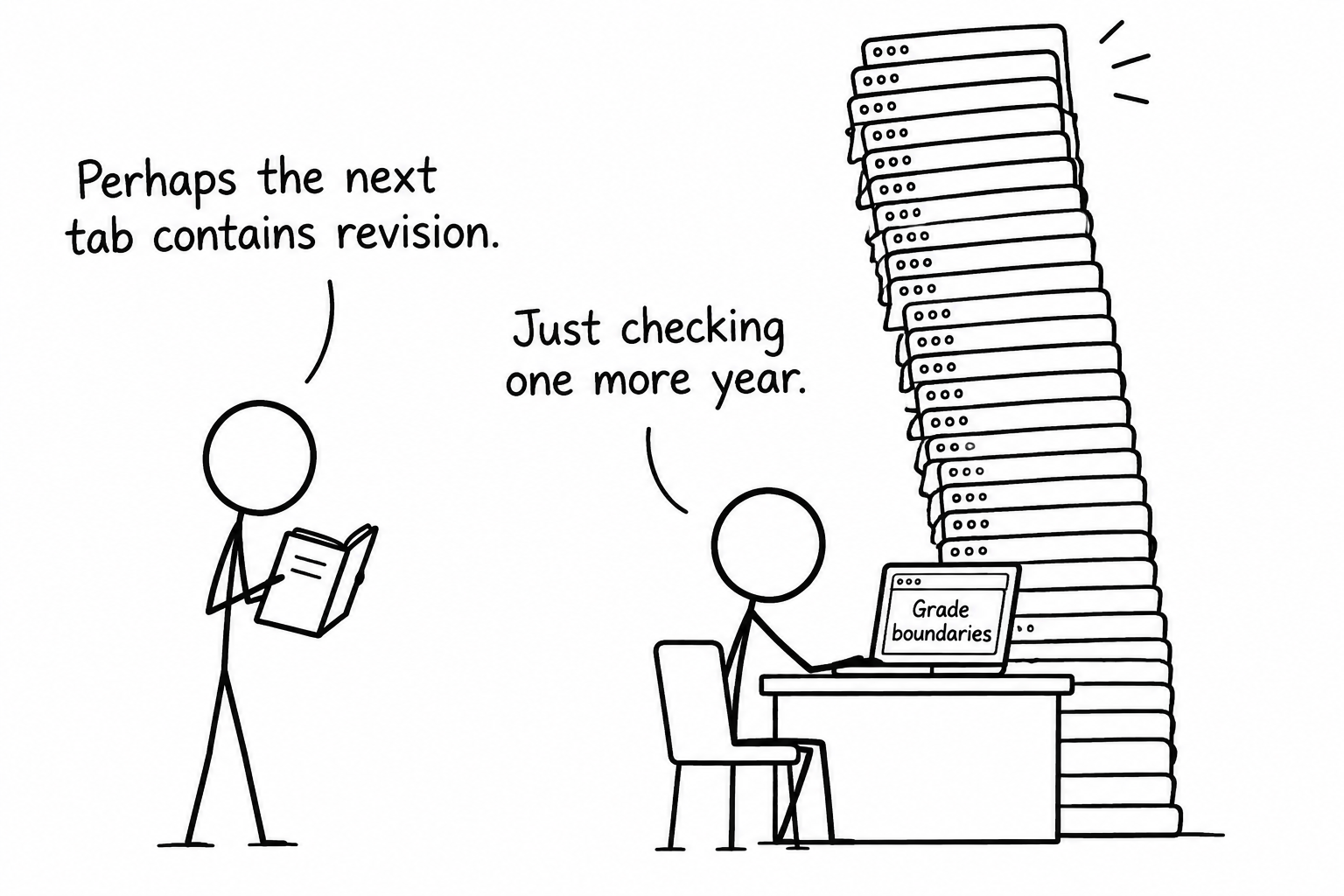 A Year 13 student discovers that checking one more boundary is not the same as revising
Why the C boundary changes each year
An A-Level grade is intended to represent a comparable standard from one series to another, but exam papers cannot be made perfectly equal in difficulty. One paper may contain an unusually demanding modelling question. Another may make familiar techniques easier to recognise.
Awarding bodies therefore use evidence from the completed exam series when setting boundaries. This includes how demanding the assessments proved and how students performed. If a paper is more accessible, the mark required for a particular grade may rise. If it is more demanding, the boundary may fall.
This is why the OCR MEI A-Level grade boundaries are confirmed after the examinations rather than promised in advance. It is also why an apparently low percentage should not be interpreted as an easy qualification. A-Level questions award marks for reasoning, interpretation and connected methods, not just recalling isolated procedures.
What should a student target for an A-Level maths C?
Imagine the Year 13 student looking at a mock total of 120120120. Compared with June 2024, that is only 222 marks below a C. Compared with June 2025, it is 888 marks below. The difference changes the mood, but it should not change the central task: find marks that can be made more reliable.
Targeting the exact historic boundary is risky. If your goal were only 128128128, then a misread graph, a dropped negative sign or a difficult comprehension question could move you below it. A safer personal target might be several marks higher, but the right margin depends on the variability of your timed-paper scores.
Use several complete papers and calculate your totals:
average total=M1+M2+⋯+Mnn\text{average total}=\frac{M_1+M_2+\cdots+M_n}{n}average total=nM1+M2+⋯+MnThen look beyond the average. If your totals vary widely, your first priority is consistency. If they cluster just below recent C boundaries, targeted topic work may be enough to move them.
The MathsGenie home page gives free access to GCSE and A-Level revision, while the A-Level Maths resources bring together exam-board materials, past papers and mark schemes.
Find the topics that move marks most
A boundary tells you where a grade began. It does not tell you how to gain the next ten marks.
For that, mark a timed paper carefully and classify every lost mark:
- Knowledge gap: you did not know the method or definition.
- Recognition gap: you knew the topic but did not identify the required approach.
- Execution error: your algebra, arithmetic or calculator work failed.
- Communication gap: you omitted reasoning, notation or interpretation.
- Time pressure: you could complete the question afterwards, but not during the paper.
Now count marks, not just questions. A recurring weakness in differentiation, integration, trigonometry, logarithms, vectors, hypothesis testing or mechanics may appear across several parts of the course. Fixing a connected topic can therefore be more valuable than repeatedly attempting whichever question happens to come next.
Use MathsGenie revision lessons to rebuild the method, then complete practice questions without notes. Follow with a mini test or timed section, check the mark scheme, and record whether the same error returns. Finally, test the improvement on a full past or predicted paper. Video solutions are particularly useful when a mark scheme shows what earns credit but not why the approach works.
Common mistakes when using grade boundaries
Treating one year as a promise
The June 2025 C boundary of 128128128 applies to that series. It is not a pre-set boundary for every future OCR MEI examination.
Averaging the paper percentages
The third paper has 757575 marks, while the other two have 100100100 each. Simply averaging three paper percentages gives each component equal weight and can distort the result. Add the raw marks first:
M=P1+P2+P3M=P_1+P_2+P_3M=P1+P2+P3Then compare the total with the relevant overall boundary.
Confusing OCR qualifications
OCR Mathematics A and OCR Mathematics B (MEI) are separate specifications. Check that your materials say Mathematics B (MEI) and H640 before using a boundary or past paper.
Revising only to scrape the boundary
A boundary is a line discovered after the exam, not a revision plan. Build a buffer by converting recurring errors into dependable marks.
Looking at totals without analysing errors
Two students can both score 120120120 for very different reasons. One may have a narrow calculus gap; another may lose small marks across the whole paper. Their revision plans should not be the same.
Turn the boundary into a plan
The important number is not only the latest C boundary. It is the gap between your current, repeatable performance and a sensible target above recent boundaries.
Complete a set of papers under timed conditions, combine the three component marks correctly, and use the relevant dated boundaries as reference points. Then stop refreshing the boundary table. The marks that change a grade are usually sitting inside identifiable topics and repeated habits.
Start with the OCR MEI grade calculator, identify the largest sources of lost marks, and move into MathsGenie A-Level Maths revision. Use the lessons on the topics that move marks most, followed by practice questions, mark schemes, video solutions and timed papers. A grade boundary tells you where the line was. Focused revision helps you move beyond it.















