

OCR MEI A-Level Maths A* Boundary Explained
OCR MEI A-Level maths A* boundary explained using 2023-2025 marks, combined paper totals, annual changes and a practical Year 13 revision marks target.
A Year 13 student checking the OCR MEI A-Level maths A boundary* usually wants one number. The most recent official boundary considered here, from June 2025, was 226226226 marks out of 275275275. That was approximately 82.2%82.2\%82.2%.
But the number is not fixed. In June 2024, an A* required 231231231 marks, while in June 2023 it required 224224224. The sensible conclusion is not that you must predict the exact boundary. It is that you need a revision target which remains useful when the boundary moves.
The short answer
For OCR Mathematics B (MEI), specification H640, your marks from all three papers are added together. The maximum is:
100+100+75=275100+100+75=275100+100+75=275Recent official A* boundaries provide a useful guide:
| Exam series | A* boundary | Percentage of 275275275 |
|---|---|---|
| June 2023 | 224224224 | 81.5%81.5\%81.5% |
| June 2024 | 231231231 | 84.0%84.0\%84.0% |
| June 2025 | 226226226 | 82.2%82.2\%82.2% |
These are historical boundaries, not promises about a future examination. A student preparing now should consider targeting around 235235235 marks or more in timed practice. That is not an official prediction. It is a practical buffer above all three boundaries shown.
You can enter individual paper marks into the OCR MEI predicted grade calculator to see how different totals compare with previous years.
How the three OCR MEI papers combine
OCR MEI A-Level Maths has three written components:
| Component | Content | Maximum mark |
|---|---|---|
| Paper 111 | Pure mathematics and mechanics | 100100100 |
| Paper 222 | Pure mathematics and statistics | 100100100 |
| Paper 333 | Pure mathematics and comprehension | 757575 |
Your final raw mark is calculated as:
T=P1+P2+P3T=P_1+P_2+P_3T=P1+P2+P3where P1P_1P1, P2P_2P2 and P3P_3P3 are your marks on the three papers.
Suppose a student receives:
P1=82,P2=80,P3=66P_1=82,\qquad P_2=80,\qquad P_3=66P1=82,P2=80,P3=66Their total is:
T=82+80+66=228T=82+80+66=228T=82+80+66=228That total would have exceeded the June 2023 and June 2025 A* boundaries, but it would have been below the June 2024 boundary. This is why relying on a single historical figure can create false confidence.
There is no requirement to reach an A* standard on every individual paper. It is the combined qualification mark that determines the grade. A weaker mechanics performance can therefore be offset by stronger marks elsewhere, although depending on compensation is riskier than addressing the weak area directly.
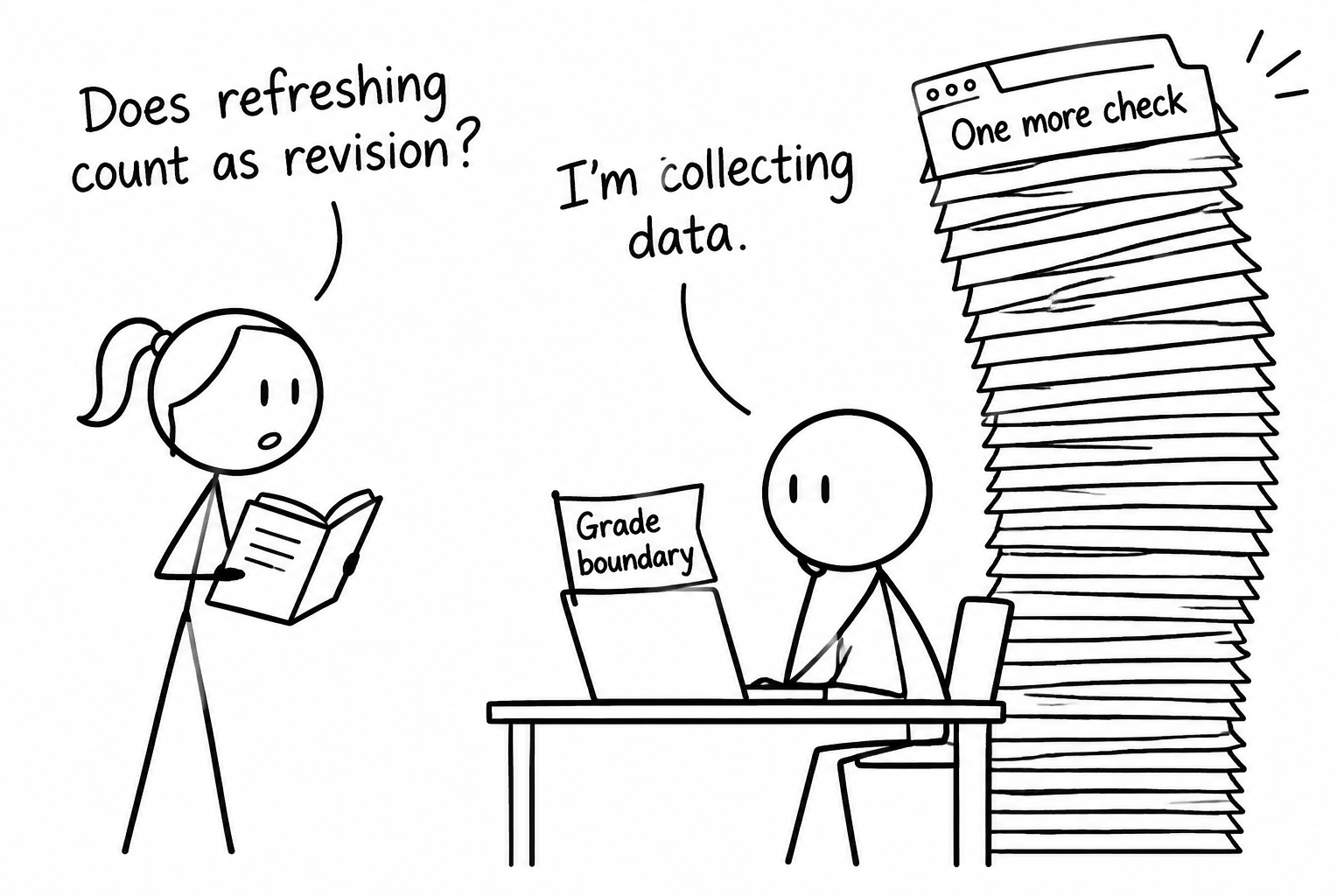 A Year 13 student insists that repeatedly checking the grade boundary counts as collecting data
Why OCR MEI A-Level grade boundaries change
An A-Level maths A* is intended to represent a consistent standard, but examination papers cannot be identical each year. One series may contain a particularly demanding mechanics problem. Another may have more accessible pure questions but an unfamiliar comprehension passage.
Grade boundaries are set after the papers have been sat and marked. Evidence about the difficulty of the assessment and how students performed is considered so that a harder paper does not automatically disadvantage the entire cohort.
The recent movement illustrates this:
224⟶231⟶226224\longrightarrow231\longrightarrow226224⟶231⟶226The increase from 2023 to 2024 was 777 marks. The following year, the boundary fell by 555 marks. Those changes are significant, but they are small enough that consistently collecting method marks remains more valuable than trying to forecast the exact threshold.
Notional boundaries may also be published for individual components. These can help you interpret a paper, but they do not create three separate grades. Your qualification grade comes from the overall total.
Choosing a useful A* target
The historical OCR MEI A-Level maths A* boundary has recently sat above 80%80\%80%. A robust practice target should therefore include some margin for variation, pressure and ordinary mistakes.
Aiming for 235235235 out of 275275275 means aiming for:
235275×100≈85.5%\frac{235}{275}\times100\approx85.5\%275235×100≈85.5%One possible distribution is:
85+85+65=23585+85+65=23585+85+65=235This is not the only route. A student stronger in pure mathematics and statistics might produce:
88+90+57=23588+90+57=23588+90+57=235The total is the same, but the profile reveals more. The second student has less protection on Paper 333, where comprehension and unfamiliar mathematical writing can expose weaknesses that ordinary textbook exercises do not reveal.
Use the OCR MEI A-Level Maths revision hub to complete past papers under timed conditions, then mark them carefully. Record lost marks by topic and by cause. A missing technique needs a lesson; a misread condition needs slower checking; an unfinished final question may indicate a timing problem.
The topics most likely to move your mark
At A* level, improvement often comes from turning partial solutions into complete ones. Pure mathematics appears throughout the qualification, so weaknesses there can affect more than one paper. The A Level Pure Mathematics lessons provide a structured place to identify those gaps.
Calculus is particularly important because questions can connect several ideas. Review implicit differentiation and integration by parts, then practise recognising which method a question requires. Knowing a technique and identifying when to use it are different exam skills.
Statistics marks can move quickly when definitions and calculator procedures become secure. Lessons on variance and standard deviation and mutually exclusive and independent events help clarify distinctions that are easy to blur under pressure.
Mechanics improvement begins with representing the situation correctly. The models and quantities lesson reinforces assumptions, units and modelling language before the algebra begins.
The most productive cycle is simple:
- complete a timed paper;
- use the mark scheme to identify exactly where marks were lost;
- revise the relevant MathsGenie lesson;
- answer focused practice questions;
- return to a similar exam question without notes.
Past papers measure your current position. Lessons and practice questions are what move it.
Common mistakes when interpreting the boundary
Treating the boundary as a guaranteed target
A boundary of 226226226 in one series does not mean that 226226226 will secure an A* next year. Future boundaries are unknown until the assessment process is complete.
Averaging paper percentages incorrectly
Paper 333 is worth 757575 marks, while Papers 111 and 222 are worth 100100100 each. Do not simply average three percentages. Add the raw marks first:
T=P1+P2+P3T=P_1+P_2+P_3T=P1+P2+P3Then compare TTT with an overall boundary.
Confusing OCR Mathematics A with OCR MEI
OCR Mathematics A and OCR Mathematics B (MEI) are different specifications. Check that your paper code is H640 before using these figures or resources.
Revising only the weakest paper
Improving a weak component matters, but pure mathematics contributes across all three papers. A targeted pure revision programme may therefore recover marks in several places.
Counting familiar questions as secure marks
Recognising a solution is easier than producing it independently. Use closed-book questions, mini tests and timed past papers to test whether the method is genuinely available under examination conditions.
Turn the boundary into a revision decision
The boundary is useful because it gives scale. It tells you that an A* does not usually require perfection, but it does require consistent marks across a demanding set of papers.
Once you know your total, stop refreshing the boundary table. Look at the gap. If your current timed score is 218218218 and your working target is 235235235, the problem is no longer an abstract grade. It is a recoverable gap of:
235−218=17235-218=17235−218=17Those marks may be spread across an omitted constant, an incomplete hypothesis test, a modelling assumption and two questions abandoned too early. Small losses accumulate. Fortunately, so do small improvements.
Start with the MathsGenie OCR MEI lessons, focusing first on the topics that cost you the most marks. Combine the lessons with exam-style questions, worksheets, past papers, mark schemes and worked solutions. The aim is not merely to know last year's A* boundary. It is to build enough margin that the next boundary matters less.















