

OCR Higher Maths Grade Boundaries Explained
OCR higher maths grade boundaries explained, including available grades, combined paper marks and dated examples to help focus your GCSE revision.
A grade boundary can feel like a finish line that someone keeps moving. You complete a past paper, count your marks and then discover that the grade attached to that total changes from one exam series to another.
The useful answer is simple: OCR higher maths grade boundaries convert your combined raw mark across three papers into a GCSE grade. They are set for each exam series after the papers have been sat and marked. You cannot know the exact boundary for a future series in advance, but previous boundaries can help you interpret practice results and set sensible targets.
OCR higher maths grade boundaries at a glance
For OCR GCSE Mathematics Higher tier, specification J560:
- you sit three papers;
- each paper is worth 100100100 marks;
- Paper 4 is non-calculator;
- Papers 5 and 6 allow a calculator;
- your marks are added to give a total out of 300300300;
- Higher tier awards grades 999 to 444, with grade 333 available as an allowed lower grade;
- the total boundary, rather than a separate grade on each paper, determines the final qualification grade.
You can find the papers and official mark schemes together on the OCR GCSE Maths past papers page. This makes it much easier to record like-for-like results.
How the three OCR Higher papers combine
Each paper contributes equally because each is worth 100100100 marks. If your marks are m4m_4m4, m5m_5m5 and m6m_6m6, your qualification total is:
T=m4+m5+m6T=m_4+m_5+m_6T=m4+m5+m6Suppose you score 585858, 636363 and 616161. Your combined mark is:
58+63+61=18258+63+61=18258+63+61=182That total of 182182182 is then compared with the qualification-level grade boundaries for that particular exam series. You do not need to achieve the same standard on every paper. A difficult non-calculator paper can be balanced by stronger performances on the calculator papers.
This matters psychologically as much as mathematically. One disappointing paper is not the whole qualification. It is one third of the available marks.
Which grades are available on OCR GCSE Maths Higher?
OCR Higher tier is designed for grades 999 to 444. OCR's specification also allows an additional grade 333 for candidates who fall just below grade 444. A result below the published grade 333 boundary is unclassified.
| Result | What it means on Higher tier |
|---|---|
| Grades 999-444 | The main grades available |
| Grade 333 | An allowed lower grade below grade 444 |
| Unclassified | The combined total did not reach the grade 333 boundary |
This is one reason tier decisions deserve care. Higher tier provides access to grades 999, 888, 777, 666 and 555, but its lower-grade range is restricted. Your school makes the final entry decision, so discuss it with your teacher if your practice totals regularly sit near the grade 333 or grade 444 boundaries.
A dated example from June 2025
OCR's official June 2025 grade-boundary document published these qualification boundaries for J560 Higher, out of 300300300:
| Grade | Minimum combined mark in June 2025 |
|---|---|
| 999 | 258258258 |
| 888 | 212212212 |
| 777 | 166166166 |
| 666 | 126126126 |
| 555 | 868686 |
| 444 | 474747 |
| 333 | 272727 |
For example, a total of 166166166 met the grade 777 boundary in June 2025. A total of 165165165 did not. That single-mark difference illustrates why method marks, accurate calculator entry and checking the final line of a solution matter.
These figures are historical evidence, not promises about a later exam. Grade boundaries can change because papers vary in difficulty and awarding takes account of how demanding that series proved to be. Avoid treating any past boundary as a guaranteed prediction.
For a quick interpretation of your total, use the OCR GCSE Maths grade calculator. Select the correct year rather than mixing your mark from one paper set with another year's boundaries.
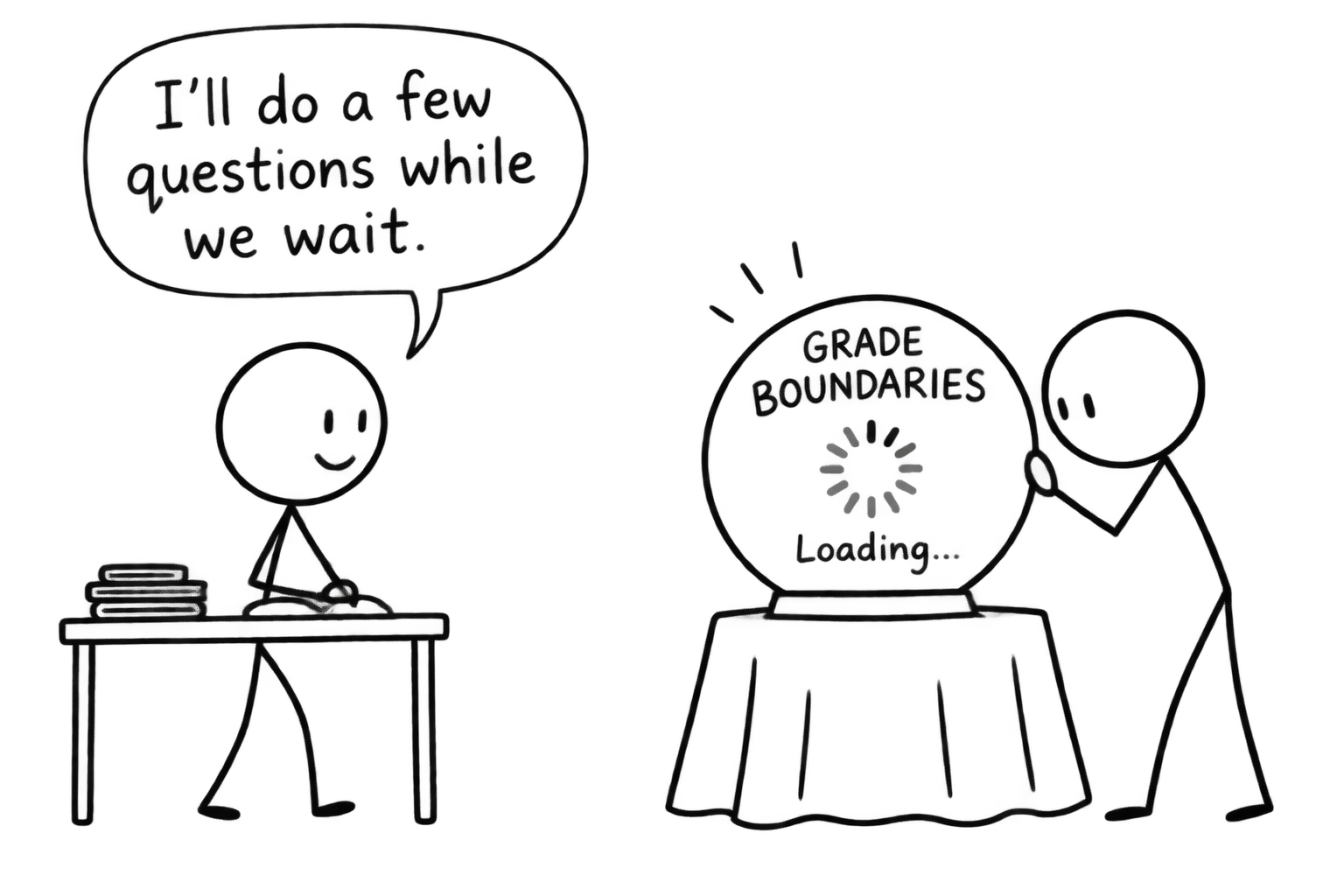 A student revises while a crystal ball labelled grade boundaries continues loading
Why boundaries move between exam series
A boundary is not chosen before students sit the examination. Awarding bodies use evidence from the completed assessment and the performance of the cohort to maintain standards between years. If a paper is more demanding, a comparable level of performance may be represented by a lower raw mark. If it is more accessible, the boundary may rise.
This does not mean that students are competing for a fixed number of each grade. Nor does it mean that a certain percentage always earns grade 777. The purpose is to maintain the standard represented by each grade while recognising that no two sets of questions have precisely the same difficulty.
Predicted boundaries should therefore be treated cautiously. Even a well-informed estimate cannot replace the official OCR results for that series.
Using boundaries without letting them control revision
Boundaries are useful for diagnosis. They are less useful as an obsession.
A productive routine looks like this:
- complete a full paper under timed conditions;
- mark it carefully with the matching mark scheme;
- add all three paper marks before estimating a grade;
- record the topics behind lost marks;
- revise those topics and answer fresh questions;
- repeat the process with another complete series.
Start with the OCR GCSE Maths revision hub, where lessons and exam-style practice are organised for the specification. If you need concentrated question practice, the OCR exam booklets by topic help turn a vague weakness into a specific task.
The most valuable target is not simply “gain 202020 marks”. It is to identify where those marks can realistically come from. Secure algebraic manipulation, percentages, ratio, probability and standard geometry methods often support several different question types. On unfamiliar problems, clear working can also earn method marks even when the final answer is wrong.
Common mistakes when reading grade boundaries
Comparing marks from different totals
OCR J560 totals 300300300 marks. Some other GCSE Maths specifications have different totals, so raw boundaries cannot be compared directly. If comparison is genuinely necessary, convert a mark to a percentage:
Percentage=markmaximum mark×100\text{Percentage}=\frac{\text{mark}}{\text{maximum mark}}\times 100Percentage=maximum markmark×100Even then, percentages do not make papers identical in difficulty.
Using one paper as a final grade
A Paper 4 score alone cannot give a reliable qualification grade. Combine Paper 4, Paper 5 and Paper 6 before consulting the overall boundary.
Treating an old boundary as a target to hit exactly
Aiming for the precise historical threshold leaves no protection against normal variation. A safer practice target sits above the relevant past boundary and is achieved repeatedly, not once.
Counting only final answers
Official mark schemes often award marks for valid methods and intermediate work. Use the mark scheme rather than checking answers informally. The guide to using OCR past papers properly explains how to turn marking into focused revision.
Revising only the hardest topics
A grade is built from marks, not from the impressive appearance of a question. Recovering several routine marks may improve your total faster than spending an entire evening on one rare, difficult problem.
Turn the boundary into a revision plan
The boundary tells you where a grade began in one past series. It does not tell you which topic to revise tomorrow. Your marked work does.
Review every lost mark and label it as a knowledge gap, an incomplete method, a reading error or a checking error. Then use Maths Genie OCR GCSE Maths lessons on the topics that move marks most. Follow each lesson with practice questions, then return to timed papers and measure whether the improvement survives exam conditions.
That is the calmer way to think about OCR higher maths grade boundaries. You cannot control the line OCR eventually publishes. You can control how many secure methods you carry into each paper, and Maths Genie gives you the free lessons, worksheets, past papers and mark schemes to build them.















