AQA GCSE Maths Grade 1 Boundary Explained
AQA GCSE maths grade 1 boundary explained with dated examples, tier guidance and a practical plan to turn Foundation paper practice into marks.
A Year 11 student opens a recent paper, adds the marks three times, and gets three different totals. The real question is not just, “What did I score?” It is, “Was that enough?”
The AQA GCSE maths grade 1 boundary is not a fixed mark. It is set after each exam series and can change from one series to another. For example, in the June 2024 AQA Foundation examination, a grade 111 required 373737 marks out of 240240240 across all three papers.
That is a useful reference, not a promise about a future examination. Students should use several past boundaries, aim above them and concentrate on gaining dependable marks.
The short answer
Here is the essential checklist:
- Grade 111 is available on the Foundation tier.
- AQA GCSE Maths has three papers, each worth 808080 marks, giving 240240240 marks in total.
- Paper 111 is non-calculator; Papers 222 and 333 allow a calculator.
- The grade comes from the combined total across all three papers.
- In June 2024, the Foundation grade 111 boundary was 373737 out of 240240240.
- Boundaries are confirmed after the papers have been marked, so the next boundary cannot be known in advance.
- A sensible revision target is higher than the previous boundary, leaving room for difficult questions and avoidable errors.
Students can compare their totals against previous series using the AQA GCSE Maths grade calculator. It is an estimate based on historical boundaries, not an advance confirmation of a future grade.
Which tier includes grade 1 maths?
AQA GCSE Maths is tiered. The Foundation tier covers grades 111 to 555, while Higher tier covers grades 444 to 999, with grade 333 available as an allowed narrow safety grade under awarding rules.
For a student currently working towards grade 111, the Foundation tier is therefore the appropriate place to look. Its three papers are:
| Paper | Calculator? | Maximum mark |
|---|---|---|
| Paper 111 | No | 808080 |
| Paper 222 | Yes | 808080 |
| Paper 333 | Yes | 808080 |
| Total | 240240240 |
There is no separate requirement to reach a particular mark on every paper. Suppose a student’s marks were:
11+15+14=4011 + 15 + 14 = 4011+15+14=40Their qualification total would be 404040 out of 240240240. A weaker Paper 111 can therefore be balanced by stronger performances on Papers 222 and 333, although relying on one paper is risky.
You can see the format and practise complete examinations on the AQA GCSE Maths past papers page.
A dated AQA grade boundary example
The published June 2024 Foundation boundaries provide a clear example of how the overall marks translated into grades.
| June 2024 grade | Minimum mark out of 240240240 |
|---|---|
| 555 | 186186186 |
| 444 | 157157157 |
| 333 | 117117117 |
| 222 | 777777 |
| 111 | 373737 |
So a student with 373737 marks reached grade 111 in that particular series. A total of 363636 did not.
In percentage terms, that boundary was:
37240×100≈15.4%\frac{37}{240}\times 100 \approx 15.4\%24037×100≈15.4%This calculation can make the target feel more manageable, but it should not become the target itself. A student aiming for exactly 373737 has no margin for a misread scale, an omitted unit or an arithmetic slip. Working towards 454545 or 505050 marks in practice would offer more protection, while continued progress towards grade 222 should remain the wider goal.
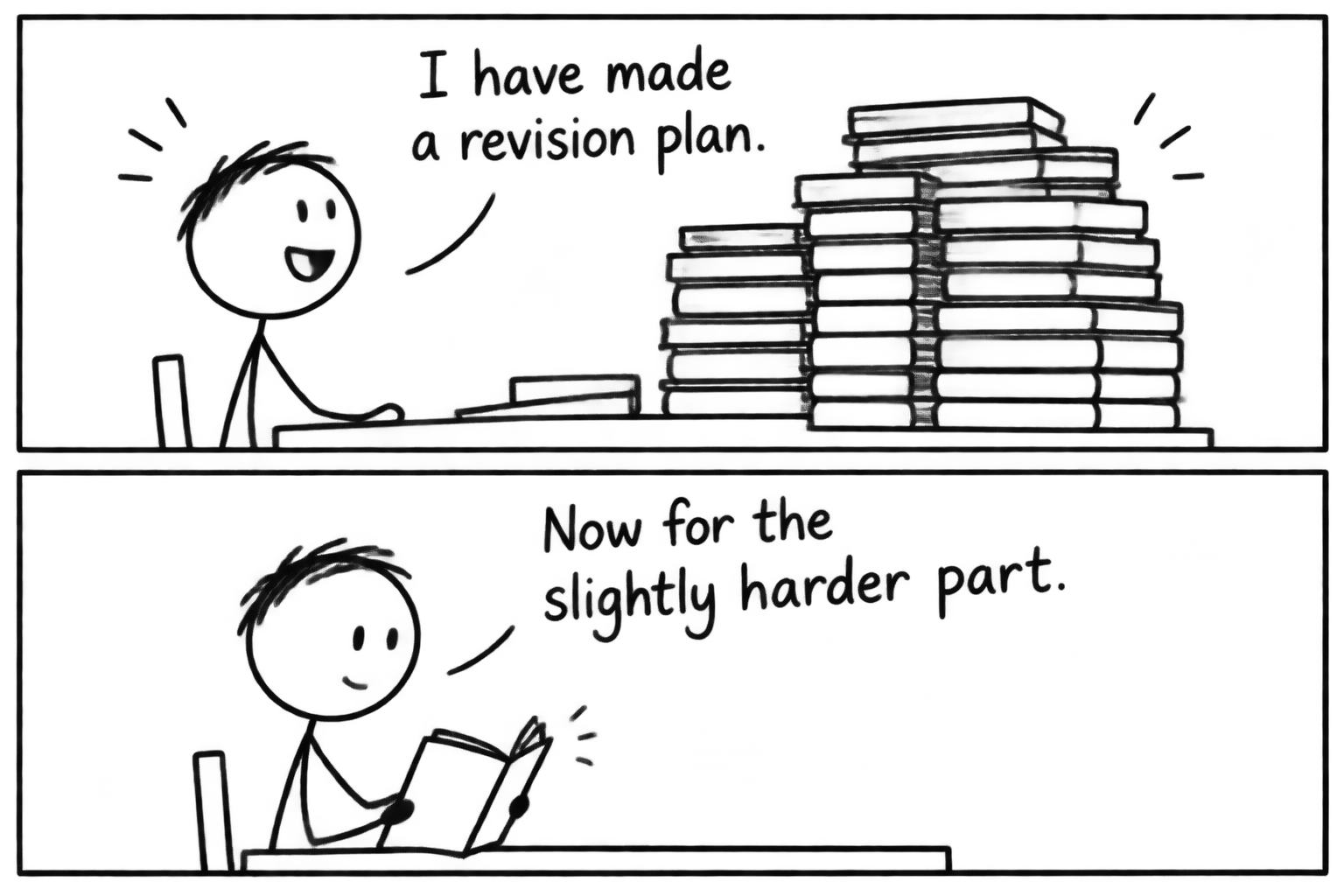 A student discovers that writing a revision plan is easier than starting it
Why the AQA GCSE maths grade 1 boundary changes
Grade boundaries are not chosen before students sit the papers. Awarding organisations set them after considering the evidence from that exam series.
The principle is fairness. One year’s papers may prove slightly more demanding than another year’s papers, even though both assess the same specification. If a paper is harder overall, a lower mark may demonstrate the same standard of performance. If it is more accessible, the boundary may be higher.
This is why AQA grade boundaries move. It does not mean that the specification’s expected standard is casually changed each summer. The numerical boundary adjusts to reflect the demand of that particular set of papers and the available awarding evidence.
It also explains why a teacher, online calculator or predicted paper cannot state the next boundary with certainty. Only the published boundary for the completed series is definitive.
Following a Year 11 student’s calculation
Imagine a Year 11 student checking three marked Foundation papers. The scores are 999, 131313 and 121212.
First, the student should add the raw marks:
9+13+12=349 + 13 + 12 = 349+13+12=34Compared with the June 2024 example, 343434 would have been 333 marks short of grade 111:
37−34=337 - 34 = 337−34=3That gap is small enough to make revision very specific. It might be closed by correctly reading one graph, completing a money calculation and showing one extra stage of working. The useful thought is not, “I cannot do maths.” It is, “Where are the next three reliable marks?”
The student should then review the paper question by question:
- Was the topic unfamiliar?
- Was the method known but applied incorrectly?
- Was a calculator entry wrong?
- Was the answer missing a unit?
- Was working absent where it might have earned a method mark?
Maths feels broad when it is described as an entire GCSE. It becomes more manageable when it is reduced to the next mark.
Topics that can move the mark total
For an early Foundation target, secure number skills have unusually wide value because they appear directly and support later topics. Prioritise:
- the four operations with integers and decimals;
- place value and ordering numbers;
- fractions, decimals and percentages;
- negative numbers;
- money, time and measures;
- simple ratio;
- reading tables, charts and scales;
- perimeter, area and basic angle facts;
- substitution and simplifying straightforward expressions.
Use the AQA GCSE Maths revision hub to choose Foundation lessons, then answer questions without looking at the solution. The wider GCSE Maths revision library also brings together worksheets, exam questions and revision guides.
A useful routine is short and repeatable:
- Watch a revision lesson on one weak topic.
- Complete its practice questions independently.
- Check the mark scheme or video solution.
- Write down the precise cause of each lost mark.
- Attempt a similar question later without notes.
- Test the skill under timed conditions in a past paper.
Lessons build the method. Papers test whether that method can be recognised when the topic name has disappeared.
Common mistakes when judging a grade 1 mark
Treating an old boundary as a forecast
The June 2024 figure of 373737 applies to June 2024. It does not guarantee that 373737 will produce grade 111 in another series.
Looking at one paper instead of the total
The final grade uses all three papers. Compare the combined mark out of 240240240, not one score out of 808080, with the qualification boundary.
Aiming exactly at the boundary
A boundary is a threshold, not a comfortable revision target. Build a margin above it.
Counting corrections as original marks
When marking a paper, record the answer first attempted under exam conditions. Corrections show learning, but they should not inflate the baseline score.
Revising only the hardest-looking topics
A student near grade 111 often gains more from accurate arithmetic, scales, money and basic fractions than from spending an evening on a complex topic that rarely offers accessible marks at this stage.
Turn the boundary into a practical next step
The most reassuring part of a low starting score is that progress can be counted. One corrected misconception may improve several questions. A sound written method can rescue a mark even when the final answer goes wrong.
Begin with the Maths Genie AQA revision lessons, focusing on number, fractions, percentages, measures and basic graphs. Then use AQA past papers with mark schemes to find the next marks that are genuinely within reach.
The boundary tells a student where the line was. Maths Genie Lessons help them move beyond it.