

November GCSE Maths Grade Boundaries vs June
November GCSE maths grade boundaries versus June: compare dated marks, understand why thresholds change, and plan focused revision with free MathsGenie tools.
Comparing a June result with a possible November resit can leave students and parents wondering whether the same standard of work could earn a different grade.
November GCSE maths grade boundaries can be higher, lower or unchanged compared with June. November is not automatically easier to pass. Exam boards adjust the marks needed to reflect each series' difficulty, while maintaining the standard represented by the grade.
Previous boundaries help explain results and assess practice papers. They cannot promise the marks needed in a future exam.
November versus June: the essentials
Before comparing GCSE maths grade boundaries, check that you are comparing:
- The same exam board and specification, such as Edexcel GCSE Mathematics 1MA1.
- The same tier, foundation or higher.
- Total qualification marks, rather than marks from individual papers.
- Clearly identified exam series, including month and year.
- Published boundaries, rather than estimates.
This article concerns GCSE maths in England using grades 9-1. Other UK qualifications can have different grading arrangements. Start with MathsGenie's GCSE maths revision hub to select your resources.
Why November GCSE maths grade boundaries change
A grade boundary is the minimum total mark required for a particular grade in a specific qualification and exam series.
Exam boards aim to produce papers of comparable difficulty, but questions cannot be identical. Students may find a problem more demanding than expected, while another paper makes familiar methods easier to recognise.
Boundaries allow for those differences. Ofqual's January 2025 guidance on November results explained that easier papers have higher boundaries and harder papers have lower boundaries. A June grade represents the same standard as that grade from November.
Senior examiners use evidence, including students' work and statistical information, when setting boundaries. They do not choose a pass mark in advance. MathsGenie's guide to how GCSE grade boundaries work explains the wider process.
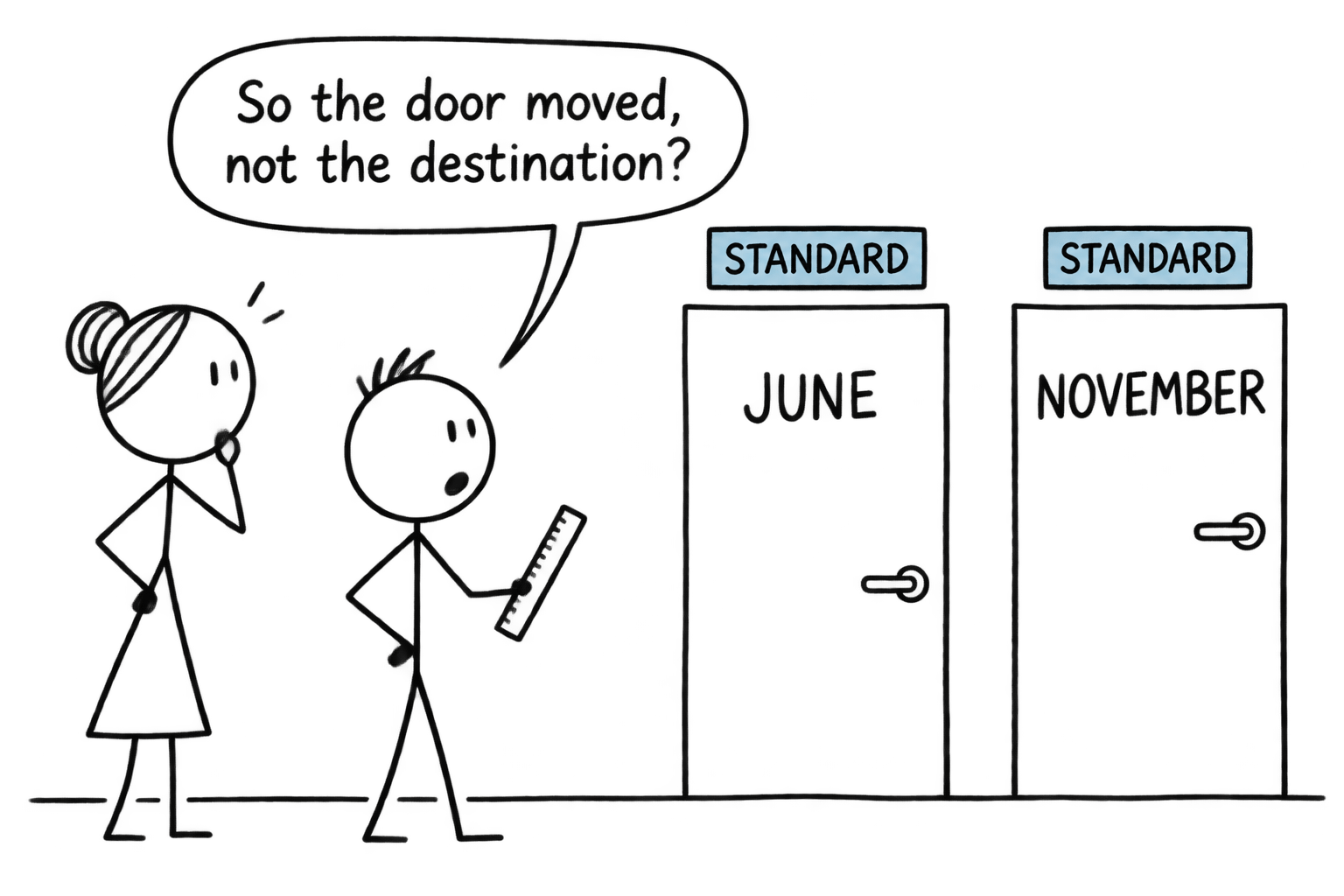 Stick-figure student and parent considering June and November exam doors with the same standard above them
A dated comparison: Edexcel foundation in 2025
These figures come from Pearson's published June 2025 and November 2025 GCSE grade boundary documents, for Edexcel GCSE Mathematics 1MA1, foundation tier. All marks are totals out of 240240240.
| GCSE maths grade | June 2025 minimum mark | November 2025 minimum mark |
|---|---|---|
| Grade 555 | 175175175 | 174174174 |
| Grade 444 | 144144144 | 143143143 |
| Grade 333 | 105105105 | 105105105 |
| Grade 222 | 676767 | 676767 |
| Grade 111 | 292929 | 292929 |
The November thresholds for grades 444 and 555 were each one mark lower. The other listed boundaries were unchanged.
This historical comparison does not show that November always offers lower thresholds. It says nothing about AQA, OCR or Eduqas, or Edexcel higher tier.
Explore dated Edexcel thresholds using MathsGenie's GCSE maths grade calculator. Select the matching series and tier when interpreting a past-paper total.
Does a lower November boundary make passing easier?
A lower threshold can sound encouraging after narrowly missing a target. But the marks and questions belong together. If a paper is harder, earning each mark may require more secure understanding. The lower boundary maintains the grade standard.
The November entry also differs from the summer entry. Ofqual's January 2025 guidance states that November GCSE English language and maths entries are restricted to students aged sixteen and over. Many are resitting, so comparing overall pass rates does not fairly measure paper difficulty.
The practical decision is whether you have time, teaching support and a realistic revision plan to improve. Ask your teacher or exam centre about entry and tier choice.
How to use boundaries during revision
Complete a full set of papers from one series under exam conditions, following its calculator rules and time limits. Mark your work, total the marks and compare with that series' published boundaries. MathsGenie's Edexcel GCSE maths past papers include mark schemes and worked solutions where available.
Then look beyond the grade. Were marks lost through unfamiliar methods, arithmetic slips, misreading or missing working?
An unfamiliar method needs a lesson followed by practice. Arithmetic slips need short fluency sessions. Misreading needs a checking routine. Where method marks are available, clear working can preserve credit despite an incorrect final answer.
Use the topic-sorted GCSE maths question bank to practise identified gaps. Return later without the solution open, then check those skills in mixed questions.
Focus on the topics that move marks
Start with topics that repeatedly cost marks in your papers. Number skills, fractions, percentages, ratio and basic algebra support work elsewhere in the specification. Prioritising weaknesses here is a revision strategy, not a prediction of future questions.
MathsGenie's revision lessons, practice questions and video solutions support this cycle. Mini tests check recall, while a revision planner helps keep practice regular. Predicted papers provide additional mixed practice, but cannot guarantee questions or boundaries.
Common mistakes when comparing boundaries
Applying June boundaries to a November paper. Use the boundaries belonging to the papers completed, or your estimated grade may mislead you.
Comparing foundation and higher percentages directly. The tiers contain different questions and assess different ranges of demand. A lower percentage on higher tier does not mean an easier pass.
Treating one paper as a final grade. The qualification result depends on combined marks across the required papers.
Aiming exactly at last year's threshold. Future boundaries are unknown, and performance varies. Build consistency across several unseen papers.
Checking boundaries instead of repairing gaps. Once you understand the comparison, move on to lessons and practice.
Turn the comparison into a plan
Use past boundaries to interpret past performance, then use marked questions to decide what needs attention now.
Begin with MathsGenie's GCSE maths revision lessons, choosing gaps that recur in your work. Improving those skills gives you a firmer foundation than hoping the next boundary moves.















