

Non-Calculator Paper Strategies for the Resit
Non-calculator paper strategies for the resit: improve written methods, manage exam time and target GCSE maths weaknesses around college and work commitments.
Make the next attempt more targeted
Imagine arriving at college after a shift, opening a revision paper and recognising the same fraction question that stopped you last time. You understand what it asks, but cannot get the calculation moving without your phone.
The most useful non-calculator paper strategies for the resit are practical: identify calculations that slow you down, practise reliable written methods, and use a clear routine for collecting marks under time pressure. You need methods you can trust when you feel uncertain.
For a post-16 student balancing college, work or other commitments, that means giving each revision session a specific job.
Your non-calculator checklist
Before your next practice session:
- Confirm your exam board, tier and which paper is non-calculator.
- Choose two weaknesses from your previous work.
- Practise written calculations without a phone or calculator nearby.
- Complete a short timed selection of questions.
- Mark it, identify each error's cause and retry those questions later.
Keep this routine small enough to repeat during an ordinary week.
Check the paper before planning your revision
Do not assume that “Paper 1” always means non-calculator. AQA GCSE Mathematics uses Paper 1 for its non-calculator assessment. OCR uses its middle assessment: component J560/02 for foundation tier and J560/05 for higher tier. Check your entry details and the paper's instructions.
For a November resit, confirm dates and arrangements with your college or exam centre using the current official exam-board timetable.
Use the MathsGenie guide to GCSE Maths Paper 1 alongside your board's information. Your revision should match the paper you are sitting.
Turn your previous attempt into a diagnosis
“I'm bad at non-calculator maths” is an understandable feeling, but it gives you nothing specific to practise.
A marked paper can reveal more useful information. Perhaps you choose the right method but lose accuracy when subtracting decimals. Perhaps fractions stop you before you can attempt the algebra.
Take a short selection of questions and label each difficulty:
- Knowledge: you did not know which method to use.
- Accuracy: you knew the method but made a calculation error.
- Reading: you missed a condition, unit or instruction.
- Timing: you could do it, but took too long.
Match your response to the problem. Watch a lesson for missing knowledge. Practise short calculations for accuracy. Change your checking routine for reading errors. Introduce timed practice once the method is secure.
Build dependable written methods
Non-calculator does not mean everything must happen in your head. Writing intermediate steps reduces what you must remember and makes your reasoning easier to check.
Prioritise multiplication, division, decimals, negative numbers, fractions, percentages and ratio. These skills also appear inside longer questions, so improving them can remove obstacles across several topics.
For fractions, distinguish the operations before starting. Addition and subtraction require a common denominator. Multiplication and division use different rules. The MathsGenie fractions revision page provides a focused starting point.
For percentages, practise finding useful amounts such as 10%10\%10%, 5%5\%5% and 1%1\%1%, then combining them where appropriate. For decimals, align place values when adding or subtracting. For negative numbers, write signs clearly and check whether your answer should be positive or negative.
Choose one reliable written method for each operation. Switching methods because another looks quicker can make an uncertain calculation harder to control.
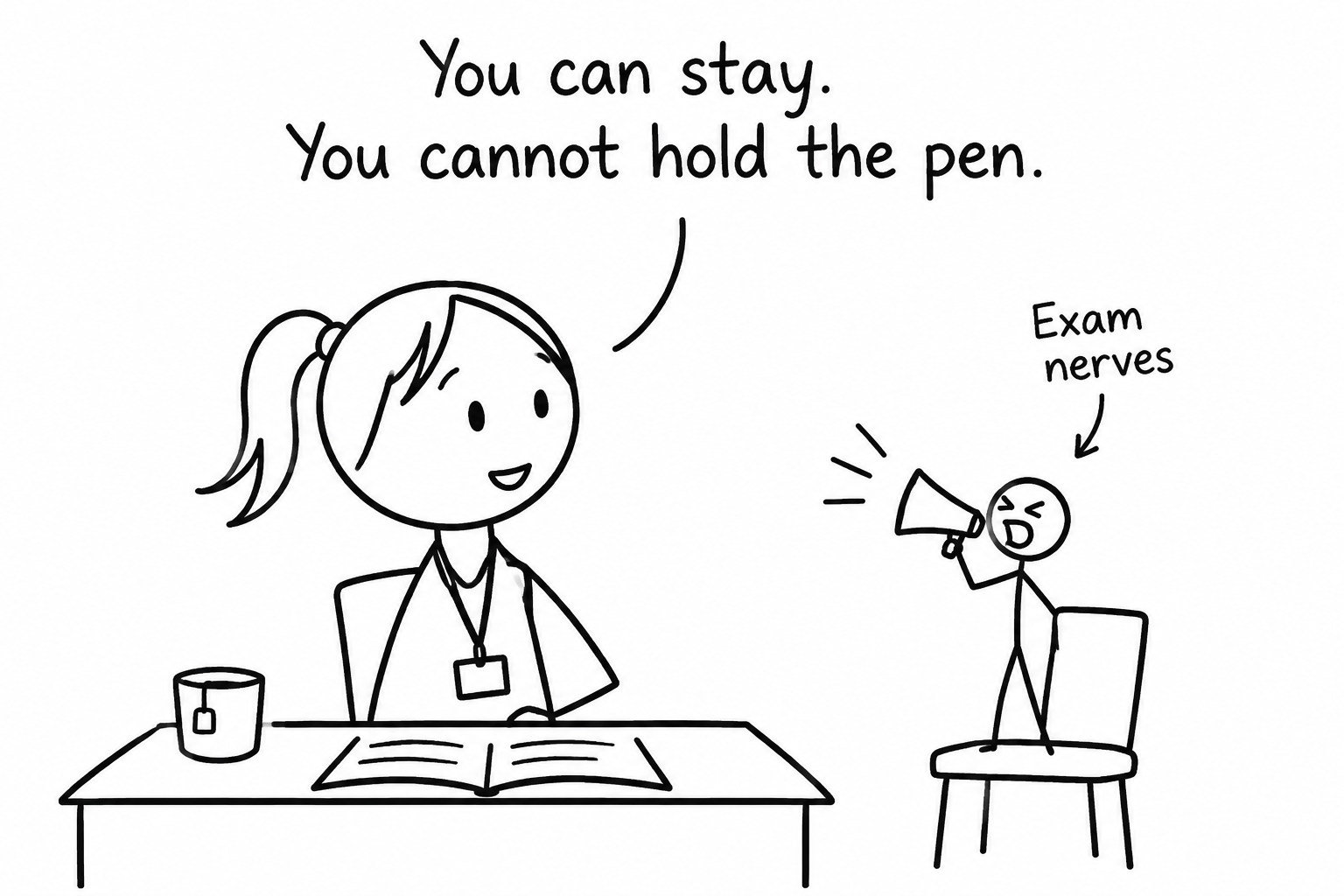 A stick-figure student holds a pen while a tiny figure representing exam nerves shouts through a megaphone.
Use a three-pass routine in the exam
Collect the accessible marks
First, attempt questions where you recognise a route. Read the whole question, show the calculation and move on when finished.
If you cannot see a useful next step, leave a clear place to return to. One difficult question should not prevent you from reaching later questions you can answer.
Return with something concrete
Next, tackle questions needing more thought. Write down relevant information: a labelled diagram, an equation, a conversion or the first stage of a calculation.
Clear working can earn method marks where the mark scheme allows them, even if the final answer is wrong. It also helps you restart. Each line should move towards the question's target.
Check the errors you actually make
Reserve time for checking, then use it deliberately. If your practice reveals frequent sign errors, check signs. If you often answer the wrong part, compare final answers with the instructions.
Check units, decimal places, simplified fractions and whether answers are a sensible size. Use estimation or an inverse operation where useful.
Fit GCSE maths resit practice around your week
Try a twenty-minute session: briefly recall a method, spend ten minutes answering questions, then mark and correct. Use MathsGenie's free revision resources to find lessons and practice questions for your identified weakness.
Build towards longer mixed practice. The Edexcel GCSE Maths short tests help Edexcel students practise moving between topics. Check calculator requirements before choosing questions.
When reviewing a mark scheme or video solution, identify the first line where your approach went wrong. Close the solution and retry independently, then revisit the question in a later session.
Common mistakes to avoid
Practising only comfortable topics. Spend most of each session on a known weakness.
Doing every calculation mentally. Write intermediate steps when memory or accuracy becomes a barrier.
Rounding too early. Keep exact values, including fractions, until the question requires an approximation.
Treating a predicted paper as a topic guarantee. Use predicted papers for practice while revising the specification.
Judging readiness from one score. Look for repeated improvements in accuracy, method choice and timing.
Build the paper your revision needs
Return to that college desk with a specific purpose: fractions, decimal accuracy or showing working.
Use MathsGenie's Mock Exam Builder to build targeted practice from past-paper questions. Select your weaknesses and check that questions suit non-calculator practice.
Sit it without a calculator, mark it carefully and let the results guide your next session. Your previous attempt becomes useful evidence for what to practise next.















