

Miss GCSE Food and Nutrition Coursework Deadline?
Miss GCSE Food and Nutrition coursework deadline? Learn what may happen, what can still be submitted and who to contact now to protect your GCSE grade.
Missing a deadline can make one unfinished document feel larger than the whole GCSE year. If you miss GCSE Food and Nutrition coursework deadline, tell your subject teacher immediately. You may still be able to submit work if it was only your school's internal deadline, but this is not guaranteed. If the final exam-board process has closed, the school may have to mark only the authenticated work completed on time.
The key is not to guess, hide the problem or abandon the subject. Find out which deadline you missed, provide evidence of any serious circumstances and ask your teacher or exams officer what the specification permits.
What to do immediately
Use this checklist today:
- Contact your Food Preparation and Nutrition teacher.
- Ask whether you missed an internal deadline or the final submission deadline.
- Submit or preserve every genuine piece of completed work.
- Explain any illness, bereavement or other serious disruption accurately.
- Give supporting evidence to your school if requested.
- Ask whether an authorised extension or special-consideration application is possible.
- Continue preparing for the written examination.
- Protect the revision time allocated to your other subjects, including maths.
Do not wait until the next convenient lesson. Deadlines become harder to manage as marking, internal standardisation and exam-board submissions move forward.
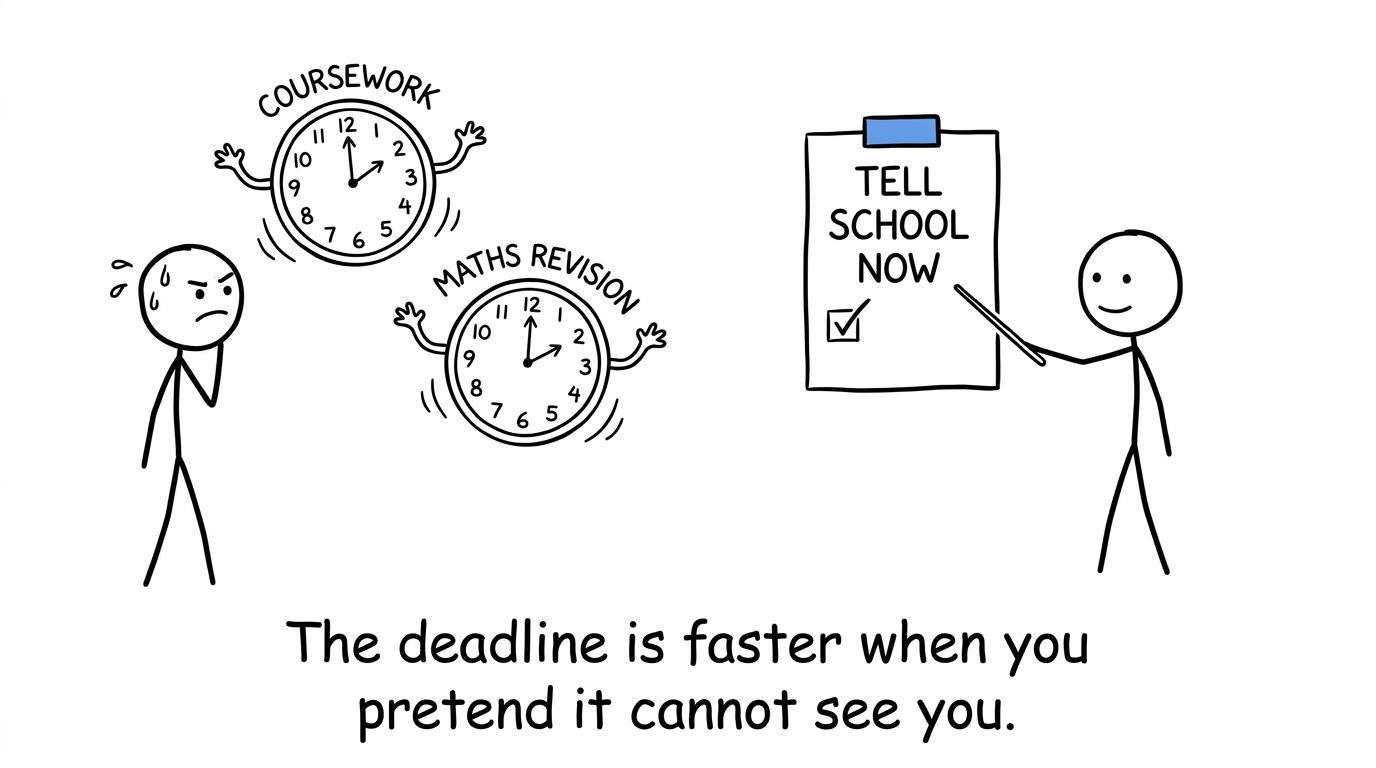 A worried student choosing to tell the school rather than hide from a deadline
What actually happens when coursework is late?
The outcome depends on what you mean by "the deadline". Schools usually set their own hand-in dates before marks must be submitted to the exam board. This gives teachers time to mark work, compare marking across classes, resolve administrative issues and prepare samples for moderation.
You missed the school's internal deadline
This is serious, but it does not always mean the work is permanently excluded. Your teacher may have some time before the school's final submission process. Whether further work can be accepted depends on the remaining timetable, the assessment controls and your school's policy.
A teacher cannot simply ignore exam-board rules because a student asks for more time. Food Preparation and Nutrition non-exam assessment, usually called NEA, must satisfy requirements concerning supervision, authenticity and permitted assistance. Work completed outside those controls may not be eligible for marks.
Only your school can tell you whether its internal deadline can be adjusted. Ask directly rather than relying on what happened to another student.
The final assessment process has closed
If marking, authentication or exam-board submission has been completed, the options are narrower. Your school may have to submit the mark supported by the eligible work available. Missing sections can therefore receive few or no marks.
This does not necessarily mean an automatic failure of the entire GCSE. In the main GCSE Food Preparation and Nutrition specifications, NEA contributes 50%50\%50% of the qualification and the written examination contributes the other 50%50\%50%. However, losing a substantial part of the NEA mark can sharply limit the final grade, even with a strong examination result.
There may also be entry, authentication and minimum-assessment requirements that the school must check. The exams officer should confirm the position for your exam board and examination series.
You submitted something incomplete
An incomplete submission is not the same as no submission. A teacher can normally award marks only for the assessment evidence that genuinely meets the published criteria. A promising plan does not automatically earn marks for practical execution, analysis or evaluation that was never completed.
Do not delete drafts, photographs, planning notes or research records. They may help your teacher identify authentic assessable evidence. Equally, do not add invented dates, fabricated practical evidence or somebody else's material. That could turn a deadline problem into a malpractice concern.
How much could a missed deadline affect your grade?
Food Preparation and Nutrition NEA commonly consists of two assessments. Although terminology should always be checked against your own specification, the weighting is generally divided into a food investigation worth 15%15\%15% of the GCSE and a food preparation assessment worth 35%35\%35%.
Together, that is:
15%+35%=50% 15\% + 35\% = 50\% 15%+35%=50%The written paper supplies the remaining:
100%−50%=50% 100\% - 50\% = 50\% 100%−50%=50%These percentages do not let you calculate a final grade in advance. Grade boundaries are based on marks and can vary by exam board and examination series. They do show why neither reaction is sensible: the missed coursework should not be dismissed as unimportant, but it should not persuade you to give up on the written paper either.
The rational response is to recover every legitimate NEA mark still available and then prepare properly for the examination.
Can the situation be fixed?
Sometimes, but there is no universal late-submission guarantee.
Ask whether there is still an authorised window
Your teacher may be able to accept outstanding material before internal marking and authentication are finalised. Alternatively, the assessment conditions may prevent further work. Ask these precise questions:
- Has the school's internal deadline passed, or the final exam-board deadline?
- Which parts of my existing work can still be assessed?
- Am I permitted to complete anything else?
- Must any remaining practical work be supervised?
- When will marking and authentication close?
A clear question is easier to answer than "Am I going to fail?"
Report serious circumstances promptly
If illness, injury, bereavement or another significant event prevented completion, tell the school and provide whatever evidence it reasonably requests. The school, not the student, decides whether to pursue an authorised adjustment or special consideration under the relevant rules.
Special consideration is not an informal bonus and does not automatically replace missing coursework. Eligibility depends on the circumstances, timing, available assessment evidence and current regulations. Ordinary forgetfulness, poor organisation or choosing to prioritise other work would not normally justify the same response as a documented event outside your control.
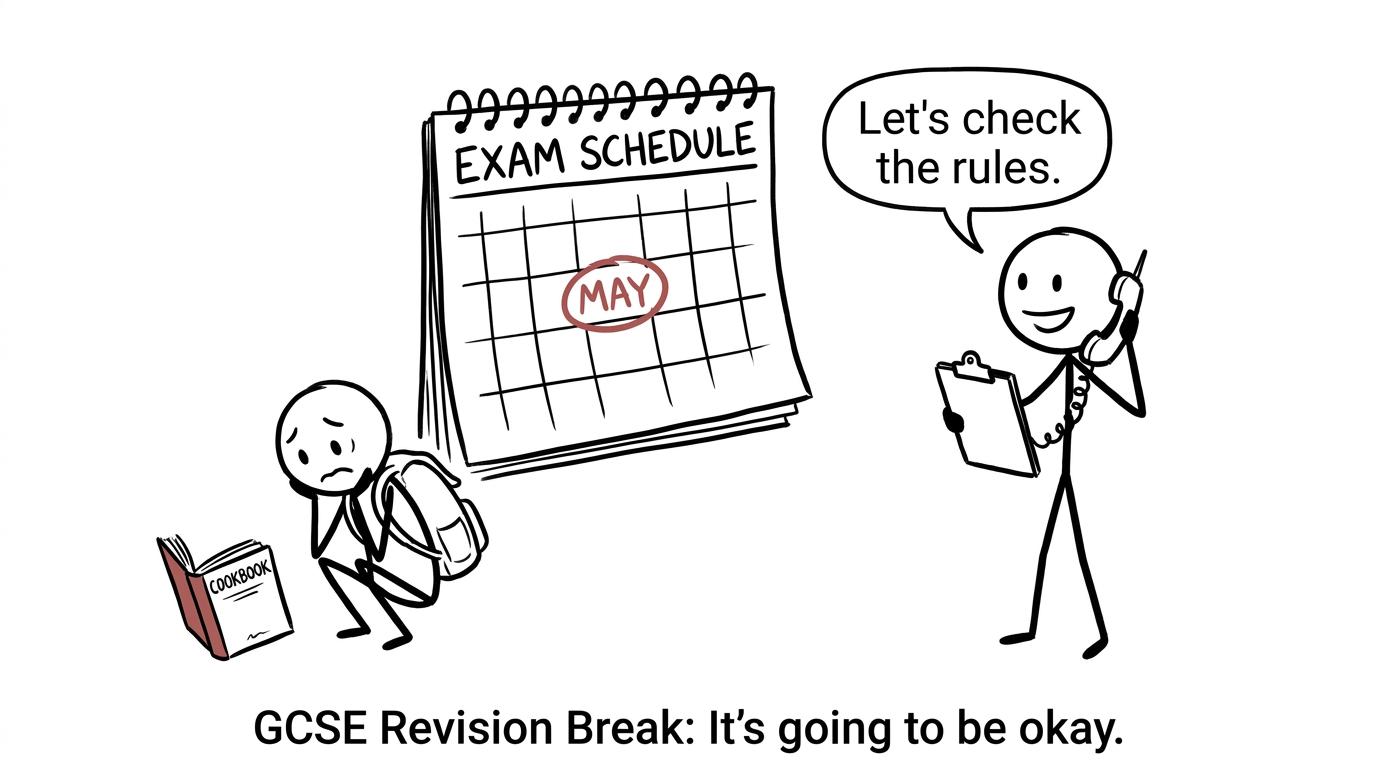 A student hiding from a calendar while an exams officer checks the rules
Involve the exams officer when necessary
Your subject teacher should usually be the first contact. The school's exams officer can then interpret administrative deadlines and the rules applying to AQA, Edexcel, OCR or Eduqas entries.
Parents or carers can help you communicate, particularly where health or personal circumstances are involved. However, sending repeated messages to several members of staff is less useful than giving one accurate account with dates and evidence.
What to write to your teacher
Keep the message short and factual. Include:
- your full name and class;
- the assessment or section affected;
- the deadline you understood applied;
- what has already been completed;
- why the deadline was missed;
- whether supporting evidence exists; and
- a request for the next permitted action.
Do not demand a particular outcome or claim that an extension must be available. You are asking the school to establish what remains possible under the specification.
Managing coursework pressure alongside GCSE maths
A late project can consume every evening because it feels urgent. Yet moving all your time into Food Preparation and Nutrition may create a second problem: neglected maths revision.
Start by separating actions from worries. Contacting your teacher, organising authentic evidence and following an approved completion plan are actions. Repeatedly imagining results day is not.
Then rebuild your timetable around short, defined tasks. MathsGenie's free GCSE maths revision resources organise topics by grade, making it easier to resume revision without deciding from scratch what to cover. Students rebuilding foundation skills can use the grade 111 GCSE topics, while those aiming for a secure pass can concentrate on the grade 444 revision topics. More demanding higher-tier material is available through the grade 777 topic collection.
Once the immediate coursework issue has been reported, place maths sessions back into your revision planner. A manageable session might include one revision lesson, a set of practice questions and a check against the mark scheme. The purpose is consistency, not punishment.
When examinations approach, use GCSE maths past papers to practise full-paper timing and identify weak topics. GCSE predicted papers can provide additional exam-style practice, but they should complement revision rather than encourage guessing about exact questions.
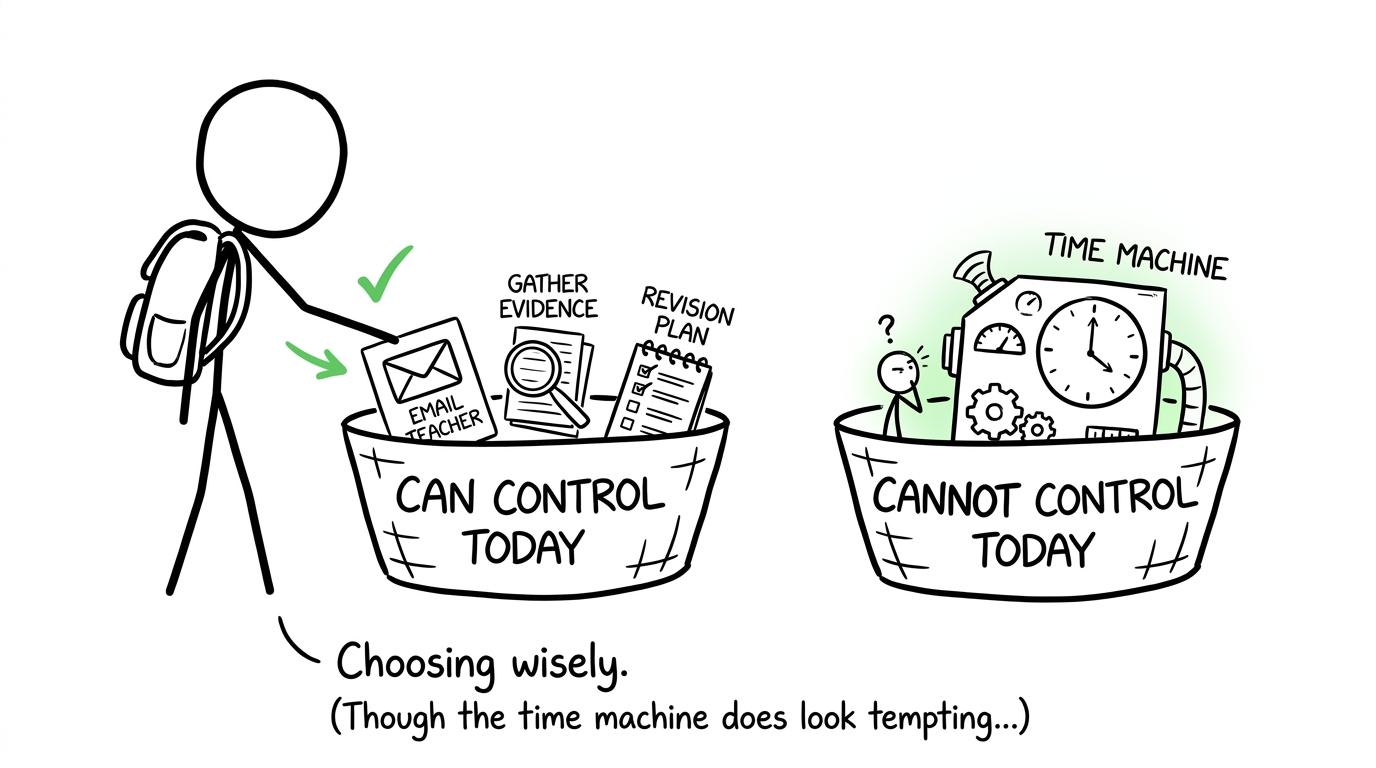 A student choosing useful actions instead of a time machine
Common mistakes after missing the deadline
Avoiding the teacher
Silence uses up whatever flexibility may remain. Teachers cannot investigate an issue they do not know about.
Assuming a friend's outcome applies to you
Another student may have a different exam board, deadline, assessment status or documented circumstance. Ask about your own entry.
Finishing work without permission
Unsupervised additions may fail the assessment's control or authentication requirements. Confirm what you are allowed to do before changing the submission.
Inventing evidence
Changing dates, fabricating practical results or submitting another person's work can create a malpractice issue. Preserve genuine evidence and be honest about what is missing.
Abandoning the written examination
NEA is a major part of the qualification, but the written paper remains important. Continue revising unless your school gives different formal advice.
Letting one deadline damage every subject
Coursework recovery needs a plan, not every available hour. Keep using a revision planner and return to targeted practice. The MathsGenie home page provides quick access to revision lessons, videos and questions, while students thinking beyond GCSE can also explore the free A Level maths revision resources.
Move quickly, then return to the plan
A missed GCSE Food and Nutrition coursework deadline is a problem to report, not a verdict to pronounce on yourself. The school may still have an internal window, may be able to assess completed evidence or may investigate an authorised process where serious circumstances apply. It may also have to tell you that no further work can be accepted.
Whichever answer you receive, knowing it is better than guessing. Contact your teacher, protect genuine evidence and follow the school's instructions. Then return to the work still within your control.
For maths, MathsGenie gives you a clear route back: choose a revision lesson, answer the practice questions, use the mark scheme, watch the video solution and test the topic again. Build towards mini tests, past papers and predicted papers one session at a time. A deadline can disrupt a plan. It does not have to end it.










