Linear Inequalities GCSE Maths: Examples and Practice
Linear inequalities GCSE maths explained with clear worked examples, number lines, common mistakes and exam-style questions to help you practise confidently.
An equation usually gives you a particular answer. An inequality often gives you a whole range. That is the first thing to understand about linear inequalities GCSE maths: solve them using familiar algebra, but keep the inequality sign and describe every value that works. If you multiply or divide both sides by a negative number, reverse the sign.
Imagine a student who keeps losing marks despite getting the algebra nearly right. Sometimes they replace the inequality sign with an equals sign. Sometimes they forget to reverse it. The breakthrough is not a new trick. It is realising that each step must preserve which values make the original statement true.
This guide follows that hypothetical student through the explanation, worked examples and practice that make the idea click.
Your linear inequalities checklist
Before answering a question, check that you can:
- Read the four inequality signs correctly.
- Use inverse operations on both sides.
- Reverse the sign when multiplying or dividing by a negative number.
- Show included and excluded endpoints on a number line.
- Distinguish a range of real values from a list of integer solutions.
MathsGenie's matching GCSE inequalities lesson brings together the topic explanation and practice resources. The method below gives you a starting point before you practise independently.
What is a linear inequality?
An inequality compares expressions rather than saying they are equal:
| Sign | Meaning |
|---|---|
| <<< | Less than |
| >>> | Greater than |
| ≤\leq≤ | Less than or equal to |
| ≥\geq≥ | Greater than or equal to |
For example, x<4x<4x<4 allows any number smaller than 444, including negative numbers and decimals. It does not include 444 itself.
By contrast, x≤4x\leq4x≤4 includes that endpoint.
In these GCSE questions, linear means the variable appears only to the first power, not squared or cubed. Solving the inequality means isolating that variable while keeping the comparison true.
Our imagined student's first mistake is treating the boundary as the only answer. Finding the boundary matters, but the sign tells you which side of it belongs in the solution.
Linear inequalities worked examples
Start with familiar inverse operations
Solve:
3x+5<173x+5<173x+5<17Subtract 555 from both sides:
3x<123x<123x<12Divide both sides by positive 333:
x<4x<4x<4The answer is a range, not x=4x=4x=4. Indeed, substituting x=4x=4x=4 gives 17<1717<1717<17, which is false. Substituting x=3x=3x=3 gives 14<1714<1714<17, which is true.
Checking a value cannot prove the whole solution, but it can expose a reversed sign or an incorrectly included endpoint.
Understand why a negative reverses the sign
Start with a true statement:
2<52<52<5Multiply both sides by −1-1−1:
−2>−5-2>-5−2>−5The order reverses because −2-2−2 lies to the right of −5-5−5 on a number line. This is why the rule exists.
Now solve:
7−2x≥157-2x\geq157−2x≥15Subtract 777 from both sides:
−2x≥8-2x\geq8−2x≥8Divide both sides by −2-2−2, reversing the sign:
x≤−4x\leq-4x≤−4For our hypothetical student, this is the turning point. A negative number appearing somewhere in the question does not automatically reverse the sign. Multiplying or dividing both sides by a negative number does.
Subtracting a number does not reverse it.
To make that distinction stick, use the inequalities Lessons and Question Bank to practise the method while it is fresh.
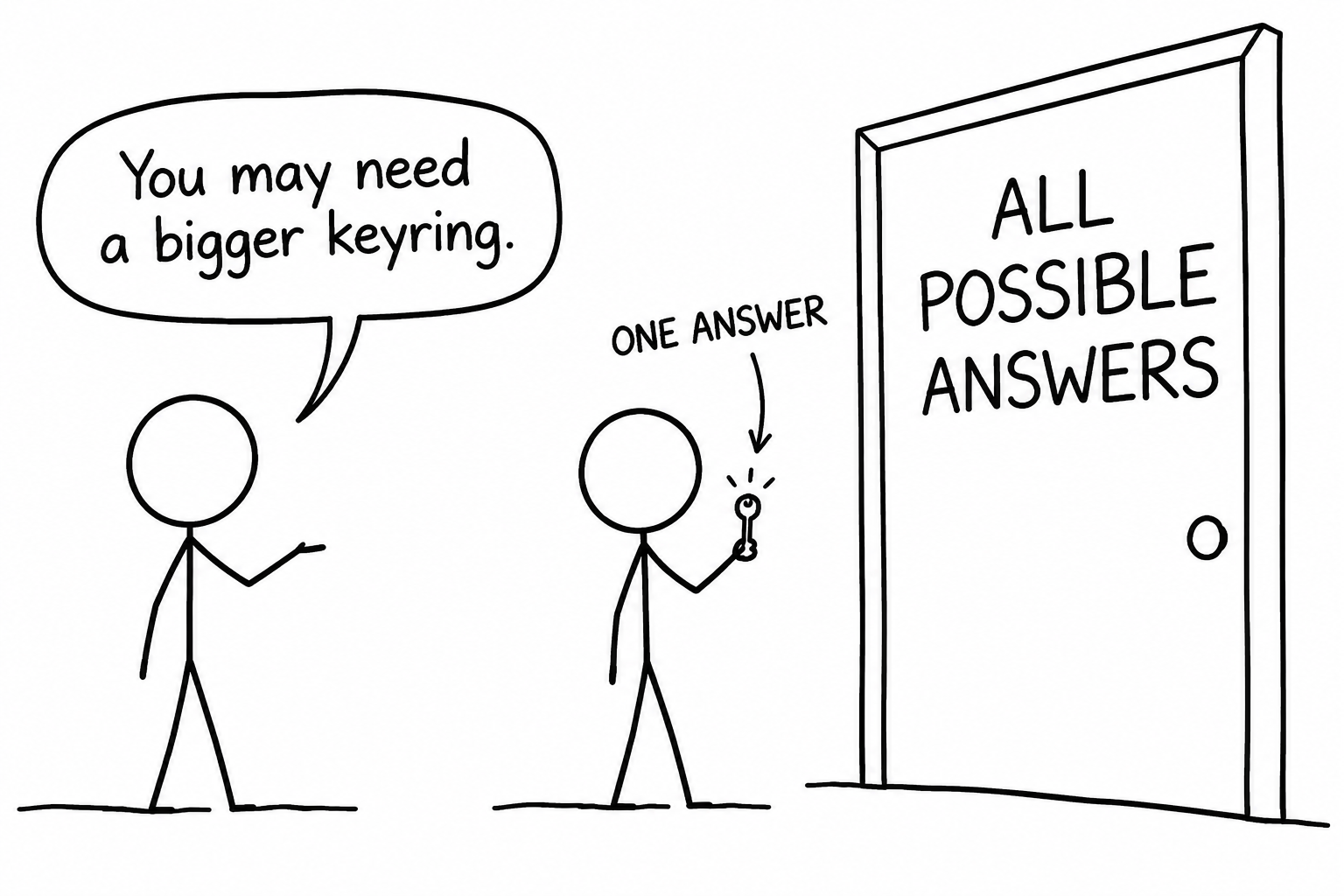 A stick figure discovers that a tiny key labelled one answer is not enough for a door labelled all possible answers.
Handle variables on both sides
Solve:
5x−3≤2x+95x-3\leq2x+95x−3≤2x+9Subtract 2x2x2x from both sides:
3x−3≤93x-3\leq93x−3≤9Add 333, then divide by positive 333:
3x≤123x\leq123x≤12 x≤4x\leq4x≤4Collecting the variable terms on the side with the larger coefficient can make the working simpler. It often avoids dividing by a negative number, although either valid method works.
Number lines and integer solutions
On a number line, the endpoint and the direction communicate different information:
- An open circle means the endpoint is excluded, for <<< or >>>.
- A filled circle means the endpoint is included, for ≤\leq≤ or ≥\geq≥.
- Values less than the endpoint extend left.
- Values greater than the endpoint extend right.
Therefore, x≤−4x\leq-4x≤−4 needs a filled circle at −4-4−4 and a line extending left.
Read the wording carefully when asked for integers. For
−2<x≤3,-2<x\leq3,−2<x≤3,the integer solutions are
−1, 0, 1, 2, 3.-1,\;0,\;1,\;2,\;3.−1,0,1,2,3.The left endpoint is excluded; the right endpoint is included. Without an integer restriction, decimals and fractions within the interval are solutions too.
If you want resources matched to your specification, MathsGenie also has AQA inequalities revision and OCR inequalities revision.
Solving a double inequality
A double inequality places an expression between two boundaries. Whatever operation you apply must affect all three parts.
Solve:
−3<2x+1≤9-3<2x+1\leq9−3<2x+1≤9Subtract 111 throughout:
−4<2x≤8-4<2x\leq8−4<2x≤8Divide throughout by positive 222:
−2<x≤4-2<x\leq4−2<x≤4The solution satisfies both boundaries at once. On a number line, draw an open circle at −2-2−2, a filled circle at 444, and join them.
Our imagined student now has a useful question to ask at every step: “Have I changed every part of the comparison consistently?”
Common mistakes and how to catch them
Writing an equation as the final answer. A boundary value alone does not describe the solution set. Keep the inequality sign visible on every line.
Reversing the sign whenever you see a minus sign. Pause only when multiplying or dividing both sides. Check whether the multiplier or divisor is negative.
Drawing the circle correctly but shading the wrong direction. Choose a value from the shaded region and substitute it into the original inequality. A false statement signals a problem.
Listing integers when the question asks you to solve. Unless the question restricts the answers to integers, give the full inequality.
Changing only two parts of a double inequality. Write each operation beneath all three parts if that helps you maintain the balance.
When checking against worked solutions, identify the first line where your reasoning differs. That tells you more than simply replacing your final answer.
Linear inequalities questions: exam-style practice
Try these without looking at the answers. Show each algebraic step, even when you could do it mentally.
- Positive coefficient: Solve 4x−7>94x-7>94x−7>9.
- Negative coefficient: Solve 6−3x≤186-3x\leq186−3x≤18.
- Variables on both sides: Solve 7x+2<3x+187x+2<3x+187x+2<3x+18.
- Double inequality: Solve −5≤3x+1<10-5\leq3x+1<10−5≤3x+1<10.
- Integer solutions: List the integers satisfying −3<x≤2-3<x\leq2−3<x≤2.
Answers and checks
- 4x>164x>164x>16, so x>4x>4x>4.
- −3x≤12-3x\leq12−3x≤12, so x≥−4x\geq-4x≥−4. Division by negative 333 reverses the sign.
- 4x<164x<164x<16, so x<4x<4x<4.
- −6≤3x<9-6\leq3x<9−6≤3x<9, so −2≤x<3-2\leq x<3−2≤x<3.
- The integers are −2,−1,0,1,2-2,-1,0,1,2−2,−1,0,1,2.
For each incorrect answer, name the error before attempting another question. Was it arithmetic, sign reversal, or interpreting the solution? That small diagnosis makes your next attempt purposeful.
Turn understanding into reliable marks
Our hypothetical student's breakthrough is a repeatable habit: solve carefully, explain the sign, then check what the answer means. You now have that method, but recognising it is different from applying it independently under exam conditions. Start your next practice session with MathsGenie's inequalities Lessons and Question Bank, focusing on the mistake you identified.