Inequalities (A-Level) A-Level Maths Explained
Inequalities (A-Level) A-Level Maths explained with clear methods, worked examples, common mistakes and exam-style questions for confident revision.
A student can solve an equation perfectly and still feel lost when the equals sign becomes an inequality sign. The algebra looks familiar, but the answer is no longer one value. It might be an interval, two separate regions or every real number except a forbidden value.
That is the central idea behind inequalities (A-Level) A-Level Maths: you are finding a set of values that makes a statement true. The safest method is to move everything to one side, identify the critical values, test the resulting intervals and present the solution precisely.
Your inequalities checklist
Before looking at the different types, keep this process beside you:
- rearrange the inequality into a useful form;
- find the critical values where the expression is zero or undefined;
- place those values on a number line;
- determine the sign in each interval;
- include or exclude boundary values carefully;
- state the final answer using inequalities or interval notation.
This turns an inequality from a guessing exercise into a repeatable method.
Linear inequalities
A linear inequality is solved much like a linear equation. You may add or subtract the same expression on both sides without changing the inequality. You may also multiply or divide both sides by a positive value.
There is one important exception: multiplying or dividing by a negative value reverses the inequality sign.
Worked example: solving a linear inequality
Solve:
5−3x<17.5-3x<17.5−3x<17.Subtract 555 from both sides:
−3x<12.-3x<12.−3x<12.Divide by −3-3−3. Because this is negative, reverse the inequality:
x>−4.x>-4.x>−4.The sign reversal is not an arbitrary rule. If 2<52<52<5, multiplying both numbers by −1-1−1 gives −2>−5-2>-5−2>−5. Their positions on the number line have reversed.
Quadratic inequalities
Quadratic inequalities are not solved by finding the roots and choosing the space between them automatically. The roots divide the number line into intervals, but you must still determine where the quadratic has the required sign.
Worked example: a quadratic inequality
Solve:
x2−x−6≤0.x^2-x-6\leq 0.x2−x−6≤0.Factorise the quadratic:
(x−3)(x+2)≤0.(x-3)(x+2)\leq 0.(x−3)(x+2)≤0.The critical values are:
x=−2andx=3.x=-2 \quad \text{and} \quad x=3.x=−2andx=3.These create three intervals:
x<−2,−2<x<3,x>3.x<-2, \qquad -2<x<3, \qquad x>3.x<−2,−2<x<3,x>3.Test one value from each interval. Using x=−3x=-3x=−3, x=0x=0x=0 and x=4x=4x=4 gives:
| Interval | Test value | Sign of (x−3)(x+2)(x-3)(x+2)(x−3)(x+2) |
|---|---|---|
| x<−2x<-2x<−2 | x=−3x=-3x=−3 | Positive |
| −2<x<3-2<x<3−2<x<3 | x=0x=0x=0 | Negative |
| x>3x>3x>3 | x=4x=4x=4 | Positive |
We need values for which the expression is negative or zero. Therefore:
−2≤x≤3.-2\leq x\leq 3.−2≤x≤3.Both roots are included because the original inequality contains ≤\leq≤.
A sketch offers another way to see this. The graph y=x2−x−6y=x^2-x-6y=x2−x−6 is an upward-opening parabola crossing the xxx-axis at −2-2−2 and 333. It lies on or below the axis between those roots.
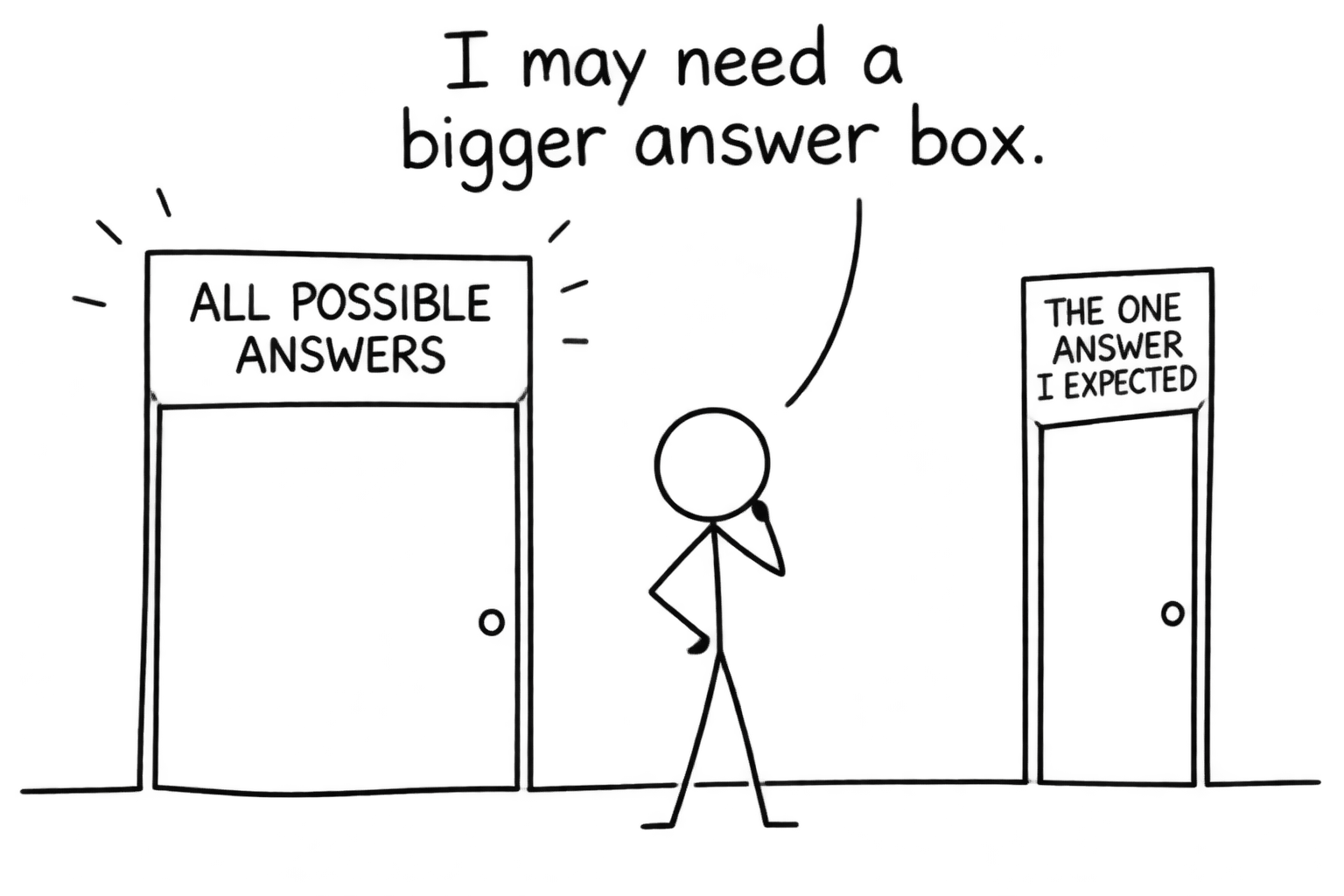 A student discovers that inequality answers can occupy a surprisingly large space
Inequalities that do not factorise neatly
The same method works when a quadratic does not factorise. Find its roots with the quadratic formula:
x=−b±b2−4ac2a.x=\frac{-b\pm\sqrt{b^2-4ac}}{2a}.x=2a−b±b2−4ac.Then use the roots to divide the number line and decide where the quadratic is positive or negative. You may do this with a sketch or test values, but the final interval must match the original inequality.
If the discriminant is negative, the quadratic has no real roots. Its sign is then determined by the coefficient of x2x^2x2. For example, if a>0a>0a>0 and b2−4ac<0b^2-4ac<0b2−4ac<0, then ax2+bx+cax^2+bx+cax2+bx+c is positive for every real xxx.
Once this routine is clear, use the MathsGenie A Level Maths revision lessons to connect each step with focused questions and solutions rather than rebuilding a practice set yourself.
Rational inequalities
A rational inequality contains an algebraic fraction. Its critical values include values that make the numerator zero and values that make the denominator zero.
A denominator can never equal zero. These excluded values must not appear in the solution, even when the inequality contains ≤\leq≤ or ≥\geq≥.
Worked example: a rational inequality
Solve:
x−1x+2>0.\frac{x-1}{x+2}>0.x+2x−1>0.The expression is zero when:
x−1=0 ⟹ x=1.x-1=0 \implies x=1.x−1=0⟹x=1.It is undefined when:
x+2=0 ⟹ x=−2.x+2=0 \implies x=-2.x+2=0⟹x=−2.The critical values create three intervals:
x<−2,−2<x<1,x>1.x<-2, \qquad -2<x<1, \qquad x>1.x<−2,−2<x<1,x>1.Now test the sign in each interval:
| Interval | Test value | Sign of the fraction |
|---|---|---|
| x<−2x<-2x<−2 | x=−3x=-3x=−3 | Positive |
| −2<x<1-2<x<1−2<x<1 | x=0x=0x=0 | Negative |
| x>1x>1x>1 | x=2x=2x=2 | Positive |
The required solution is therefore:
x<−2orx>1.x<-2 \quad \text{or} \quad x>1.x<−2orx>1.Neither boundary is included. The value x=−2x=-2x=−2 makes the denominator zero, while x=1x=1x=1 makes the fraction equal to zero rather than greater than zero.
Do not simply multiply both sides by x+2x+2x+2. Its sign is unknown, so you would not know whether the inequality should reverse. A sign table avoids that risk.
Inequalities involving a modulus
The modulus ∣x∣|x|∣x∣ represents distance from zero. More generally, ∣x−a∣|x-a|∣x−a∣ is the distance between xxx and aaa.
For k>0k>0k>0:
∣x−a∣<k ⟺ a−k<x<a+k,|x-a|<k \iff a-k<x<a+k,∣x−a∣<k⟺a−k<x<a+k,while:
∣x−a∣>k ⟺ x<a−korx>a+k.|x-a|>k \iff x<a-k \quad \text{or} \quad x>a+k.∣x−a∣>k⟺x<a−korx>a+k.Worked example: a modulus inequality
Solve:
∣2x−3∣≤5.|2x-3|\leq 5.∣2x−3∣≤5.Write the corresponding compound inequality:
−5≤2x−3≤5.-5\leq 2x-3\leq 5.−5≤2x−3≤5.Add 333 throughout:
−2≤2x≤8.-2\leq 2x\leq 8.−2≤2x≤8.Divide throughout by 222:
−1≤x≤4.-1\leq x\leq 4.−1≤x≤4.This represents all values of xxx for which 2x−32x-32x−3 lies no more than 555 units from zero.
Common mistakes in A Level inequalities
Forgetting to reverse the sign
When multiplying or dividing an inequality by a negative number, reverse the sign. Write this reversal as its own line so it cannot disappear inside mental arithmetic.
Assuming the answer lies between the roots
That depends on the inequality and the shape of the graph. Use a sign table or sketch rather than relying on memory.
Including an undefined value
A denominator of zero is never permitted. Mark these critical values as excluded before testing intervals.
Multiplying by an expression with an unknown sign
In a rational inequality, multiplying by an algebraic denominator may require the inequality to reverse. Rearranging into one fraction and using intervals is safer.
Giving roots instead of a solution set
The roots are usually boundaries, not the whole answer. An exam question on inequalities expects the interval or intervals where the statement is true.
Exam-style practice
Try these without looking back at the worked examples:
- Solve 7−2x≥157-2x\geq 157−2x≥15.
- Solve x2+2x−15<0x^2+2x-15<0x2+2x−15<0.
- Solve 2x2−x−6≥02x^2-x-6\geq 02x2−x−6≥0.
- Solve x+3x−2≤0\frac{x+3}{x-2}\leq 0x−2x+3≤0.
- Solve ∣3x+1∣<7|3x+1|<7∣3x+1∣<7.
Answers:
- x≤−4x\leq -4x≤−4.
- −5<x<3-5<x<3−5<x<3.
- x≤−32x\leq -\frac{3}{2}x≤−23 or x≥2x\geq 2x≥2.
- −3≤x<2-3\leq x<2−3≤x<2.
- −83<x<2-\frac{8}{3}<x<2−38<x<2.
For each one, ask three questions: what are the critical values, which intervals have the required sign, and which boundaries are allowed? Those checks matter in inequalities (A-Level) exam questions, where a correct method can still lose the final mark through an imprecise solution set.
Turn the method into marks
Understanding the sign table is the first step; producing it accurately under exam pressure takes deliberate practice. Use the MathsGenie A Level lessons and Question Bank to practise linear, quadratic, rational and modulus inequalities with the method fresh in your mind. Start the inequalities lesson, then answer the matching Question Bank set.