

Indices GCSE Maths Resit: Reach Grade 4
Indices GCSE maths resit revision made clear: learn grade 4 index laws, follow two worked examples, avoid lost marks and build targeted practice today.
A resit can make familiar maths feel heavier than it really is. You may remember seeing powers before, yet hesitate when several appear in one expression. For indices GCSE maths resit questions, the route forward is quite contained: understand what an index means, learn a small set of laws, then practise recognising which law a question needs.
That is the goal here. You will learn the index laws commonly needed around grade 4, follow two exam-style worked examples and see which mistakes can quietly cost marks.
Your indices grade 4 checklist
Before attempting mixed GCSE maths resit revision, make sure you can:
- recognise the base and index in a power
- evaluate positive integer powers
- multiply powers with the same base
- divide powers with the same base
- raise a power to another power
- use the zero index law
- interpret a negative index
- show enough working for a marker to follow your method
Start with the MathsGenie indices revision lesson, which brings together lessons, videos and exam-style practice. OCR students can use the corresponding OCR indices revision resources.
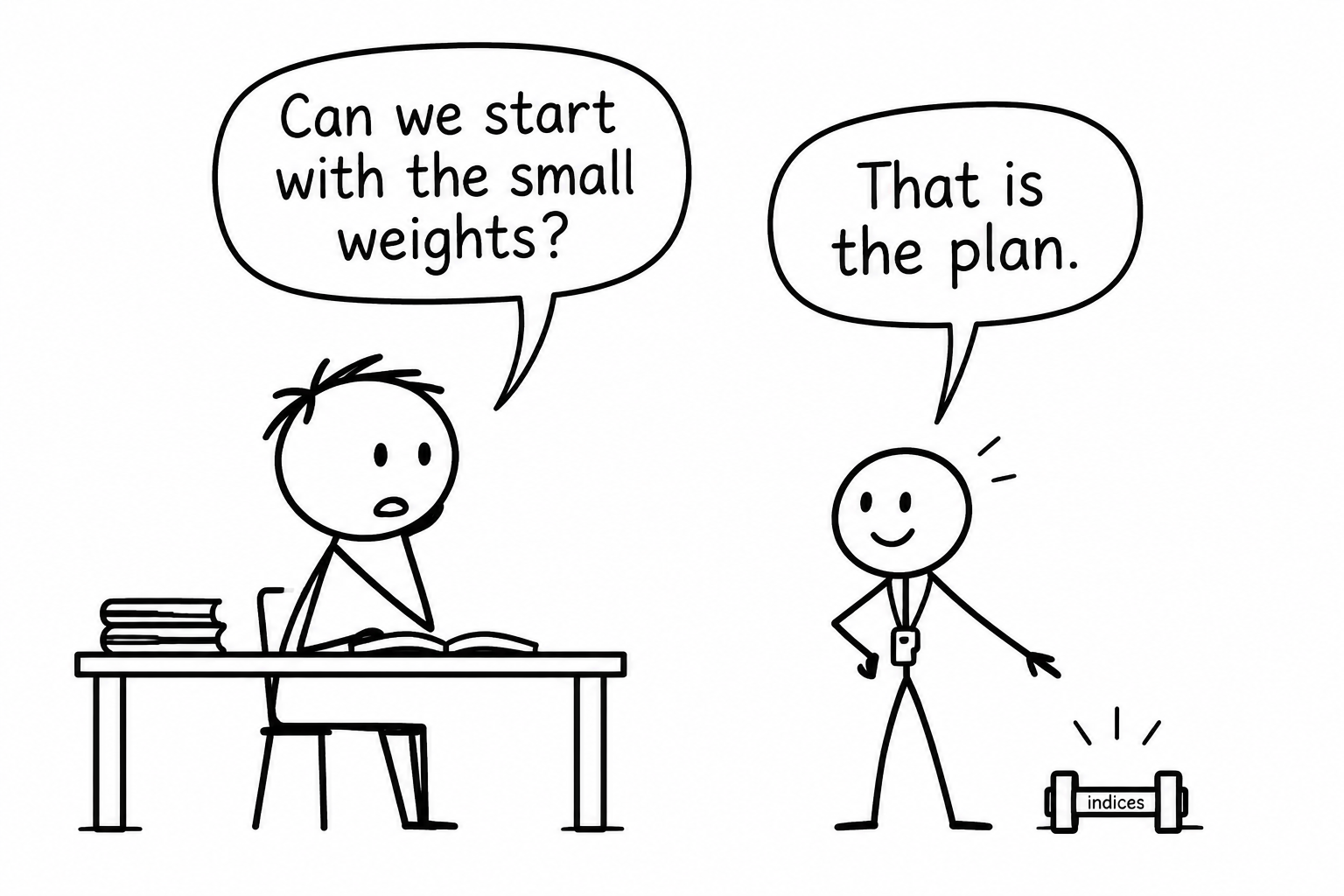 A post-16 student choosing manageable indices revision
What does an index mean?
In the expression 535^353, the number 555 is the base and 333 is the index, sometimes called the power. It means that 555 is multiplied by itself three times:
53=5×5×5=1255^3 = 5 \times 5 \times 5 = 12553=5×5×5=125The index is not a number that you multiply the base by. In particular:
53≠5×35^3 \ne 5 \times 353=5×3This simple distinction matters because every index law is built on repeated multiplication.
The index laws you need to know
The most important detail is that the bases must be the same before you combine indices.
| Situation | Index law | What happens |
|---|---|---|
| Multiplying equal bases | am×an=am+na^m \times a^n = a^{m+n}am×an=am+n | Add the indices |
| Dividing equal bases | am÷an=am−na^m \div a^n = a^{m-n}am÷an=am−n | Subtract the indices |
| A power raised to a power | (am)n=amn(a^m)^n = a^{mn}(am)n=amn | Multiply the indices |
| Zero index | a0=1a^0 = 1a0=1 | The value is 111, provided a≠0a \ne 0a=0 |
| Negative index | a−n=1ana^{-n} = \frac{1}{a^n}a−n=an1 | Take the reciprocal |
These laws are short, but they are not interchangeable. The operation tells you what to do. Multiplication leads to addition, division leads to subtraction, and an outer power leads to multiplication.
A useful habit is to write the relevant index calculation before simplifying. That one line can prevent a memory slip and may also show a valid method if the final answer goes wrong.
Worked example: simplifying equal bases
Question: Simplify fully:
2p7×3p2p4\frac{2p^7 \times 3p^2}{p^4}p42p7×3p2First multiply the numerical coefficients:
2×3=62 \times 3 = 62×3=6The powers all have the same base, ppp. Add the indices when multiplying, then subtract the index when dividing:
p7+2−4=p5p^{7+2-4} = p^5p7+2−4=p5Therefore:
2p7×3p2p4=6p5\frac{2p^7 \times 3p^2}{p^4} = 6p^5p42p7×3p2=6p5Notice that the coefficients and powers were handled separately. A common error is to change 2×32 \times 32×3 into 2+32+32+3 because the indices are being added. The index law applies to the powers of ppp, not to the ordinary numbers in front.
If collecting terms still feels uncertain, revisit simplifying algebra on MathsGenie before returning to indices.
Worked example: zero and negative indices
Question: Work out:
30+3−23^0 + 3^{-2}30+3−2Use the zero index law first:
30=13^0 = 130=1A negative index means take the reciprocal. It does not make the value negative:
3−2=132=193^{-2} = \frac{1}{3^2} = \frac{1}{9}3−2=321=91Now add the two values:
1+19=99+19=1091 + \frac{1}{9} = \frac{9}{9} + \frac{1}{9} = \frac{10}{9}1+91=99+91=910So the answer is:
109\frac{10}{9}910This example contains two facts worth memorising: a non-zero number to the power zero equals 111, and a negative index creates a reciprocal.
How to recognise the right law
Indices become easier when you pause before calculating. Ask three questions:
- Are the bases the same?
- What operation connects the powers?
- Is there a power outside brackets?
For example, x4×x3x^4 \times x^3x4×x3 has equal bases and multiplication, so the indices are added. By contrast, (x4)3(x^4)^3(x4)3 has an outer power, so the indices are multiplied.
You cannot use the same-base multiplication law on 23×532^3 \times 5^323×53 by adding the indices. The bases differ. You could instead use the shared power:
23×53=(2×5)3=1032^3 \times 5^3 = (2 \times 5)^3 = 10^323×53=(2×5)3=103That is a different structure. Reading the expression before reaching for a rule is often the difference between gaining and losing the mark.
Mistakes that cost marks
Adding indices when there is addition
The law am×an=am+na^m \times a^n = a^{m+n}am×an=am+n applies to multiplication, not addition. In general:
am+an≠am+na^m + a^n \ne a^{m+n}am+an=am+nFor instance, x2+x3x^2+x^3x2+x3 cannot be simplified into one power.
Using an index law with different bases
You may simplify y6÷y2y^6 \div y^2y6÷y2 because both powers have base yyy. You cannot subtract the indices in y6÷z2y^6 \div z^2y6÷z2.
Adding instead of multiplying in brackets
For a power raised to a power:
(a3)4=a12(a^3)^4 = a^{12}(a3)4=a12The indices are multiplied, not added.
Writing a0=0a^0=0a0=0
For a non-zero base:
a0=1a^0=1a0=1The zero is the index. It does not mean the entire expression becomes zero.
Treating a negative index as a negative value
The expression 4−24^{-2}4−2 is not −16-16−16. It is:
4−2=142=1164^{-2}=\frac{1}{4^2}=\frac{1}{16}4−2=421=161Hiding every step
A calculator may evaluate a numerical power, but it does not explain an algebraic simplification. Write the index operation clearly, particularly on questions worth more than one mark.
A focused resit revision routine
A resit timetable has to fit around the rest of life. Short, targeted sessions are often more manageable than reopening an entire textbook without a plan.
Try this sequence:
- watch the indices lesson and write the five laws from memory
- complete a small set of practice questions without notes
- mark the work and label each error by type
- repeat only the question types that caused difficulty
- return to the topic two or three days later for a mini test
- add mixed questions once the individual laws feel secure
MathsGenie gives you free revision lessons, practice questions, video solutions, past papers and mark schemes through its GCSE Maths revision resources. You can also create a realistic schedule with the free revision planner and check where indices sit alongside other content using the GCSE Maths topics guide.
Turn the method into marks
A grade is built from many small decisions. On indices questions, those decisions are unusually visible: check the bases, identify the operation, choose the law and show the step.
Once you can do that reliably, move beyond isolated exercises. Use the MathsGenie Mock Exam Builder to build a targeted practice paper from past-paper questions. Complete it under exam conditions, mark it carefully, then return to the exact law behind each lost mark. That cycle turns indices from a remembered weakness into a dependable part of your grade 4 toolkit.















