Index Laws (A-Level): A-Level Maths Explained
Index laws (A-Level) made clear with rational powers, step-by-step worked examples, common mistakes and exam-style practice for A-Level Maths students.
A sixth-form student can recognise every index law on a formula sheet and still hesitate when the indices become fractions, negatives or algebraic expressions. The rules look familiar; the questions do not.
This guide explains index laws (A-Level) A-Level Maths students need for simplifying expressions and solving equations. The central idea is simple: multiplication adds indices, division subtracts them, and raising a power to another power multiplies them. The challenge is knowing which rule applies and using it without losing a sign.
Index laws checklist
At A-Level, you should be able to:
- multiply and divide powers with the same base;
- raise a power to another power;
- interpret zero and negative indices;
- move between fractional indices and roots;
- simplify expressions containing numerical and algebraic factors;
- solve equations by rewriting terms with a common base;
- state necessary restrictions, such as a denominator being non-zero.
Official A-Level Maths content requires students to understand and use index laws for rational exponents. That means the exponent may be any rational number, including an integer, a fraction or a negative fraction.
You can study the topic directly through the Edexcel AS negative and fractional indices lesson. OCR students can use the matching OCR A-Level indices lesson.
The index laws you need to know
For the following three laws, the base must be the same:
am×an=am+na^m \times a^n=a^{m+n}am×an=am+n aman=am−n,a≠0\frac{a^m}{a^n}=a^{m-n}, \qquad a\ne 0anam=am−n,a=0 (am)n=amn\left(a^m\right)^n=a^{mn}(am)n=amnThere are three further facts that appear frequently:
a0=1,a≠0a^0=1, \qquad a\ne 0a0=1,a=0 a−n=1an,a≠0a^{-n}=\frac{1}{a^n}, \qquad a\ne 0a−n=an1,a=0 amn=amn=(an)ma^{\frac{m}{n}}=\sqrt[n]{a^m}=\left(\sqrt[n]{a}\right)^manm=nam=(na)mFor standard A-Level work with fractional indices, the base is usually assumed to be positive unless the question gives a setting in which a real-valued root of a negative number is valid.
The laws are easier to remember when they are connected rather than treated as six isolated instructions. A negative index describes a reciprocal. A fractional index describes a root. Neither changes the underlying rules for multiplying, dividing or raising powers.
A reliable method for index questions
When an expression looks complicated, use this sequence:
- identify the base of each power;
- deal with any brackets by multiplying indices;
- rewrite roots and reciprocals as powers if that helps;
- combine only terms with the same base;
- make the final answer match the form requested;
- check restrictions caused by denominators or even roots.
This order prevents a common problem: trying to simplify the whole expression mentally and applying two rules at once.
You now have the method; use the Maths Genie A-Level Maths lessons and topic resources to practise each step before moving to mixed exam questions.
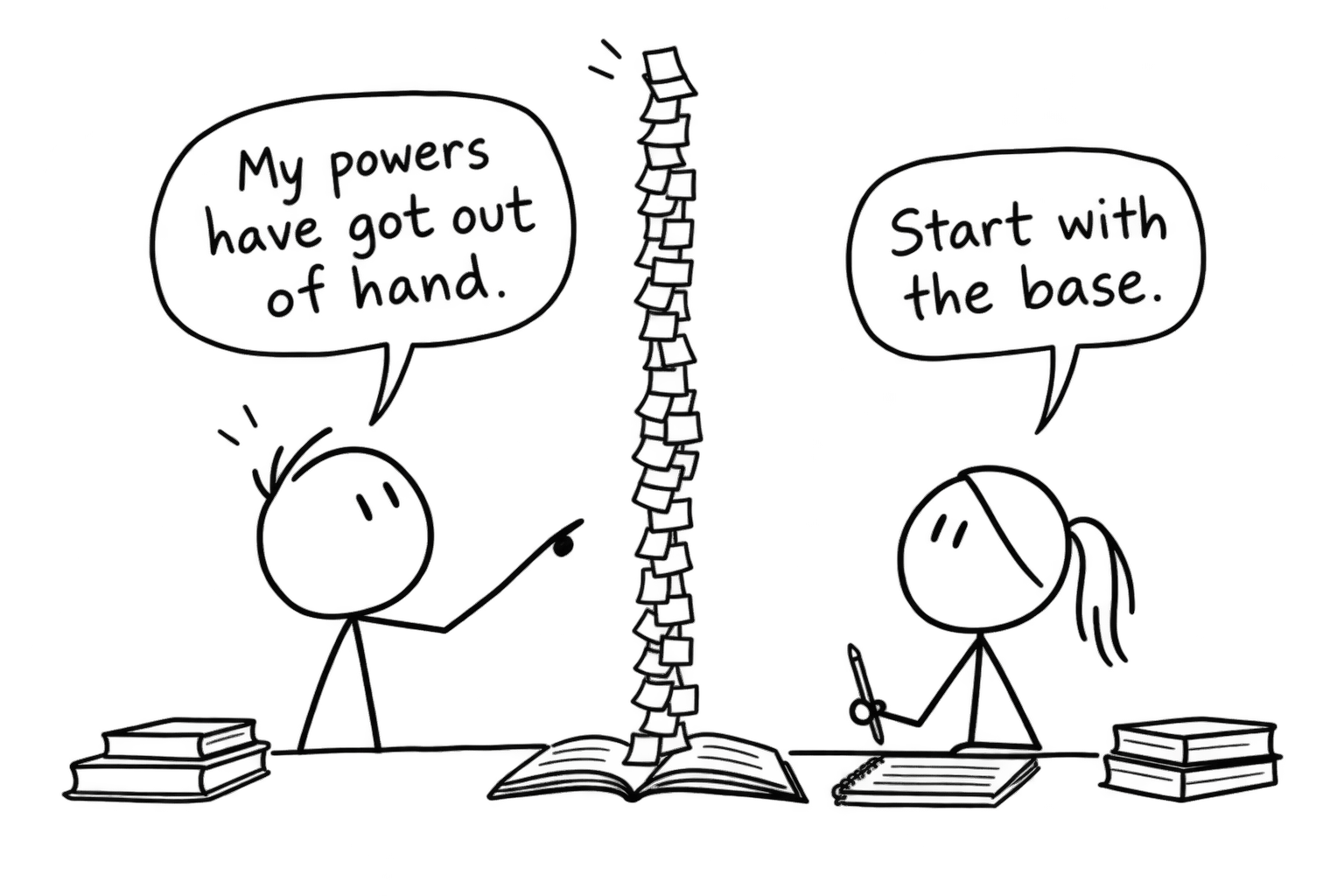 Two sixth-form students joke about powers getting out of hand during revision
Index laws (A-Level) worked examples
Simplifying powers with the same base
Simplify:
x7×x−2x3\frac{x^7\times x^{-2}}{x^3}x3x7×x−2First combine the powers in the numerator:
x7×x−2=x7+(−2)=x5x^7\times x^{-2}=x^{7+(-2)}=x^5x7×x−2=x7+(−2)=x5Then divide powers with the same base:
x5x3=x5−3=x2\frac{x^5}{x^3}=x^{5-3}=x^2x3x5=x5−3=x2Therefore:
x7×x−2x3=x2,x≠0\frac{x^7\times x^{-2}}{x^3}=x^2, \qquad x\ne 0x3x7×x−2=x2,x=0The restriction matters because the original expression contains division by x3x^3x3.
Using a power of a power
Simplify:
(4a−3b2)2\left(4a^{-3}b^2\right)^2(4a−3b2)2The outer index applies to every factor inside the bracket:
42(a−3)2(b2)24^2\left(a^{-3}\right)^2\left(b^2\right)^242(a−3)2(b2)2Multiply the indices:
16a−6b416a^{-6}b^416a−6b4A final answer is usually clearer with positive indices:
16b4a6,a≠0\frac{16b^4}{a^6}, \qquad a\ne 0a616b4,a=0Notice that the numerical coefficient is squared too. The outside power does not apply only to the letters.
Simplifying a fractional index
Evaluate:
642364^{\frac{2}{3}}6432The denominator of the index gives the root, while the numerator gives the power:
6423=(643)264^{\frac{2}{3}}=\left(\sqrt[3]{64}\right)^26432=(364)2Since 643=4\sqrt[3]{64}=4364=4:
6423=42=1664^{\frac{2}{3}}=4^2=166432=42=16Taking the cube root first keeps the arithmetic manageable. Raising 646464 to the power of 222 first would be valid, but inefficient.
Combining negative and fractional indices
Simplify:
81−3481^{-\frac{3}{4}}81−43The negative index means take the reciprocal:
81−34=1813481^{-\frac{3}{4}}=\frac{1}{81^{\frac{3}{4}}}81−43=81431Now use the fourth root:
8134=(814)3=33=2781^{\frac{3}{4}}=\left(\sqrt[4]{81}\right)^3=3^3=278143=(481)3=33=27Therefore:
81−34=12781^{-\frac{3}{4}}=\frac{1}{27}81−43=271A negative index does not make the value negative. It creates a reciprocal.
Solving equations using index laws
Index laws become especially useful when every term can be written with the same base.
Solve:
8x+1=42x−18^{x+1}=4^{2x-1}8x+1=42x−1Write both sides as powers of 222:
(23)x+1=(22)2x−1\left(2^3\right)^{x+1}=\left(2^2\right)^{2x-1}(23)x+1=(22)2x−1Multiply the indices:
23(x+1)=22(2x−1)2^{3(x+1)}=2^{2(2x-1)}23(x+1)=22(2x−1)Equal powers with the same valid base have equal indices, so:
3(x+1)=2(2x−1)3(x+1)=2(2x-1)3(x+1)=2(2x−1)Expand and solve:
3x+3=4x−23x+3=4x-23x+3=4x−2 x=5x=5x=5Substitution provides a quick check. When x=5x=5x=5, both sides equal 2182^{18}218.
This common-base technique should be considered before logarithms. If no convenient common base exists, logarithms may be the appropriate later method.
Index laws (A-Level) exam questions
Exam questions rarely announce which law to use. Instead, the skill is placed inside algebra, surds, functions or exponentials. Build confidence in stages:
- simplify one expression involving integer indices;
- repeat with negative indices;
- include fractional indices and roots;
- solve equations by finding a common base;
- finish with mixed questions under timed conditions.
Try these exam-style prompts before checking any solution:
- Simplify p52p−1p12\dfrac{p^{\frac{5}{2}}p^{-1}}{p^{\frac{1}{2}}}p21p25p−1, where p>0p>0p>0.
- Write (27x6)23\left(27x^6\right)^{\frac{2}{3}}(27x6)32 in its simplest form, where x>0x>0x>0.
- Solve 9x−1=272x+19^{x-1}=27^{2x+1}9x−1=272x+1.
The answers are ppp, 9x49x^49x4 and x=−5x=-5x=−5 respectively. Your working should show the applicable law, not only the final answer.
Once individual questions feel secure, use the Edexcel A-Level Maths Question Bank to move from routine simplification to exam-style selection. Related AS Level surds revision is useful because fractional indices and roots often appear together.
Common mistakes with index laws
Adding bases instead of indices
The product rule applies when the bases match:
am×an=am+na^m\times a^n=a^{m+n}am×an=am+nIt does not mean that am×bma^m\times b^mam×bm becomes (a+b)m(a+b)^m(a+b)m. In fact:
am×bm=(ab)ma^m\times b^m=(ab)^mam×bm=(ab)mMultiplying indices during ordinary multiplication
Students sometimes write a3×a4=a12a^3\times a^4=a^{12}a3×a4=a12. Multiplying indices is reserved for a power raised to another power:
(a3)4=a12\left(a^3\right)^4=a^{12}(a3)4=a12For ordinary multiplication, add them:
a3×a4=a7a^3\times a^4=a^7a3×a4=a7Treating a negative index as a negative value
The expression a−2a^{-2}a−2 is not −a2-a^2−a2. It means:
a−2=1a2a^{-2}=\frac{1}{a^2}a−2=a21Applying an outside power selectively
In (3x2)4\left(3x^2\right)^4(3x2)4, both factors must be raised to the fourth power:
(3x2)4=34x8=81x8\left(3x^2\right)^4=3^4x^8=81x^8(3x2)4=34x8=81x8Ignoring the requested form
An answer such as x−3x^{-3}x−3 may be mathematically equivalent to 1x3\dfrac{1}{x^3}x31, but a question may ask for positive indices. Read the final instruction before stopping.
Turn understanding into reliable marks
Knowing the rules is only the first step; the gap is applying the right rule when several powers appear in one question. Build that habit with the matching Maths Genie Lessons, then move directly into the Question Bank while each method is fresh. Start the index laws lesson and complete a focused set from the Question Bank.