

IGCSE Further Pure Grade Boundaries Explained
IGCSE further pure grade boundaries explained using June 2025 Edexcel marks, paper totals and clear revision advice for students and parents today.
Picture a student walking out of the second Further Pure Maths paper. They remember the question they could not finish, but forget the six demanding questions they handled well. At home, a parent searches for IGCSE further pure grade boundaries, hoping one table will turn uncertainty into an answer.
Here is the direct answer. For Edexcel International GCSE Further Pure Mathematics, qualification code 4PM1, the official June 2025 boundary for a grade 999 was 173173173 marks out of 200200200 for papers 01 and 02. A grade 888 required 156156156, while a grade 777 required 140140140. The regional papers, 01R and 02R, had different boundaries. These figures apply only to that dated exam series and must not be treated as guaranteed boundaries for another year.
The boundaries at a glance
The official Pearson Edexcel June 2025 subject boundaries were:
| Paper route | Maximum mark | Grade 999 | Grade 888 | Grade 777 | Grade 666 | Grade 555 | Grade 444 | Grade 333 | | --- | --- | --- | --- | --- | --- | --- | --- | --- | --- | | June 2025 papers 01 and 02 | 200200200 | 173173173 | 156156156 | 140140140 | 113113113 | 868686 | 606060 | 474747 | | June 2025 papers 01R and 02R | 200200200 | 184184184 | 164164164 | 145145145 | 120120120 | 969696 | 727272 | 606060 |
A useful checklist is:
- confirm that the qualification code is 4PM1;
- check whether the student sat papers 01 and 02 or the regional 01R and 02R papers;
- add the marks from both papers before comparing the total with the subject boundary;
- use the boundary from the correct exam series;
- treat older boundaries as evidence, not as a promise about a future result.
Students can use the free Edexcel IGCSE Maths revision resources to strengthen the underlying algebra, graphs, geometry and trigonometry needed for Further Pure Maths.
What Edexcel IGCSE Further Pure Maths grade boundaries mean
A grade boundary is the minimum total mark needed for a particular grade in a particular exam series. If a student taking the standard June 2025 papers earned 156156156 marks, they reached the grade 888 boundary. A total of 155155155 would fall below that threshold and into the grade 777 range.
The result comes from the combined subject total, not from earning a particular grade on each paper. With two papers worth 100100100 marks each, the total is:
Subject mark=Paper 1 mark+Paper 2 mark.\text{Subject mark}=\text{Paper 1 mark}+\text{Paper 2 mark}.Subject mark=Paper 1 mark+Paper 2 mark.For example, a June 2025 student with 828282 marks on Paper 1 and 767676 on Paper 2 would have:
82+76=158.82+76=158.82+76=158.Using the June 2025 papers 01 and 02 boundaries, that total would meet the grade 888 threshold. This is a dated illustration, not a prediction for another series.
The official June 2025 table published thresholds from grades 999 to 333. It did not publish grade 222 or grade 111 thresholds for this qualification. This is one reason parents should avoid assuming that every table of GCSE maths grades has the same structure.
Why the boundaries change between exam series
Grade boundaries are not fixed percentages carved into the specification. They can move because the difficulty and demand of the papers are not identical each year.
In June 2024, the standard papers 01 and 02 required 168168168 marks for a grade 999, 149149149 for a grade 888 and 130130130 for a grade 777. In June 2025, those thresholds became 173173173, 156156156 and 140140140 respectively.
| Exam series | Grade 999 | Grade 888 | Grade 777 |
|---|---|---|---|
| June 2024, papers 01 and 02 | 168168168 | 149149149 | 130130130 |
| June 2025, papers 01 and 02 | 173173173 | 156156156 | 140140140 |
The movement does not mean that students suddenly became better or that one cohort was treated more harshly. Boundaries are set for the particular assessments. Their purpose is to keep the standard represented by each grade reasonably consistent when paper difficulty varies.
This is also why predicting a future boundary to the exact mark is unreliable. A sensible revision target includes a margin above an earlier threshold. If a previous grade 888 boundary was 156156156, repeatedly scoring exactly 156156156 is less reassuring than building a consistent buffer.
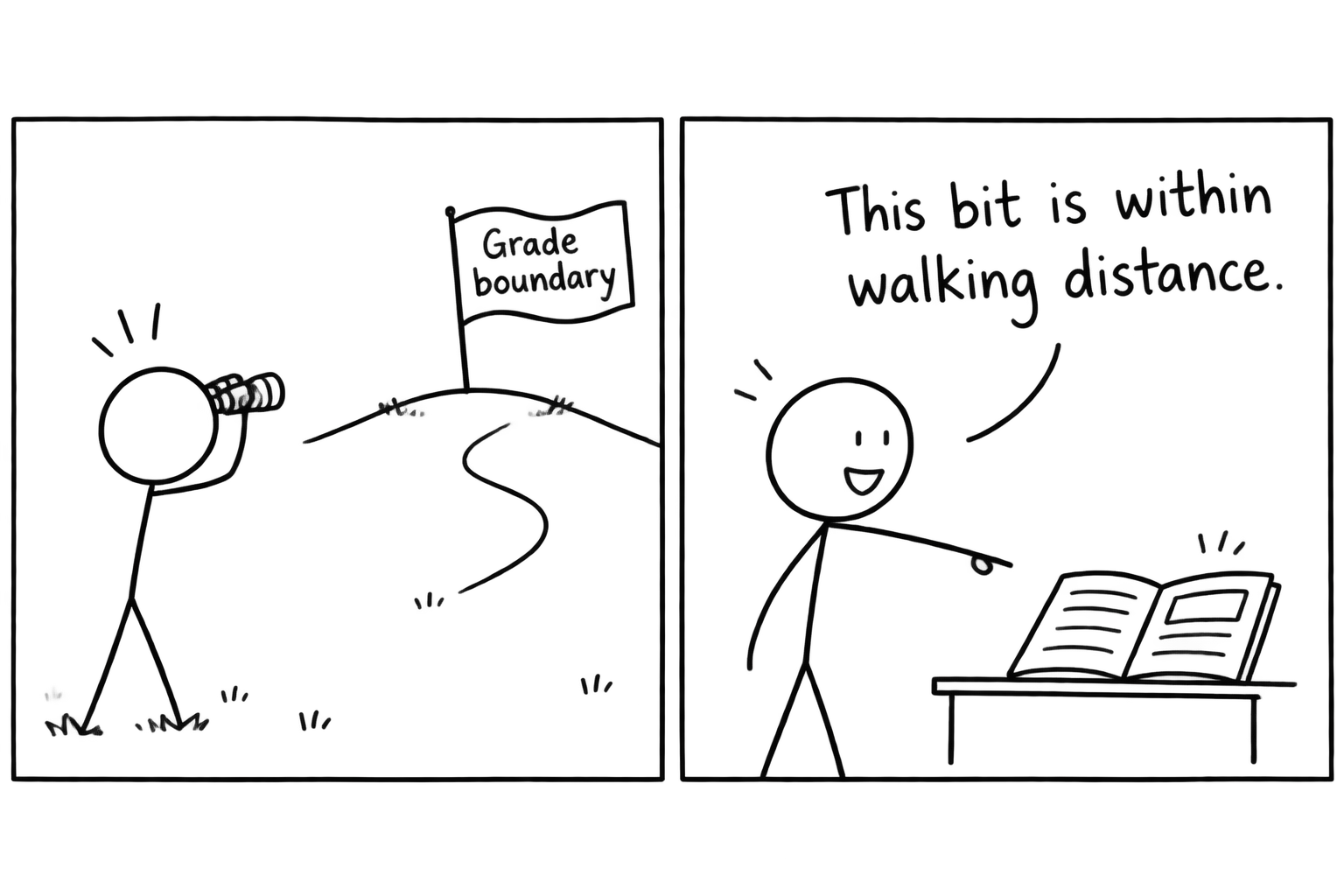 A student looks towards a distant grade boundary while another points to an open revision workbook
Further Pure boundaries are not ordinary GCSE maths boundaries
Students often search for GCSE maths grade boundaries and accidentally use figures for Edexcel GCSE Maths or International GCSE Mathematics A. Those are separate qualifications with different papers, totals and candidate groups.
Further Pure Mathematics also contains more advanced algebraic and mathematical ideas. It should not be confused with a foundation or higher tier entry for ordinary GCSE Maths. Before using any boundary table, check the qualification title, code, exam series and paper route.
For ordinary International GCSE Maths, the Edexcel IGCSE grade calculator can help students interpret practice-paper totals. It is not a Further Pure Maths calculator, so 4PM1 marks should not be entered as though the qualifications were interchangeable.
Parents may also find it helpful to read what a grade 9 in GCSE Maths means. A grade is useful evidence of performance, but it is not a complete description of a student's confidence, mathematical habits or readiness for the next course.
Turning a boundary into a revision plan
A boundary becomes useful when it changes what the student does next. Suppose a student is aiming for a grade 888 and scores 142142142 on a June 2025 standard paper set. The gap from that year's grade 888 threshold would be:
156−142=14.156-142=14.156−142=14.The helpful question is not simply, “Can I find 141414 marks?” It is, “Which recurring errors are costing those marks?”
Sort lost marks into three groups:
- Knowledge gaps: the student did not know the method or theorem.
- Execution errors: the method was understood, but algebra, signs or arithmetic went wrong.
- Exam decisions: too much time was spent on one question, working was omitted or the requested form was missed.
Then prioritise topics that appear repeatedly and support several areas of the course. Algebraic fluency is especially valuable because weak manipulation can affect functions, coordinate geometry, calculus and trigonometry. The free Edexcel GCSE Maths lessons provide structured practice for these foundations, with worksheets and revision support.
Past papers should come next. Complete them under realistic conditions, mark them carefully and revisit every lost mark. A mark scheme is not merely a score sheet. It shows what valid reasoning looks like and where clear working earns credit. Maths Genie brings together free revision lessons, practice questions, past papers, mark schemes, video support and planning tools on the Maths Genie revision website.
Common mistakes when using grade boundaries
Treating last year's figure as a forecast
A historical boundary describes a completed exam series. It cannot reveal the exact boundary for an exam that has not yet been marked and awarded.
Reading the wrong paper route
The standard and regional papers can have different thresholds. In June 2025, the grade 999 boundary was 173173173 for papers 01 and 02 but 184184184 for papers 01R and 02R.
Comparing one paper with the overall boundary
The published subject boundary is out of 200200200. Comparing a single mark out of 100100100 directly with 173173173 or 156156156 produces no useful conclusion.
Assuming a high boundary means there is no room for error
Even the June 2025 standard grade 999 boundary allowed 272727 marks to be lost:
200−173=27.200-173=27.200−173=27.Strong performance does not require perfection. It requires enough accurate mathematics across both papers.
Focusing on the boundary instead of the lost marks
Students cannot control the final boundary. They can control whether they practise completing the square, manipulating functions, proving identities or checking signs in differentiation. That is where anxiety becomes action.
Make the next mark easier to win
A grade boundary is a line drawn after the exam. Revision happens before it, one corrected misconception and one better decision at a time.
Use historical IGCSE further pure grade boundaries to understand the standard, then stop staring at the line. Review a paper, identify the topics costing marks and rebuild them deliberately. Start with Maths Genie Lessons on the topics that move marks most, then use practice questions, past papers and mark schemes to turn understanding into dependable exam performance.















