Identities GCSE Maths: A Clear Guide
Identities GCSE maths explained clearly with worked examples, coefficient matching, common mistakes and exam-style questions for effective revision.
A student can expand brackets correctly for months and still look at the identity symbol as if algebra has quietly changed the rules.
That is where our student starts. They see an expression such as 3(x+2)3(x+2)3(x+2), expand it to 3x+63x+63x+6, and understand every step. But when the question uses ≡\equiv≡ instead of ===, confidence disappears.
The key idea in identities GCSE maths is simple: an identity is true for every permitted value of the variable. An equation is usually true only for particular values. Once that distinction clicks, identities become less mysterious. They become a familiar combination of expanding, simplifying and comparing coefficients.
Identities at a glance
Use this checklist whenever you meet an identity:
- Read ≡\equiv≡ as “is identically equal to”.
- Remember that the statement must be true for every permitted value.
- Expand brackets carefully.
- Collect like terms.
- Compare coefficients of matching terms.
- Compare constant terms separately.
- Substitute a value at the end if you want to check your result.
These skills connect closely to ordinary algebra. If expanding or simplifying feels uncertain, revisit the free GCSE Maths revision resources before moving on.
What is an identity in GCSE maths?
An identity states that two expressions have the same value for every permitted value of the variable.
For example:
3(x+2)≡3x+63(x+2) \equiv 3x+63(x+2)≡3x+6This is true whether x=1x=1x=1, x=10x=10x=10 or x=−4x=-4x=−4. Expanding the left-hand side always produces the right-hand side.
Compare that with:
3x+2=113x+2=113x+2=11This equation is true only when x=3x=3x=3. If x=4x=4x=4, the left-hand side is 141414, so the statement is no longer true.
| Statement type | What it means | Example |
|---|---|---|
| Expression | An algebraic quantity with no claim that it equals something | 3x+23x+23x+2 |
| Equation | A statement that is true for particular value or values | 3x+2=113x+2=113x+2=11 |
| Identity | A statement that is true for every permitted value | 3(x+2)≡3x+63(x+2)\equiv3x+63(x+2)≡3x+6 |
The symbol matters. In GCSE questions, ≡\equiv≡ signals that you are working with an identity rather than solving an ordinary equation.
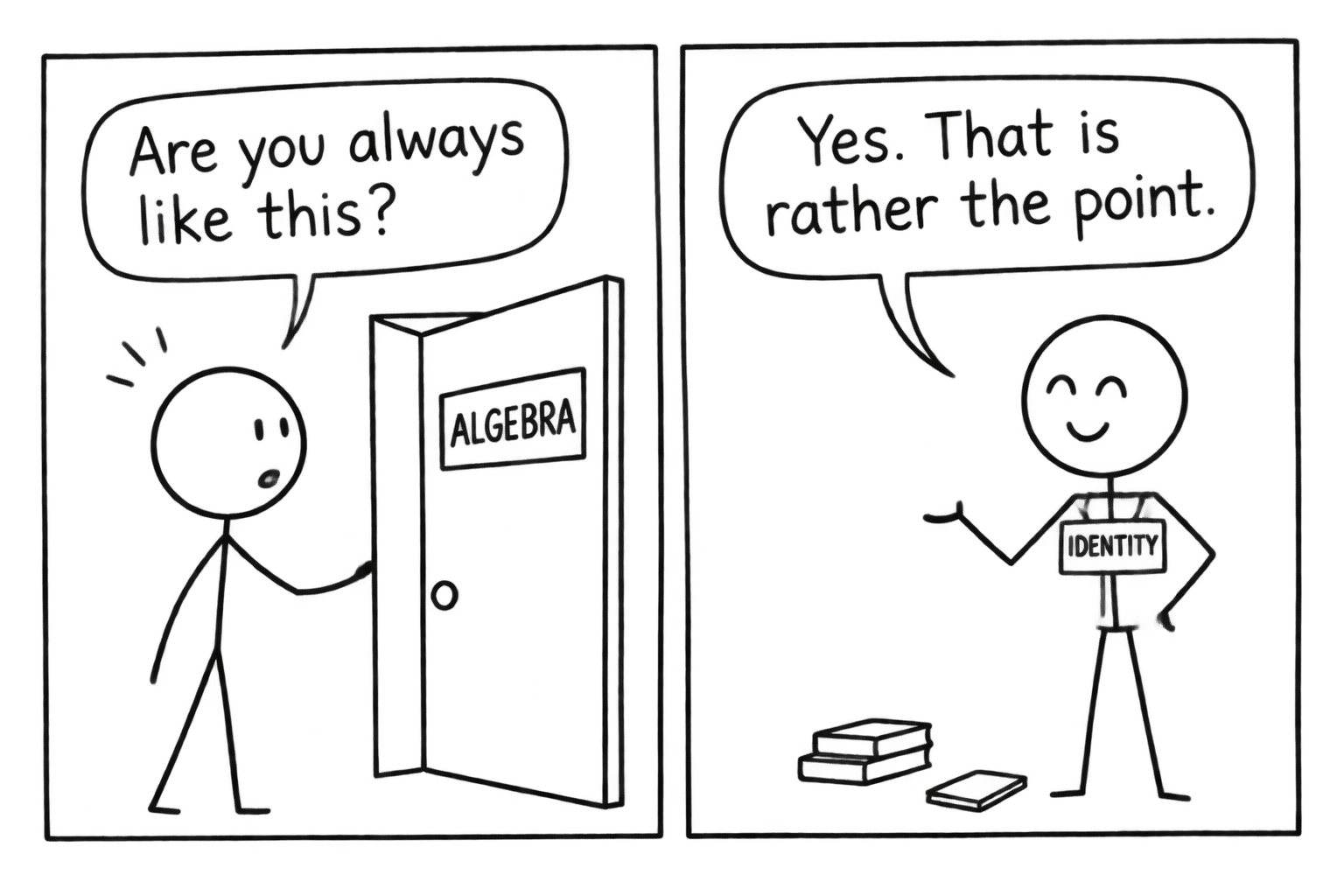 A student meets an identity that is always itself
How to prove an identity
To prove a simple algebraic identity, begin with one side and manipulate it until it becomes the other side. Do not assume the result you are trying to establish.
Consider:
2(3x−4)+5≡6x−32(3x-4)+5 \equiv 6x-32(3x−4)+5≡6x−3Start with the left-hand side:
2(3x−4)+52(3x-4)+52(3x−4)+5Expand the bracket:
6x−8+56x-8+56x−8+5Collect the constant terms:
6x−36x-36x−3This matches the right-hand side, so the identity is proved.
The important habit is to show the chain of algebra. Writing only “true” may not demonstrate why both expressions are identical.
Our student’s first breakthrough comes here. They stop trying random values of xxx and begin simplifying the algebra itself. Substitution can check an identity, but testing a few values does not prove that it is true for every value.
Identities worked examples
Finding one missing coefficient
Find aaa if:
4(x+3)≡ax+124(x+3)\equiv ax+124(x+3)≡ax+12Expand the left-hand side:
4x+12≡ax+124x+12\equiv ax+124x+12≡ax+12Compare the coefficients of xxx. On the left, the coefficient is 444; on the right, it is aaa.
Therefore:
a=4a=4a=4The constant terms already match because both are 121212.
Finding two unknowns
Find aaa and bbb if:
3(2x+5)+x≡ax+b3(2x+5)+x\equiv ax+b3(2x+5)+x≡ax+bExpand the bracket:
6x+15+x≡ax+b6x+15+x\equiv ax+b6x+15+x≡ax+bCollect like terms:
7x+15≡ax+b7x+15\equiv ax+b7x+15≡ax+bNow match corresponding parts:
a=7a=7a=7and
b=15b=15b=15This is the method students often describe as “matching coefficients”. The coefficient of xxx must match the coefficient of xxx, while the constant must match the constant.
Matching quadratic coefficients
Find aaa, bbb and ccc if:
(x+2)(x+5)≡ax2+bx+c(x+2)(x+5)\equiv ax^2+bx+c(x+2)(x+5)≡ax2+bx+cExpand the brackets:
(x+2)(x+5)=x2+5x+2x+10(x+2)(x+5)=x^2+5x+2x+10(x+2)(x+5)=x2+5x+2x+10Collect like terms:
x2+7x+10x^2+7x+10x2+7x+10Compare this with:
ax2+bx+cax^2+bx+cax2+bx+cTherefore:
a=1,b=7,c=10a=1,\qquad b=7,\qquad c=10a=1,b=7,c=10The student in our story had previously missed a=1a=1a=1 because the 111 was invisible. Once they began writing x2x^2x2 mentally as 1x21x^21x2, the comparison became routine.
You now have the full method; use the MathsGenie Lessons and Question Bank to repeat these steps until matching coefficients feels automatic.
How to answer identities questions in an exam
An exam-style identities question often hides the straightforward part inside unfamiliar letters. Keep the process fixed:
- Expand every bracket on one side.
- Collect powers such as x2x^2x2, terms such as xxx, and constants separately.
- Place the simplified expression beside the given form.
- Match corresponding coefficients.
- Check signs and any implied coefficient of 111.
Try this question:
2(x+4)+3(x−1)≡ax+b2(x+4)+3(x-1)\equiv ax+b2(x+4)+3(x−1)≡ax+bExpand:
2x+8+3x−3≡ax+b2x+8+3x-3\equiv ax+b2x+8+3x−3≡ax+bSimplify:
5x+5≡ax+b5x+5\equiv ax+b5x+5≡ax+bHence:
a=5,b=5a=5,\qquad b=5a=5,b=5Now try these identities questions without looking back:
- Find aaa and bbb if 5(x−2)+3≡ax+b5(x-2)+3\equiv ax+b5(x−2)+3≡ax+b.
- Find ppp and qqq if 2(3x+1)−x≡px+q2(3x+1)-x\equiv px+q2(3x+1)−x≡px+q.
- Find aaa, bbb and ccc if (x+1)(x+6)≡ax2+bx+c(x+1)(x+6)\equiv ax^2+bx+c(x+1)(x+6)≡ax2+bx+c.
The answers are:
a=5,b=−7a=5,\qquad b=-7a=5,b=−7 p=5,q=2p=5,\qquad q=2p=5,q=2 a=1,b=7,c=6a=1,\qquad b=7,\qquad c=6a=1,b=7,c=6Do not just mark an answer right or wrong. If yours differs, return to the first line where the expressions stop matching. That line usually reveals the exact skill to practise.
Common mistakes with identities
Treating ≡\equiv≡ exactly like an equation to solve
An identity is true for every permitted value, so there is usually no single value of xxx to find. Look for unknown coefficients instead.
Matching before expanding
In 3(x+4)3(x+4)3(x+4), the visible 333 is not simply the coefficient to copy without processing the expression. Expand first:
3(x+4)=3x+123(x+4)=3x+123(x+4)=3x+12Forgetting a negative sign
For example:
−2(x−3)=−2x+6-2(x-3)=-2x+6−2(x−3)=−2x+6The multiplier affects every term inside the bracket.
Combining unlike terms
Terms such as x2x^2x2 and xxx cannot be combined. Keep powers in separate groups before comparing coefficients.
Using substitution as a proof
Checking x=1x=1x=1 and x=2x=2x=2 can expose an incorrect identity, but two successful checks cannot establish that it works for every value. Algebraic simplification provides the proof.
Ignoring an unwritten coefficient
In x2+4x+3x^2+4x+3x2+4x+3, the coefficient of x2x^2x2 is 111. In −x-x−x, the coefficient of xxx is −1-1−1.
A reliable revision routine
Our student’s improvement does not come from memorising a longer definition. It comes from using the same short routine repeatedly:
- say whether the statement is an expression, equation or identity;
- expand and simplify;
- arrange terms in descending powers;
- match the coefficients;
- check one substitution after completing the algebra.
That final check is especially useful for catching sign errors. It supports the proof rather than replacing it.
When practising, work in small sets. Begin with linear identities, move to expressions containing two brackets, and then try quadratic forms. Mark each set before continuing. MathsGenie’s free GCSE area also provides past papers and mark schemes, helping you see how algebra sits alongside the rest of an exam paper.
Make identities click with MathsGenie
The student now knows what changed: not the algebra, but the way they read the question. Knowing the method is the first step; following it accurately under exam pressure takes deliberate practice.
Your turn. Start the matching MathsGenie Lessons and Question Bank, work through the identities questions step by step, and use each solution to correct the first line where your algebra changed course.