How to Revise for A-Level Maths Statistics
How to revise for A-Level Maths Statistics with a focused weekly plan, effective exam practice, mistake analysis and spaced topic review.
A student sits down on Monday evening with a blank timetable and a familiar problem. Statistics is not one topic. It is probability, distributions, hypothesis tests, data interpretation and the small details hidden inside exam wording.
If you are wondering how to revise for A-Level Maths Statistics, the short answer is this: diagnose your weakest topics, revisit the underlying ideas, complete exam questions without notes, mark them carefully and return to mistakes after a gap. Your plan should alternate focused topic practice with mixed maths paper revision.
This approach works across Edexcel, AQA, OCR and Eduqas, although topic order, notation and paper structure can differ. Check your own specification before deciding exactly what to revise.
Your statistics revision checklist
A useful revision cycle contains five actions:
- List the statistics topics in your specification.
- Test each topic with questions rather than judging it from memory.
- Prioritise topics where understanding or accuracy is weak.
- Mark every attempt and record why marks were lost.
- Reattempt difficult questions several days later.
The student in our opening scene could fill every box of a colourful timetable and still make little progress. A plan measures what you will do, not merely how long you will sit at a desk.
Build a realistic maths revision plan
Begin with a topic audit. Depending on your course, this may include sampling, data presentation, probability, statistical distributions, correlation, regression and hypothesis testing. Some specifications also require familiarity with a large data set or pre-release data.
Give each topic one of three labels:
- Secure: you can complete unfamiliar questions accurately without support.
- Developing: you know the method but hesitate, need prompts or make repeated errors.
- Priority: you cannot yet explain or apply the central idea.
Do not label a topic secure because a video feels familiar. Attempt several questions first. Recognition is comfortable, but retrieval is what the exam demands.
A simple weekly structure might look like this:
| Session | Main task | Evidence of progress |
|---|---|---|
| Monday | Learn or revisit one priority topic | A short summary written from memory |
| Tuesday | Complete focused questions | Marked answers and an error log |
| Wednesday | Review an earlier topic | Correct reattempts without notes |
| Thursday | Practise another weak area | Improved accuracy across several questions |
| Friday | Complete mixed statistics questions | A list of topics requiring follow-up |
| Weekend | Attempt a timed paper section | Marks, timing notes and corrections |
This is a framework, not a rule. Short, repeated sessions usually make more sense than placing all statistics revision into one exhausting afternoon. Your maths revision plan must also leave room for pure mathematics, mechanics and your other subjects.
If setting up this rotation feels like another revision task, you can use the MathsGenie Revision Planner to build your schedule instead of repeatedly redrawing it.
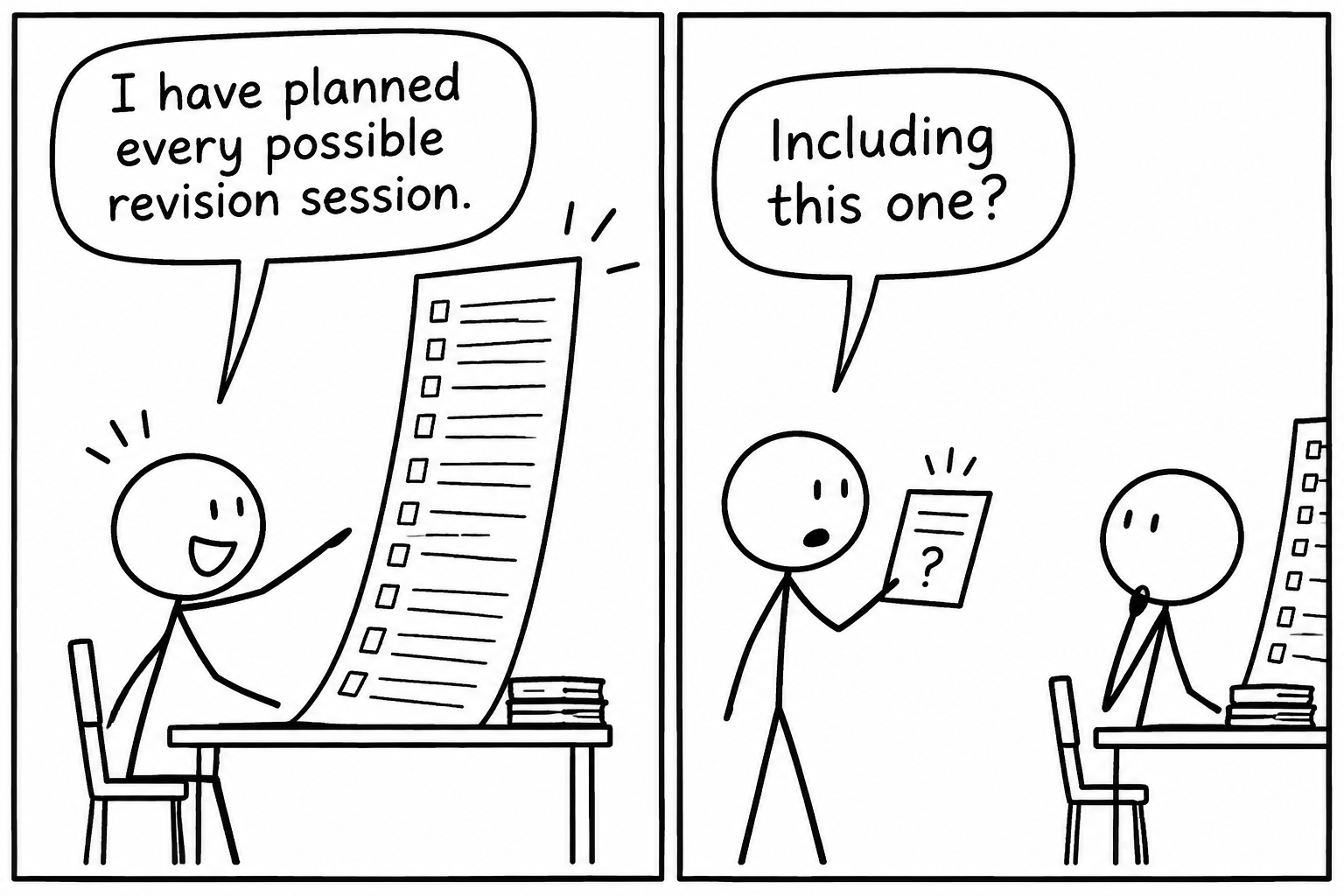 A student discovers that planning revision is not the same as answering a practice question
Revise ideas before memorising procedures
Statistics can appear procedural. Choose a distribution, enter values into a calculator and report an answer. Yet the most valuable marks often depend on knowing why that model or conclusion is appropriate.
For a binomial model, for example, you should recognise the assumptions behind
X∼B(n,p).X \sim \operatorname{B}(n,p).X∼B(n,p).There is a fixed number of trials, each trial has two possible outcomes, the probability of success remains constant and the trials are independent. Learning only the calculator steps leaves you exposed when a question asks whether the model is suitable.
The same principle applies to hypothesis testing. You need to understand the relationship between the null hypothesis, alternative hypothesis, significance level and observed result. A conclusion must be written in context. It should not claim that a hypothesis has been proved.
Use the MathsGenie A-Level revision resources to revisit an idea, then close the explanation and reproduce the reasoning yourself. For a particularly demanding area, the hypothesis testing revision lesson brings together lessons, videos and practice resources.
Turn questions into active revision
Good statistics revision has three stages.
Attempt without support
Start with focused practice questions. Write complete solutions and include the interpretation requested by the question. Avoid checking notes at the first moment of uncertainty. The effort of trying to retrieve a method is part of revision.
Mark for the reason, not only the result
Use the mark scheme to identify where your reasoning diverged. Record the cause of each lost mark, such as:
- choosing an unsuitable distribution;
- entering an incorrect calculator expression;
- confusing P(X<x)P(X<x)P(X<x) with P(X≤x)P(X\leq x)P(X≤x);
- using an inaccurate value too early;
- omitting hypotheses or defining them poorly;
- giving a conclusion without context.
This turns a mark into useful information. A score tells you what happened. An error category tells you what to change.
Reattempt after a delay
Correcting a solution while reading the mark scheme can create false confidence. Return to the question after several days and solve it from a blank page. If the same difficulty remains, revisit the lesson before trying a related question.
Make maths paper revision count
Past papers become most useful after you have repaired the largest topic gaps. Attempting full papers too early can spend considerable time confirming problems you already knew existed.
Progress through three phases:
- Focused questions: practise one skill until the reasoning is stable.
- Mixed sections: decide which technique is needed without being told the topic.
- Timed papers: practise selection, accuracy and pacing under exam conditions.
MathsGenie provides A-Level past papers for realistic maths paper revision. Complete the relevant paper for your exam board, use its mark scheme and review every dropped mark. Predicted papers can provide additional practice, but they cannot reliably tell you exactly what will appear. Your specification remains the boundary of what may be assessed.
Calculator fluency matters too. Practise the statistical functions permitted for your course using your own calculator. However, do not let calculator speed replace written reasoning. Examiners may require a model, hypothesis, inequality or contextual conclusion as well as a numerical answer.
Common statistics revision mistakes
Revising only favourite topics
Comfortable questions feel productive because they move quickly. Give more sessions to priority topics while periodically reviewing secure ones so that they stay secure.
Watching without retrieving
A video can explain a method clearly, but understanding someone else's solution is not the same as producing your own. Follow every lesson with closed-book questions.
Ignoring exact wording
Words such as independent, significant, correlation and association have precise meanings. Learn how your course and its mark schemes use them.
Rounding too early
Keep accurate calculator values during intermediate work and round only when required. Early rounding can change a later probability or critical comparison.
Treating every error as careless
A mistake that happens repeatedly is usually a pattern. Record it and design a response. If you frequently use the wrong probability tail, for instance, sketch or describe the required region before using your calculator.
Build the schedule you will actually follow
Our student now has more than a neat timetable. Each session has a purpose, each paper produces feedback and every difficult question has a date for another attempt. The remaining challenge is turning that sensible structure into consistent action before fixed exam dates arrive.
You have seen how focused topics, delayed reattempts and timed papers fit together. Build your A-Level Statistics schedule in the MathsGenie Revision Planner.