How to Do a Gap Analysis After Mocks
How to do a gap analysis after mocks: turn GCSE maths feedback into focused revision, fix weak topics and prepare confidently for your next paper.

A mock result can make one sheet of paper feel unusually powerful. You see a grade and start imagining the summer exams. But the most useful information sits beneath that total.
Learning how to do a gap analysis after mocks means identifying which topics, habits and exam techniques cost you marks, then using that evidence to plan revision. Collect your paper, classify the mistakes, prioritise the gaps and practise them deliberately. Finally, check whether you can answer fresh questions independently.
Your result describes one performance. Your analysis helps you decide what to do next.
Your post-mock gap analysis checklist
Before changing your revision timetable:
- Gather your answers, the question paper, mark scheme and teacher feedback.
- Record marks lost by topic and cause.
- Separate repeated weaknesses from isolated slips.
- Choose three priority areas.
- Complete targeted lessons and practice questions.
- Retest independently, then update your plan.
The GCSE Maths revision hub provides resources for turning those priorities into practical tasks.
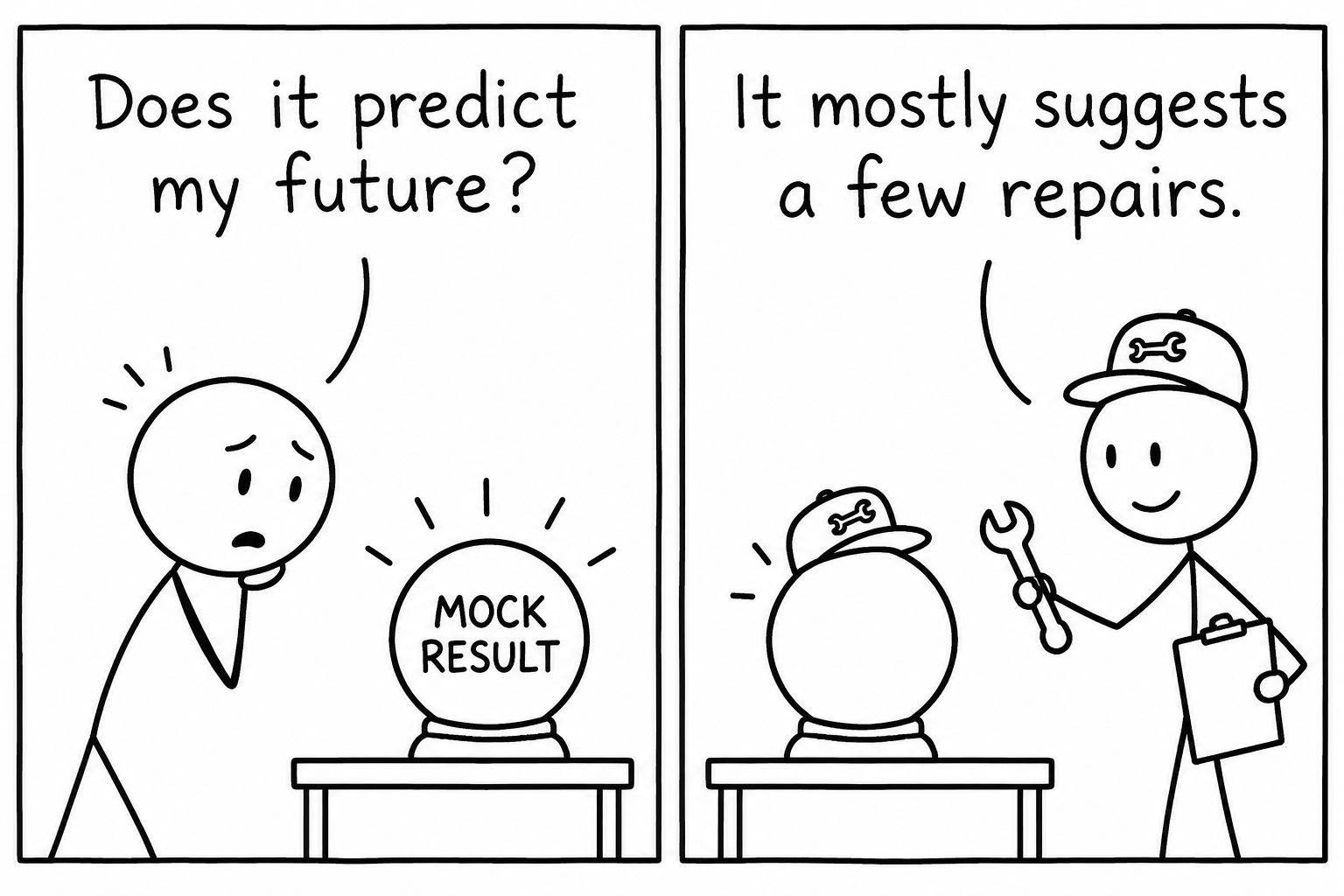 A student asks whether a mock result predicts the future while a mechanic treats it as a repair list
Start with the paper, not the grade
Two students with the same mark may need different revision plans. One might understand the content but rush calculations. Another might work carefully but struggle to choose suitable methods.
For each question, record the topic, marks available, marks awarded and reason for any loss. Add an action that could prevent the mistake next time.
Use teacher feedback and the mark scheme rather than guessing. A wrong final answer may still earn method marks. The GCSE past papers and mark schemes help you understand these distinctions. If a marking decision remains unclear, ask your teacher before deciding what needs revision.
Classify every lost mark
A topic name alone does not explain what went wrong. Classify the cause so your response matches the problem.
| Type of gap | What it may look like | Useful response |
|---|---|---|
| Knowledge | You cannot recall a rule or fact | Relearn it and check recall |
| Method | You recognise the topic but cannot finish | Practise the process in stages |
| Accuracy | Correct reasoning, incorrect calculation | Show working and check each line |
| Interpretation | You misunderstand wording or a diagram | Practise identifying what is required |
| Timing | Questions are unfinished or rushed | Use timed sets and review pacing |
A video lesson may repair missing knowledge. Timing problems need practice applying knowledge within a limit. Some questions reveal several causes; record the main obstacle first.
Measure performance by topic
Group questions under specific labels such as changing the subject, cumulative frequency or compound measures. Broad headings such as algebra can hide the precise skill you need.
Calculate a topic success rate if useful:
topic success rate=marks earnedmarks available×100%\text{topic success rate}=\frac{\text{marks earned}}{\text{marks available}}\times 100\%topic success rate=marks availablemarks earned×100%Treat this as a guide. One short question gives limited evidence; repeated difficulties across several papers reveal a clearer pattern.
Use red for an absent or unsuitable method, amber for partial understanding and green for secure understanding. Record accuracy slips separately so that a small arithmetic error does not disguise a sound method.
Rank gaps instead of revising everything
Choose priorities using three questions:
- Does the weakness repeat? Recurring errors deserve attention.
- Is an earlier skill missing? Difficulty with algebraic fractions may begin with insecure factorising.
- Are the marks recoverable? A familiar method you almost completed may offer a practical starting point.
Begin with roughly three areas. Include foundational skills that support other topics, and choose questions appropriate to your foundation or higher tier specification. Avoid building the whole plan around the hardest question simply because it was memorable.
Turn each gap into targeted practice
Follow a consistent repair-and-retest cycle:
- Relearn: watch a revision lesson and identify the missing idea.
- Practise: complete focused questions without time pressure.
- Check: mark your work and explain each correction.
- Retest: attempt fresh questions without notes or prompts.
- Revisit: check the skill again several days later.
MathsGenie's free maths revision resources bring together lessons, practice questions, mark schemes and video solutions. Use GCSE mini tests for manageable checks between longer practice sessions.
Put concrete tasks into the revision planner. “Complete a ratio lesson and mark ten questions” tells you what to do and when the task is finished. “Revise maths” leaves both uncertain.
Check whether the gap has closed
Understanding a correction is encouraging, but independent performance provides stronger evidence.
Use the MathsGenie Mock Exam Builder to create targeted practice around the areas you identified. Match practice to your exam board and tier, then work under realistic conditions.
After marking, check whether you selected the method independently, showed sufficient working and avoided previous errors. Move secure topics into occasional maintenance practice. Keep unresolved gaps in your next revision cycle.
Later, complete papers and GCSE predicted papers can help you practise switching between topics. Predicted papers provide practice, not a guarantee of exam content.
Common gap analysis mistakes
Treating every incorrect answer equally: prioritise repeated, foundational and recoverable gaps.
Copying corrections without retesting: a completed solution does not establish that you can reproduce the reasoning independently.
Dismissing careless errors: repeated slips may reveal rushed reading, unclear working or missing checks. Practise a specific checking routine.
Using only full papers: combine broad exam practice with focused work on the skills your analysis identifies.
Judging progress only by grades: track improved methods and fewer repeated errors as well as totals.
Make the mock useful
A marked paper becomes valuable when each significant error leads to an action, and each action leads to another check.
Start with three priority gaps. Use MathsGenie's free lessons, practice questions, mini tests and video solutions to repair them. Retest, review the evidence and adjust your plan. Your next revision session can begin with a clear task instead of a worrying grade.