Home Schooled GCSE Art and Design: How to Sit It
Home schooled GCSE Art and Design is possible. Learn how to find a centre, choose an exam board, meet assessment rules, deadlines and fees with confidence.
A sketchbook can be completed at home. The difficult part is finding somewhere willing to assess it.
The short answer is yes: home schooled GCSE Art and Design students can sit the qualification as private candidates. However, Art and Design is harder to arrange than a written-only GCSE because it includes a portfolio, supervised work, authentication, centre assessment and exam-board moderation.
Your first task is therefore not buying materials or choosing a project. It is finding an approved centre that accepts private candidates for this particular subject. The centre must be able to meet the chosen exam board's assessment requirements, not merely provide a desk for the final supervised session.
Your essential checklist
Before committing to the qualification, make sure you can:
- find an approved centre accepting private Art and Design candidates;
- agree on an exam board and the correct Art and Design endorsement;
- understand how the portfolio will be supervised and authenticated;
- meet the centre's internal deadlines;
- attend any required progress checks and supervised sessions;
- pay entry, administration, assessment and possible late fees;
- transport and submit physical or digital work safely;
- receive written confirmation of every important arrangement.
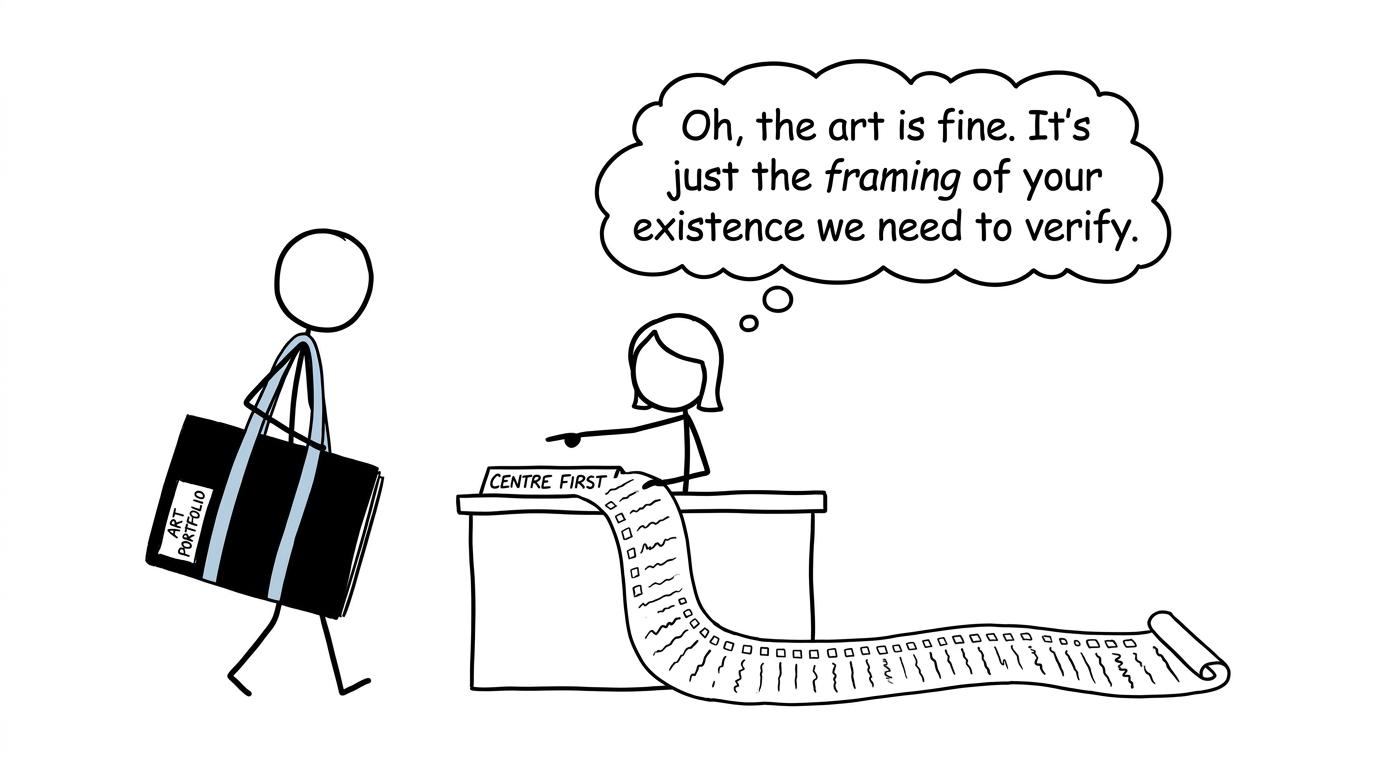 A student discovers that finding an exam centre comes before framing the artwork
Why GCSE Art and Design is different for private candidates
Most written GCSEs can be arranged by entering a candidate and providing a suitable room on the published examination date. Art and Design has a longer chain of responsibilities.
Across the main English and Welsh exam boards, the qualification normally combines a portfolio or personal portfolio worth 60%60\%60% with an externally set assignment worth 40%40\%40%. The externally set component generally concludes with 101010 hours of supervised work, although you must check the current specification for your board, qualification and examination series.
The centre may also need to:
- verify that the submitted work is genuinely yours;
- supervise relevant stages of production;
- provide a qualified person to assess the work;
- standardise marking where required;
- display or organise the work for moderation;
- retain evidence until the exam board permits its release;
- investigate any suspected malpractice.
This explains why a centre that accepts private candidates for Maths or English may decline Art. It is not necessarily questioning your ability. It may simply lack an art teacher, secure storage, specialist facilities or the capacity to conduct internal assessment.
How to find a centre for home schooled GCSE Art and Design
Begin with approved examination centres within a realistic travelling distance. These may include independent schools, further education colleges, specialist private-candidate centres, tutorial colleges or other registered centres.
Exam-board private-candidate guidance and centre-search services can help you create an initial list. Treat that list as a starting point rather than confirmation. A centre might accept private candidates generally while excluding qualifications with non-exam assessment.
Ask subject-specific questions
When contacting a centre, state clearly that the enquiry concerns GCSE Art and Design. Ask:
- Which exam boards and Art and Design endorsements do you offer?
- Do you accept home-educated private candidates for the complete qualification?
- Who will monitor, authenticate and mark the portfolio?
- How often must the candidate attend the centre before final submission?
- Can work completed before registration be accepted and authenticated?
- Where will the 101010 hours of supervised work take place?
- What materials, equipment and storage are available?
- What are your portfolio, entry and payment deadlines?
- What is included in the quoted fee?
- How will access arrangements be handled, if relevant?
Contact several centres. Policies and costs differ, and availability can change from one examination series to the next. Keep a written record of replies so that an informal conversation does not become the foundation of an expensive plan.
Secure the centre before building the portfolio
A common temptation is to complete months of work and search for a centre afterwards. That is risky. A centre cannot automatically authenticate work it has never seen being developed, and its chosen specification may not match the course you followed.
Find the centre first. Obtain the specification code, endorsement, assessment expectations and attendance arrangements in writing. Only then should you shape the portfolio around those requirements.
Choosing an exam board and endorsement
AQA, Pearson Edexcel, OCR and Eduqas offer GCSE Art and Design qualifications, but the titles, specification codes, administrative processes and available endorsements are not identical.
Possible areas include fine art, photography, graphic communication, textile design and three-dimensional design. Availability depends on both the board and the centre. Photography, for example, still requires a centre capable of supervising, assessing and authenticating the work; it is not automatically easier to arrange because much of the work is digital.
Do not choose a board solely because its specification looks appealing. For a private candidate, the workable board is usually the one your confirmed centre can administer properly.
Read the current specification and assessment guidance together. Pay attention to:
- the assessment objectives;
- evidence of research and contextual understanding;
- experimentation with materials and processes;
- recording ideas and observations;
- development towards a personal response;
- rules governing preparatory and supervised work;
- file, display or portfolio submission requirements.
The finished piece matters, but it is not the whole qualification. Development, reflection and decision-making must also be visible.
Registration, entry deadlines and fees
There is no single booking deadline that every private candidate can safely use. Exam boards publish entry dates for each examination series, but centres normally impose earlier internal deadlines. This gives them time to confirm identification, gather information, arrange assessment and submit entries.
For a summer series, begin contacting centres during the preceding autumn if possible. Do not wait for the exam board's standard entry deadline, which commonly falls later in the academic year. A centre may already have closed Art entries, and late entries can attract additional charges.
Ask for a complete written quotation. The total may include:
- the exam-board entry fee;
- centre administration;
- portfolio monitoring and assessment;
- supervised-session costs;
- materials or studio access;
- postage, moderation or storage;
- access-arrangement administration;
- late-entry or amendment fees.
Before paying, check the cancellation policy and whether the fee changes if extra assessment meetings are required. Entry dates and charges are time-sensitive, so confirm them directly with the centre for the intended examination series rather than relying on an old online discussion.
Preparing work that can be authenticated
Authentication is a central issue for home-educated candidates. Your centre needs enough evidence to be satisfied that the work submitted is your own.
The precise process varies, but it may involve scheduled tutorials, dated progress photographs, supervised practical sessions, annotated sketchbooks, digital file histories and conversations about artistic decisions. These records support authentication; they do not replace any formal process required by the board or centre.
Be transparent about assistance. A tutor can teach techniques and discuss the specification, but submitted decisions and outcomes must remain the candidate's own. Keep source material clearly identified and distinguish research from original work. Copying an image without acknowledgement can create both assessment and malpractice concerns.
Follow the centre's instructions for artificial intelligence tools, image manipulation and online source material. Exam-board and JCQ guidance can change, so current written instructions take priority over assumptions.
Balancing Art and Design with GCSE Maths revision
Art deadlines often arrive while preparation for written GCSEs is accelerating. The workload is different: Maths improves through frequent retrieval and problem practice, while Art may require longer uninterrupted sessions.
A simple weekly plan can protect both. Put fixed centre appointments and portfolio deadlines in first. Then schedule shorter, regular Maths sessions using the free GCSE Maths revision lessons. Videos and practice questions make it easier to target one weak area without turning every evening into a full mock examination.
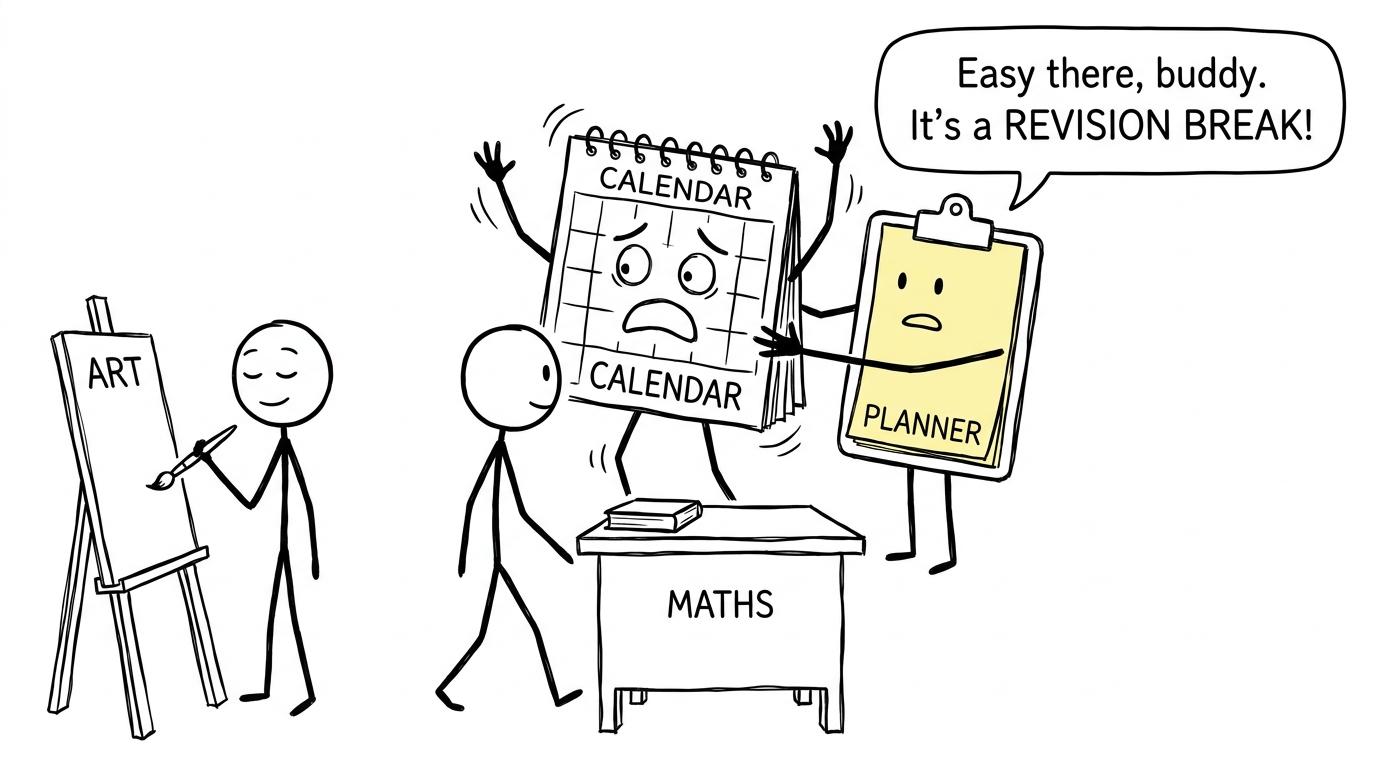 A calm student balances an art easel and Maths revision while a calendar is restrained by a planner
Use GCSE Maths past papers periodically to measure progress under timed conditions. Nearer the examination series, MathsGenie predicted papers can provide further practice in the style and balance of a full paper. Predicted papers are revision resources, not claims about the exact questions that will appear.
Students working towards foundation tier can organise topics through the foundation GCSE Maths revision resources, while higher-tier candidates can use the same topic-by-topic GCSE revision collection to identify gaps before attempting complete papers. Mark your answers honestly and return to the relevant video solution when a method is uncertain.
What happens during the externally set assignment?
The exam board releases an externally set paper or assignment according to its timetable. Candidates normally receive a preparatory period in which they research, experiment and develop ideas within the permitted rules.
The final response is then produced during supervised time, commonly totalling 101010 hours. Your centre decides how this time is scheduled within the board's regulations. It may be divided across more than one session.
Before the first session, confirm:
- arrival times and identification requirements;
- permitted preparatory material;
- which materials the centre supplies;
- whether specialist equipment must be booked;
- arrangements for drying or storing unfinished work;
- rules for phones, cameras and digital files;
- what happens between supervised sessions.
The centre's instructions matter. An arrangement that was permitted during ordinary portfolio development may not be allowed once supervised work begins.
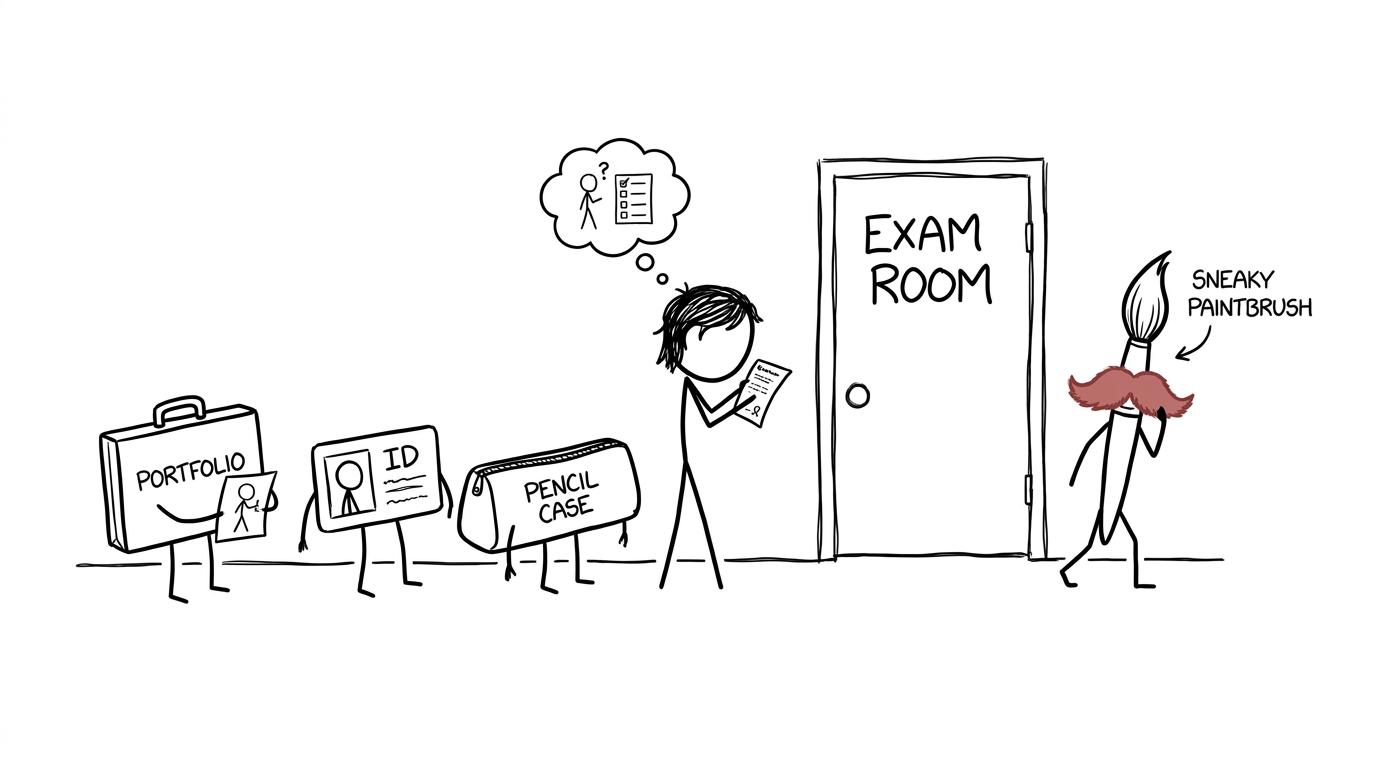 Art materials queue for the exam room while a paintbrush attempts an unconvincing disguise
Common mistakes to avoid
Assuming every private-candidate centre offers Art
Always name the subject, board and endorsement. Acceptance for written GCSEs does not establish that a centre can assess Art and Design.
Starting before confirming the specification
A strong portfolio can still be unsuitable if it follows the wrong assessment structure or cannot be authenticated by the eventual centre.
Treating the published entry date as a personal deadline
Your centre's internal cut-off may be much earlier. Ask about entry, portfolio and payment deadlines separately.
Focusing only on the final piece
Assessment also rewards investigation, experimentation, recording and development. The portfolio should show how ideas changed and why decisions were made.
Underestimating the full cost
Request an itemised quotation. Entry, supervision, marking, studio access and late changes may be charged separately.
Leaving Maths revision until the portfolio is finished
Art can expand to fill every available hour. Protect regular practice with MathsGenie's free GCSE resources, then use official-style past-paper practice to keep written-exam technique moving forward.
The practical route forward
Sitting GCSE Art and Design as a home-schooled candidate is possible, but the order matters: centre first, specification second, portfolio third. Confirm who will authenticate and assess the work, understand every attendance requirement, and work backwards from the centre's deadlines rather than the public examination timetable.
Once the administrative foundations are secure, the qualification becomes much more manageable. You can concentrate on developing thoughtful artwork while maintaining steady preparation for your other GCSEs.
For Maths, start with the MathsGenie GCSE revision hub, choose lessons and practice questions for your current grade, and build towards timed past papers and predicted-paper practice. Good revision rarely depends on one heroic week. Like a strong portfolio, it grows through visible, consistent progress.