Hardest GCSE Maths Paper Ever: How to Survive It
GCSE hardest maths paper ever? Learn what makes papers feel brutal, how to grab method marks, and practise smarter with Maths Genie papers and tests.
The hardest GCSE maths paper ever (and why it feels personal)
There’s a particular moment that makes people swear they’ve just sat the hardest GCSE maths paper ever. It’s not usually the first question, and those are designed to settle you. It’s the moment halfway through when the questions stop looking like the ones you revised, and start looking like someone has taken familiar topics and turned them a quarter-turn. You know the maths is in there somewhere, but you can’t see the door.
If that’s ever been you, you’re not alone. Every year, after Edexcel, AQA, OCR or Eduqas papers, the same story returns: “That was the hardest GCSE paper ever.” And every year, the truth is both kinder and more useful: the paper probably wasn’t uniquely impossible, but it was designed to separate careful method from quick pattern-matching.
This post is about how to handle that kind of paper. Not with hype, but with strategy. You’ll get a checklist, worked examples (the sort of twists that appear on higher tier), and a way to use Maths Genie to practise the skills that actually rescue marks.
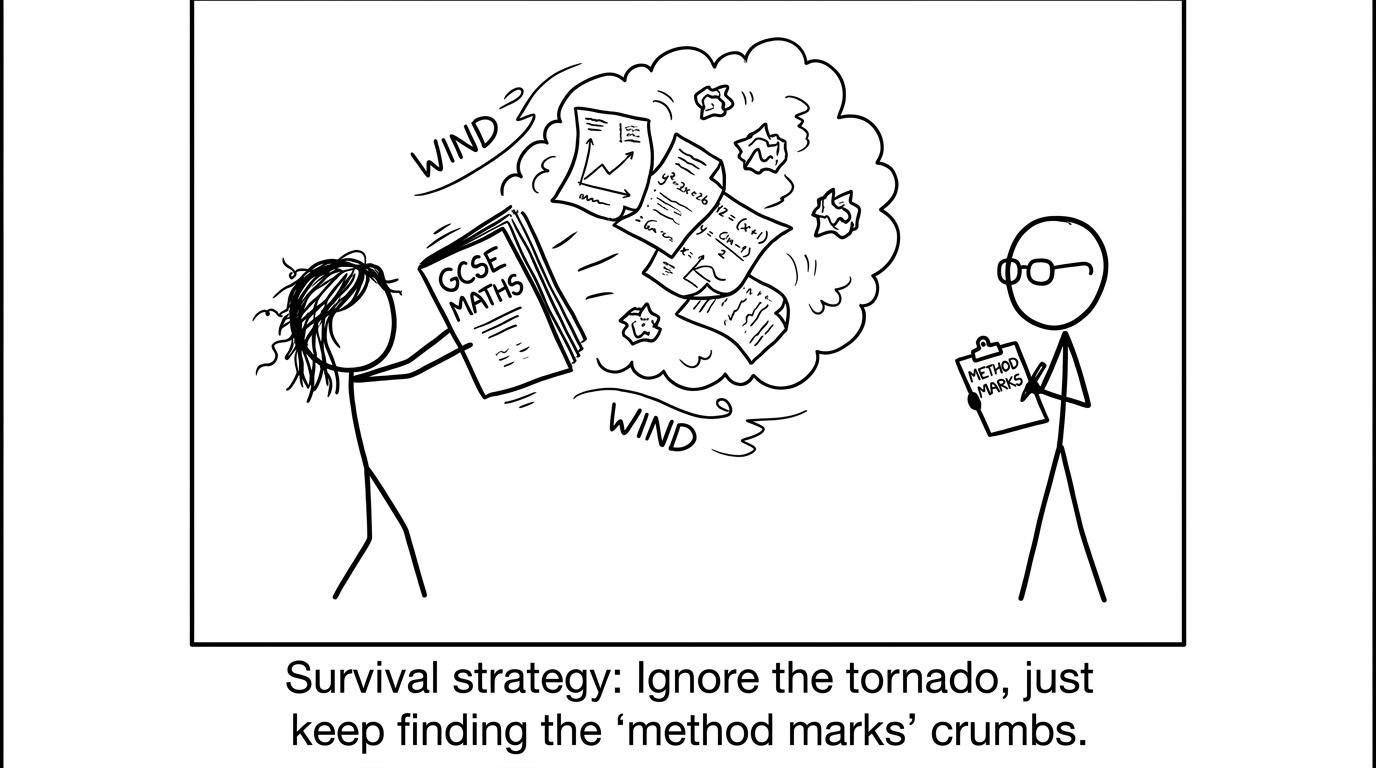 Student opens GCSE paper and notes fly everywhere
A quick survival checklist for a “hard” GCSE paper
When a GCSE paper feels nasty, it’s usually because it demands judgement. Use this checklist to buy yourself time and marks:
- Scan for guaranteed marks first. Aim to bank the first 202020 to 303030 marks quickly.
- Write something for every multi-mark question. Method marks are real, even when your final answer isn’t.
- Translate before you calculate. Underline what the question is truly asking.
- Draw a diagram, even if one is given. Your own diagram is often clearer than theirs.
- If you’re stuck, do the simplest possible step. Rearrange, substitute, list outcomes, label angles.
- Leave clean breadcrumbs. Mark schemes reward logical steps.
- Use past papers to normalise the feeling. The goal isn’t to avoid hard questions; it’s to recognise them.
Maths Genie resources that match this approach:
- GCSE Maths Revision
- Edexcel GCSE Papers and Mark Schemes
- Predicted Papers GCSE Maths
- GCSE Target Tests (Mini Tests)
- GCSE Resources
- OCR GCSE Maths Papers
- GCSE Statistics Revision
What makes the “hardest GCSE maths paper” feel hard?
A paper becomes “hard” in your head when it breaks your expectation of what revision looks like. Most students revise by recognition: “I’ve seen this type before.” The hardest GCSE questions attack that comfort.
The paper mixes topics instead of labelling them
A straightforward ratio question is labelled by the student as ratio. A hard question might be ratio inside a compound measure inside a percentage change. The maths isn’t new; the packaging is.
It tests judgement, not just skill
You can know how to solve simultaneous equations and still lose marks because you chose the wrong method under time pressure. Hard GCSE papers often contain questions where several methods work, but only one is efficient.
The last 5 questions are designed to stretch Grade 8-9 thinking
Higher tier papers are built to discriminate near the top. That doesn’t mean you need full marks to get a 9. It means you need a plan to pick up marks even when the final question looks like it belongs in A Level.
 Calculator and non-calculator paper arguing
How examiners reward method marks on a hard GCSE paper
There’s a quiet secret about the hardest GCSE paper ever: it’s still marked by a human with a mark scheme built around method.
For multi-mark problems, marks typically split into:
- M marks (method): setting up correctly
- A marks (accuracy): correct calculations from a correct method
So your job is to show a method that could work, even if you don’t complete it.
Worked example: rearranging to access method marks
A classic “panic” moment is when a formula is given and you’re asked to make a variable the subject.
Make xxx the subject of $v = u + tx\frac{t}{x}xt$.
Start by subtracting uuu:
v−u=tx v - u = \frac{t}{x} v−u=xtNow multiply both sides by xxx:
x(v−u)=t x(v-u) = t x(v−u)=tNow divide by (v−u)(v-u)(v−u):
x=tv−u x = \frac{t}{v-u} x=v−utEven if you stopped after x(v−u)=tx(v-u)=tx(v−u)=t, you’d often collect a method mark. On a hard GCSE paper, that’s how you stay in the game.
The “hardest GCSE paper” skill: turning words into algebra
The questions that wreck confidence are usually translation questions. They don’t ask you to do difficult algebra; they ask you to decide what the algebra should be.
Worked example: forming and solving an equation
A rectangle has perimeter 343434 cm. The length is 333 cm more than twice the width. Find the width.
Let the width be www cm.
Then the length is 2w+32w+32w+3 cm.
Perimeter of a rectangle is 2(length+width)2(\text{length} + \text{width})2(length+width):
2((2w+3)+w)=34 2\big((2w+3)+w\big)=34 2((2w+3)+w)=34Simplify:
2(3w+3)=34 2(3w+3)=34 2(3w+3)=34 6w+6=34 6w+6=34 6w+6=34 6w=28 6w=28 6w=28 w=286=143 w=\frac{28}{6}=\frac{14}{3} w=628=314So the width is 143\frac{14}{3}314 cm.
On a higher tier GCSE paper, answers like 143\frac{14}{3}314 are normal. The hard part wasn’t the fraction; it was building the equation cleanly.
To practise these translations, combine:
- topic revision lessons on Maths Genie (so the method is secure)
- then GCSE Target Tests (Mini Tests) to make it automatic
- then full Edexcel GCSE Papers and Mark Schemes to experience mixed topics
The trap at the top end: algebraic “proof-style” GCSE questions
Some of the hardest GCSE paper questions feel like mini proofs: “show that”, “prove that”, “hence”, “find an expression”. These reward calm structure more than speed.
Worked example: showing something is always odd
Prove that the sum of the squares of two consecutive integers is always odd.
Let the first integer be nnn. Then the next consecutive integer is n+1n+1n+1.
Their squares are n2n^2n2 and (n+1)2(n+1)^2(n+1)2.
Add them:
n2+(n+1)2=n2+(n2+2n+1)=2n2+2n+1 n^2 + (n+1)^2 = n^2 + (n^2 + 2n + 1) = 2n^2 + 2n + 1 n2+(n+1)2=n2+(n2+2n+1)=2n2+2n+1Factorise the first two terms:
2n2+2n+1=2n(n+1)+1 2n^2 + 2n + 1 = 2n(n+1) + 1 2n2+2n+1=2n(n+1)+1Since 2n(n+1)2n(n+1)2n(n+1) is even (it’s a multiple of 222), an even number plus 111 is odd. Therefore the sum is always odd.
That style appears again and again across Edexcel, AQA, OCR and Eduqas GCSE papers. Once you’ve seen two or three, they stop feeling like magic and start feeling like a template.
Using past papers to train for the hardest GCSE maths paper ever
A student often believes the hardest GCSE paper is the one they did least preparation for. Not because they didn’t revise content, but because they didn’t revise paper behaviour.
Here’s a simple way to train it on Maths Genie:
Build familiarity with the real thing
- Do a full paper from your board:
- Edexcel GCSE Papers and Mark Schemes
- OCR GCSE Maths Papers
- (Maths Genie also hosts AQA papers through its GCSE papers pages)
Then do a predicted paper to practise being surprised
- Use Predicted Papers GCSE Maths to practise unseen combinations.
- Use GCSE Resources to find extra paper-style practice.
Then tighten weak topics with mini tests
- Use GCSE Target Tests (Mini Tests) to fix the specific topics that cost you marks.
That loop is how you stop fearing the “hardest GCSE paper ever” and start expecting it.
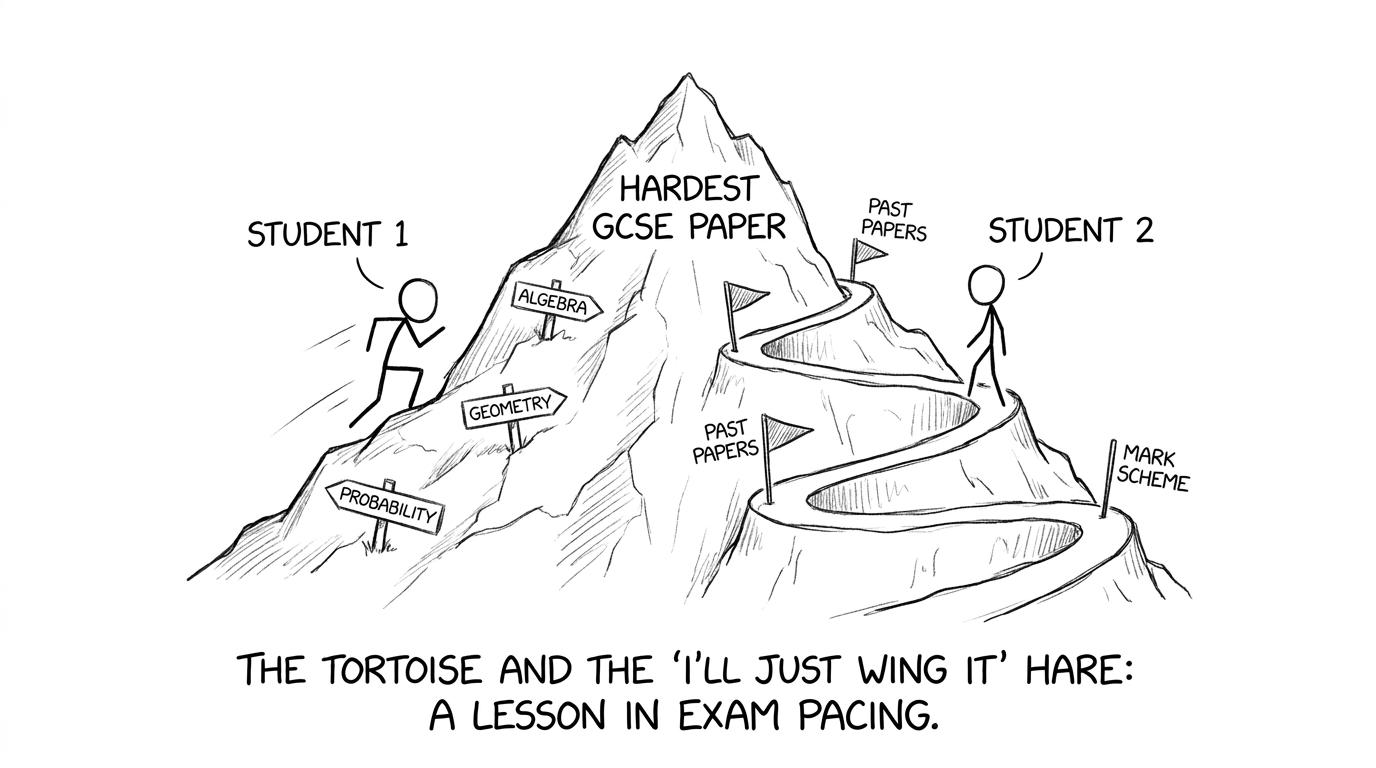 Mountain labelled Hardest GCSE Paper with zig-zag path
Common mistakes students make on a hard GCSE paper
- Treating a hard question as all-or-nothing. Most multi-mark questions allow partial credit for correct setup.
- Restarting repeatedly. A messy but progressing solution often scores more than three abandoned attempts.
- Not writing down what each symbol means. Defining nnn, xxx, www, θ\thetaθ can be worth the clarity that earns method marks.
- Ignoring units and context. If the question is about speed, your answer should be in the correct units, and your working should show conversions.
- Overusing the calculator on calculator papers. The calculator is for arithmetic; the thinking is still algebra, geometry, probability.
- Giving up on the last questions too early. Even one correct line can secure a mark.
The real way to beat the hardest GCSE maths paper ever
The hardest GCSE paper ever isn’t beaten by brilliance. It’s beaten by habits: writing down definitions, taking method marks seriously, and practising with enough variety that “unfamiliar” stops meaning “impossible”.
If you want a simple plan, make Maths Genie your home base:
- Learn and revisit topics with GCSE Maths Revision
- Practise under exam conditions using Edexcel GCSE Papers and Mark Schemes and OCR GCSE Maths Papers
- Pressure-test your readiness with Predicted Papers GCSE Maths
- Patch gaps quickly with GCSE Target Tests (Mini Tests)
Do that, and the next time someone says they’ve just sat the hardest GCSE maths paper ever, you’ll recognise the feeling, and you’ll know what to do with it.