Is a Grade 6 in GCSE French Enough for Sixth Form?
Grade 6 GCSE French sixth form entry is often possible, but requirements vary. Check subject rules, overall grades and your next steps before results day.
A result can look simple on paper and still leave you with a complicated question. You see a Grade 6 in French, then wonder whether one number could alter everything you planned for sixth form.
The short answer is reassuring: a Grade 6 in GCSE French is often enough for sixth-form entry and may meet the requirement for A Level French, but it is not guaranteed. Every school and college sets its own general and subject-specific entry requirements. The real question behind grade 6 gcse french sixth form searches is therefore not whether the grade is good in isolation, but whether it satisfies the published rules for the course and provider you want.
Your French grade may be decisive if you want to continue the subject. If you plan to take Maths, Biology or another course, it may simply contribute to your overall GCSE profile. That distinction matters.
Your sixth-form entry checklist
Before worrying about one result, check these four things:
- the sixth form's general entry requirements;
- the requirement for each A Level or vocational course you selected;
- whether the requirement refers specifically to GCSE French;
- what happens if you miss an entry grade narrowly.
Read the prospectus for your intended year of entry rather than relying on an older screenshot, a friend's offer or something remembered from an open evening. Requirements can differ between providers and admission cycles.
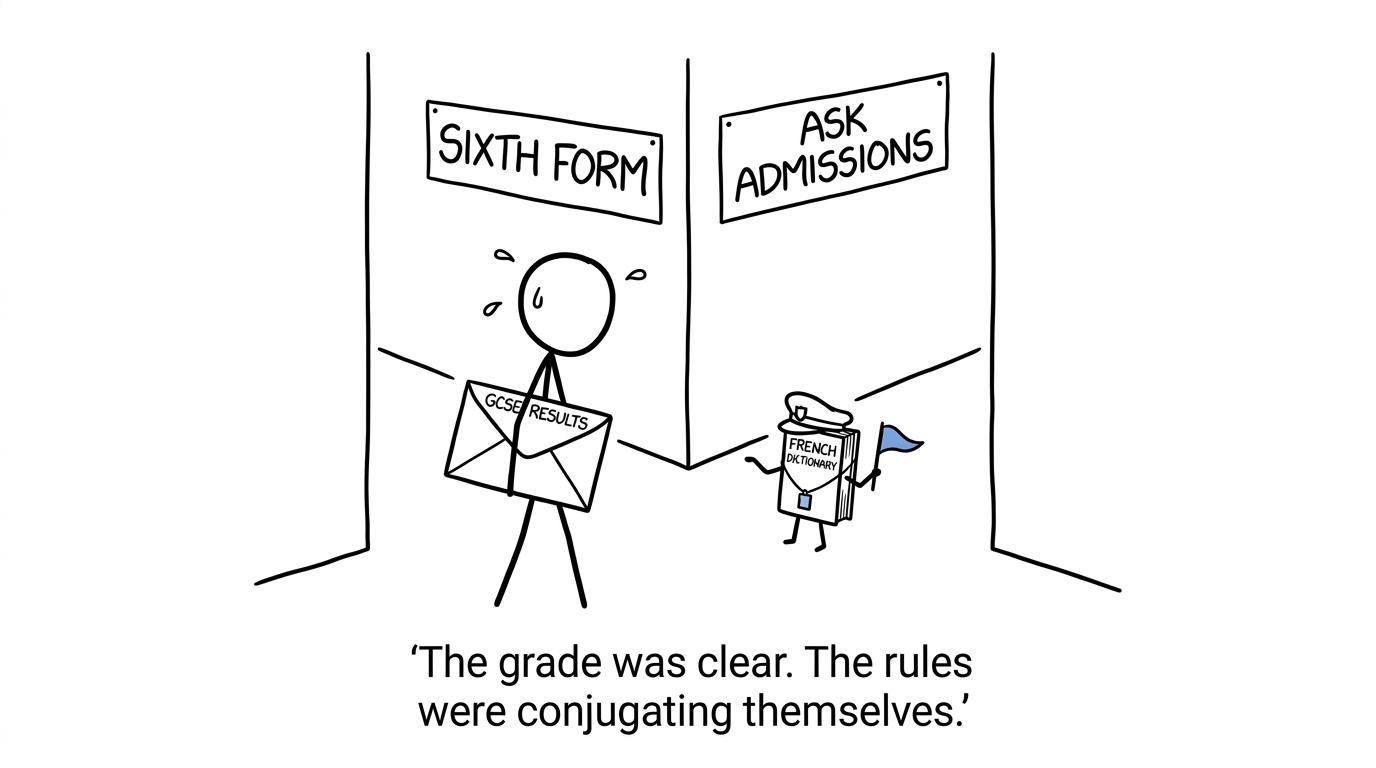 A student discovering that sixth-form entry rules need translating
Is a Grade 6 in GCSE French a good result?
Yes. On the GCSE grades 9-1 scale used in England, Grade 4 is described as a standard pass and Grade 5 as a strong pass. Grade 6 is above both benchmarks and shows a secure performance in the subject.
However, GCSE grades have two different jobs. They record what you achieved, but they can also act as entry conditions for your next course. A grade can be objectively good while still falling below the minimum for one unusually selective programme. Equally, it can be more than sufficient for another.
This is why comparing your Grade 6 with somebody else's Grade 7 does not answer the admissions question. The published course requirement does.
Is Grade 6 enough to study A Level French?
For many sixth forms and colleges, a Grade 6 is within the typical range requested for A Level French. Some providers may accept Grade 5, while others may ask for Grade 7 or apply additional conditions. There is no single national admissions threshold that every sixth form must use.
A Level French develops several connected skills: listening, reading, writing, translation, speaking, grammar and engagement with cultural material. Schools set their thresholds because the course moves beyond GCSE work and expects students to communicate with greater independence.
If your chosen provider states that Grade 6 is required, achieving it normally satisfies that subject condition. You must still meet any general entry rules, such as requirements covering GCSE English Language, GCSE Maths or a broader set of GCSE results.
If the prospectus asks for Grade 7, a Grade 6 does not automatically qualify. It is still worth contacting the admissions team. They can explain whether there is any flexibility, whether places affect the decision and whether your wider performance may be considered. Ask rather than assume, but do not treat discretion as a promise.
Check which French qualification is named
Make sure the requirement applies to the qualification you took. Schools may refer simply to GCSE French, but you should confirm the details if your course, exam board or grading arrangement differs from the standard route.
Edexcel, AQA and Eduqas offer GCSE French qualifications, but sixth-form entry is controlled by the receiving school or college rather than by the GCSE exam board. Your exam board awards the qualification; it does not decide whether a particular sixth form admits you.
What if you do not want to study French?
If you want to take subjects unrelated to French, your Grade 6 is unlikely to be considered as a French-specific condition. Instead, it may count towards the general GCSE profile used for admission.
Suppose your intended combination is Maths, Physics and Computer Science. The provider is more likely to focus on your GCSE Maths grade, and perhaps your science grades, than to demand a particular result in French. A Grade 6 in French can strengthen your overall set of results, but it cannot replace a subject-specific Maths requirement.
The same principle works in the other direction. A strong Maths grade does not override a published Grade 7 French requirement if you want to study A Level French. Sixth-form decisions often contain several separate gates, and you need to pass each one that applies.
Why your GCSE Maths grade may matter more
Many sixth forms set a higher GCSE Maths threshold for A Level Maths than their basic school-wide requirement. Further Maths can have a higher threshold again. Exact grades vary, so use the current prospectus for your chosen provider.
If Maths is part of your plan, make that requirement visible now. Start with MathsGenie's free GCSE maths revision lessons, where topics are organised by grade and supported by videos and exam-style practice questions.
This creates a better revision strategy. You are no longer revising vaguely because every grade feels important. You know which subjects contain non-negotiable entry conditions and can allocate time accordingly.
How to check whether you qualify
Begin with the official course page or prospectus for the sixth form or college you actually intend to attend. Look for two separate sections: general admissions and individual course requirements.
Then check the wording carefully. Phrases such as “minimum entry requirement” describe a threshold, not a prediction that every applicant meeting it will necessarily receive a place. Popular courses may also be affected by availability, timetabling and the provider's admissions policy.
Your next steps should be practical:
- save the current prospectus or admissions page;
- write down the general entry conditions;
- record the requirement beside each proposed course;
- note whether English Language or Maths is specified;
- ask admissions about any unclear wording;
- keep an alternative subject combination available.
If you already hold a conditional offer, read the offer itself. It may be more relevant to your situation than a general summary on the website.
Predicted grades and final results
Predicted grades can help sixth forms discuss courses and make conditional offers, but final enrolment decisions are normally based on achieved results and the provider's admissions arrangements. A prediction of Grade 7 is not the same as achieving it, just as a lower prediction does not place a ceiling on your final result.
Focus on the part you can still influence: preparation. For Maths, combine topic revision with complete GCSE Maths past papers. Past papers reveal whether you can select methods when questions are mixed together, rather than only when a worksheet tells you the topic.
MathsGenie's predicted GCSE papers can provide further exam-style practice. They should support a broad revision programme, not be treated as a list of questions guaranteed to appear.
What to do if the course asks for Grade 7
Missing a requirement by one grade can feel final, but the sensible response is to collect accurate information before drawing conclusions.
Contact the admissions team and ask a precise question: does the published Grade 7 operate as a fixed minimum, or can Grade 6 applicants ever be considered? Explain which course you want and mention any offer you already hold. Do not ask a teacher to guarantee an outcome controlled by another institution.
At the same time, prepare alternatives. These might include a different subject combination, another provider with different requirements or a related course. A backup is not an admission of defeat. It prevents one decision made on results day from carrying more weight than it deserves.
If a review of marking or appeal might be relevant, speak promptly to your school or exams officer. Formal post-results services have rules, deadlines and possible outcomes; they are not simply requests for extra marks. Your school can explain the current process and whether the script supports taking action.
Balancing French with GCSE maths revision
The danger of sixth-form requirements is that they can make every revision session feel like an emergency. Better planning separates genuine priorities from background anxiety.
List your intended courses and identify the GCSE subjects attached to explicit entry requirements. Give those subjects consistent revision time while maintaining the rest of your timetable. For Maths, move between three modes:
- learn or revisit a method through a revision lesson;
- practise focused questions and use the mark scheme;
- test mixed knowledge under timed conditions.
Use the free MathsGenie GCSE revision hub to locate weak topics, then return to GCSE exam papers and mark schemes to see whether the improvement transfers to full papers. Video solutions are particularly useful when a mark scheme shows the answer but not why your route failed.
If A Level Maths is part of your longer-term plan, you can also explore the A Level maths revision resources. This is not a reason to rush ahead before your GCSE exams. It is simply a way to understand the road you are trying to enter.
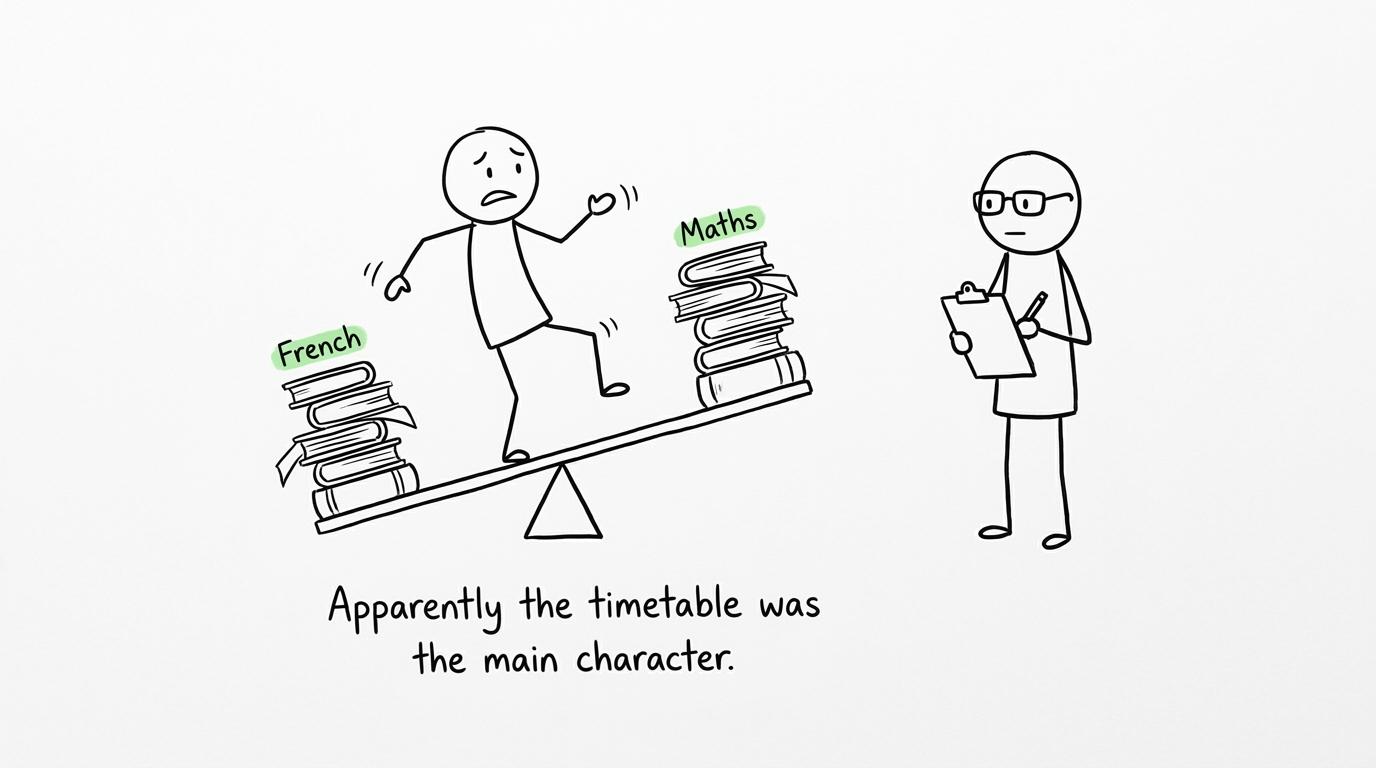 A student balancing French, maths and a revision timetable
Common mistakes when judging sixth-form entry
Treating one grade as the whole admissions decision
A Grade 6 in French may satisfy one condition while another course depends on GCSE Maths, English Language or Science. Check the complete offer rather than isolating the result that worries you most.
Assuming every sixth form uses the same threshold
Entry requirements are set locally. Advice from another student may be accurate for their school and still be wrong for yours.
Reading an outdated prospectus
Course requirements and admissions policies can change. Always use information for your intended entry year and confirm uncertainty directly with the provider.
Confusing a general requirement with a course requirement
A sixth form might have one threshold for admission overall and a separate, higher threshold for A Level French or Maths. Meeting the first does not necessarily satisfy the second.
Ignoring the exact wording of an offer
An offer may specify particular grades in named subjects. Read every condition and ask for clarification before results day if anything is ambiguous.
Revising only the subjects causing anxiety
An entry requirement can make one subject feel urgent, but neglecting Maths or English may create a different barrier. A revision planner should reflect the whole course combination you want.
Make the grade serve the plan
A Grade 6 in GCSE French is a good achievement and will be sufficient for many sixth-form routes. Whether it is enough for your route depends on the provider's general admissions policy, the requirement for your chosen course and the conditions in any offer you receive.
Check those rules now. If Grade 6 meets them, turn your attention back to earning the strongest overall results you can. If it falls short, speak to admissions and build a realistic alternative rather than waiting for results day without a plan.
For the maths grades supporting your next step, make MathsGenie your revision base. Use the free lessons, mini tests and practice questions to strengthen individual topics, then measure progress with GCSE past papers, mark schemes, video solutions and predicted papers. Sixth-form entry can appear to rest on a few numbers. Good preparation is built from the smaller decisions you repeat before those numbers arrive.