Grade 5 GCSE French: Enough for Sixth Form?
Grade 5 GCSE French sixth form choices explained: check course entry rules, subject requirements and how to protect the maths grades your next step needs.
A results sheet can make one number feel larger than it really is. If you are searching for grade 5 GCSE French sixth form options, the short answer is reassuring: a grade 555 may be enough for general sixth-form or college entry, but it may not meet the subject requirement for A Level French.
There is no single national admissions rule covering every sixth form and course. Each provider publishes its own entry requirements. Some accept a grade 555 in French for A Level French; many ask for a grade 666, and occasionally the requirement is higher. If you want to take a different subject, your French result may simply count towards the required number of GCSE passes.
The important question is therefore not whether a grade 555 is universally “good”. It is whether it unlocks the course you actually want.
The quick admissions checklist
Before changing your plans, check these points:
- the sixth form or college's general GCSE entry requirements;
- the individual requirement for each course you want to take;
- whether A Level French has a higher subject-specific threshold;
- the required grades in GCSE English and maths;
- whether your chosen subjects, such as A Level Maths or sciences, have separate conditions;
- whether the published grades are firm requirements or guidance;
- what the provider says about near-miss results and enrolment-day decisions;
- at least one realistic alternative course or institution.
Use the current course page or prospectus for your intended year of entry. Requirements can change, and a friend's experience from an earlier admissions cycle is not an admissions policy.
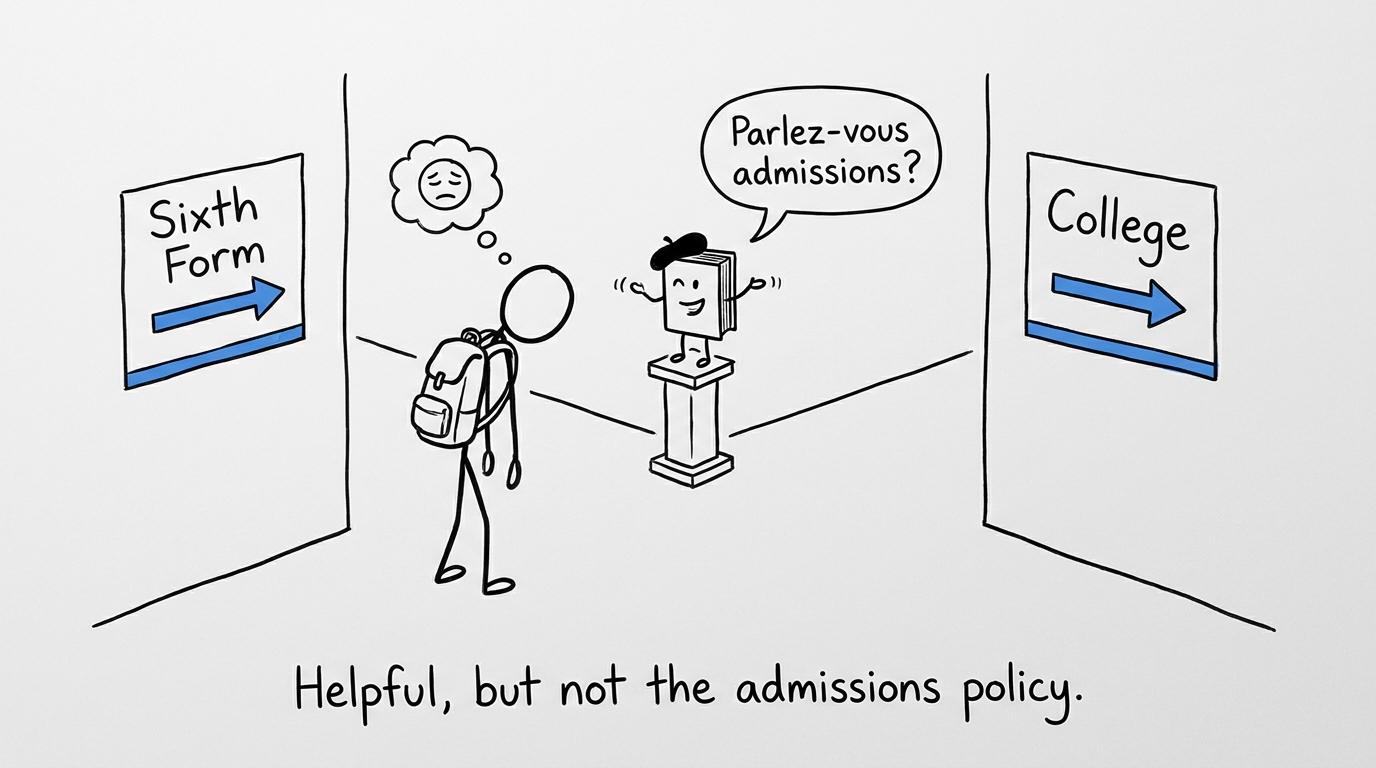 A French phrasebook confidently attempts to explain the route to sixth form
What does a grade 5 in GCSE French mean?
Under the GCSE grading system used in England, grade 444 is commonly described as a standard pass and grade 555 as a strong pass in school performance measures. A grade 555 is therefore a respectable result. It shows that you have developed meaningful knowledge across the assessed language skills, although it does not automatically predict how comfortable you will find A Level French.
The precise assessment structure depends on the specification and exam board, such as AQA, Edexcel, OCR or Eduqas. Your final grade represents performance across the required components rather than one isolated classroom test.
A grade 555 can serve several different purposes:
- it may count towards a sixth form's overall GCSE profile;
- it may satisfy an entry rule for a course unrelated to French;
- it may meet the minimum for A Level French at some providers;
- it may fall one grade short where a grade 666 is required.
That final possibility is why the wording of the course requirement matters more than general opinions about the grade.
Is grade 5 enough for general sixth-form entry?
It can be. Sixth forms and colleges commonly consider a collection of GCSE results rather than making a decision from French alone. They may require a particular number of GCSEs at specified grades, together with minimum results in English and maths.
A grade 555 in French can strengthen that overall profile. However, it cannot compensate automatically for a missing requirement elsewhere. If a provider requires a particular maths grade, for example, a stronger language result does not normally replace it.
This distinction is easy to miss:
- General entry requirements decide whether you can enrol at the institution.
- Subject-specific requirements decide whether you can take a particular course.
You might satisfy the first but not the second. Equally, you could have a grade 555 in French and still qualify for several A Levels that do not require a higher French grade.
Is grade 5 enough for A Level French?
This depends entirely on the provider. A Level French builds on GCSE vocabulary, grammar, listening, reading, speaking and writing, while introducing more demanding texts, ideas and independent expression. For that reason, many departments set a higher subject threshold than the sixth form's general admissions threshold.
Some courses accept grade 555. Others specify grade 666 or above. There is no contradiction here: sixth forms are making their own judgement about the preparation they believe students need for their course.
Read the exact wording carefully. Look for statements such as:
- a minimum grade in GCSE French;
- a recommended rather than compulsory grade;
- different requirements for higher and foundation tier subjects where relevant;
- an expectation of satisfactory speaking or writing skills;
- permission from the head of department;
- consideration of applications on an individual basis.
Do not assume that “five GCSEs at grade 555” means grade 555 is accepted for every A Level. An institution can impose a separate grade 666 requirement for French, mathematics or a science.
 A student detective searches a prospectus for the entry requirements
Check the course you actually want
Your French grade matters differently depending on your intended route.
If you want to study A Level French
Check the dedicated French course page first. If it asks for grade 666 and you currently expect a grade 555, contact admissions or the French department before assuming the answer is no.
Ask a precise question: whether grade 555 applicants are ever considered and what evidence may be reviewed. The answer might depend on final results, available places and departmental judgement. Treat any flexibility as a possibility, not a promise.
Continue preparing as if every extra mark matters. A secure grade 666 removes uncertainty in a way that an informal conversation cannot.
If you want to study another A Level
French may only contribute to your overall GCSE total. The decisive grades will often be those named for your chosen subjects.
A Level Maths, for instance, normally has its own GCSE Maths requirement because the course depends directly on algebra, graphs, trigonometry and other higher-tier knowledge. The exact threshold varies, so check it rather than assuming that general sixth-form admission guarantees a place.
If mathematics is part of your plan, use MathsGenie's GCSE maths revision resources to identify topics by grade and build the knowledge required for your next course.
If you want a vocational or mixed programme
Colleges may offer vocational qualifications, A Levels and mixed programmes with different entry profiles. French could count as one useful GCSE without being central to the course.
Check the complete requirements, including any English, maths, science, portfolio or interview conditions. The course title alone rarely tells you everything needed for admission.
Why your maths grade still matters
It is possible to spend so much time worrying about one borderline French result that another important subject receives too little attention. For students considering sixth form, GCSE Maths often has two roles: it may form part of the institution's general entry criteria, and it may be a specific requirement for subjects such as mathematics, computing, economics or the sciences.
Begin with a realistic diagnosis. MathsGenie's free GCSE revision programme organises lessons and questions by topic and grade, making it easier to see what you can already do and where marks are being lost.
Then test that knowledge under exam conditions. The collection of GCSE maths past papers and mark schemes helps you practise the mixture of topics, wording and time pressure found in a full paper. As the exams approach, predicted GCSE maths papers can provide additional structured practice, although they should complement rather than replace specification-wide revision.
If A Level Maths is your intended destination, explore the MathsGenie A Level maths resources as a preview of the step up. You do not need to race ahead. The purpose is to understand why secure GCSE algebra and number skills matter.
 A calendar keeps French and maths revision books balanced
What to do if the requirement is grade 6
Finding a grade 666 requirement when you are working at grade 555 is information, not a verdict. It gives you a specific gap to address.
First, confirm that the published requirement applies to your entry year. Then speak to your French teacher about the components holding your grade back. A student losing marks through listening needs a different plan from one whose main difficulty is extended writing.
Next, keep your options open:
- apply to another provider whose requirements fit your profile;
- ask whether the department considers near-miss applicants;
- choose a related course that does not require A Level French;
- maintain a backup subject combination;
- revisit your choices after receiving confirmed results.
If your result is unexpectedly below the marks shown in your school records, speak to your school about the official post-results process. Reviews of marking have rules, deadlines and possible outcomes, including the possibility that a mark or grade could stay the same or change. They are not a general method for negotiating an admissions threshold.
Build a balanced revision plan
A good revision plan reflects the consequences of each grade without treating every subject identically. French may need targeted work because it is one grade below your preferred course requirement. Maths may deserve equal protection because it affects both general entry and your intended A Level choices.
Use three simple categories:
- Must secure: subjects with non-negotiable entry requirements;
- Need to improve: subjects currently close to a required boundary;
- Need to maintain: subjects already performing securely but still requiring practice.
For maths, move between short topic sessions and full-paper practice. Revision lessons and video solutions can clarify a method; practice questions and mini tests reveal whether you can use it independently; papers show whether you can recognise the method when the topic is not announced.
The MathsGenie home page brings these free resources together, while the published GCSE grade boundaries can help you interpret past papers appropriately. Grade boundaries vary between exam series, so do not turn one historical boundary into a guaranteed target for your own examination.
Common mistakes when judging sixth-form entry
Assuming every sixth form uses the same grades
Entry requirements are set by individual institutions and can differ between courses at the same institution. Always check your chosen provider.
Confusing general entry with course entry
Being admitted to the sixth form does not automatically qualify you for every subject. Read both sets of requirements.
Relying on an old prospectus or a friend's offer
Admissions policies and course availability can change. Use the current published information and confirm uncertainty directly with admissions.
Ignoring English and maths requirements
A good French result does not override a named condition in another subject. Check the whole offer, especially if your future course has a specific GCSE Maths threshold.
Treating a predicted grade as a final result
Predicted grades help with planning and applications, but enrolment decisions may depend on achieved grades. Use the prediction to guide revision rather than to declare the outcome settled.
Abandoning the plan before asking
If you miss a stated threshold narrowly, ask the provider what happens next. Do not assume discretion will be offered, but do not reject yourself before the institution has considered your confirmed results.
Make the requirement work for you
A grade 555 in GCSE French is a solid achievement. It may be enough for general sixth-form entry, and it may be accepted for A Level French by some providers. But the only dependable answer comes from the current requirements for your institution and course.
Check those requirements now. Separate general entry from subject entry, identify every important English and maths condition, and prepare a sensible alternative. Once the uncertainty becomes a list of actions, it usually feels smaller.
Then turn back to the marks you can still influence. Use MathsGenie's free revision lessons, video solutions, practice questions, mini tests, past papers, predicted papers and mark schemes to strengthen your GCSE Maths result. Your next step should not depend on guesswork, and neither should your revision.