Is Grade 5 English Enough for Sixth Form?
Grade 5 GCSE English Language sixth form entry explained. Learn whether it meets general and course-specific requirements, plus what to check next.
The moment you start reading sixth-form entry requirements, a simple GCSE grade can feel strangely complicated. One course asks for a standard pass, another lists a higher English requirement, and a third talks about an overall GCSE profile.
So, is a grade 5 GCSE English Language sixth form result good enough? In many cases, yes. A grade 5 is above the grade 4 standard pass used in England and will commonly satisfy a sixth form or college's basic English requirement. But it does not guarantee entry to every institution or every course. Your overall GCSE results and the subject-specific requirements for your chosen programme still matter.
The most useful question is therefore not just, "Is grade 5 good?" It is, "Is grade 5 enough for the course I actually want?"
The short answer
A grade 5 in GCSE English Language will often be sufficient if:
- the sixth form requires grade 4 or above in English Language;
- your overall GCSE profile meets its general entry criteria;
- your chosen subjects do not demand a higher English grade;
- you meet any separate requirement in GCSE Maths or a related subject.
You may need a higher grade if you want to take an essay-heavy A Level, particularly English Language, English Literature or another course whose published entry criteria specify grade 6 or above. Requirements vary, so the admissions policy for your chosen sixth form or college is the deciding document.
This article focuses mainly on the grades 9-1 system used in England. Requirements and grading arrangements elsewhere in the UK can differ.
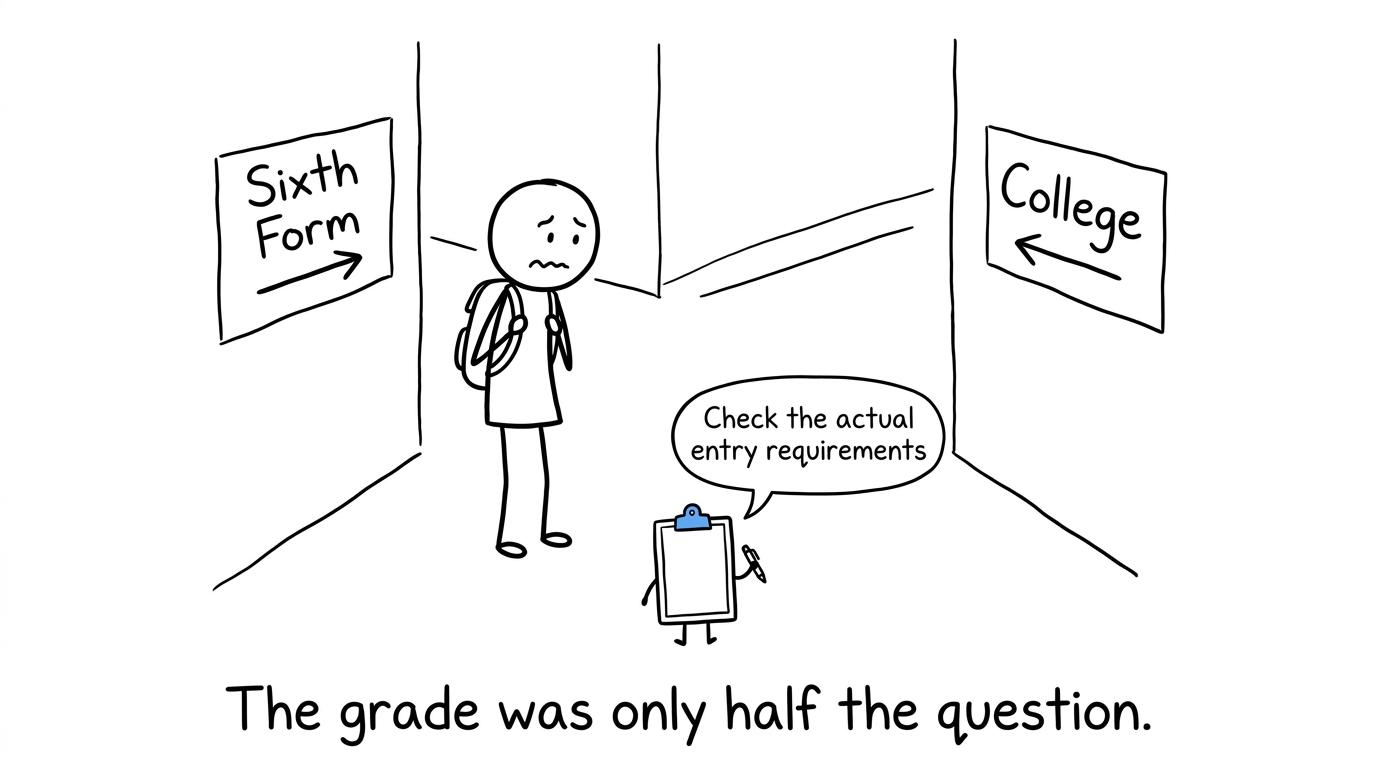 A student discovers that checking the course rules matters as much as checking the grade
What does a grade 5 in GCSE English Language mean?
In England's reformed GCSE grading system, grade 4 is described as a standard pass and grade 5 as a strong pass. Grade 5 therefore represents a secure result rather than a narrow pass.
It is also above the usual threshold at which eligible post-16 students are required under the English and maths condition of funding to continue working towards an approved English qualification. Students who finish Year 11 below grade 4 in GCSE English Language or English Literature will generally need to continue English as part of their post-16 programme, subject to the current rules and permitted qualifications.
A grade 5 normally puts you beyond that resit concern. It does not, however, create one national admissions guarantee. Sixth forms and colleges publish their own general and course-specific entry requirements.
That distinction matters. Government funding rules determine who must continue English after GCSE; an institution's admissions rules determine who can join a particular programme. They answer different questions.
Your sixth-form place depends on more than English
Think of sixth-form admission as a set of gates rather than one locked door. Your English grade may open the first gate, while your overall results and chosen subjects determine whether the others open.
General entry requirements
A sixth form may ask for a particular number of GCSEs at grades 9-4 or 9-5. Some institutions also calculate an average grade or place additional conditions on particular programmes.
Under this type of policy, grade 5 English Language may comfortably meet the English condition while your remaining GCSE results decide whether you satisfy the overall profile. Read every part of the policy rather than stopping when you see the word "English".
Subject-specific requirements
Individual A Levels often have separate requirements. A student hoping to take A Level Maths, for example, may find that the crucial subject-specific condition is a higher grade in GCSE Maths. The English grade can still count towards general admission, but it may not be the result that decides entry to Maths.
Requirements for A Level Maths vary between institutions, with many asking for a strong GCSE Maths grade because the course develops algebra, functions, trigonometry and proof at considerable pace. Always check the exact published grade rather than relying on what another school asks for.
If A Level Maths is your goal, use the free GCSE Maths revision lessons to strengthen the topics that will matter both on results day and at the start of Year 12. You can then explore A Level Maths revision resources to see how the subject develops.
English-heavy courses
A grade 5 may meet general sixth-form entry but fall short of a higher requirement for English Language, English Literature or another writing-intensive subject. Some courses may accept English Language or Literature; others specify one qualification. The wording matters.
Look for separate lines covering:
- admission to the sixth form;
- entry to a three-A-Level programme;
- requirements for each chosen subject;
- whether English Language, English Literature or either qualification is accepted.
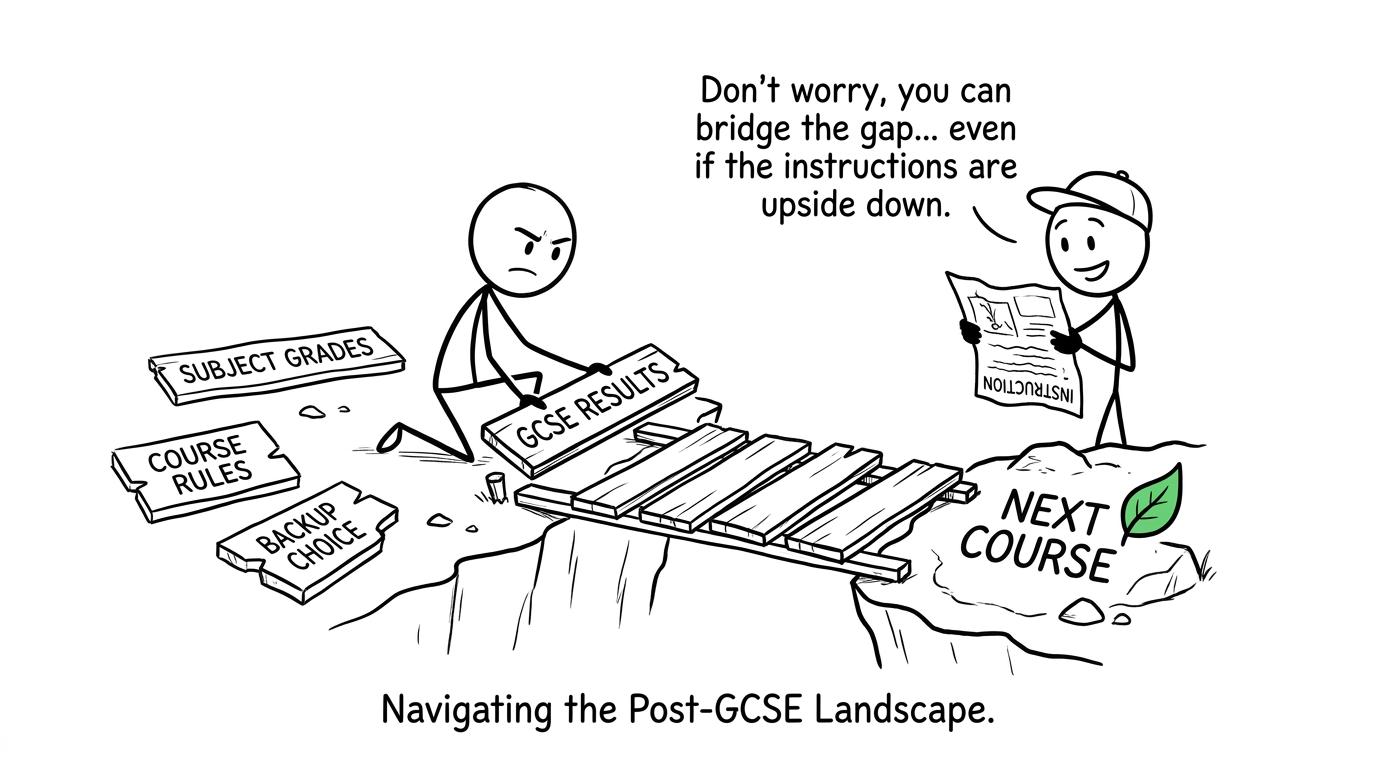 A student assembles subject grades and course rules into a bridge towards the next course
How to check whether grade 5 is enough for your course
Admissions information can look dense, but the decision process is manageable.
Find the policy for the correct year
Use the sixth form or college's official website and open the admissions information for the year in which you intend to start. Entry rules can change, so an older prospectus or a friend's previous offer may no longer be reliable.
Separate general entry from course entry
Write down three pieces of information:
- the minimum English Language grade;
- the overall GCSE profile required;
- the requirement for each subject you want to take.
If all three conditions are satisfied, a grade 5 is likely to be enough from an English Language perspective. Remember that an offer may still depend on the complete published policy and available course places.
Ask when the wording is unclear
Contact the admissions team if a policy says "English" without explaining whether it means English Language, English Literature or either GCSE. You should also ask if your grade is one below a subject requirement or if exceptional consideration is mentioned.
Ask a precise question. State your English Language grade, the course you want and any closely related GCSE grade. Admissions staff can give a more useful answer when they know which rule you are asking about.
Keep a realistic alternative
A backup choice is not an admission of defeat. It is protection against a rule you cannot control. Consider another subject combination, a different sixth form or a suitable college course alongside your preferred option.
The important thing is to preserve routes forward. One institution's threshold is not a universal judgement of your ability.
What grade 5 English means if you want A Level Maths
For a prospective A Level Maths student, grade 5 English Language will often be adequate for the general English requirement. Your GCSE Maths result is more likely to determine whether you can take the subject, although only the chosen institution can confirm this.
That creates a sensible revision priority. Keep working carefully on English, but do not allow anxiety about one acceptable grade to distract you from a course-specific Maths target.
Start by identifying where marks are currently being lost. The Grade 5 Maths revision page can help consolidate key topics, while Grade 6 Maths revision supports the next stage of progress. If some foundations remain uncertain, revisiting the Grade 4 Maths topics is efficient revision, not a step backwards.
Then move from topic practice to complete papers. MathsGenie's GCSE Maths past papers let you practise timing, topic recognition and exam technique using realistic questions and mark schemes. Nearer the examination, GCSE predicted papers provide further structured practice.
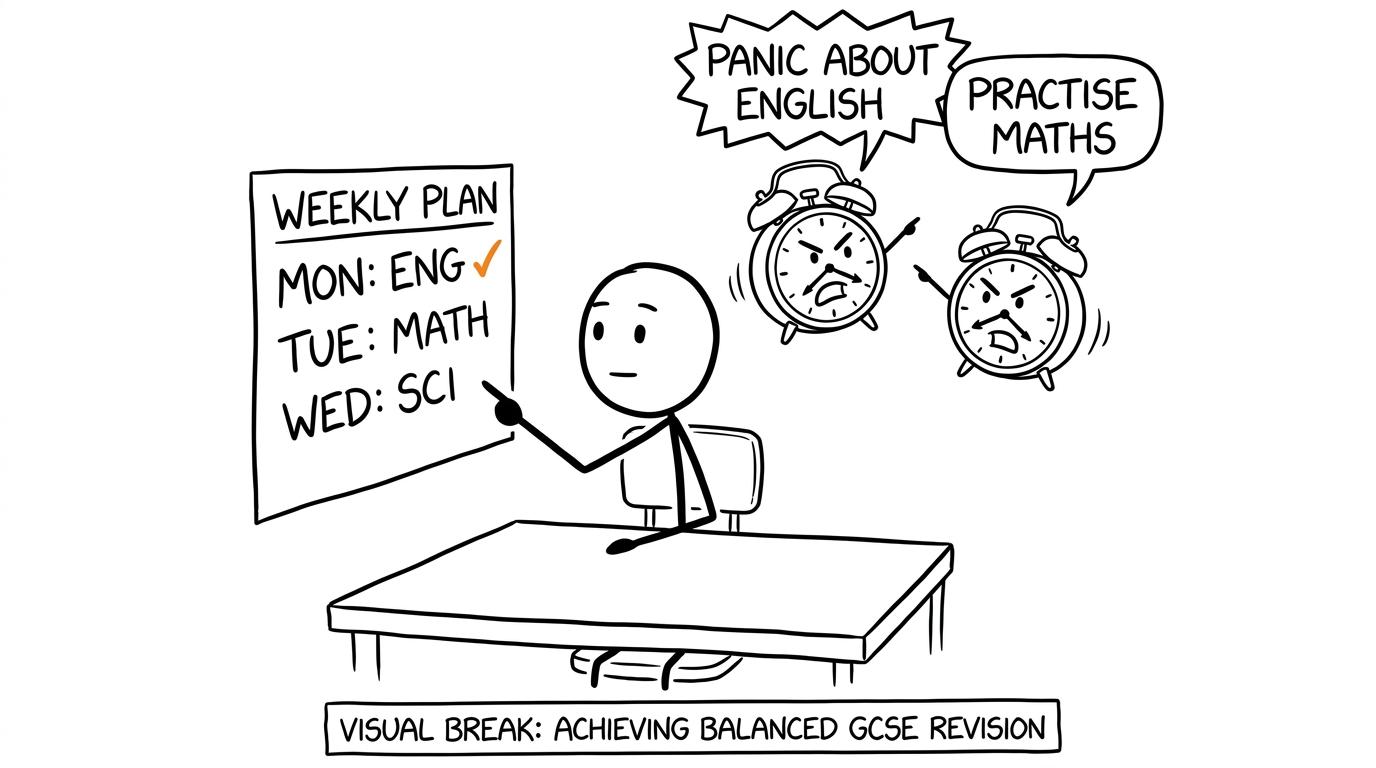 A calm student chooses a balanced revision plan while two alarm clocks argue about what deserves panic
What to do before results day
You do not need to wait for your final grades before checking your position.
Create a short list containing your preferred institution, chosen courses, general entry requirements and subject requirements. Add a second-choice route with conditions you understand. If anything is ambiguous, contact admissions while there is still time to plan.
For maths revision, combine three forms of practice:
- revision lessons to rebuild understanding;
- topic questions to develop accuracy;
- full papers to improve selection, timing and stamina.
Mark your work honestly. A mark scheme is not just a device for producing a total; it shows which statements, steps and conclusions examiners reward. After each paper, return to the weakest topic before attempting another one. Students often improve more by repairing repeated errors than by collecting untouched papers.
When you are ready for harder material, the Grade 7 Maths revision resources can help you extend beyond the middle grades without losing sight of the foundations beneath them.
Common mistakes when judging sixth-form entry
Treating grade 5 as a universal guarantee
A grade 5 is a strong pass, but every institution can publish its own admissions criteria. Check the actual policy for your year and programme.
Looking only at the English requirement
General admission may also depend on the number and profile of your GCSE grades. Your chosen A Levels can then add separate subject conditions.
Confusing a resit threshold with an entry requirement
Being above the grade normally associated with compulsory continued English does not automatically qualify you for every sixth-form course. Funding rules and admissions policies serve different purposes.
Assuming all English qualifications are interchangeable
A policy may require English Language specifically, accept Language or Literature, or set different grades for different subjects. Do not guess from the word "English" alone.
Using another student's offer as evidence
Their course, institution, application year and overall results may be different. It is useful context, but it is not your admissions policy.
Neglecting the grade that matters for your chosen subject
If you want A Level Maths, improving GCSE Maths may have more influence on your options than worrying repeatedly about an English grade that already meets the stated minimum.
A grade is information, not a verdict
A grade 5 in GCSE English Language is good enough for many sixth-form and college routes. It is a strong pass and will commonly meet a basic English requirement. The final answer, however, belongs to the published rules for your institution and chosen course.
Check the current policy, separate general admission from subject entry, and ask the admissions team about anything unclear. Then return your attention to what you can still improve.
MathsGenie gives you a free route from uncertainty to purposeful practice: clear revision lessons, grade-based topic questions, video solutions, past papers, predicted papers and mark schemes. Choose the area costing you marks, practise it carefully, and let each corrected mistake make the next paper a little less unfamiliar.