Geometric Sequences Exam Questions for GCSE
Geometric sequences exam questions explained through three GCSE examples, with clear methods, mark guidance, common mistakes and practice tips.

A geometric sequence can look harmless at first. Then an exam question asks for its nth term, hides the common ratio inside fractions, or asks whether a distant number belongs to the sequence.
The reliable way to answer geometric sequences exam questions is to find the multiplier between consecutive terms, write the rule in the form a×rn−1a \times r^{n-1}a×rn−1, and then use that rule carefully. In this guide, we follow a GCSE student through three questions of rising difficulty and show where method marks are likely to come from.
The geometric sequence checklist
Before attempting a question, remember these four ideas:
- A geometric sequence has the same multiplier, called the common ratio, between consecutive terms.
- Find the ratio by dividing a term by the term before it.
- If the first term is aaa and the common ratio is rrr, the nth term is:
- Check your formula by substituting n=1n=1n=1 and n=2n=2n=2.
The exponent is n−1n-1n−1 because the first term has experienced no multiplications by the common ratio. By the second term, the ratio has been applied once. By the third, it has been applied twice.
Question one: finding the next terms
Imagine a student, Sam, beginning with a familiar-looking question.
The sequence is:
3, 12, 48, 192,…3,\ 12,\ 48,\ 192,\ldots3, 12, 48, 192,…Write down the next two terms.
Sam first checks the differences. They are 999, 363636 and 144144144, so they are not constant. That means this is not an arithmetic sequence.
Next, Sam checks the multiplier:
12÷3=412 \div 3 = 412÷3=4 48÷12=448 \div 12 = 448÷12=4 192÷48=4192 \div 48 = 4192÷48=4The common ratio is therefore 444. Sam continues the pattern:
192×4=768192 \times 4 = 768192×4=768 768×4=3072768 \times 4 = 3072768×4=3072The next two terms are:
768, 3072\boxed{768,\ 3072}768, 3072Where the marks come from
For a short question, the marks may simply be awarded for the two correct terms. Writing the multiplication helps the examiner follow the method and can protect a method mark where the mark scheme allows one.
The important habit is to test more than one pair of terms. A coincidental relationship between the first two terms does not prove that the whole sequence is geometric.
You can reinforce this process with the Maths Genie GCSE revision lessons, which organise topics by grade and include practice materials.
Question two: finding the nth term
Sam now meets the type of question that causes more uncertainty.
Find the nth term of:
5, 15, 45, 135,…5,\ 15,\ 45,\ 135,\ldots5, 15, 45, 135,…The common ratio is found by division:
15÷5=315 \div 5 = 315÷5=3So a=5a=5a=5 and r=3r=3r=3. Sam uses the geometric sequence formula:
un=a×rn−1u_n = a \times r^{n-1}un=a×rn−1Substituting the values gives:
un=5×3n−1u_n = 5 \times 3^{n-1}un=5×3n−1Therefore, the nth term is:
5×3n−1\boxed{5 \times 3^{n-1}}5×3n−1Sam checks the result. When n=1n=1n=1:
5×31−1=5×30=55 \times 3^{1-1}=5 \times 3^0=55×31−1=5×30=5When n=2n=2n=2:
5×32−1=5×3=155 \times 3^{2-1}=5 \times 3=155×32−1=5×3=15Both values match the sequence.
Why n−1n-1n−1 matters
A frequent wrong answer is 5×3n5 \times 3^n5×3n. It seems close, but substituting n=1n=1n=1 gives 151515, which is the second term rather than the first.
One way to see the structure is to write the early terms with powers:
5×30,5×31,5×32,5×335 \times 3^0,\quad 5 \times 3^1,\quad 5 \times 3^2,\quad 5 \times 3^35×30,5×31,5×32,5×33The term number is always one greater than the exponent. That is why the exponent is n−1n-1n−1.
Where the marks come from
In a typical GCSE question, credit may be available for identifying the ratio and building a correct expression, even if a later simplification goes wrong. Exact allocation varies by paper and mark scheme, so show these stages:
- State the common ratio.
- Identify the first term.
- Substitute into a×rn−1a \times r^{n-1}a×rn−1.
- Check the first term.
Once this method feels clear, use the Maths Genie lessons and GCSE question bank to practise recognising the ratio and writing the nth term without relying on notes.
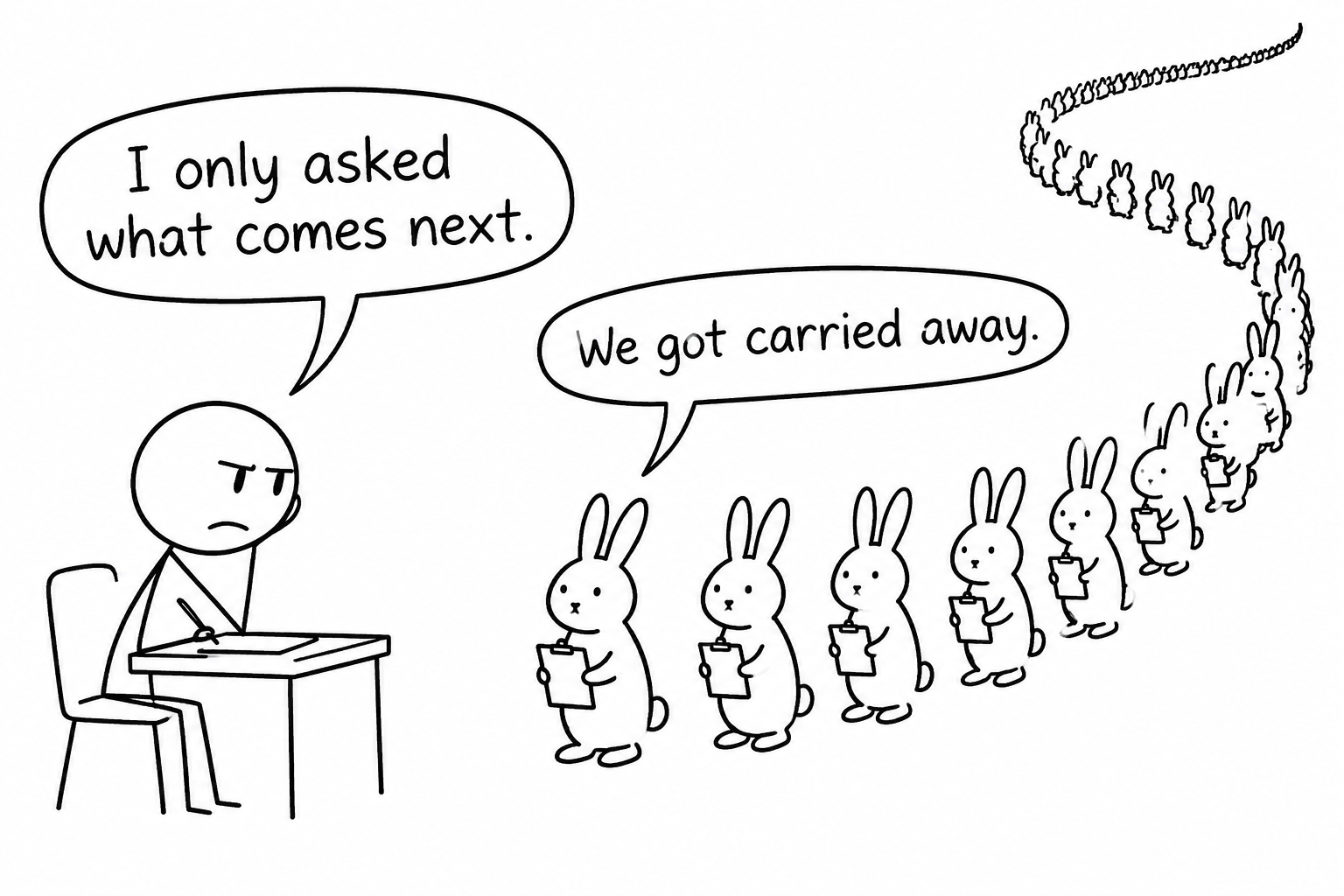 A student discovers that a repeating pattern has got carried away
Question three: deciding whether a number is a term
The final question combines several steps.
The nth term of a geometric sequence is:
2×3n−12 \times 3^{n-1}2×3n−1Is 145814581458 a term in the sequence? Show your reasoning.
Sam sets the nth term equal to 145814581458:
2×3n−1=14582 \times 3^{n-1}=14582×3n−1=1458Divide both sides by 222:
3n−1=7293^{n-1}=7293n−1=729Sam recognises that:
729=36729=3^6729=36Therefore:
3n−1=363^{n-1}=3^63n−1=36So the exponents must be equal:
n−1=6n-1=6n−1=6 n=7n=7n=7Because n=7n=7n=7 is a positive integer, 145814581458 is the seventh term of the sequence.
1458 is the seventh term.\boxed{1458\text{ is the seventh term.}}1458 is the seventh term.Where the marks come from
A multi-step geometric sequences GCSE exam question often rewards the chain of reasoning. Sam has shown:
- an equation connecting the given number to the nth term;
- division by the first-term coefficient;
- recognition of a power of 333;
- a valid integer term number;
- a conclusion answering the question.
Simply writing “yes” leaves the examiner no method to credit. The conclusion also matters: finding n=7n=7n=7 should be followed by an explicit statement that the number is a term.
How to practise exam-style questions
Reading a solution can create a dangerous sense of familiarity. The method looks obvious because somebody else has already chosen each step.
A stronger revision routine is:
- complete one question with the method visible;
- cover the method and answer a similar question;
- mark it immediately;
- label the error precisely, such as “used nnn instead of n−1n-1n−1”;
- retry the question later without notes;
- finish with mixed sequence questions so you must decide which method applies.
Mixed practice matters because an exam will not announce whether a sequence is arithmetic, quadratic or geometric. You have to diagnose it. Use GCSE past papers and mark schemes to practise making that decision in an authentic paper rather than only completing isolated exercises.
Common mistakes in geometric sequences
Looking only at the differences
Constant differences identify arithmetic sequences. In a geometric sequence, divide consecutive terms to find a constant ratio.
Using the wrong division order
Calculate:
next termprevious term\frac{\text{next term}}{\text{previous term}}previous termnext termReversing the division gives the reciprocal of the required ratio.
Forgetting that the ratio can be negative
For example, the sequence
4, −8, 16, −32,…4,\ -8,\ 16,\ -32,\ldots4, −8, 16, −32,…has common ratio −2-2−2. The alternating signs are part of the pattern.
Writing a×rna \times r^na×rn
For a sequence beginning at n=1n=1n=1, the usual form is:
a×rn−1a \times r^{n-1}a×rn−1Always substitute n=1n=1n=1 to check that the formula returns the first term.
Giving an incomplete membership answer
If solving for nnn gives a positive integer, the number occupies that term position. If it gives a non-integer, it is not a term. State the conclusion rather than leaving an unsupported equation.
Hiding every calculation
Correct working makes the reasoning clearer and may earn method marks when the final answer is wrong. This is particularly valuable in geometric sequences past paper questions with several linked stages.
Turn the method into exam confidence
Sam’s progress came from using the same small routine each time: divide to find the ratio, write a×rn−1a \times r^{n-1}a×rn−1, substitute carefully and check. Knowing that routine is the first step; applying it reliably under exam conditions takes deliberate practice.
Use the Maths Genie Lessons and Question Bank to revisit the matching sequence lesson, then answer exam-style questions until you can show every mark-worthy step without prompts. Start the geometric sequences lesson and Question Bank practice now.