

GCSE Active Recall: Turn WJEC Physics Notes into Marks
GCSE active recall for WJEC students: turn Physics notes into self-testing routines, then transfer the method to maths with YesGenie practice.
If you’re a WJEC student, you probably know this feeling: your GCSE Physics notes look immaculate, colour-coded, and oddly comforting… but the moment you close the page, your mind goes blank. That’s not because you’re “bad at revision”. It’s because notes are storage, not retrieval. And GCSE exams don’t reward storage. They reward recall under pressure.
This post shows how to turn WJEC Physics notes into active recall, and then how to reuse the same method in GCSE maths, where marks often come from doing the right method, not having read the right page. You’ll leave with a simple routine, a few templates, and worked maths examples you can practise straight away.
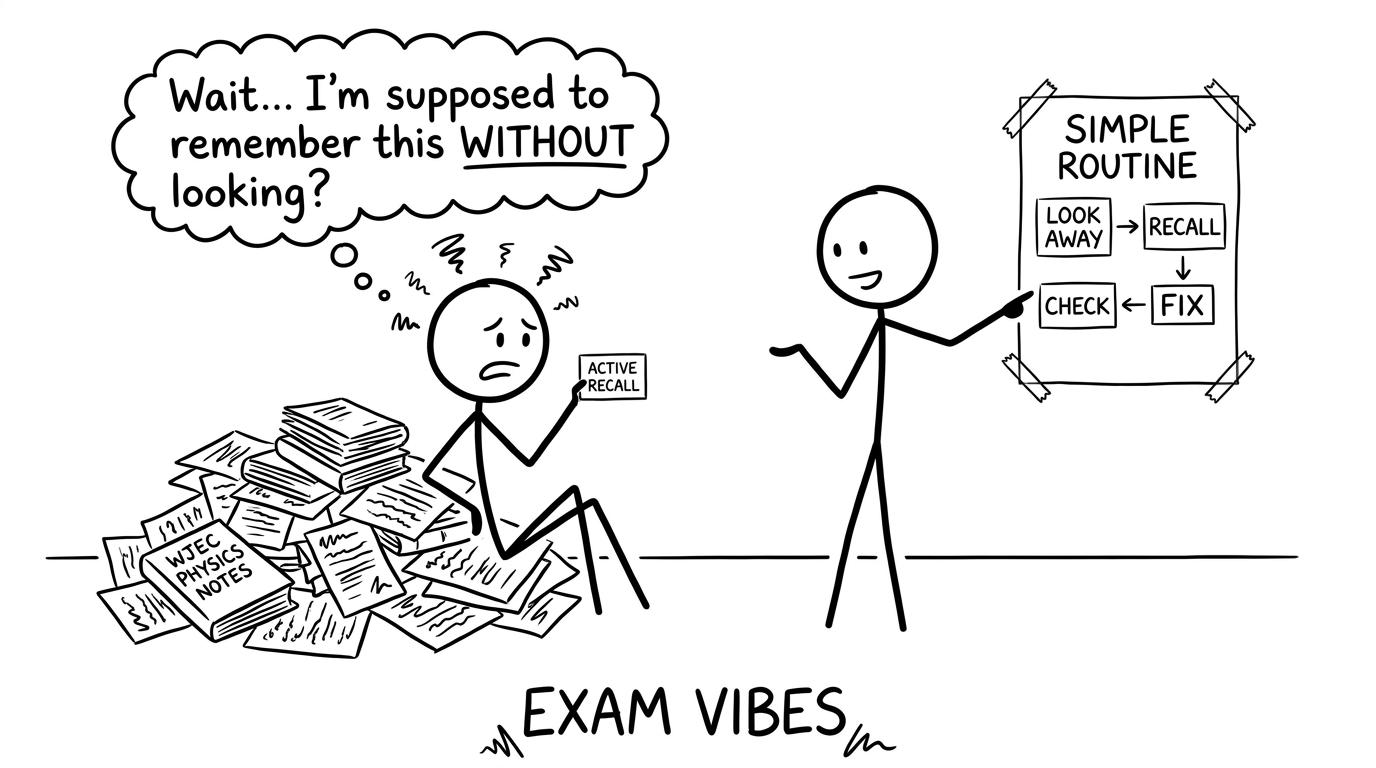 Student vs notes vs active recall
The shift that changes everything: notes are not revision
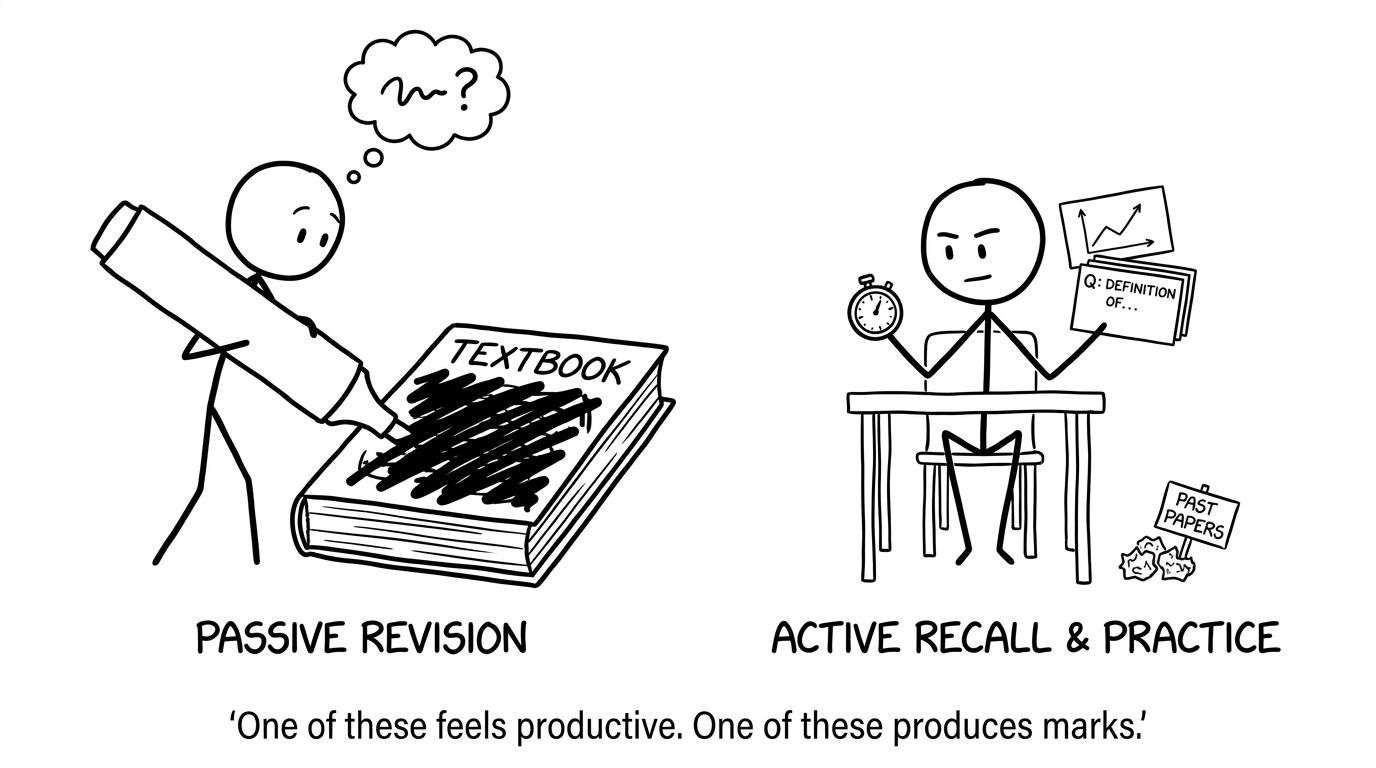
Most students treat revision like re-reading. It feels safe. Your brain recognises the words, and recognition pretends to be knowing.
Active recall is different: you force your brain to produce the idea without looking. It’s slightly uncomfortable, like doing a rep at the gym. That discomfort is the point; it’s how your memory gets stronger.
For WJEC GCSE Physics, this matters because the questions often mix facts with application: definitions, equations, required practicals, then a curveball where you need to pick the right relationship and rearrange it. For GCSE maths, it matters even more: the paper is basically one long test of whether you can retrieve methods on demand.
If you want a clean place to practise retrieval in maths, start here: GCSE Subjects and the wider Resources hub.
A quick checklist: turning WJEC notes into active recall
Here’s the routine you’ll use for both GCSE Physics and GCSE maths:
- Reduce each page of notes into questions, not sentences.
- Hide the answers (cover, fold, or use flashcards).
- Recall from memory for 303030 a few 909090 seconds.
- Check against your notes or a mark scheme.
- Fix gaps immediately (rewrite the question or add a clue).
- Space it: come back tomorrow, then in 333 days, then in a week.
If you’re revising maths alongside Physics, build the “check” step around worked solutions and mark schemes: GCSE Past papers is a simple way to make that automatic.
 Passive vs active revision
How to convert WJEC GCSE Physics notes into active recall prompts
Turn headings into exam-style questions
Take a typical Physics heading like “Specific heat capacity”. If your notes say:
- “Energy required to raise 1 kg1\text{ kg}1 kg by 1∘C1^\circ\text{C}1∘C”
- “Equation E=mcΔTE = mc\Delta TE=mcΔT”
Convert that into prompts:
- “Define specific heat capacity.”
- “Write the equation linking E,m,c,ΔTE, m, c, \Delta TE,m,c,ΔT.”
- “Rearrange to make ccc the subject.”
- “What are the units of ccc?”
Now your notes are a question bank. That’s active recall.
Use the “blank page method” for required practicals
Required practical notes are often long. Active recall turns them into a simple loop:
- Look at the title: “WJEC required practical: I-V characteristics.”
- On a blank page, write the method from memory in bullet points.
- Check your notes.
- Add the missing steps as questions (e.g. “Why use a variable resistor?”).
This is exactly how you should treat multi-step GCSE maths topics too: method first, details second.
The hidden advantage: active recall transfers perfectly to GCSE maths
Physics gives you formulas. Maths gives you methods. Both punish hesitation.
Once you get used to retrieval in WJEC GCSE Physics, you can apply the same approach to your maths revision on YesGenie:
- Learn a method with a short explanation
- Recall the steps without looking
- Check with worked solutions
- Repeat with spacing
For board-specific practice, these are good anchors:
Even if you’re not on WJEC for maths, the active recall process stays the same.
 Spacing and interleaving gym
Worked maths examples: practising active recall the right way
Below are maths examples designed to feel like Physics recall: pick a relationship, rearrange, calculate, check units/logic. When you do them, cover the solution and try to retrieve the method first.
Example 1: rearranging a formula (the Physics-to-maths bridge)
Make xxx the subject:
y=3x−7 y = 3x - 7 y=3x−7Method (recall it): isolate the xxx term, then divide.
Solution:
y+7=3x y + 7 = 3x y+7=3x x=y+73 x = \frac{y+7}{3} x=3y+7If rearranging is a weak spot, build retrieval around short prompts like “move the constant”, “divide by the coefficient”, and practise with mixed questions.
Example 2: standard form calculation (common in Physics and maths)
Calculate (3.2×10⁵)(4×10³)(3.2 \times 10^5)(4 \times 10^3)(3.2×10⁵)(4×10³) in standard form.
Solution:
Multiply the numbers and add the powers:
3.2×4=12.8 3.2 \times 4 = 12.8 3.2×4=12.8 105×103=108 10^5 \times 10^3 = 10^{8} 105×103=108So:
12.8×108=1.28×10⁹ 12.8 \times 10^8 = 1.28 \times 10^9 12.8×108=1.28×10⁹Active recall prompt you can write on a card: “Multiply the front, add the powers, re-standardise.”
Example 3: ratio and proportion (the “choose the relationship” skill)
A recipe uses flour and sugar in the ratio 5:25:25:2. If flour is 350 g350\text{ g}350 g, how much sugar is needed?
Solution:
If 555 parts =350 g= 350\text{ g}=350 g, then 111 part is:
3505=70 g \frac{350}{5} = 70\text{ g} 5350=70 gSugar is 222 parts:
2×70=140 g 2 \times 70 = 140\text{ g} 2×70=140 gThis is exactly the same thinking as Physics scaling questions: identify “parts”, find one part, scale up.
For mixed GCSE maths practice that forces retrieval, try short focused tests: Edexcel GCSE Maths Mini Tests (use them even if you’re on another board; methods overlap heavily across GCSE specs).
How to space and interleave (without making a timetable you’ll ignore)
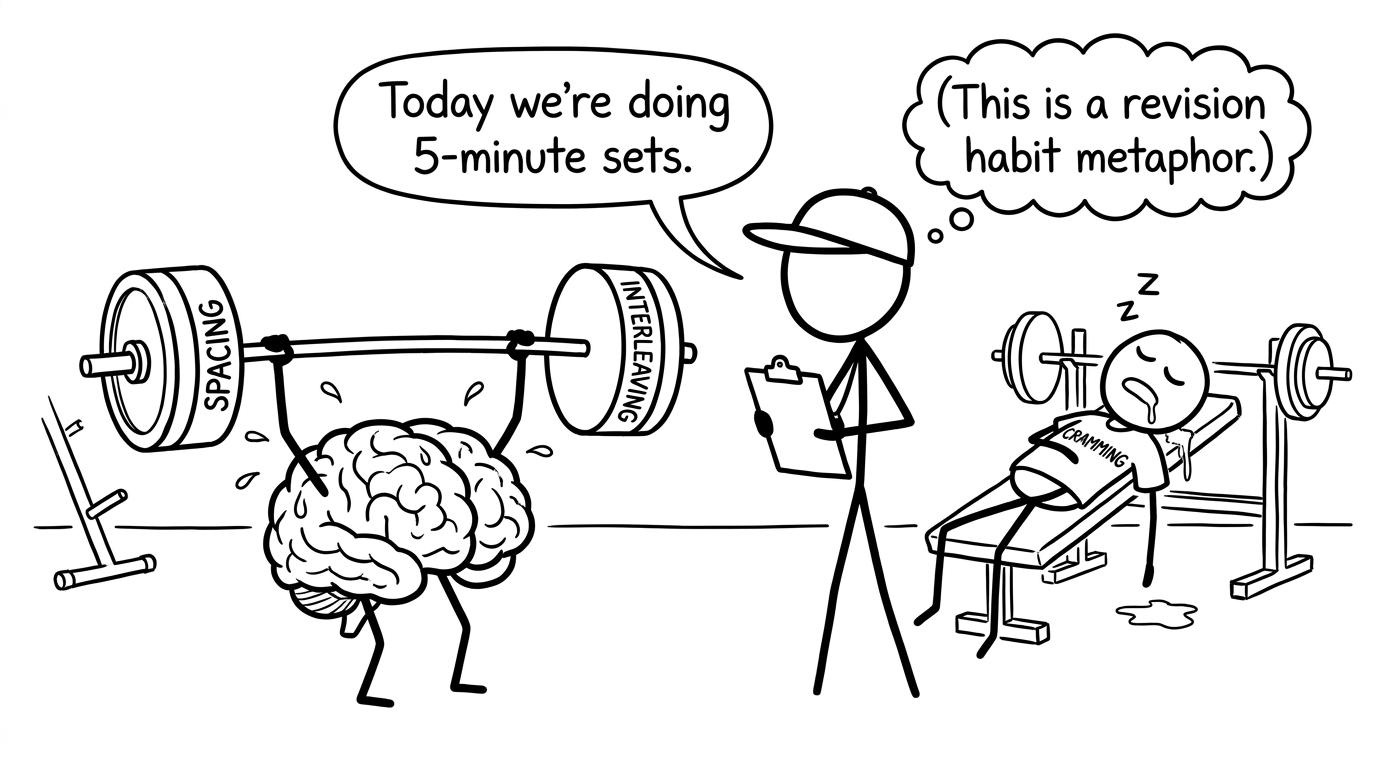
Spacing is revisiting the same idea after time has passed. Interleaving is mixing topics so your brain has to choose the method.
A realistic GCSE routine looks like this:
- Day 1: convert notes into questions (Physics) + do one maths topic lesson.
- Day 2: active recall the Physics questions + a short maths mini test.
- Day 4: redo the hardest Physics prompts + mixed maths questions.
- Day 7: past paper section + mark scheme check.
YesGenie makes the maths side easy because you can rotate between lessons, question bank style practice, and full papers. Start with Resources, then step into GCSE Past papers when you’re ready to test under time pressure.
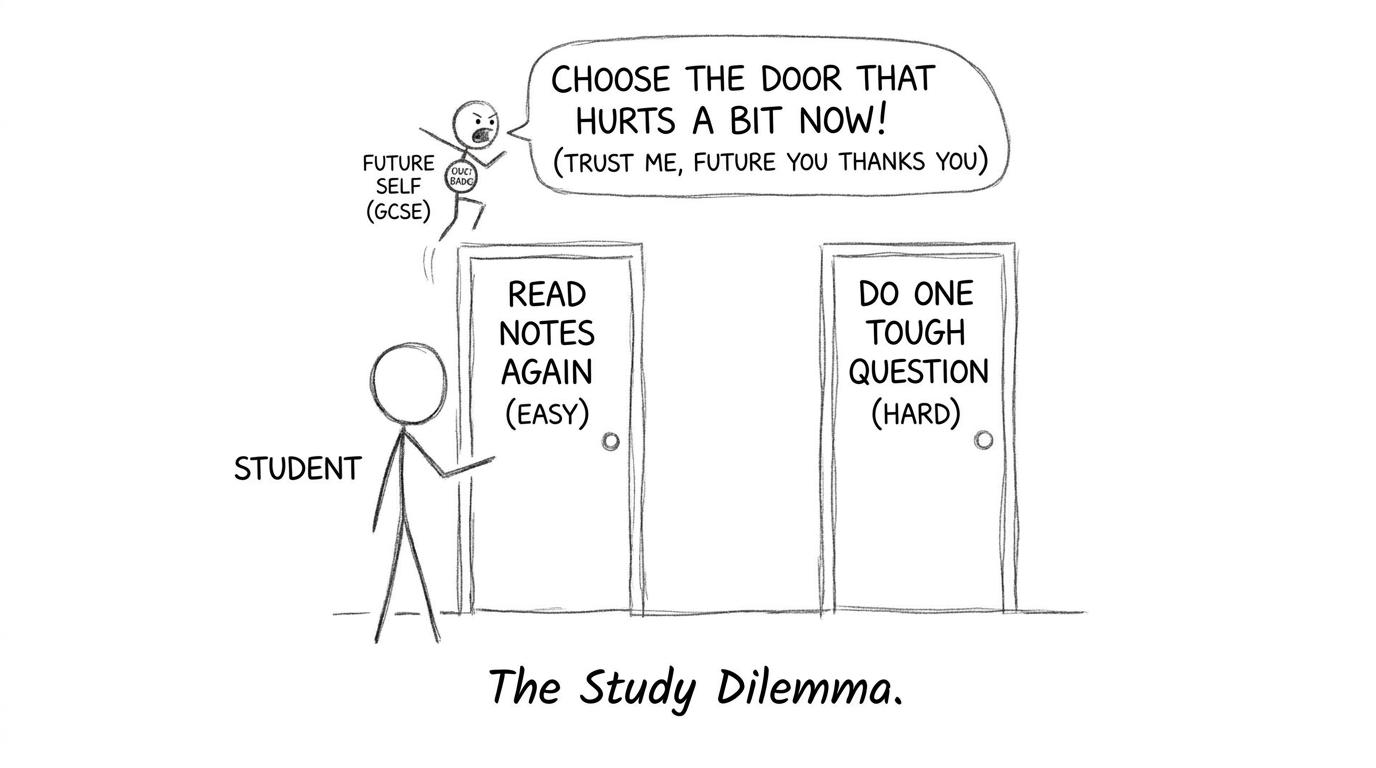 Choose the tough door
Common mistakes (and how to fix them)
- Mistaking recognition for recall. If you can only answer while looking at notes, you haven’t revised it yet. Fix: close the page, write what you remember, then check.
- Writing flashcards that are too vague. “Energy” is not a question. Fix: use precise prompts like “State the equation for…” or “Explain why…”
- Never checking against mark schemes. In GCSE maths, method marks matter. Fix: practise with worked solutions and mark schemes using WJEC GCSE Maths Past Papers.
- Doing active recall but not spacing it. One good session feels productive but fades quickly. Fix: schedule 555-minute reviews on Days 2,4,72, 4, 72,4,7.
- Only revising your favourite topics. Confidence grows where you already feel safe. Grades grow where you feel friction. Fix: track weak areas and deliberately return to them.
Closing: make your notes earn you GCSE marks
Neat notes are comforting, but comfort isn’t the goal. Marks are. For WJEC students, the fastest route is to turn GCSE Physics notes into questions you can answer without looking, then space those questions until recall becomes automatic.
And if you’re revising maths alongside Physics, use the same active recall engine on YesGenie: learn the method, retrieve it, check it, then build exam confidence with practice questions, mark schemes, mini tests and past papers. Start with WJEC GCSE Maths Revision or explore GCSE Subjects, and finish your week with timed practice from GCSE Past papers.
Your GCSE grade won’t come from what you’ve written down. It’ll come from what you can pull back out, on demand, when the paper is in front of you.










