GCSE: Find Your Weakest Topics (WJEC Physics)
GCSE revision for WJEC Physics: learn how to spot your weakest topics fast using papers, mark schemes and a simple maths-based method on YesGenie.

GCSE Physics revision can feel like trying to fix a leaky roof in the rain: everything looks urgent, so you patch the loudest hole and hope it holds. If you’re a WJEC student, the quickest way to improve isn’t “more revision”; it’s smarter revision. That starts by finding your weakest topics, then using a simple, maths-led system to turn those weak spots into reliable marks.
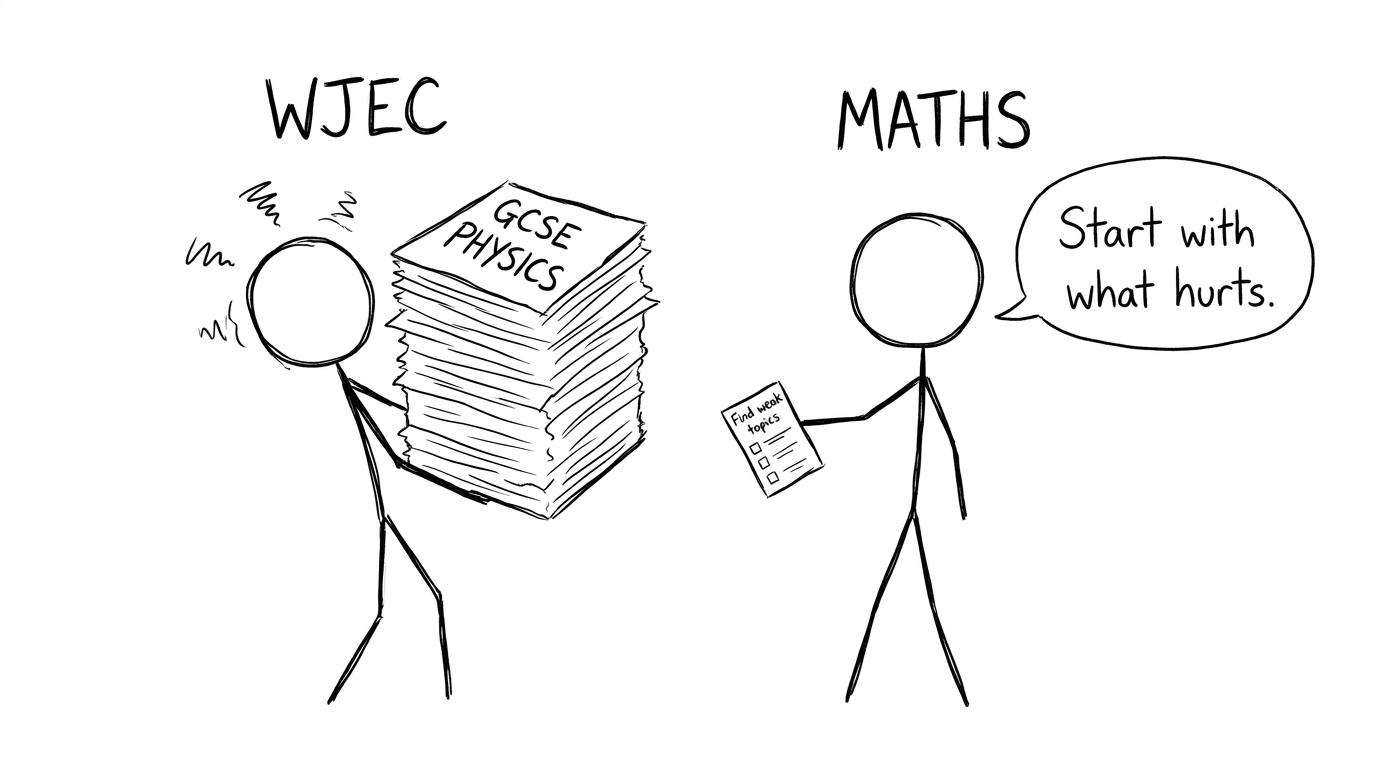 WJEC student meets a checklist
This matters even if you’re here for maths rather than Physics. Because the method is mathematical: collect data, summarise it, spot patterns, then iterate. It’s the same thinking you use in GCSE maths when you check errors, improve accuracy, and build confidence through practice. And if you’re doing both subjects (most students are), the spillover is real: better habits in one subject make the other feel lighter.
A quick checklist for finding weak topics (WJEC)
Use this as your map. You’ll flesh it out properly in the sections below.
- Do one timed paper (or a half paper) and mark it honestly.
- Tag every lost mark by topic (not by question number).
- Calculate a “weakness score” per topic.
- Fix the top 2 topics first using a loop: lesson, practice, mini test, reattempt.
- Repeat weekly so your GCSE progress is measurable, not guessed.
To build the habit on the maths side as well, keep these YesGenie pages open in your tabs:
- GCSE Past Papers
- GCSE Mini Tests
- Resources (including Predicted Papers)
- Edexcel GCSE Maths Past Papers
- Edexcel GCSE Maths Predicted Papers
- Edexcel GCSE Maths Mini Tests
- AQA GCSE Maths Revision Guides
- Eduqas GCSE Maths Revision
- WJEC GCSE Maths: 3D Pythagoras and Trigonometry
Yes, some of those are maths-specific. That’s deliberate: this post is about how to find weak topics in WJEC GCSE Physics, but we’re doing it in a way that also upgrades how you revise maths.
Why “weakest topics” beat “hardest topics” in GCSE revision
Students often say: “I’m bad at Electricity” or “I hate Forces”. But “hard” is a feeling. “Weak” is data.
A topic is weak when, under exam conditions, it reliably costs you marks. You might like it. You might understand it when your teacher explains it. But if you lose marks when you’re tired, rushed, or facing an unfamiliar context, it’s weak.
The strange comfort here is that weakness is useful. It tells you where revision will pay you back fastest.
Step one: collect your data using a paper (without breaking your confidence)
For WJEC GCSE Physics, use whatever your school has given you (past paper packs, mocks, topic tests). The key is to make the attempt realistic:
- Set a timer.
- Don’t pause to “just check one thing”.
- Finish the paper, even if you’re guessing.
Then mark it. Use the mark scheme like a mirror, not a judge. Lost marks aren’t proof you’re “bad at GCSE Physics”; they’re a list of the next things to practise.
On the maths side, do the same with a GCSE maths paper on YesGenie:
- GCSE Past Papers (choose your board and tier)
- Or, if you want shorter bursts, use GCSE Mini Tests
The method you learn from marking maths cleanly transfers to marking Physics cleanly: you start noticing exactly where marks go missing.
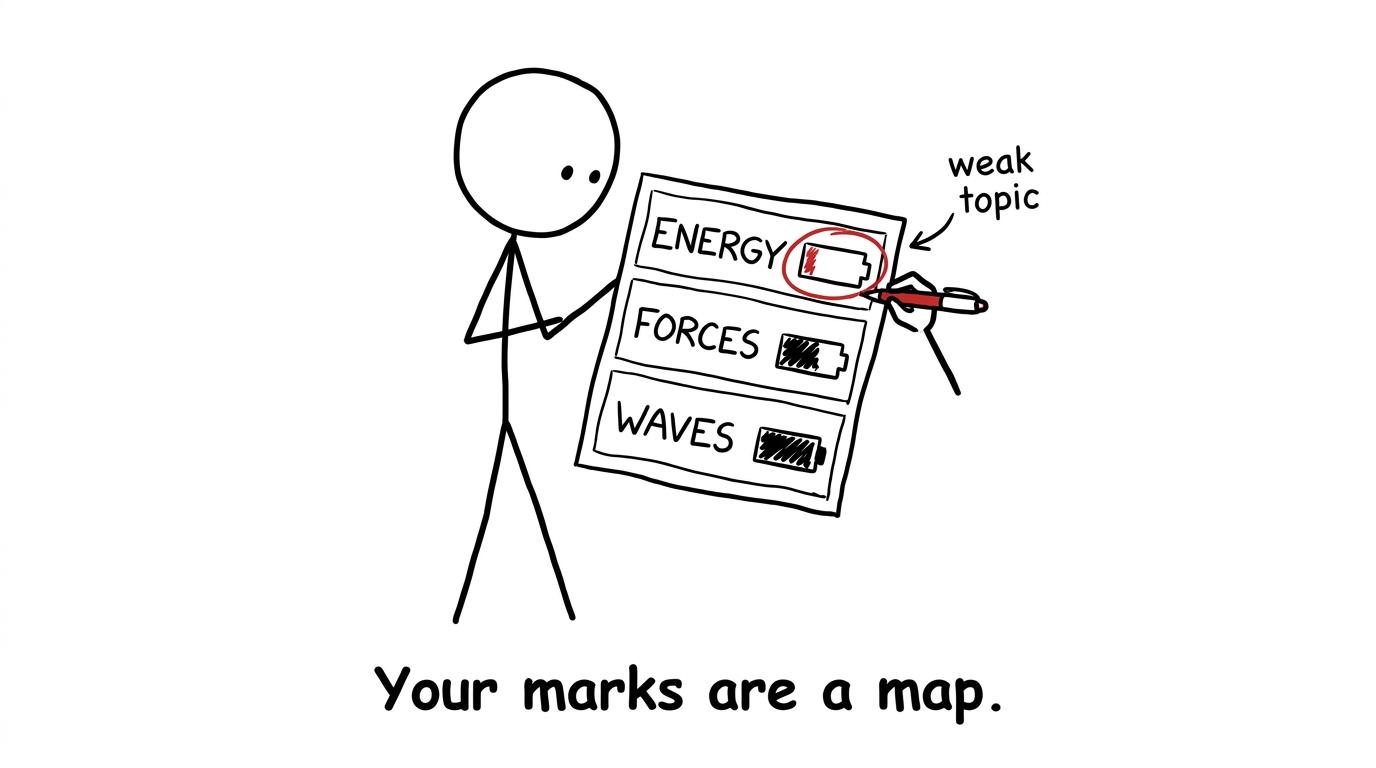 Your marks are a map
Step two: tag every lost mark by topic (the part most students skip)
Don’t write “Q4 wrong”. Write the topic that caused the loss.
In WJEC GCSE Physics, that might be:
- Forces and motion
- Energy stores and transfers
- Electricity and circuits
- Waves
- Particle model
- Magnetism and electromagnetism
Now connect each lost mark to a topic label. If one question mixes topics, split the marks. For example, if you lost 444 marks on a question that involved both equations and units, you might tag 222 marks as “using equations” and 222 marks as “units/standard form”.
That last part is where your GCSE maths skills become quietly powerful: Physics often punishes unit slips, rearranging errors, rounding errors, and standard form mistakes.
If you know you’re shaky on those maths foundations, build them up directly on YesGenie:
- AQA GCSE Maths Revision Guides (pick the skill you need and practise it)
- Eduqas GCSE Maths Revision (great for topic-by-topic practice structures)
Step three: calculate a weakness score (simple maths, big clarity)
Here’s the system. For each topic, record:
- MMM = marks lost in that topic
- AAA = total marks available in that topic (from the paper)
Define a weakness rate:
W=MAW = \frac{M}{A}W=AMThis gives a number between 000 and 111.
- If W=0.2W=0.2W=0.2, you’re losing 20%20\%20% of the marks in that topic.
- If W=0.6W=0.6W=0.6, you’re losing 60%60\%60%.
Now add one extra factor: how often the topic appears. Call it FFF (frequency). Use a simple scale:
- F=3F=3F=3 if it appears a lot in your papers/mocks
- F=2F=2F=2 if it appears sometimes
- F=1F=1F=1 if it appears rarely
Your final “priority score” can be:
P=W×FP = W \times FP=W×FWorked example: turning a messy paper into a clear plan
Imagine you did a WJEC GCSE Physics paper and you tracked marks like this:
- Electricity: M=9M=9M=9 lost out of A=15A=15A=15 available
- Forces: M=4M=4M=4 lost out of A=12A=12A=12 available
- Waves: M=3M=3M=3 lost out of A=8A=8A=8 available
Compute weakness rates:
- Electricity: W=915=0.6W=\frac{9}{15}=0.6W=159=0.6
- Forces: W=412=13≈0.333W=\frac{4}{12}=\frac{1}{3}\approx 0.333W=124=31≈0.333
- Waves: W=38=0.375W=\frac{3}{8}=0.375W=83=0.375
Now estimate frequency from what you’ve seen (and what your teacher emphasises):
- Electricity appears often: F=3F=3F=3
- Forces appears often: F=3F=3F=3
- Waves appears sometimes: F=2F=2F=2
Priority scores:
- Electricity: P=0.6×3=1.8P=0.6\times 3=1.8P=0.6×3=1.8
- Forces: P≈0.333×3≈0.999P\approx 0.333\times 3\approx 0.999P≈0.333×3≈0.999
- Waves: P=0.375×2=0.75P=0.375\times 2=0.75P=0.375×2=0.75
So even if Waves feels harder, Electricity is your highest-return revision target.
This is GCSE revision at its most mature: not mood-led, but evidence-led.
Step four: run a “fix loop” for each weak topic
Once you’ve identified your top two weak topics, don’t spread your time thinly across everything. Run a short loop until that topic stops bleeding marks.
Use this structure:
- Learn (notes/lesson): remind yourself of the core model and equations.
- Practise (targeted questions): focus on the exact skill you missed.
- Mini test (timed): check retrieval under pressure.
- Reattempt: redo the questions you got wrong, without looking.
On YesGenie for GCSE maths, the loop is built into the platform: lessons, practice cards, question banks, mini tests, and past papers. Use the exact same structure for your maths weak areas while you do it for Physics.
Helpful places to run the loop in maths:
And if one of your Physics weak topics is trig or 3D geometry (it happens in forces, moments, vectors in extension materials, and practical contexts), use:
A GCSE maths crossover: the three calculations that quietly lose Physics marks
Even strong Physics students leak marks through maths. Here are three common ones, with clean methods.
Rearranging equations (without getting lost)
If v=stv=\frac{s}{t}v=ts and you need ttt, multiply both sides by ttt:
vt=svt=svt=sNow divide by vvv:
t=svt=\frac{s}{v}t=vsThis is basic GCSE algebra, but in Physics it’s often wrapped in words and units, so the rearranging has to be automatic.
Standard form (when answers are huge or tiny)
If you calculate 0.000450.000450.00045, write it as standard form:
0.00045=4.5×10−40.00045 = 4.5 \times 10^{-4}0.00045=4.5×10⁻⁴Count how many places the decimal moves to become 4.54.54.5: it moves 444 places right, so the power is −4-4−4.
Percent error (common in required practicals)
If the accepted value is 2.502.502.50 and your value is 2.352.352.35, then the absolute error is:
∣2.35−2.50∣=0.15|2.35-2.50|=0.15∣2.35−2.50∣=0.15Percentage error:
0.152.50×100=6\frac{0.15}{2.50}\times 100 = 62.500.15×100=6So the percentage error is 6%6\%6%.
These are GCSE maths skills first, Physics skills second. If they’re weak, they will keep showing up as “Physics mistakes” when they’re really “maths fluency” mistakes.
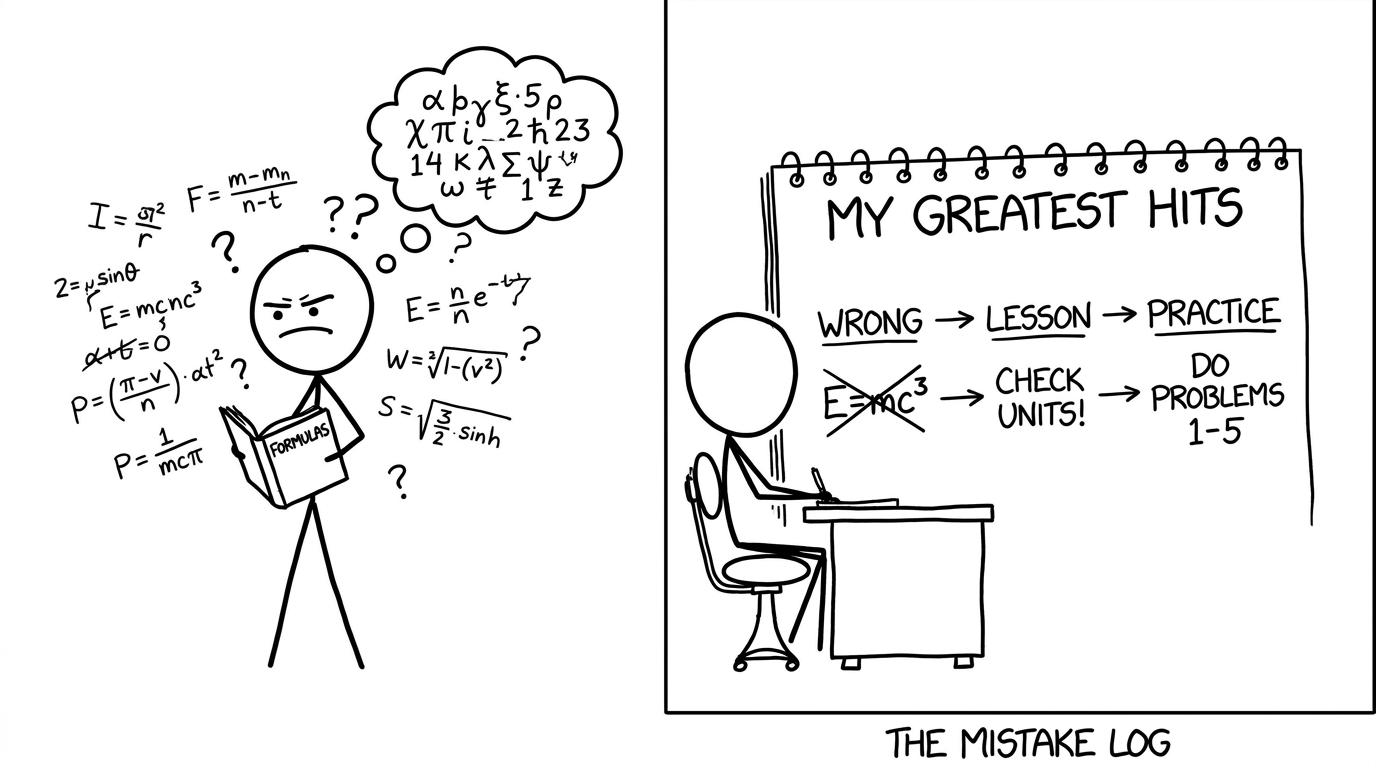 Mistake log: my greatest hits
Common mistakes when finding weak topics (and how to avoid them)
- Only counting questions you got fully wrong. In GCSE mark schemes, method marks matter. If you keep dropping 111 mark for units or rounding, that’s still a weak area.
- Changing your topic labels every time. Keep consistent categories so your data means something over weeks.
- Over-revising what you enjoy. Comfort topics feel productive, but they often add the fewest marks.
- Not retesting. If you don’t reattempt under timed conditions, you don’t know if the weakness has genuinely improved.
- Treating “careless mistakes” as random. They’re usually patterns: skipping steps, not writing units, calculator errors, or not checking reasonableness.
Bring it home: make GCSE improvement measurable
The calmest students in a GCSE exam aren’t calm because they’re naturally relaxed. They’re calm because they’ve seen their weak topics shrink on paper, week by week, and they trust the process.
So if you’re a WJEC student trying to find your weakest topics in GCSE Physics, don’t rely on instinct. Use data: papers, mark schemes, topic tags, and a simple weakness score. Then keep the loop tight and boring: learn, practise, mini test, reattempt.
And while you do that, keep your maths revision equally systematic on YesGenie. Use GCSE Past Papers, GCSE Mini Tests, and the broader Resources page (including predicted papers) to turn weak maths topics into steady marks. Targeted practice is the fastest way to raise grades 9-1, and YesGenie is built to make that targeting simple.
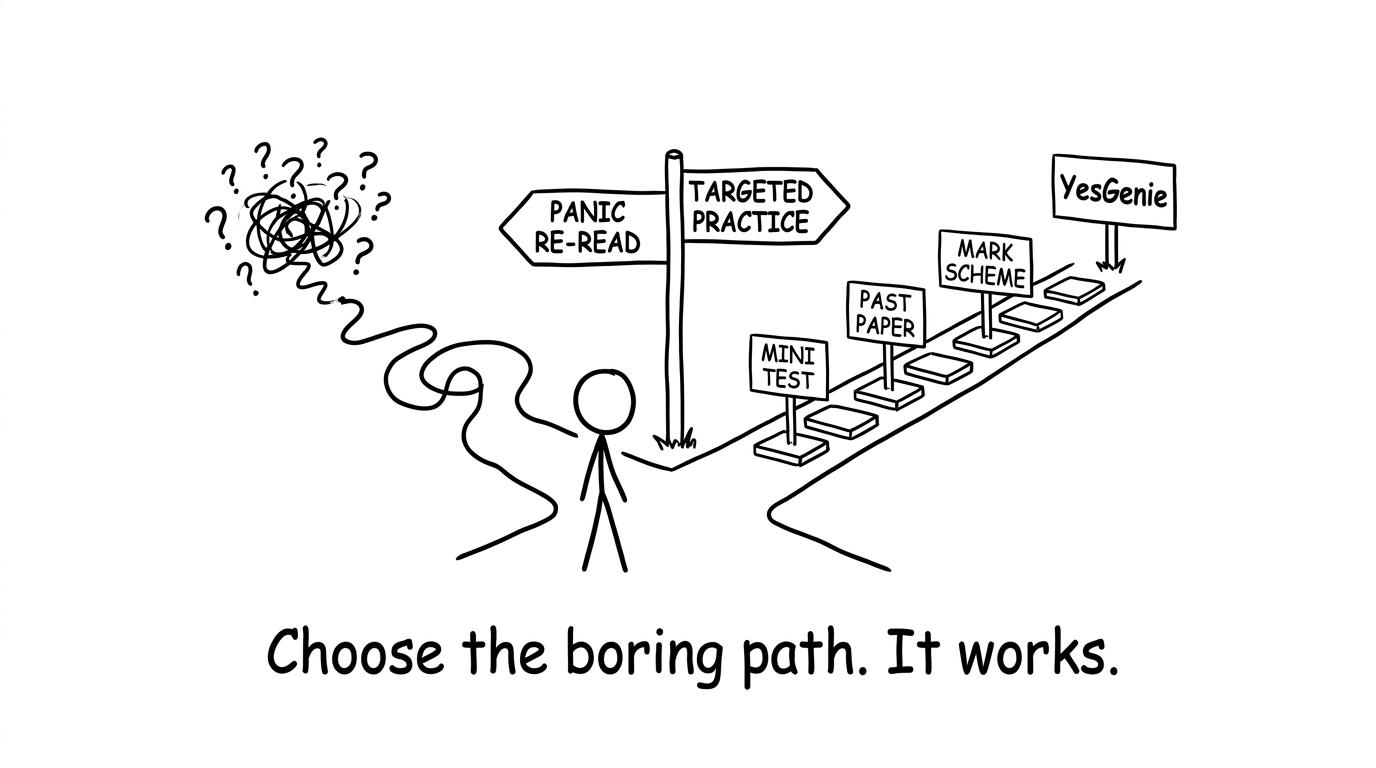 Choose targeted practice