

GCSE WJEC Maths: How Parents Can Help Without Nagging
GCSE WJEC guide for parents: support maths revision without nagging. Simple routines, past papers, and feedback loops using YesGenie resources.
Sometimes the loudest thing in the house isn’t the kettle, or the printer, or even the group chat; it’s the tension around GCSE revision. A parent asks, “Have you done any maths?” and a student hears, “You’re falling behind.” No-one means it that way, but it lands that way. If you’re revising for WJEC GCSE Maths (or you’re a parent trying to help), the real goal isn’t more pressure. It’s better feedback, smaller steps, and a plan that feels doable on a Tuesday night.
This guide is written for students, but it doubles as a script you can hand to a well-meaning adult. Because the best support doesn’t sound like nagging, it sounds like structure.
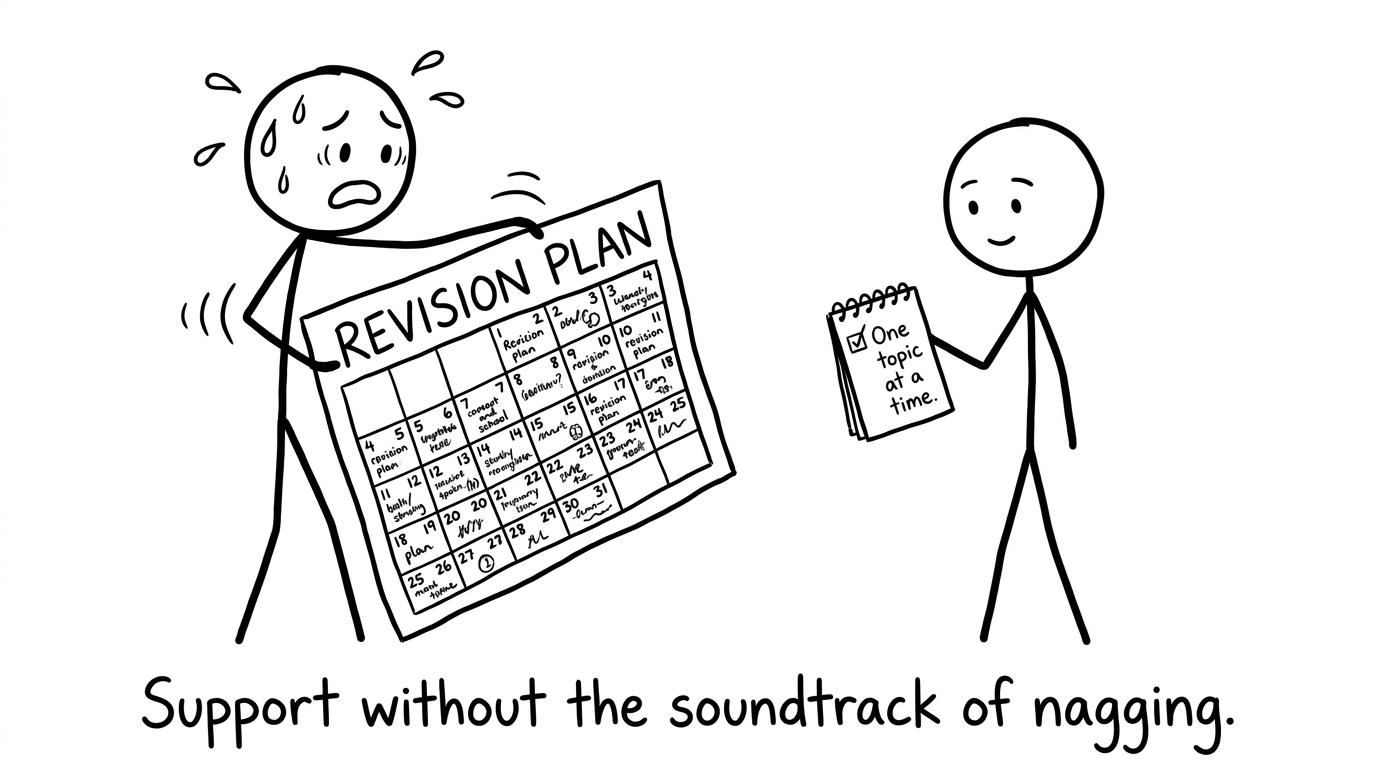 A parent holding a huge revision plan while a student holds a small checklist
The no-nagging checklist (what actually helps)
Here’s the support that moves marks without starting arguments:
- Agree a time and place for maths revision (short and consistent beats long and rare).
- Swap “have you revised?” for “what topic are you on?”
- Use one resource hub so you’re not hunting across tabs.
- Practise with exam-style questions, then mark, then fix.
- Track mistakes by topic, not by mood.
- Use past papers and predicted papers at the right moment, not as punishment.
On YesGenie, students can keep it simple: start on a board home page (WJEC in this case), use revision guides to learn, question bank to practise, then past papers to prove it.
Useful starting points:
- GCSE Maths (Edexcel hub) (the structure is the same across boards)
- Eduqas GCSE Maths revision guides (WJEC/Eduqas-style topic organisation)
- WJEC Algebraic Fractions revision guide (a good example of a full topic page with methods and exam advice)
- GCSE past papers
- Resources (mini tests, predicted papers, more)
A WJEC GCSE reality check: revision fails when feedback is missing
Most students don’t avoid revision because they’re lazy. They avoid revision because it’s unclear.
If you do ten questions and never check them, you haven’t revised; you’ve just performed optimism. WJEC-style GCSE questions reward method marks and clear working. That means your revision has to include the unglamorous bit: identifying exactly where a solution went off the rails.
The kindest thing a parent can do is stop measuring effort by time and start measuring effort by feedback loops:
- Learn a method.
- Do a small set of questions.
- Mark with a mark scheme or video solution.
- Write one correction per mistake.
- Repeat once, then move on.
YesGenie is built for this: revision lessons and topic guides, practice questions, then mark schemes and video solutions.
How parents can “check in” without nagging (a script that works)
Nagging is usually repetitive questions with no clear action attached. Support is a short conversation that ends with a plan.
Try this two-minute script:
- “What’s your next maths topic?”
- “What does a good answer look like; is there a method to copy?”
- “How will you check it’s right: mark scheme or video solution?”
- “What’s your smallest next step: ten minutes or five questions?”
Notice what’s missing: threats, comparisons, and vague pressure.
A practical upgrade: keep a shared note called Maths Mistakes List. Each line is: topic, mistake, fix.
Example entry: “Percentages: forgot to multiply by 1.121.121.12 for increase. Fix: change to multiplier first.”
A tiny worked example (so parents see what “method” looks like)
When someone says “show your working”, they mean “make your thinking markable.” Here are two GCSE staples where method matters.
Worked example: reverse percentage (common WJEC GCSE skill)
A sale price is £48 after a 20%20\%20% discount. Find the original price.
A 20%20\%20% discount means the sale price is 80%80\%80% of the original.
Let the original price be xxx.
0.8x=48 0.8x = 48 0.8x=48 x=480.8=60 x = \frac{48}{0.8} = 60 x=0.848=60So the original price is £60.
A parent doesn’t need to “teach” this. They can simply ask, “What multiplier did you use, and why?” That pushes the student into explaining, which is a powerful revision skill.
Worked example: solving a linear equation cleanly
Solve 3(2x−5)=213(2x-5)=213(2x−5)=21.
Expand:
6x−15=21 6x - 15 = 21 6x−15=21Add 151515 to both sides:
6x=36 6x = 36 6x=36Divide by 666:
x=6 x = 6 x=6The method is calm, step-by-step. That calmness is what your revision routine should feel like too.
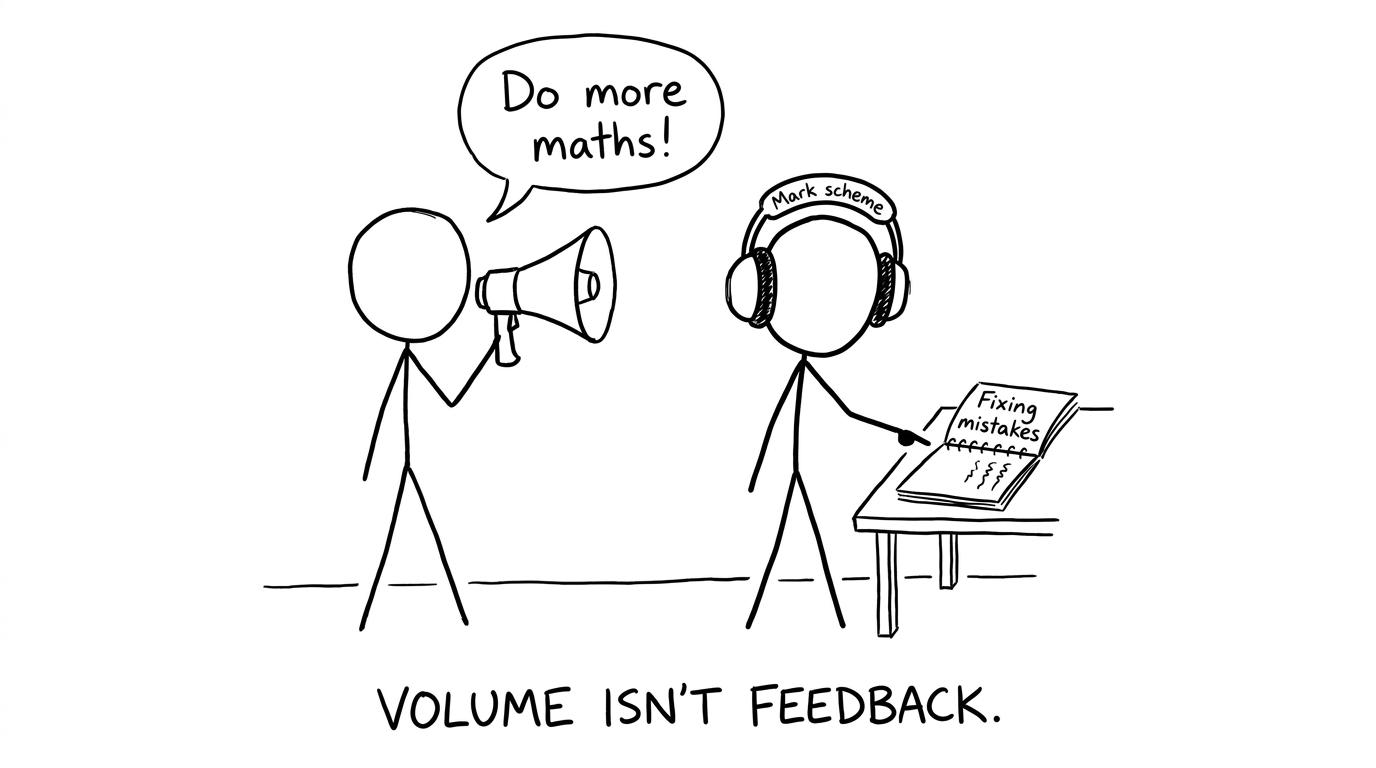 A stick figure shouting “Do more maths!” while another focuses on a mark scheme
The best GCSE routine is boring (and that’s a compliment)
A routine that relies on motivation collapses the first time you’re tired. A routine that relies on habit survives.
A simple WJEC-friendly weekly pattern:
- Mon to Thu (20-30 mins): one topic per session using a revision guide, then practice questions.
- Fri (15 mins): fix mistakes from the week (no new content).
- Weekend (45-90 mins): one past paper section or a mini test, marked properly.
Where YesGenie fits:
- Learn methods using topic notes and videos on revision guides (for example, WJEC Algebraic Fractions revision guide).
- Practise using question banks and worksheets on the same topic pages.
- Build exam confidence with GCSE past papers.
- When exams are close, use predicted papers and timed practice from the Resources page.
Past papers without panic: how to use them properly
The mistake parents often make is using past papers as a test of worth. “Do a full paper tonight” becomes a threat. Then the student starts avoiding the whole thing.
A better approach:
- Start with sections: choose a cluster of topics you’ve revised.
- Do it timed, but not brutally timed.
- Mark it the same day.
- For every wrong answer, do a “repair attempt” immediately after watching/reading the solution.
If you’re using video solutions, build the habit of pausing before the key step and asking, “What would I write next?” That’s active recall, not passive watching.
Examples of where to practise:
- GCSE past papers
- June 2019 Paper 1 video solutions (example format)
- GCSE Maths predicted papers (example)
Even if you’re WJEC, the skill is the same: practise, mark, reflect, repeat.
Common mistakes (that create nagging at home)
These are the patterns that trigger frustration for students and parents alike:
- Measuring revision by time, not outcomes. Ninety minutes of scrolling is not ninety minutes of GCSE maths revision.
- Doing questions without marking. If you don’t look at the mark scheme or video solution, you don’t get feedback.
- Fixing nothing. A wrong answer becomes useful only when you write the corrected method.
- Topic-hopping. Switching from algebra to geometry to ratio in one session feels busy but sticks poorly.
- Saving past papers for “when I’m ready”. Readiness comes from doing them, not waiting.
- Parents re-teaching from memory. Techniques and wording can differ by specification; use a trusted GCSE resource and the mark scheme.
The gentle deal: structure over stress
If you’re a student, you want independence. If you’re a parent, you want reassurance. The compromise is a routine that produces visible proof: a list of topics covered, a record of mistakes fixed, and a growing pile of marked GCSE questions.
YesGenie is there for the moments when revision gets foggy: revision lessons to learn the method, topic practice to build fluency, and then past papers and predicted papers to test it under pressure. Start with one topic, one method, one feedback loop, and let consistency do the heavy lifting.
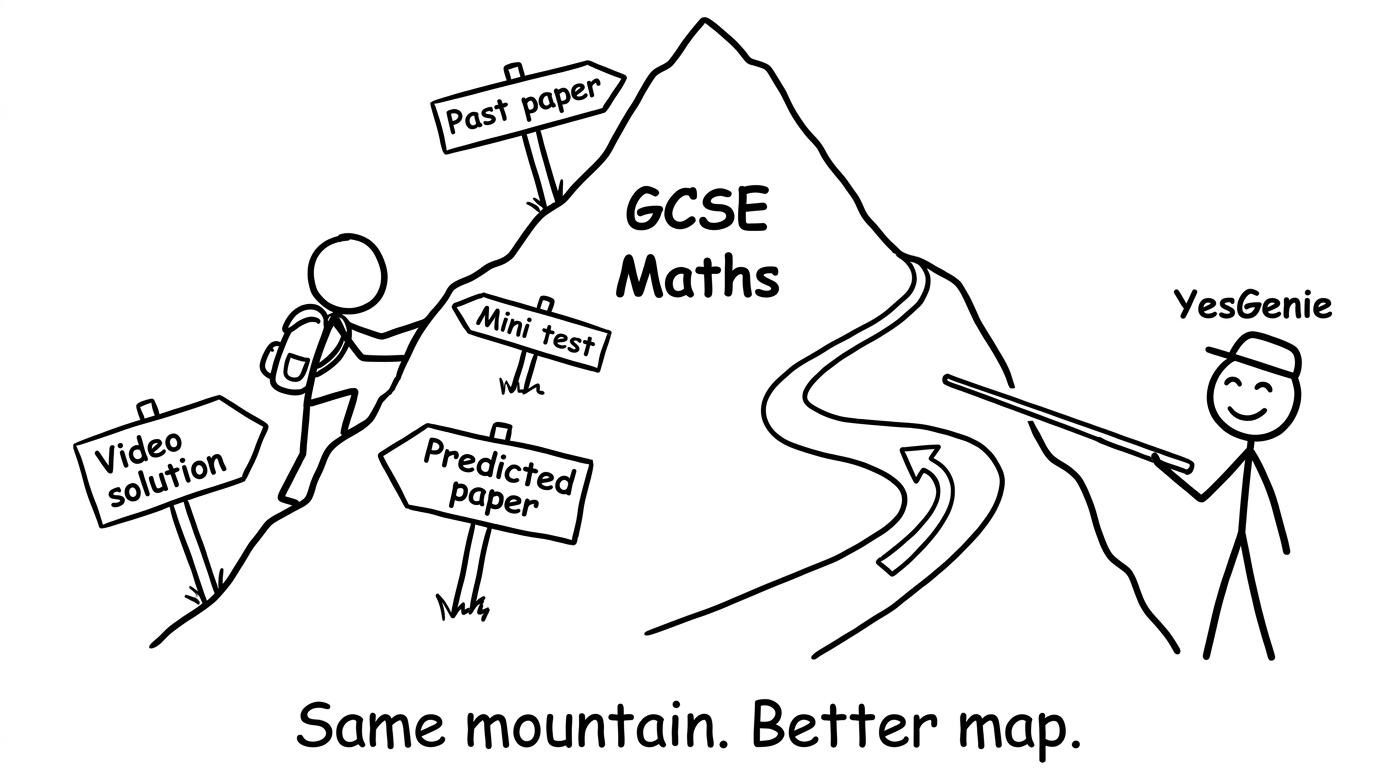 A student climbing a “GCSE Maths” mountain with signposts and a guide labelled YesGenie
When you’re ready, pick your next topic on YesGenie, practise it, mark it, fix it, and repeat. That’s how GCSE maths revision stops sounding like nagging and starts sounding like progress.










