GCSE: How WJEC Students Use Mark Schemes to Improve
GCSE mark schemes can boost WJEC Maths grades fast. Learn how to spot method marks, fix habits, and revise smarter with YesGenie resources.

There’s a particular kind of frustration that hits after a GCSE maths paper: you knew what to do, you did something sensible… and yet the mark total doesn’t match the effort. WJEC students often feel this sharply because the questions can be unfamiliar in style, and it’s easy to assume the solution is simply “do more practice”.
But the real lever isn’t usually more questions. It’s better feedback.
A mark scheme is not just the “right answers” document. Used properly, it’s a map of how examiners reward mathematical thinking. If you learn to read it like an examiner, you stop revising randomly and start revising precisely. This guide shows how WJEC students can use mark schemes to improve in GCSE Maths, and how to turn every mistake into future marks.
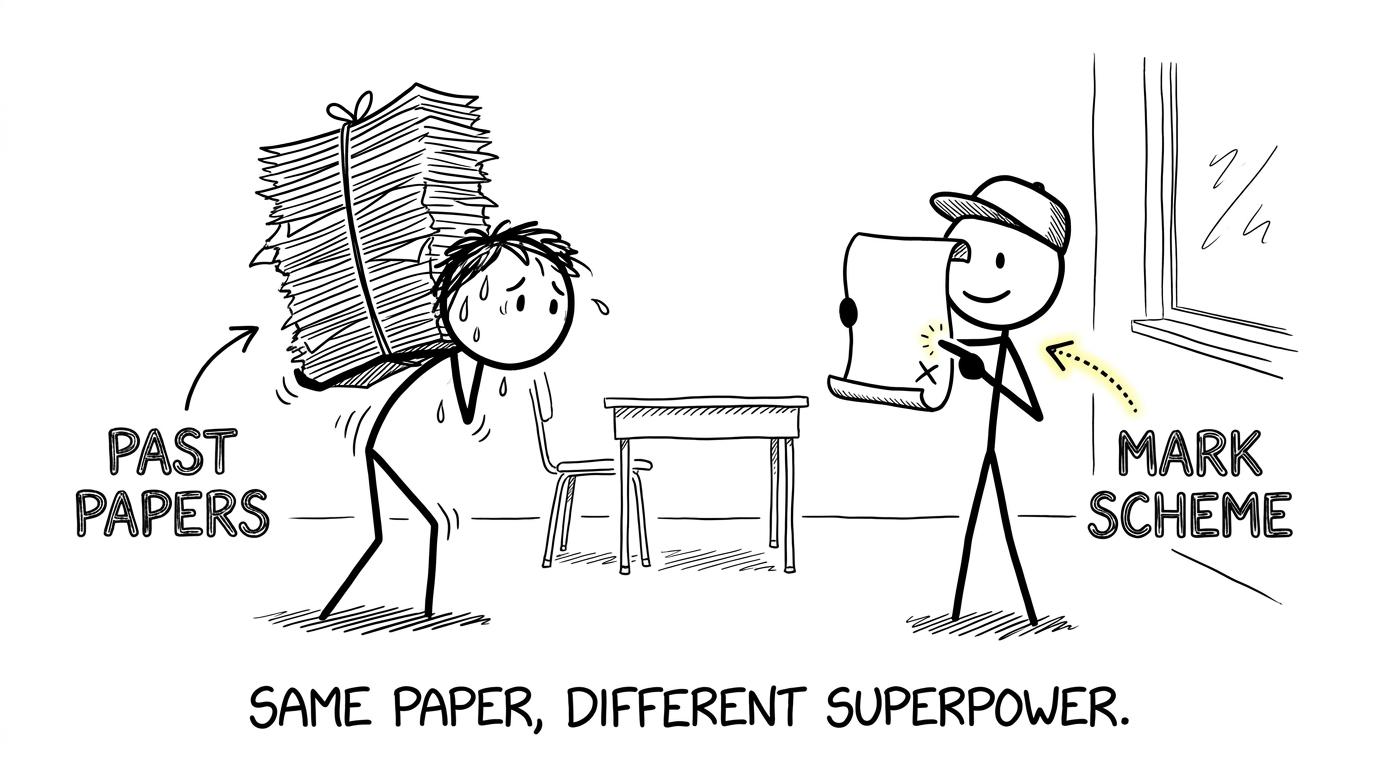 A student discovers the mark scheme superpower
A quick checklist: how to use mark schemes in GCSE Maths
Keep this routine simple enough that you’ll actually do it.
- Do a question under timed conditions.
- Mark with the mark scheme using a different coloured pen.
- Label each lost mark as one of: method, accuracy, communication, final answer.
- Write a one-line fix: “Next time, I will…”
- Re-do the question from scratch 24-48 hours later.
If you want a bank of exam-style questions to practise this on, start with GCSE Past papers, then move to targeted revision using Resources (mini tests and predicted papers).
Why mark schemes work (and why WJEC students should care)
Most students treat a mark scheme like a verdict: correct or incorrect. Examiners treat it like a structure: a list of things that deserve marks.
This matters for WJEC GCSE Maths because you can often earn marks even when the final answer is wrong, provided your method is clear and mathematically valid. In other words: your working is not decoration. It’s a mark-earning tool.
Even when you revise using materials for other boards (Edexcel, AQA, OCR, Eduqas), the mark scheme logic is similar: method marks reward correct process, accuracy marks reward correct calculation, and communication marks reward correct mathematical statements, units, and conclusions. If you can learn this language, you can apply it to every WJEC paper you do.
To build the content knowledge alongside this skill, use WJEC topic notes like Algebraic Fractions (WJEC) and Substitution (WJEC).
What the codes are really telling you
Many mark schemes use common codes such as MMM (method), AAA (accuracy), and BBB (working), plus phrases like “cao” (correct answer only) or “ft” (follow through). You don’t need to memorise every code, but you do need to understand the philosophy:
- Method marks are about choosing a valid approach.
- Accuracy marks are about carrying out that approach correctly.
- Follow-through marks mean later steps can still earn credit based on your earlier (possibly wrong) result.
So when you lose marks, ask: did I choose the wrong plan, or did I execute a right plan badly?
That single distinction changes your revision.
How to mark like an examiner (not like a disappointed version of you)
When you self-mark a GCSE paper, you’re tempted to “sort of” give yourself credit because you were close. Real marking is stricter, but also more generous in a predictable way: marks are awarded for specific evidence.
Try this three-pass method:
Pass 1: Find the first valid step
Look for the earliest line of working that is mathematically correct and relevant.
If it’s there, you likely have a method mark available. If it isn’t there, your revision target is not accuracy; it’s starting properly.
Pass 2: Match your working to the mark scheme items
Don’t think “I was thinking it”. If it isn’t written, it usually isn’t marked.
This is why practising with mark schemes is such a high-return habit for GCSE Maths: it trains you to write what the exam rewards.
Pass 3: Decide what you would change next time
Write a micro-action, not a mood.
Bad: “Be more careful.”
Good: “Write the formula first, then substitute.”
For that exact habit, revise substitution properly using Substitution (WJEC).
Worked example: using the mark scheme to rescue method marks
Here’s a classic GCSE setup: you lose the final answer, but you could still earn most of the marks.
Example: speed, distance, time
A car travels 84 km84\text{ km}84 km in 1.5 hours1.5\text{ hours}1.5 hours. Find the speed in km/h\text{km/h}km/h.
A strong exam solution looks like this:
speed=distancetime=841.5 \text{speed} = \frac{\text{distance}}{\text{time}} = \frac{84}{1.5} speed=timedistance=1.584Convert 1.51.51.5 hours to a fraction:
1.5=32 1.5 = \frac{3}{2} 1.5=23So:
841.5=8432=84×23=56 \frac{84}{1.5} = \frac{84}{\frac{3}{2}} = 84 \times \frac{2}{3} = 56 1.584=2384=84×32=56Therefore, the speed is 56 km/h56\text{ km/h}56 km/h.
How the mark scheme thinking helps
If you wrote speed=841.5\text{speed} = \frac{84}{1.5}speed=1.584 but then made an arithmetic slip and got 545454, you’ve still shown the correct method. That is exactly what method marks are for.
Your revision action is not “relearn speed questions”. It’s “practise dividing by decimals” and “use fractions to divide cleanly”.
To practise in a way that mirrors exam marking, use topic-by-topic practice then self-mark: start on the relevant board page such as GCSE Maths OCR (the question style is still excellent exam practice), then shift into WJEC topics.
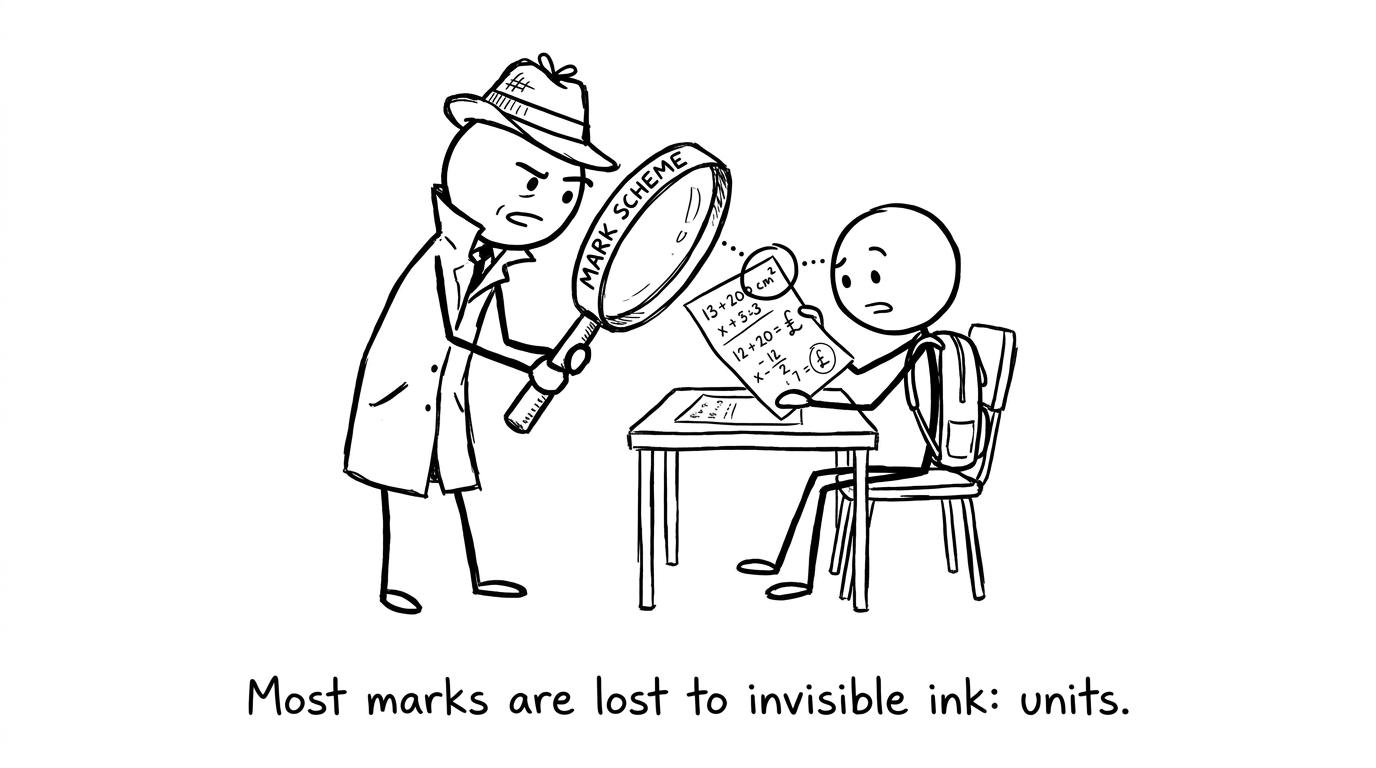 Detective finds missing units and symbols
Worked example: algebraic fractions and “what earns the mark”
WJEC GCSE Maths often rewards clear structure in algebra, especially where cancelling is only allowed for factors.
Example: simplify
Simplify:
x2−9x2−3x \frac{x^2-9}{x^2-3x} x2−3xx2−9Factorise top and bottom:
x2−9=(x−3)(x+3) x^2-9 = (x-3)(x+3) x2−9=(x−3)(x+3) x2−3x=x(x−3) x^2-3x = x(x-3) x2−3x=x(x−3)Now cancel the common factor (x−3)(x-3)(x−3):
(x−3)(x+3)x(x−3)=x+3x \frac{(x-3)(x+3)}{x(x-3)} = \frac{x+3}{x} x(x−3)(x−3)(x+3)=xx+3So the simplified form is:
x+3x \frac{x+3}{x} xx+3How the mark scheme changes what you practise
If your old habit was to cancel xxx terms without factorising, the mark scheme will effectively mark that as “no valid method shown”, even if you accidentally land on something close.
So the revision target becomes: “Factorise first, then cancel factors.”
You can reinforce that habit with Algebraic Fractions (WJEC) and build your basics with Simplifying Algebra.
The most powerful mark scheme question you can ask
After you mark a question, don’t ask, “Why did I get it wrong?”
Ask: “What would I have had to write to get the next mark?”
This question is calm, practical, and oddly hopeful. It makes revision feel like building, not judging.
On YesGenie, the best way to use that mindset is:
- Do a paper from GCSE Past papers.
- Use the mark scheme to identify your “next mark” actions.
- Then practise those actions using Resources such as mini tests.
Common mistakes WJEC GCSE students make with mark schemes
Treating the mark scheme as one perfect solution
Many questions allow multiple valid methods. If your method is different but correct, you can still earn marks. The fix is to check whether your working shows a coherent chain of reasoning, not whether it matches the exact layout.
Not writing down the method
If you do mental maths and jump to an answer, you may lose method marks when you make a slip. Even one line like speed=dt\text{speed} = \frac{d}{t}speed=td can protect you.
Dropping units or conclusions
In real-life contexts, GCSE mark schemes often expect a unit and sometimes a sentence conclusion. Writing 565656 instead of 56 km/h56\text{ km/h}56 km/h is a painful way to lose a mark.
Rounding too early
Mark schemes frequently allow “awrt” style answers (answer which rounds to), but only if your rounding is sensible and late. Keep full calculator values until the end.
Misreading “cao” questions
When a mark scheme indicates “correct answer only”, working may not earn partial credit. Your revision strategy changes: you practise accuracy under pressure on that question type.
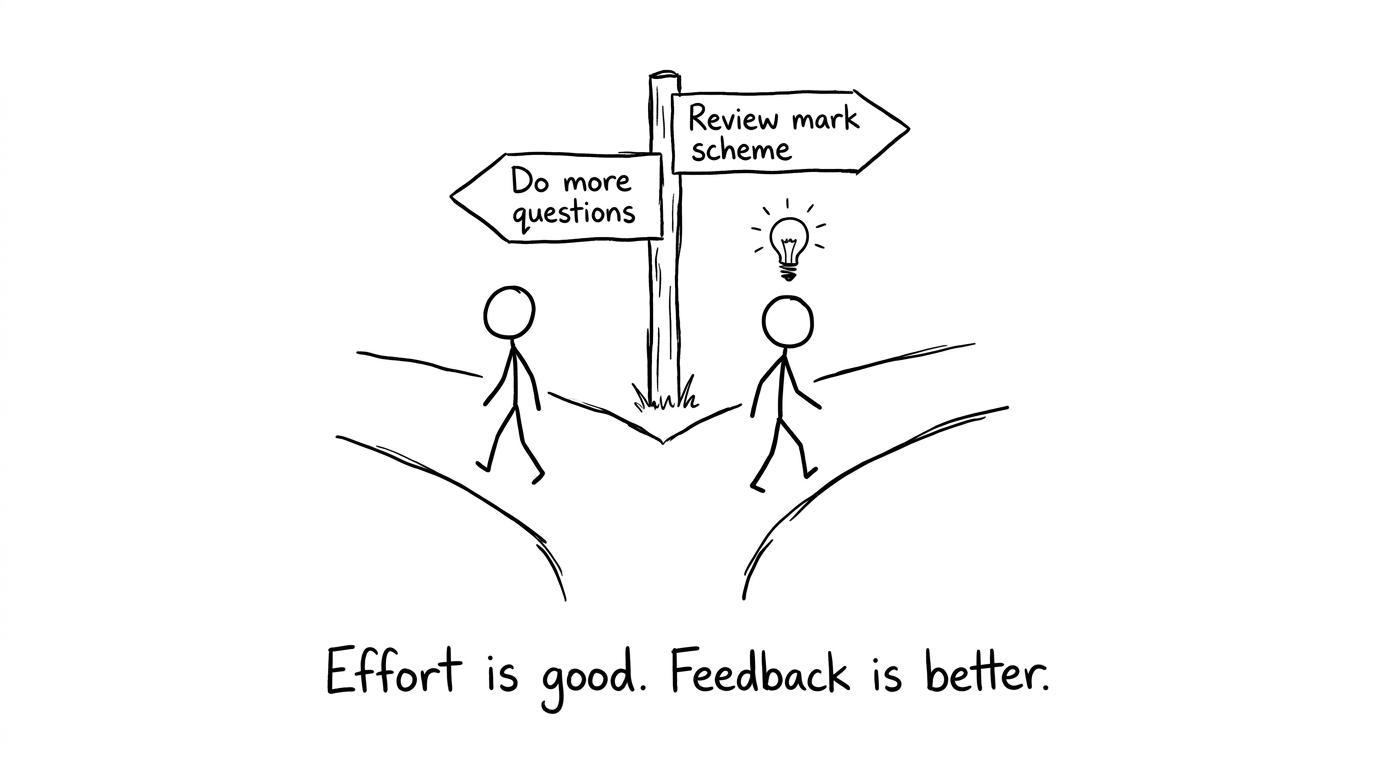 Two paths: practice vs review mark scheme
A practical 7-day routine using mark schemes (fits real life)
Days 1-2: build a baseline paper
Do one paper (or half a paper) timed. If time is tight, use shorter resources like Edexcel GCSE Maths 45 Min Tests for a realistic sprint.
Day 3: mark and categorise
Mark carefully. Next to each lost mark, write one label: MMM (method), AAA (accuracy), or CCC (communication).
Day 4: patch the biggest leak
If you lost lots of method marks in algebra, revise one topic properly rather than doing another full paper. Use a focused page like Proof (GCSE) if your weakness is explanation and structure, or use WJEC-specific topics.
Days 5-6: mini tests for repetition
Use Edexcel GCSE Maths Mini Tests as short, repeatable practice blocks. The exam board label matters less than the skill repetition and mark scheme review.
Day 7: re-do your worst questions
Reattempt the questions you lost the most marks on, without looking at your previous working. Then mark again. Your improvement is now measurable.
Closing: make the mark scheme your revision partner
A GCSE mark scheme is quietly honest. It doesn’t care how long you spent revising, or how close your answer felt in the moment. It cares about evidence on the page: methods chosen, steps shown, and conclusions made clear.
For WJEC students, that’s encouraging. It means you don’t need to become a different person to improve in GCSE Maths. You just need a repeatable system: attempt, mark, diagnose, fix, reattempt.
Build that system on YesGenie: start with GCSE Past papers, strengthen weak topics with WJEC revision guides like Substitution (WJEC) and Algebraic Fractions (WJEC), then pressure-test your progress using Resources (mini tests, predicted papers, and more practice questions with solutions).
If you want one simple promise to carry into your next paper, let it be this: every time you read a mark scheme, you’re not just seeing what you missed; you’re learning what the exam is willing to reward. And that’s how GCSE grades move.