

GCSE: Find Your Weakest Topics (WJEC Students)
GCSE revision for WJEC students: learn how to spot your weakest topics fast using mark schemes, question patterns and a simple tracking method on YesGenie.

GCSE revision can feel like trying to fix a leaky roof in the dark: you know there’s a problem somewhere, but everything looks equally urgent. If you’re a WJEC student revising Biology, the pressure is familiar: big content, limited time, and that nagging fear that your weakest topics will show up on exam day. The good news is that the skill of finding weak spots is transferable, and maths is the best place to practise it because your mistakes leave a clear trail.
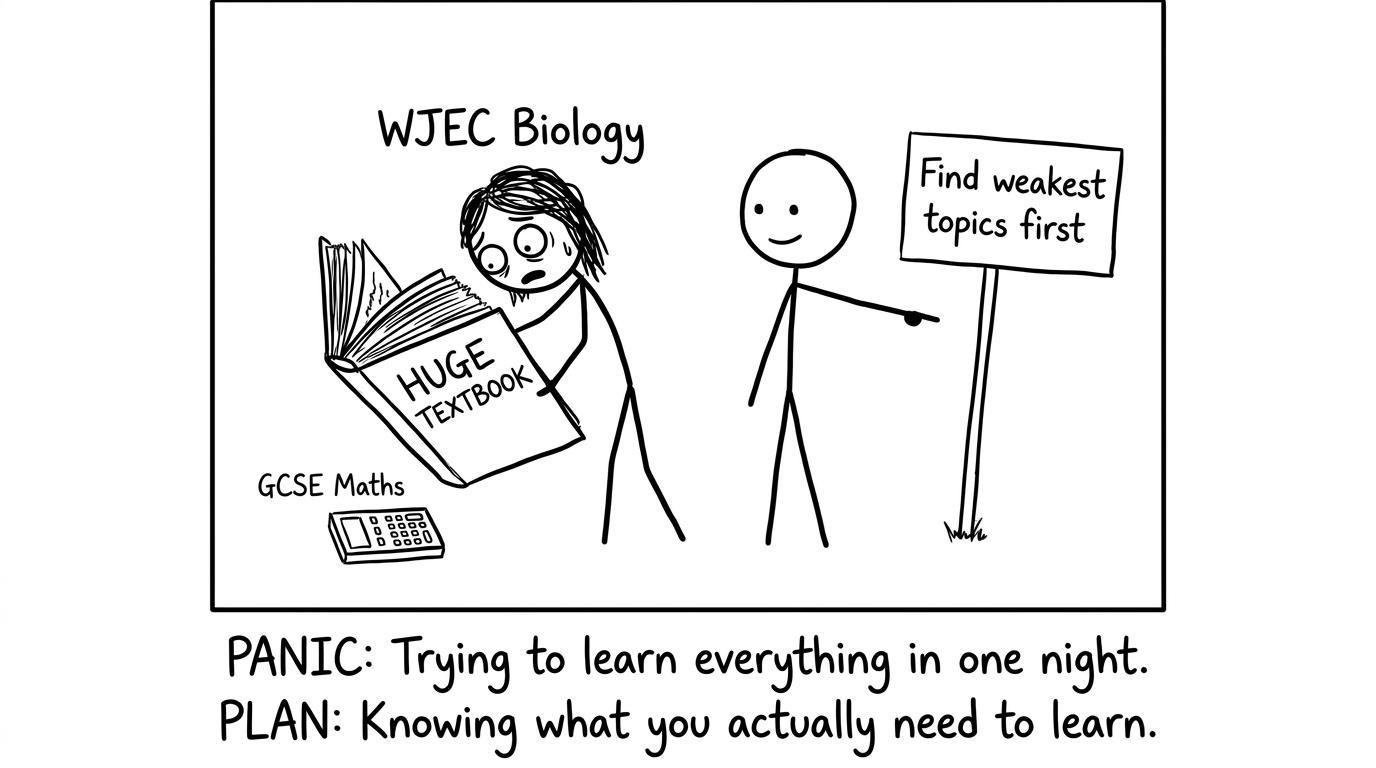 A student torn between Biology panic and a maths plan
This post shows you a simple, evidence-based way to find your weakest topics (for WJEC Biology), using the same process you can apply to your GCSE maths revision. We’ll keep it calm, practical, and measurable: you’ll leave with a method, a tracking sheet idea, and a way to turn “I’m bad at this” into “I missed these three question types here’s the fix”.
Throughout, we’ll lean on YesGenie tools you already have access to: revision lessons, topic questions, mini tests, past papers, predicted papers, and video solutions.
A quick checklist to find your weakest topics
Use this loop for any GCSE subject (including WJEC Biology) and then practise the loop in maths because it’s quicker to get feedback.
- Collect evidence: do a short test or a paper.
- Mark it properly: use a mark scheme, not your memory.
- Tag each mistake: topic + mistake type.
- Look for patterns: the same ideas repeat.
- Fix one thing at a time: lesson, practice, re-test.
For maths practice and rapid feedback, start here: GCSE Maths Revision.
Why WJEC students should treat “weak topics” as a data problem
In WJEC Biology, “weakest topic” often feels emotional: the chapter you dread, the practical you never quite understood, the keyword you can’t remember. But weakness is usually not a whole topic; it’s a small set of repeatable mistakes.
Maths makes this obvious. If you get an algebra question wrong, it’s rarely because you “can’t do algebra”. It’s more likely one of these:
- you misread the question,
- you chose the wrong method,
- you made a slip in arithmetic,
- you don’t know one key fact.
That’s why using GCSE maths as your training ground works so well: your errors are visible, your improvements are measurable, and you can build the habit you’ll use in Biology.
If you’re WJEC for maths too, this hub is the simplest starting point: WJEC GCSE Maths Revision.
The “3-layer weakness” model (works for Biology and GCSE maths)
When you miss marks, your weakness usually lives in one of three layers.
Layer 1: Knowledge gaps
In Biology, this might be missing a definition or a required equation. In GCSE maths, it might be forgetting a rule like index laws.
Example: if you forget that am×an=am+na^m \times a^n = a^{m+n}am×an=am+n, you’ll lose marks even if your algebra is otherwise strong.
Layer 2: Method gaps
In Biology, method gaps are things like describing a practical correctly, or linking cause to effect in the right chain. In GCSE maths, method gaps show up when you don’t know which technique to use.
Example: you know what simultaneous equations are, but you can’t decide whether to eliminate or substitute.
Layer 3: Exam technique gaps
In Biology, this is command words, structure, and hitting mark points. In GCSE maths, it’s showing enough working, using correct units, and not rounding too early.
A fast way to build technique is marking with worked solutions. YesGenie makes this easy with paper-specific support, for example: GCSE Past Papers.
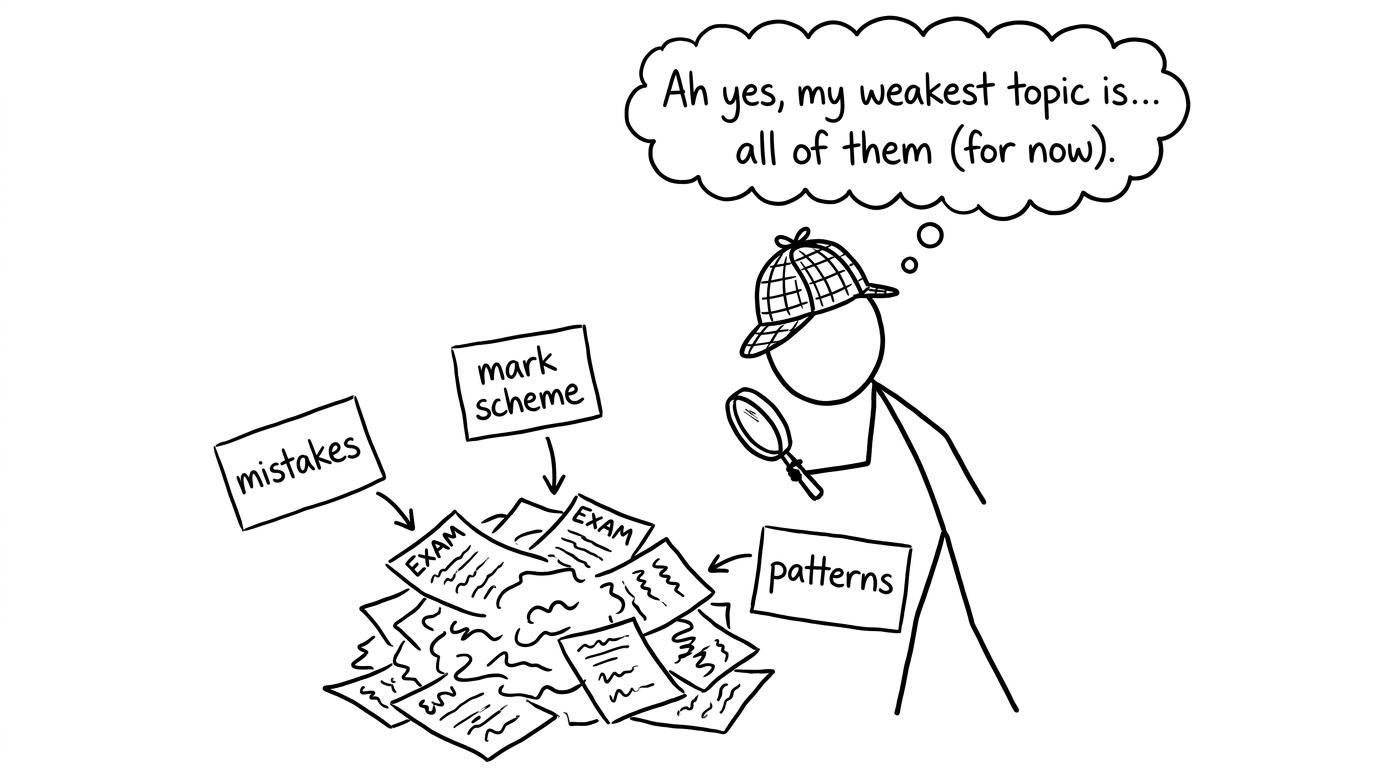 A detective searching for patterns in mistakes
Step-by-step: how to find your weakest topics (the method)
Do a short, timed test (low stakes, high information)
For maths, mini tests are perfect because they’re short enough to fit into a weekday.
Use: Edexcel GCSE Maths Mini Tests even if you’re not Edexcel; the skill is diagnosis, not board-specific content.
If you want a broader menu of resources, use: Resources.
Mark brutally honestly (and write down the reason)
For each question you lose marks on, write one line:
- Topic (e.g. percentages, algebra, probability)
- Mistake type (knowledge/method/technique)
- Trigger (what confused you)
Over time, you’re building a map of your GCSE weaknesses. That map is far more useful than “I’ll revise everything”.
Turn marks into a topic score
Here’s a simple scoring method you can do in a notebook.
Suppose you do a 20-mark mini test and you lose marks like this:
- Percentages: 4 marks lost
- Algebra: 3 marks lost
- Graphs: 1 mark lost
Compute the proportion of marks lost per topic.
Total marks lost =4+3+1=8= 4+3+1 = 8=4+3+1=8.
So:
- Percentages weakness share =48=12=0.5= \frac{4}{8} = \frac{1}{2} = 0.5=84=21=0.5 (50%)
- Algebra weakness share =38=0.375= \frac{3}{8} = 0.375=83=0.375 (37.5%)
- Graphs weakness share =18=0.125= \frac{1}{8} = 0.125=81=0.125 (12.5%)
This isn’t to make you feel judged by a number. It’s to stop you wasting time. Your next revision block should target percentages first.
Fix the weakness immediately with one lesson + one set of questions
On YesGenie, the quickest “repair cycle” is:
- revision guide/lesson, 2) topic questions, 3) check solutions, 4) re-test.
For example, if your gap is algebra manipulation, start with a focused page like Simplifying Algebra.
If your gap is problem-solving with money, use a targeted topic like Best Buy Questions.
Worked examples: turning “weak topic” into a method
These are GCSE maths examples, but read them like training drills. The same thinking helps WJEC Biology: identify the step that fails, fix the step, then practise it.
Worked example 1: percentage change (common weak topic)
A jacket costs £48. It is reduced by 15%. What is the new price?
A 15% reduction means you keep 100%−15%=85%100\% - 15\% = 85\%100%−15%=85%.
Convert to a multiplier: 85%=0.8585\% = 0.8585%=0.85.
So the new price is:
48×0.85=40.8 48 \times 0.85 = 40.8 48×0.85=40.8New price = £40.80.
Why this finds weakness: if you got this wrong, your tag might be:
- Topic: percentages
- Mistake type: method gap
- Trigger: didn’t know whether to use 0.150.150.15 or 0.850.850.85
Now you know exactly what to fix.
Worked example 2: forming and solving a linear equation
A phone plan costs £12 plus £3 per month. The total cost is £33. How many months is this?
Let months be mmm.
Total cost: 12+3m=3312 + 3m = 3312+3m=33.
Subtract 12 from both sides:
3m=21 3m = 21 3m=21Divide by 3:
m=7 m = 7 m=7So it’s 7 months.
Why this finds weakness: lots of students can do the algebra but lose marks on forming the equation. Your weakness might be reading the structure, not solving.
Worked example 3: probability from a frequency table
A bag contains 5 red and 3 blue counters. Pick one counter at random. What is P(blue)P(\text{blue})P(blue)?
Total counters =5+3=8= 5+3 = 8=5+3=8.
Probability:
P(blue)=38 P(\text{blue}) = \frac{3}{8} P(blue)=83Why this finds weakness: if you wrote 35\frac{3}{5}53, that’s a knowledge/technique issue: probability is “desired over total”. Simple fix, big mark gain.
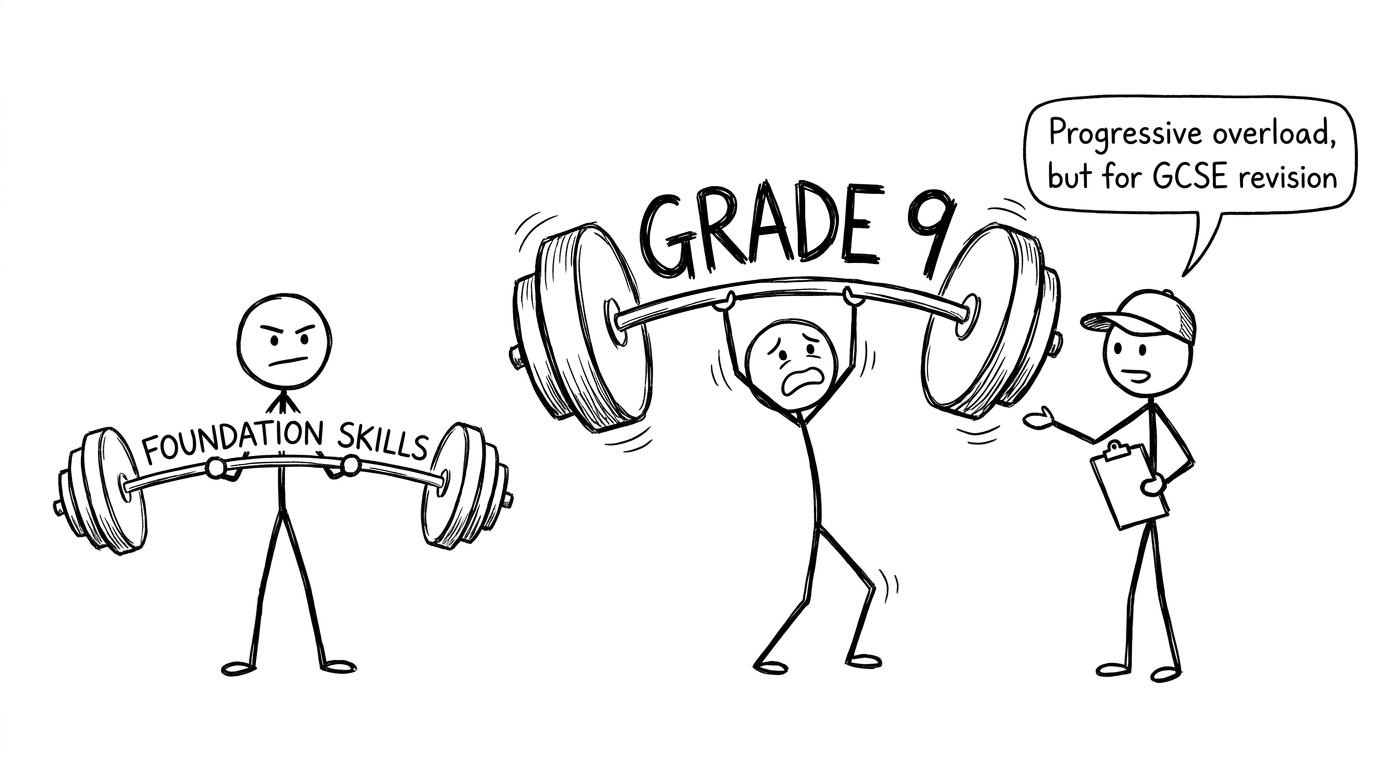 Revision as progressive overload
How to transfer this to WJEC Biology (without pretending YesGenie is a Biology site)
You’re here for maths revision, but the question is about WJEC Biology. So here’s the honest bridge:
- In Biology, your “topic score” comes from exam questions and mark schemes.
- Your goal is not to label yourself as “bad at cells”. It’s to find “I miss 2-mark explain questions on diffusion because I don’t link concentration gradient to net movement”.
- Then you use Biology-specific resources at school to fix it.
But you can practise the whole diagnostic skill inside GCSE maths, quickly and repeatedly, using YesGenie. That’s how you become the student who walks into any exam knowing what to prioritise.
To practise diagnosis with full papers, use: GCSE Past Papers.
To stress-test closer to the real exam window, use predicted sets like: Edexcel GCSE Maths Predicted Papers (again, the point is your process).
Common mistakes when trying to find your weakest topics
- Revising by feeling instead of evidence. If you don’t mark and track, your brain will prioritise what feels hardest, not what costs the most marks.
- Calling everything a weak topic. Early on, it’s normal to feel weak everywhere. The fix is to narrow it: one paper, one list of mistakes, one next action.
- Ignoring the mark scheme logic. In Biology, it’s keyword-dependent; in GCSE maths, method marks matter. Either way, you must learn what the examiner rewards.
- Practising without feedback. Doing 50 questions and not checking solutions just rehearses the same errors.
- Over-correcting. If percentages is weak, you don’t need a five-hour percentages day. You need a tight loop: lesson, 10 questions, review, re-test.
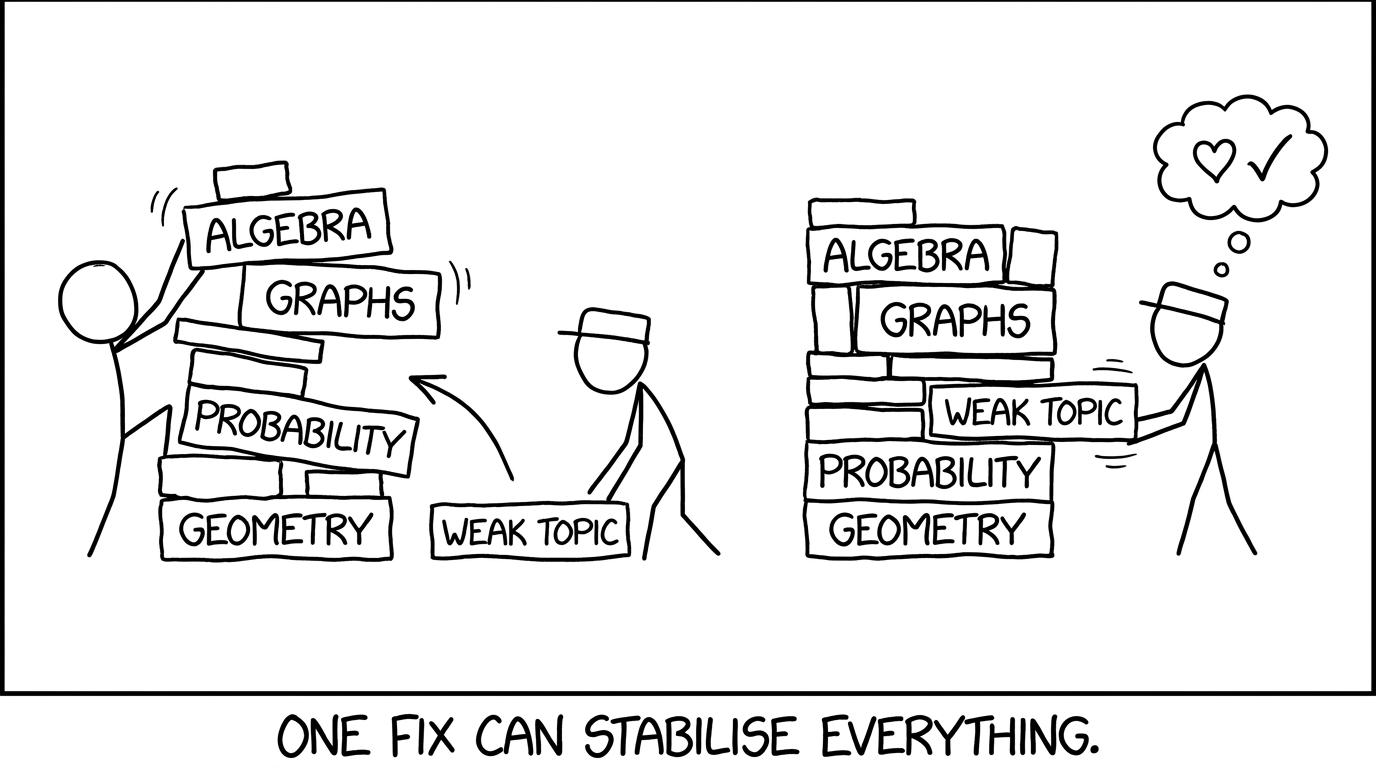 Fix one missing brick and everything stabilises
The calm finish: make “weakest topics” your advantage
The best GCSE students aren’t the ones who never get things wrong. They’re the ones who treat mistakes like directions. If you’re a WJEC Biology student trying to find weak topics, the fastest route is to build a repeatable system: test, mark, tag, fix, re-test. Then practise that system daily in GCSE maths, where progress is easier to measure and confidence builds quickly.
Make YesGenie your base camp: start at GCSE Maths Revision, use GCSE Past Papers for real exam practice, and add Predicted Papers when you want timed pressure with smart focus. Use the lessons, practice questions, mark schemes, and video solutions to close one gap at a time.
Your weakest topics don’t have to be the chapters you avoid. With the right evidence, they become the easiest marks you haven’t collected yet.










