

GCSE WJEC English Language: Stop Forgetting Content
GCSE revision for WJEC students who keep forgetting English Language content. Use recall, spacing and mark schemes, plus a maths-style plan that sticks.
The moment you realise your GCSE revision isn’t sticking
You know that feeling when you open your notebook and it’s like someone swapped your brain overnight? Yesterday you could explain a writer’s methods. Today you can barely remember the quote you highlighted three times. For lots of WJEC students, that’s the story of GCSE English Language revision: you do the work, yet the content keeps slipping away.
The frustrating part is that it doesn’t look like forgetting. It looks like you “understood it at the time”. And that’s exactly the trap. Rereading notes creates a warm sense of familiarity. But exams reward retrieval: what you can pull out under pressure, in a timed response, using the mark scheme’s language.
This post is written for students who revise maths on YesGenie and want the same reliability in English Language. We’re going to borrow the calm, method-led approach you use for GCSE maths and apply it to WJEC English Language, without pretending English is about memorising endless facts.
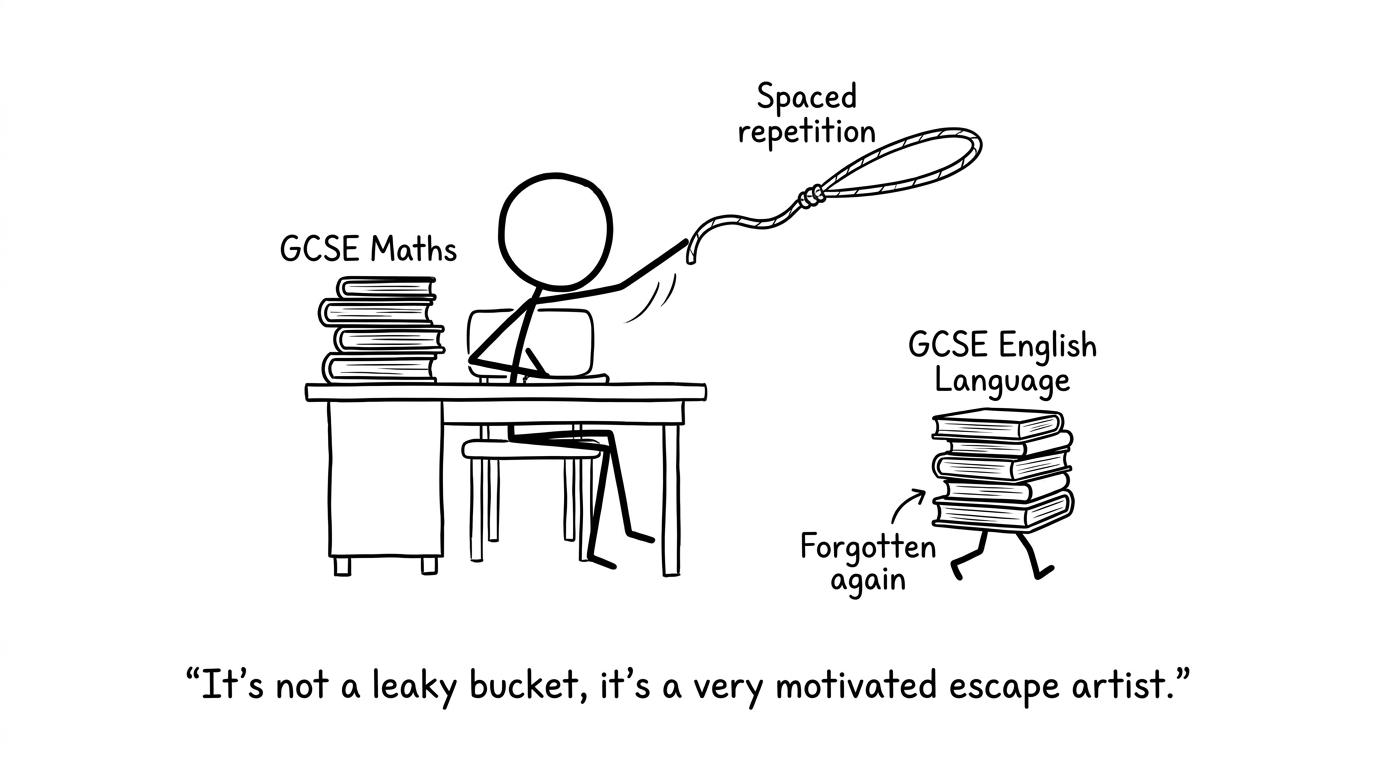 A student tries to lasso runaway English revision
A quick checklist to stop forgetting GCSE English Language
If you only take one thing, take this: forgetting is normal. Your system just needs to make forgetting visible early, then fix it.
Use this checklist for GCSE English Language (WJEC) revision:
- Practise active recall daily (small, specific prompts).
- Space your revision (return after 1 day, 3 days, 7 days, 14 days).
- Tie everything to the mark scheme language (what gets marks, not what feels smart).
- Chunk techniques into a small “toolkit” you can actually use in timed writing.
- Do exam-style practice, then improve one thing each time.
For the maths side of your week, keep your routines tight: lessons, questions, then papers.
Useful YesGenie places to anchor your overall GCSE plan:
- WJEC GCSE Maths Revision
- GCSE Past papers
- Resources Hub (mini tests, predicted papers and more)
- Other resources (self-assessment sheets, formulae)
Why WJEC students forget English Language content (and why it’s not your fault)
Forgetting usually happens for three boring reasons.
Familiarity isn’t retrieval
When you reread a model answer or highlight quotes, your brain recognises the page. Recognition feels like knowing. But in the GCSE exam you don’t get the page. You get a blank answer box and a clock.
A simple shift: swap “I’ve looked at this” for “I can produce this”. In maths, you know the difference. Seeing a worked solution to a simultaneous equations question is not the same as solving one yourself. English works the same way.
Your knowledge is too wide and not organised
Many students collect techniques like stickers: simile, metaphor, pathetic fallacy, juxtaposition, short sentence, rhetorical question. Then in an exam they panic because everything feels possible.
The fix is a small toolkit. Think: fewer moves, used more often.
You aren’t revising the mark scheme
In GCSE maths, marks come from method. You learn the method, then you learn where it earns marks.
English Language is also method. The “method” is: make a point, choose evidence, analyse effect, connect to the writer’s purpose, and keep it rooted in the question. If you don’t practise that method repeatedly, your knowledge stays fuzzy.
YesGenie makes this easier because you can build your revision around exam practice and mark schemes in the same place you already do maths.
Even if you’re WJEC, the habits transfer: practise with real papers, read the mark scheme, improve one paragraph at a time.
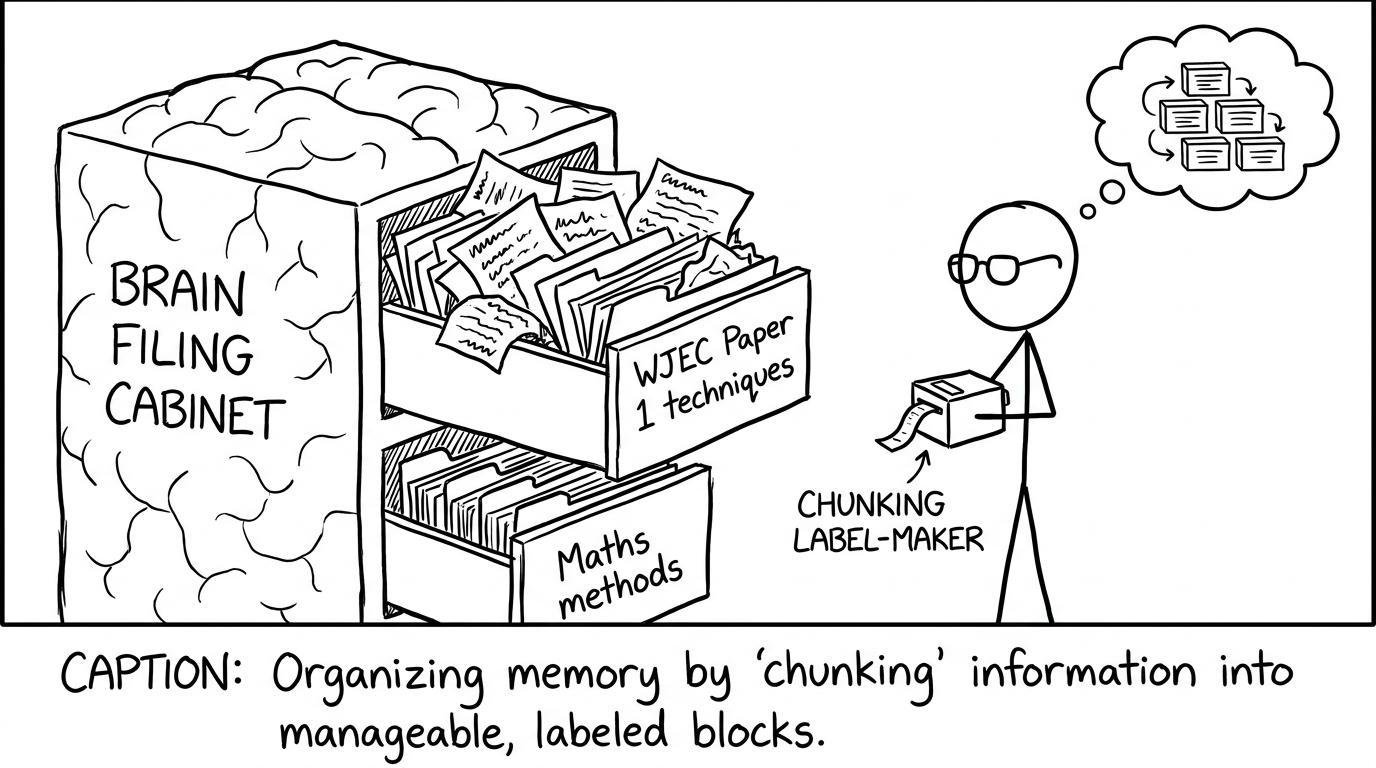 A brain filing cabinet gets reorganised with “chunking”
A maths-style memory system for GCSE English Language (that actually sticks)
Here’s the part most students skip: you need a system that expects forgetting.
Build a “quote bank” like a formula sheet
Not 40 quotes. Not a page per text. For GCSE English Language, you want a small bank of flexible evidence.
Create:
- 8-12 short, versatile quotations (or micro-quotes) per key text type you practise.
- For each quote: 2 techniques you can confidently analyse, and 2 effects you can argue.
Example structure:
- Quote: “…”
- Technique: imagery + contrast
- Effect: creates tension; positions reader to…
- Link to purpose: suggests the writer wants…
Then practise retrieving it.
Use spaced repetition with tiny prompts
Your prompts must be specific. “Revise Paper 1” is not a prompt. “Write one PETAL paragraph using a short quotation and analysing a single method” is.
A simple spacing schedule:
- Day 0: learn / build the paragraph plan.
- Day 1: recall it from memory.
- Day 3: recall it again.
- Day 7: do it under a 10-minute timer.
- Day 14: integrate it into a full response.
This is the same logic as returning to algebra, then returning again, then doing a full mixed paper.
To support the maths side while you do this, keep your practice varied:
Track consistency like you track marks
In maths, progress is visible: you either got the answer or you didn’t. English can feel foggy, so make the progress measurable.
Use a simple score out of 555 for each paragraph:
- 111 for a clear point
- 111 for relevant evidence
- 111 for method/technique
- 111 for effect/meaning
- 111 for linking back to the question/purpose
If you score 3/53/53/5, you don’t need “more revision”. You need to add the missing two moves.
Worked examples: borrowing GCSE maths thinking to fix English forgetting
These examples are deliberately maths-flavoured, because you’re a maths reviser. The aim is to make revision feel like a method, not a mood.
Worked example 1: modelling forgetting as decay (so you plan for it)
Suppose your recall strength (how easily you can retrieve a quote and analysis) drops by 20%20\%20% each day if you don’t revisit it.
Let the strength today be S0=100S_0 = 100S0=100.
After 1 day:
S1=0.8×100=80 S_1 = 0.8 \times 100 = 80 S1=0.8×100=80After 2 days:
S2=0.8×80=64 S_2 = 0.8 \times 80 = 64 S2=0.8×80=64After 3 days:
S3=0.8×64=51.2 S_3 = 0.8 \times 64 = 51.2 S3=0.8×64=51.2By day 3 you are basically at half-strength. This is why “I revised it last weekend” feels like a lie by Wednesday.
The point isn’t the exact percentage. The point is that your GCSE plan should expect decay and schedule retrieval before you drop too far.
Worked example 2: using averages to keep revision honest
Imagine you do 555 timed paragraphs across a week. Your self-scores out of 555 are:
4, 3, 2, 4, 2 4,\ 3,\ 2,\ 4,\ 2 4, 3, 2, 4, 2Mean score:
mean=4+3+2+4+25=155=3 \text{mean} = \frac{4+3+2+4+2}{5} = \frac{15}{5} = 3 mean=54+3+2+4+2=515=3A mean of 3/53/53/5 tells you something specific: you’re usually missing two core moves. That’s a better diagnosis than “English isn’t my subject”.
Now set a narrow target: for the next week, aim to lift the mean to 3.53.53.5 by always adding (1) writer’s purpose and (2) effect on reader.
This is exactly how you’d fix a GCSE maths topic: identify the mark-losing step, then drill it.
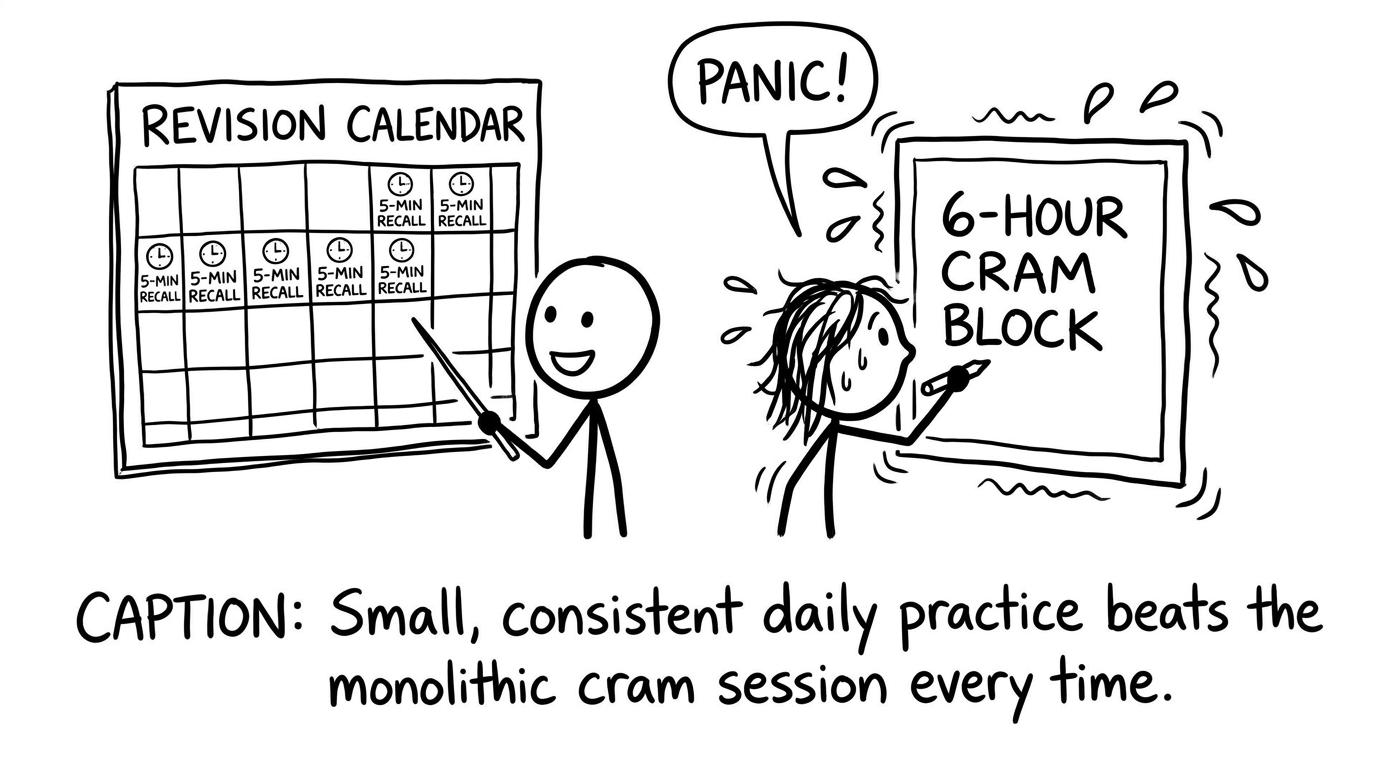 A revision calendar panics at a giant cram session
How to practise WJEC English Language without drowning in resources
WJEC has its own papers and wording, but your revision behaviours matter more than the perfect resource stack.
Do short “retrieval sprints” before maths practice
Before you open your maths questions, do a 555-minute English sprint:
- Write two quotations from memory.
- Write one sentence of analysis for each.
- Write one sentence linking to purpose.
Then move to maths. You’ve just trained your brain that English content is something you retrieve, not something you look at.
Practise the mark scheme like it’s a method
After any English practice, ask:
- Where did I earn marks?
- Where did I hint at an idea but not actually say it?
- Did I analyse a method, or just identify it?
For maths, keep strengthening method marks with structured practice:
- Probability - GCSE Maths Revision Guide (WJEC)
- Substitution - GCSE Maths Revision Guide (WJEC)
- Algebraic Fractions - GCSE Maths Revision Guide (WJEC)
Keeping maths stable reduces overall exam stress, which makes forgetting in English less likely.
Common mistakes that keep GCSE English Language content slippery
- Rereading instead of recalling. If your revision doesn’t force you to produce a paragraph from memory, it won’t hold under exam pressure.
- Collecting techniques without using them. Knowing the word “juxtaposition” is not the same as analysing why it matters.
- Writing long paragraphs with no structure. Length can hide the fact that you didn’t link back to the question or writer’s purpose.
- Leaving feedback invisible. If you don’t note the one thing to improve next time, you repeat the same errors.
- Cramming. A single six-hour session creates familiarity, then decay. Spaced, smaller sessions create retrieval strength.
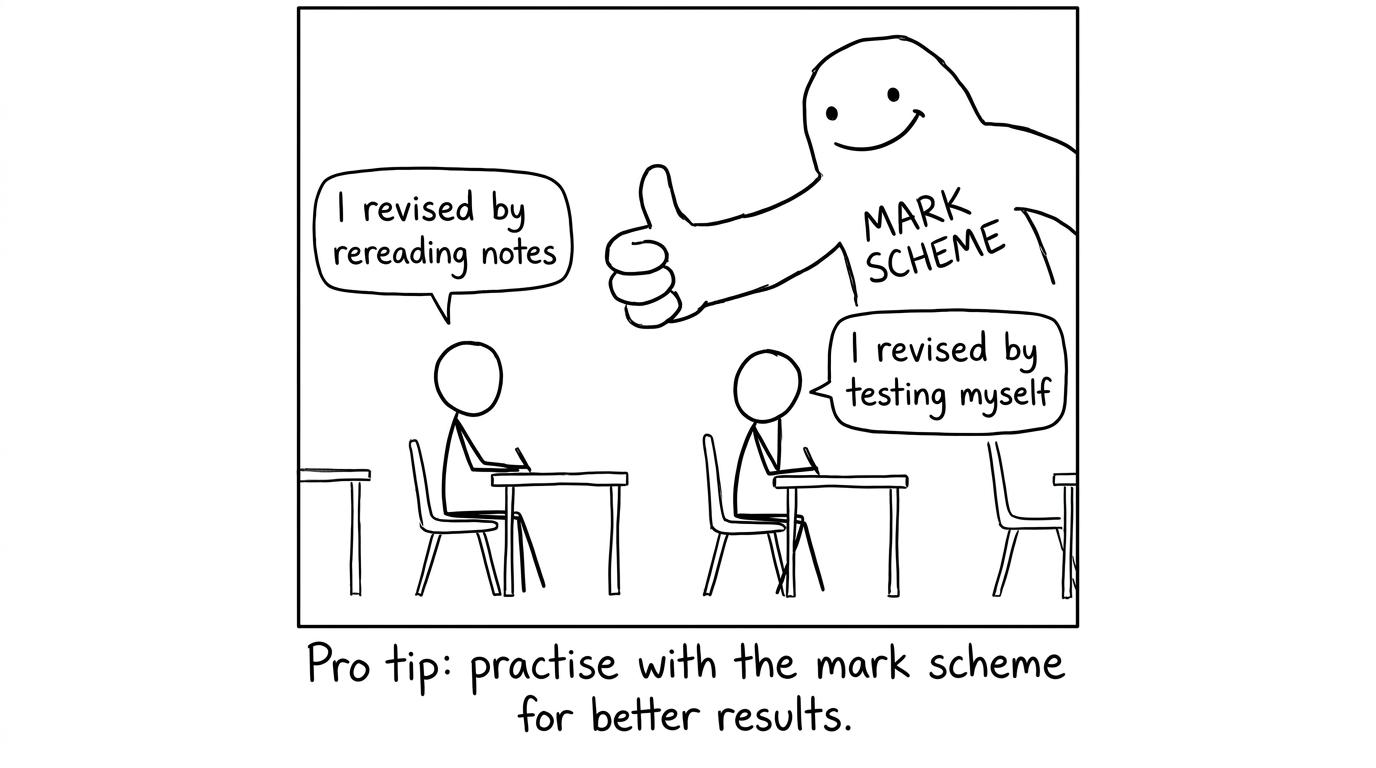 The Mark Scheme monster approves active recall
Bringing it together: a GCSE plan that doesn’t depend on motivation
The students who stop forgetting aren’t the ones with perfect memory. They’re the ones who treat memory like a system: retrieve, space, improve, repeat.
If you’re revising WJEC English Language while also pushing for higher grades in GCSE maths, make the plan small enough to be consistent. Do 555 minutes of English recall, then do your maths practice properly: topic lessons, question banks, and past papers.
Build your routine around YesGenie:
- Use WJEC GCSE Maths Revision to keep methods sharp.
- Add timed practice from GCSE Past papers.
- Use the Resources Hub to bring in mini tests and predicted papers when exams are close.
Your goal isn’t to “stop forgetting” forever. Your goal is to forget earlier, notice sooner, and rebuild faster, until, on exam day, the GCSE content you need is simply there when you reach for it.










