GCSE: Find Weakest Topics for WJEC English Language
GCSE WJEC English Language: find your weakest topics fast using past papers, mark schemes and a simple tracking method (with maths-style evidence).

GCSE revision has a weird moment about halfway through: you stop asking, “Have I revised?” and start asking, “What exactly should I revise next?” For WJEC English Language, that question can feel slippery because your weaknesses hide inside broad labels like reading or writing. But you can make it concrete. Treat your English Language performance like a set of topics, gather evidence from papers and mark schemes, and then target the gaps.
And because you’re a maths student (or at least you’re revising maths too), you already have the right mindset: diagnose first, then practise the method, then repeat until it sticks. That’s how GCSE marks move.
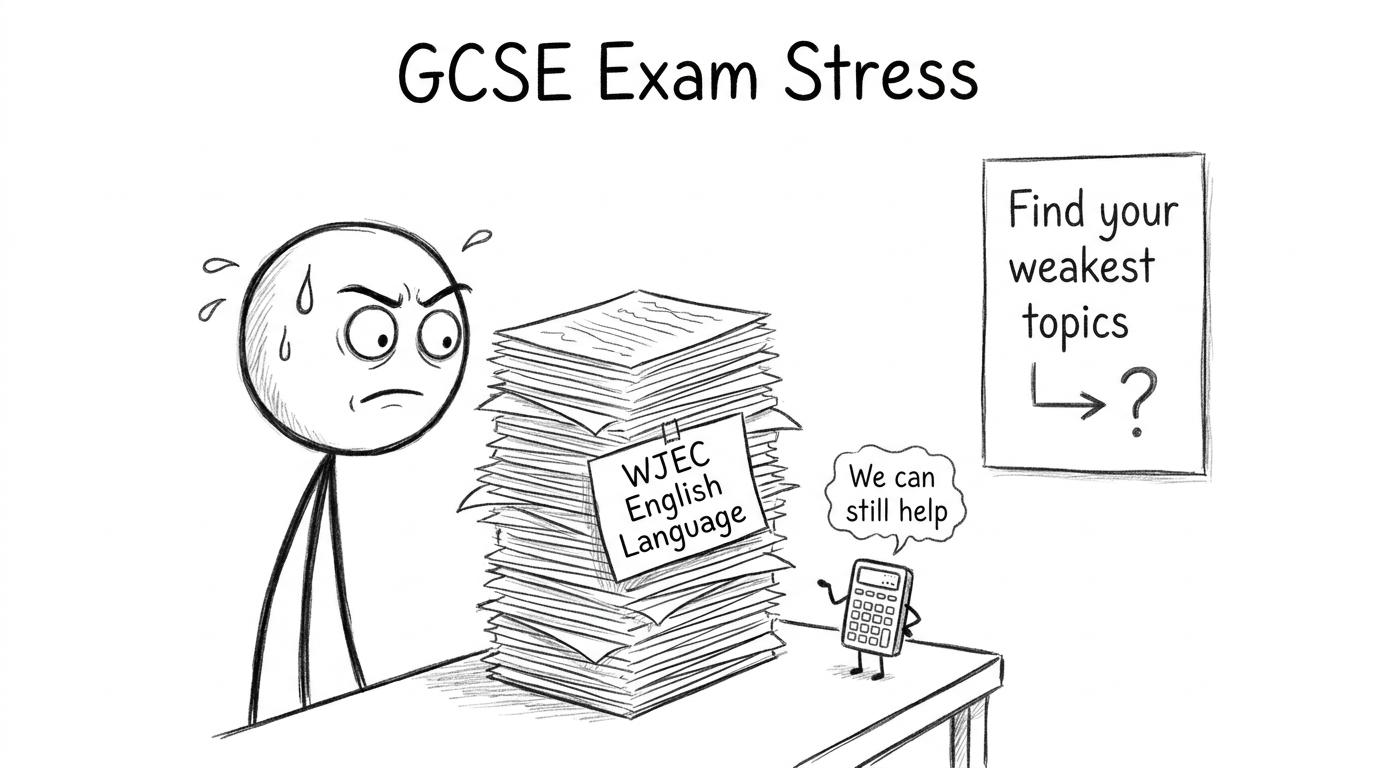 A student overwhelmed by papers while a calculator whispers “We can still help”
A quick checklist for finding your weakest topics (WJEC)
Use this as your simple loop for GCSE improvement:
- Gather evidence: do one timed paper section (not a whole marathon).
- Mark carefully using a mark scheme.
- Convert mistakes into topic labels (specific, not vague).
- Track your results with a tiny bit of maths.
- Revisit the exact skill with focused practice.
- Re-test after a few days.
You can do the same process for maths using WJEC GCSE Maths Past Papers and for any subject using GCSE Past papers. The subject changes, the system stays.
Why “weakest topics” wins more GCSE marks than “more revision”
Most GCSE revision fails quietly. Not because you didn’t work, but because you worked in the wrong direction. You re-read a lot, you highlight a lot, and you tell yourself you’re covering it. Meanwhile, the exam keeps asking for the same handful of skills.
For WJEC English Language, you don’t lose marks for “not knowing English”. You lose marks for missing exam moves: selecting evidence efficiently, explaining effects, comparing viewpoints, organising writing, controlling tone, and using sentence variety with accuracy.
A useful definition is:
- A weak topic is a skill that repeatedly costs you marks under timed conditions.
That last bit matters. Timed conditions are where GCSE performance actually lives.
Make WJEC English Language measurable (a maths student’s method)
Step 1: Break WJEC English Language into trackable skills
Instead of “Paper 1” and “Paper 2”, build a skills list you can spot in your answers. For example:
- Retrieving explicit information accurately
- Selecting quotations (or references) that actually support the point
- Explaining language effects (methods + effect + meaning)
- Analysing structure (shifts, contrast, openings/endings)
- Comparison (similarities/differences + evidence)
- Evaluation (a judgement that is argued, not declared)
- Transactional writing (audience, purpose, form)
- Creative/descriptive writing (imagery, viewpoint, craft)
- Accuracy (spelling, punctuation, grammar)
- Timing (finishing every question)
Keep the list short enough to use. If you can’t label a mistake in 10 seconds, the list is too complicated.
Step 2: Do a short timed attempt, not a full paper
Pick one section (for example, a single reading question or half a writing task) and time it properly. You’re not chasing stamina yet. You’re gathering clean data.
YesGenie makes this style of practice easy because you can move between exam practice and targeted skill work. For maths, students often do the same with Edexcel GCSE Maths Revision Guides or WJEC GCSE Maths Revision when they discover a gap.
Step 3: Mark like you’re trying to prove yourself wrong
A mark scheme isn’t there to comfort you. It’s there to disagree with you.
Use the closest available paper and mark scheme you can access on YesGenie. If you’re also revising English with other boards, you can still practise skills using board pages like AQA GCSE English Language Revision and adapt the skill focus to WJEC.
When you mark:
- Circle where you earned marks (so you can repeat it).
- Underline where the mark scheme wanted something you didn’t give.
- Write one sentence: why you lost those marks.
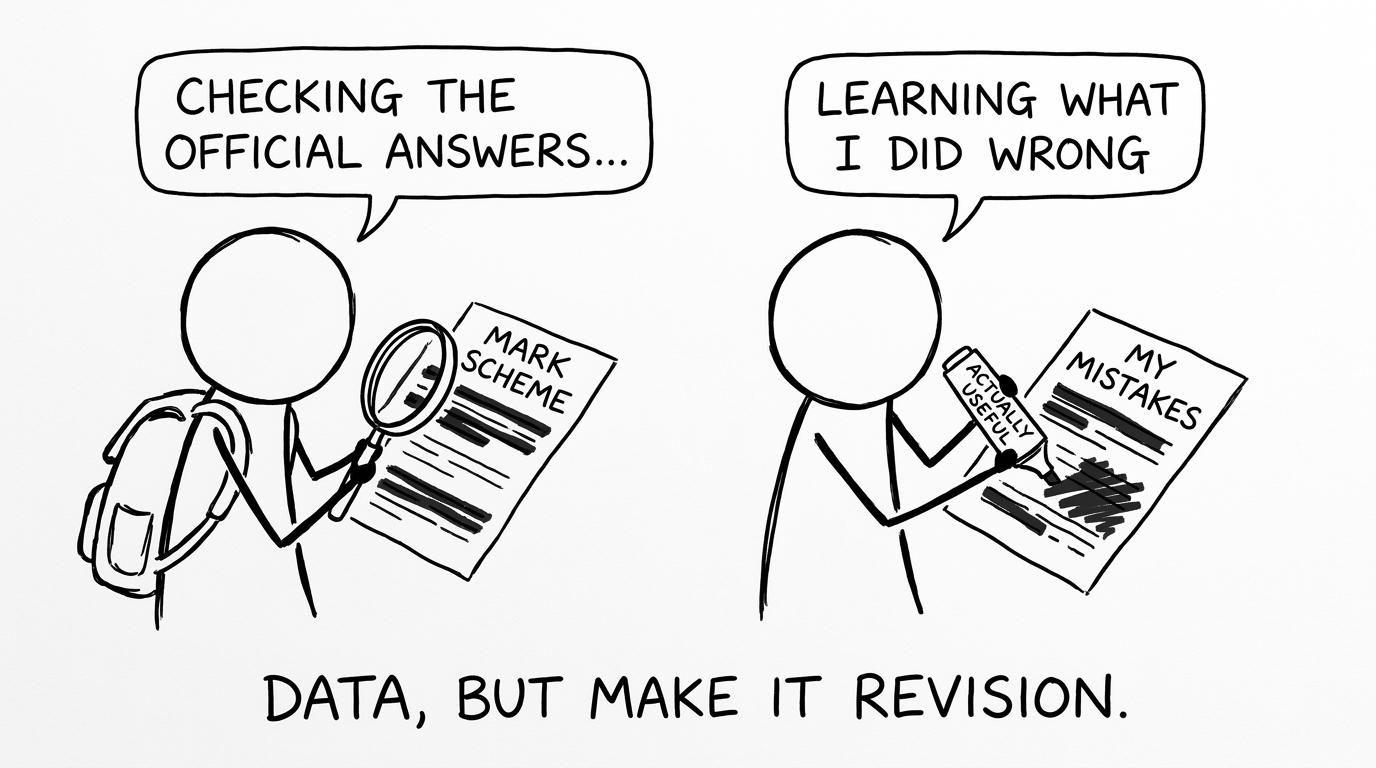 Two students: one with a magnifying glass on the mark scheme, one highlighting “Actually useful” mistakes
Turn marks into a weakness score (simple GCSE maths)
Here’s the move that stops your revision being guesswork.
For each question you attempt, record:
- Marks achieved: mmm
- Marks available: MMM
Then compute your success rate:
Success rate=mM \text{Success rate} = \frac{m}{M} Success rate=MmAnd your weakness score:
Weakness score=1−mM \text{Weakness score} = 1 - \frac{m}{M} Weakness score=1−MmWorked example: building a weakness table
Suppose you do three reading questions over a week:
- Q1 (retrieve): m=3m=3m=3, M=4M=4M=4
- Q2 (language analysis): m=4m=4m=4, M=10M=10M=10
- Q3 (comparison): m=5m=5m=5, M=10M=10M=10
Compute weakness scores:
- Retrieve: 1−34=14=0.251-\frac{3}{4}=\frac{1}{4}=0.251−43=41=0.25
- Language analysis: 1−410=610=0.61-\frac{4}{10}=\frac{6}{10}=0.61−104=106=0.6
- Comparison: 1−510=510=0.51-\frac{5}{10}=\frac{5}{10}=0.51−105=105=0.5
So your weakest topic right now is language analysis.
This is the GCSE mindset shift: you don’t “revise English”. You improve one skill that is expensive in marks.
Why this works for maths students
It mirrors how you fix maths weaknesses:
- If you keep dropping marks on algebraic fractions, you go to a focused resource like Algebraic Fractions (WJEC) Revision Guide.
- If substitution is costing you easy marks, you practise it directly with Substitution (WJEC) Revision Guide.
English Language is the same. The topics just look more like “explain effect” than “solve equation”.
How to translate a WJEC mark scheme into a “to practise” list
A mark scheme often rewards a small number of repeatable behaviours. Your goal is to convert them into actions.
Example: “language analysis” into a repeatable paragraph method
A reliable paragraph structure is:
- Point (what the writer suggests)
- Evidence (a short quotation)
- Method (word class/technique)
- Effect (meaning + reader response)
- Link (back to question)
You can make this measurable. For each paragraph, aim to include:
- 111 clear point
- 111 embedded quotation
- 111 method
- 111 effect
So your self-check is out of 444 per paragraph.
If you write two paragraphs and only include method once, your “method hit-rate” is:
12=0.5 \frac{1}{2} = 0.5 21=0.5That number is not there to judge you. It’s there to tell you what to do next.
Use the “two-pass” review to find hidden weak topics
Sometimes your weakest topics aren’t the obvious ones. They’re the quiet leaks.
First pass: where did the marks go?
Look for big losses:
- Dropping 666 marks on a 101010-mark analysis question
- Not finishing a question (often a 100%100\%100% loss on that section)
Second pass: why did they go?
Label the cause:
- Timing
- Misread the command word
- No evidence
- Evidence not explained
- Too much retelling
- Paragraphing/structure
- Technical accuracy
This is how you find a “weak topic” like timing that sits underneath everything.
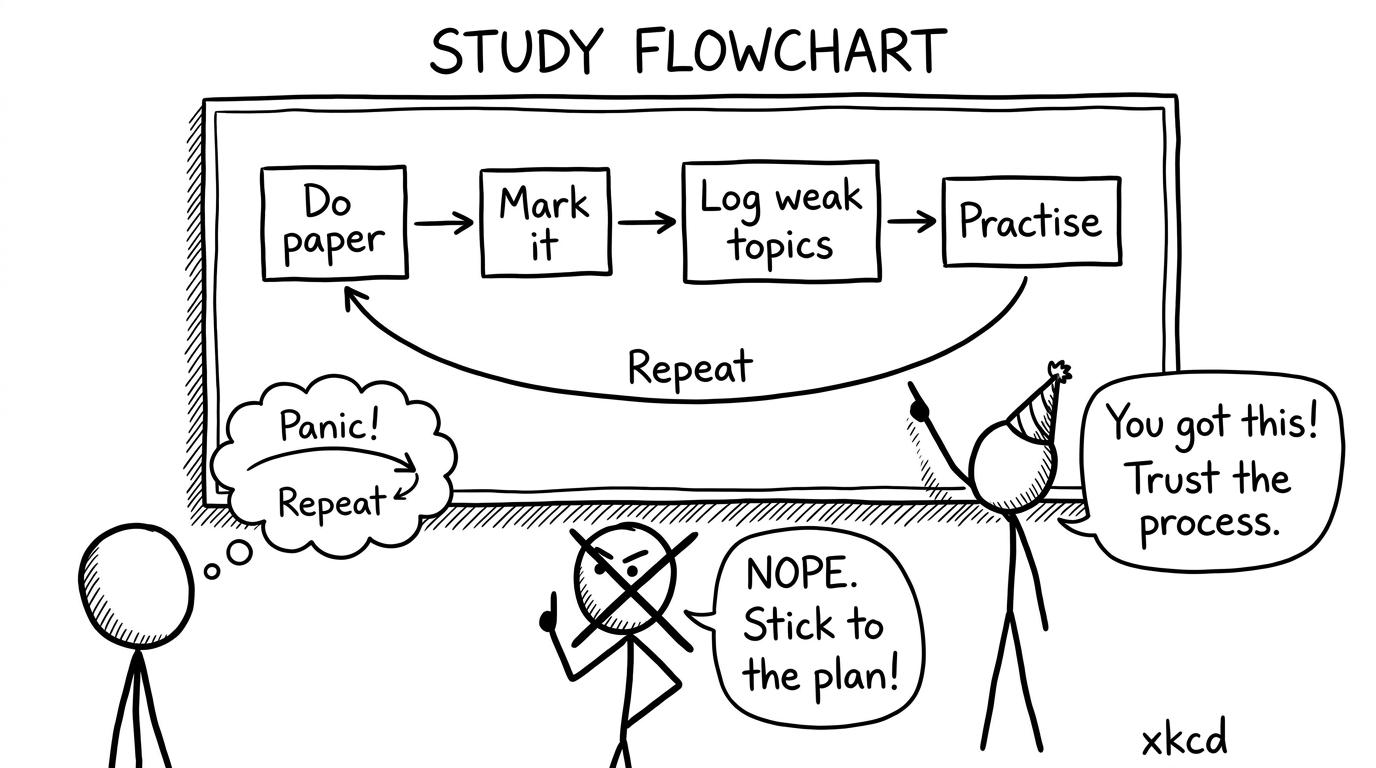 A flowchart showing “Do paper -> Mark it -> Log weak topics -> Practise -> Repeat”, with a crossed-out “Panic” shortcut
How to turn weak topics into a weekly GCSE plan
A plan should be small enough to follow when you’re tired.
Try this:
- One timed English Language section (20-30 minutes)
- Mark and log weaknesses (10 minutes)
- Two short practice blocks for the weakest topic (2 × 15 minutes)
- One re-test question later in the week (10-15 minutes)
Then do the same rhythm for maths using YesGenie lessons, mini tests, and papers. Start from the hub pages when you need direction: Resources on YesGenie and Other Resources are good places to reset your plan.
If you’re juggling GCSE and A Level, keep your maths exam practice efficient by leaning on Edexcel A Level Maths Past Papers the same way: diagnose, target, repeat.
Common mistakes when finding weakest topics (and how to avoid them)
- Calling a weakness “Paper 2”: that’s not a topic, it’s a container. Name the skill (comparison, evaluation, transactional writing, accuracy).
- Marking generously: if you wouldn’t award it as an examiner, don’t award it as you. Your GCSE grade improves faster with honest marking.
- Only counting wrong answers, not missing answers: timing is a topic. If you leave 888 marks blank, that is the biggest weakness score possible.
- Practising randomly after you identify a weakness: the point is targeted practice. Fix the exact move the mark scheme rewards.
- Revising what feels good: you’ll naturally drift towards strengths. Your weakest topics rarely feel satisfying at first.
- Not re-testing: if you never re-test, you never confirm improvement. GCSE revision needs feedback loops.
Closing: use GCSE evidence, then let YesGenie do the heavy lifting
If you’re a WJEC student trying to find your weakest topics in GCSE English Language, the win is not a magical list. The win is a repeatable process: attempt, mark, label, track, and practise the specific skill that keeps leaking marks.
That’s exactly how strong maths revision works too. On YesGenie, you can keep that loop going with revision lessons, revision guides, practice questions, mini tests, past papers, predicted papers, and clear mark schemes. Start with a single paper section today, compute one weakness score, and then use YesGenie to target the topic until it stops being your weakest.