

GCSE Revision: Stop Forgetting Content (WJEC Chemistry)
GCSE revision for WJEC Chemistry: stop forgetting content with spaced practice, retrieval and maths-first routines. Use YesGenie to stay consistent.
You sit down to revise. You open a WJEC Chemistry booklet. Everything feels familiar, until you try to say it out loud.
That’s the moment most people misread as “I’m bad at science”. It’s not. It’s a GCSE memory problem: you’ve seen the ideas, but you haven’t practised bringing them back under exam pressure. And if you’re also revising maths, you’ll recognise the pattern: you can watch ten videos on a topic and still freeze when the question changes shape.
This post is for WJEC students who keep forgetting GCSE Chemistry content, written for the kind of student who wants a routine that actually sticks. We’ll use a maths mindset: small steps, spaced practice, mark-scheme accuracy, because it’s the same skill in different clothing.
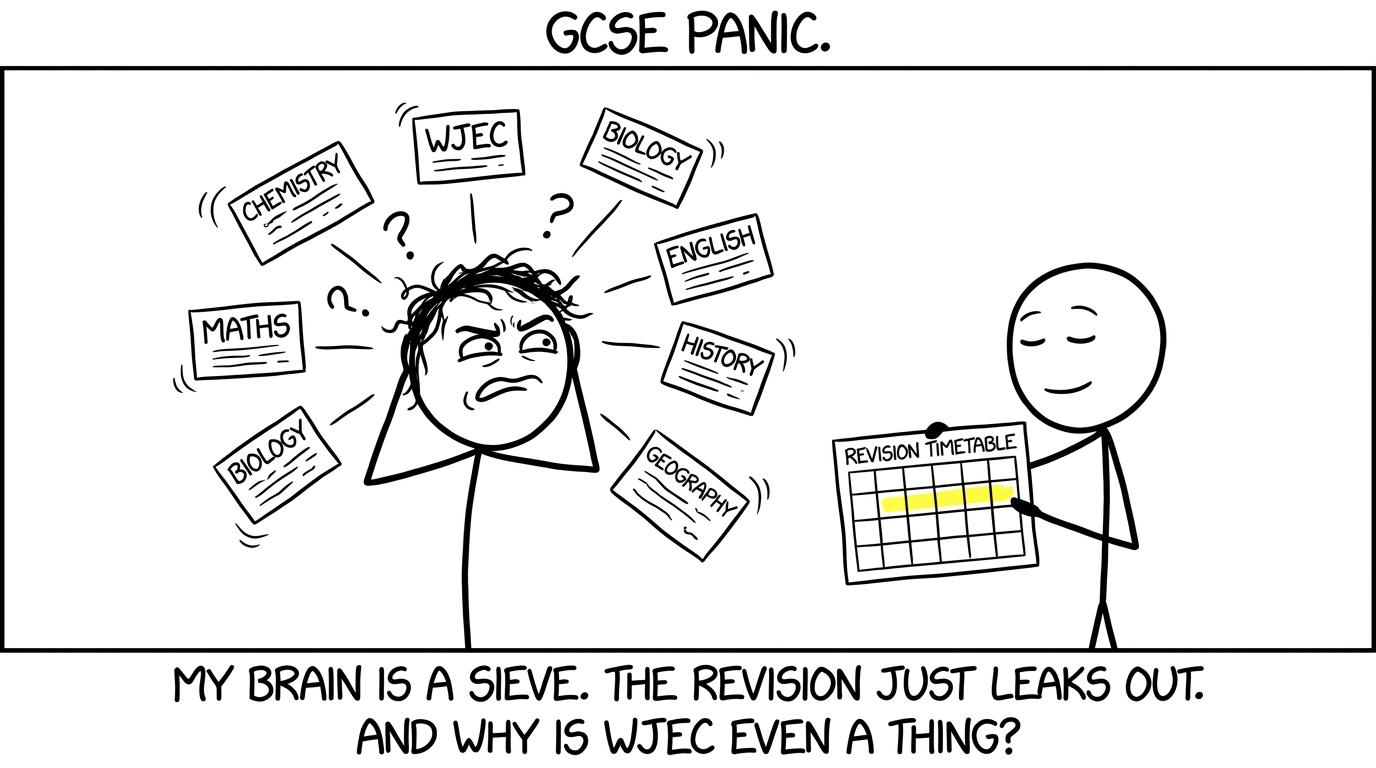 A student surrounded by flashcards and a calm friend with a timetable
A quick checklist to stop forgetting GCSE content
If you do nothing else, do these consistently for the next two weeks:
- Short retrieval every day (no notes open for the first 5 minutes).
- Spaced repetition: revisit the same ideas on Day 1, 3, 7 and 14.
- Exam phrasing: mark-scheme language matters, especially in WJEC “explain” questions.
- Maths-first clarity: practise the calculations (moles, rates, graphs) until they feel routine.
- Proof of learning: one timed set of questions each week.
For the maths side of your routine, keep your practice structured with the GCSE Past papers hub and the Resources page (mini tests, predicted papers, and more).
Why WJEC students forget GCSE Chemistry (and why it’s not your fault)
Most forgetting isn’t caused by laziness. It’s caused by revision that feels productive but doesn’t create retrieval strength.
Reading notes is comfortable because it creates recognition: “Yes, I remember this.” But GCSE exams don’t ask you to recognise a page. They ask you to generate an answer from a cue you didn’t design.
Chemistry adds two extra difficulties:
- High vocabulary load (electrolysis, reduction, homologous series, equilibrium). Your brain stores the words separately from the meaning unless you keep reconnecting them.
- Mixed question styles: a six-mark explanation, then a calculation, then an unfamiliar practical context.
Maths students already know the cure: you don’t get better at algebra by re-reading. You get better by doing it, checking it, and repeating it.
If you want a stable maths routine alongside science, it helps to anchor your week with one or two focused resources like Edexcel GCSE Maths Lessons or AQA GCSE Maths Lessons (even if you’re not on those boards, the skills transfer).
GCSE spaced repetition that actually works (without taking over your life)
Spaced repetition sounds fancy. In practice, it’s just refusing to trust your memory too early.
Here’s a simple pattern that works for WJEC Chemistry content and your GCSE maths topics:
- Day 1: learn + immediate retrieval
- Day 3: retrieval again (short)
- Day 7: questions (longer)
- Day 14: timed questions + mark scheme
Your sessions don’t need to be long. What matters is that you struggle a little (the good kind) because that’s what strengthens recall.
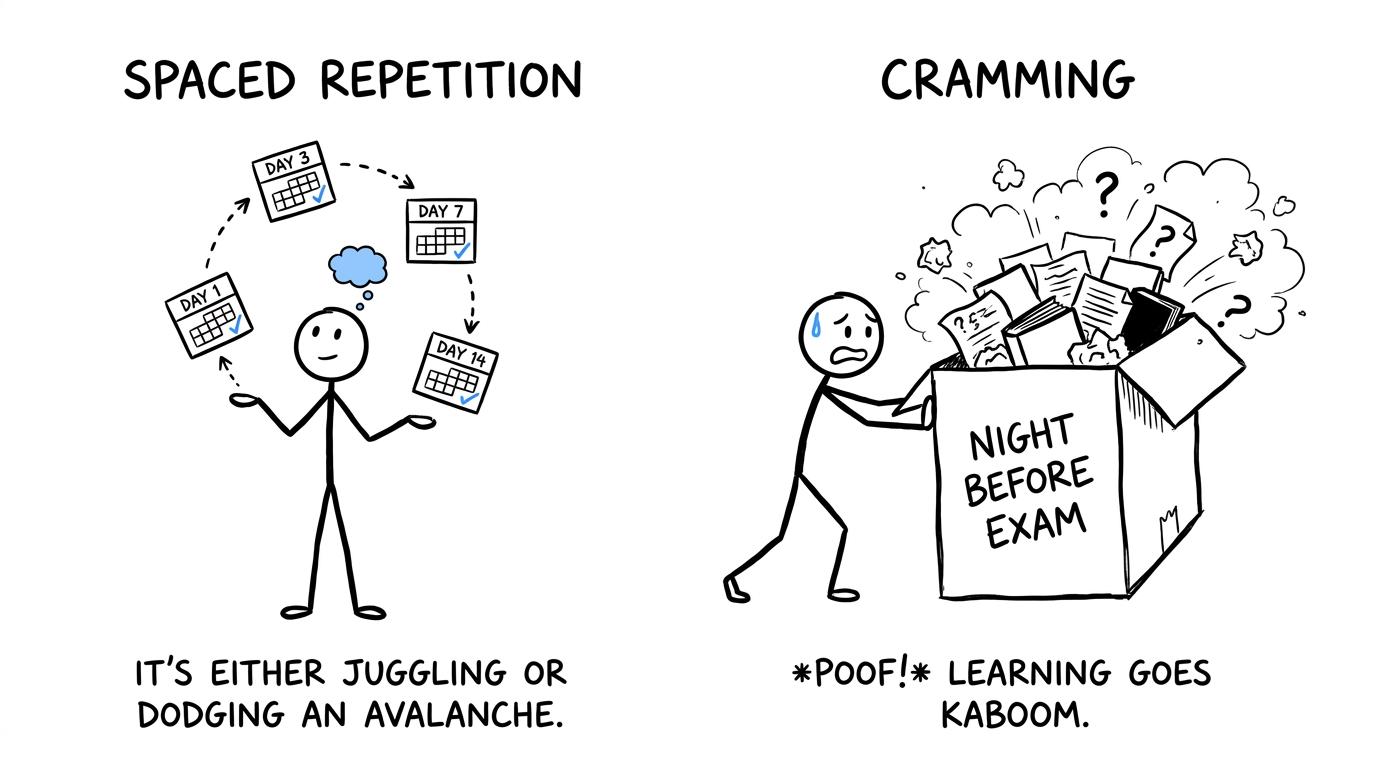 Spaced repetition vs cramming exploding the night before
A 20-minute GCSE routine (Chemistry + maths)
Try this when you get home:
- 5 mins: Chemistry retrieval (no notes): write everything you can about one subtopic.
- 10 mins: one maths skill block (e.g. rearranging, percentages, graphs).
- 5 mins: mark + fix one mistake properly.
The reason this works is that you end with correction, not comfort.
For your maths block, pick a single page and stay there until you can do it cleanly. For example, if algebra is leaking marks, use a focused revision guide like Simplifying Algebra (GCSE), then come back to it in a few days.
The maths inside WJEC Chemistry: make it automatic
A lot of “forgetting Chemistry” is really “I don’t trust the calculations”. When you feel shaky on the numbers, you avoid the topic, and the content fades.
So let’s treat the maths bits like maths revision: method first, then variety.
Worked example: percentage change (useful across GCSE science)
A common science skill is comparing results.
Question: A student’s result increases from 404040 to 525252. Find the percentage increase.
Method:
- Find the increase: 52−40=1252 - 40 = 1252−40=12
- Divide by the original: 1240=0.3\frac{12}{40} = 0.34012=0.3
- Convert to a percentage: 0.3×100=300.3 \times 100 = 300.3×100=30
So the percentage increase is 30%30\%30%.
This is exactly the same method you use in GCSE maths. If you want more practice in this style, keep your skills sharp with mini, low-pressure tests like Edexcel GCSE Maths Mini Tests.
Worked example: rearranging a formula (the hidden GCSE skill)
Chemistry often asks you to handle equations like density or rate. The GCSE maths skill underneath is rearranging.
Suppose you have:
m=ρV m = \rho V m=ρVIf you need VVV in terms of mmm and ρ\rhoρ:
- Divide both sides by ρ\rhoρ:
So:
V=mρ V = \frac{m}{\rho} V=ρmIf you want this to feel easier, it’s because you’ve seen it repeatedly in maths contexts. Keep that repetition going with topic booklets such as Expanding and Factorising Exam Booklet (different skill, same habit: do, mark, improve).
Retrieval practice for WJEC Chemistry (the part most students skip)
If you’re forgetting GCSE Chemistry content, stop asking “Have I revised it?” and start asking “Can I retrieve it?”
Here are three retrieval formats that work well:
Brain dump then patch
Pick one WJEC topic (say, reactivity series). Set a timer for 4 minutes. Write everything you know in rough bullets.
Then open your notes and patch the gaps in a different colour. Your brain learns the difference between what you thought you knew and what you can actually recall.
Two-minute definitions
Chemistry marks are often won with one clean sentence. Practise writing definitions from memory, then compare to a mark scheme.
The “why” ladder
For any process (electrolysis, neutralisation, equilibrium), write a chain of “why” statements until you reach first principles. This helps you answer WJEC “explain” questions without memorising whole paragraphs.
And because GCSE maths is also built on short, precise statements (like “substitute into the formula”, “collect like terms”), practising this precision helps both subjects.
Use mark schemes like a map, not a judgement
Students often avoid mark schemes because they feel like a verdict. But a mark scheme is really a map of what the examiner is willing to reward.
For WJEC Chemistry, wording is especially important when questions say state, describe, explain, or evaluate. You don’t need poetic writing. You need the right idea in the right shape.
The same is true in maths: method marks exist, and clean working matters. That’s why having everything organised in one place is so useful: GCSE Past papers and the wider Sitemap of subjects and boards make it easier to keep your practice consistent.
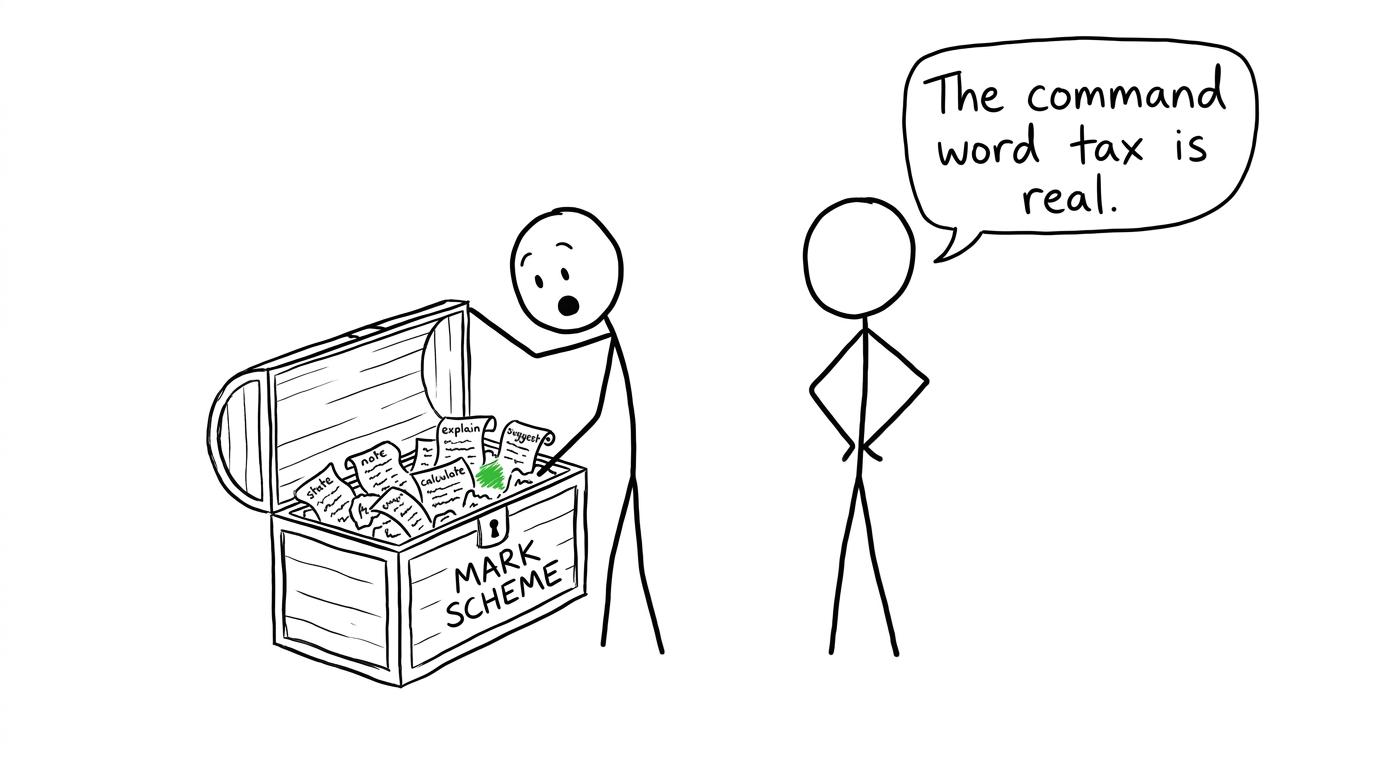 A mark scheme treasure chest full of command words
Common mistakes that make GCSE content slip away
- Re-reading instead of retrieving: it feels fluent but doesn’t build recall.
- Cramming WJEC Chemistry in blocks: you get a short-term boost and a fast drop.
- Avoiding calculations: fear turns into avoidance, and avoidance becomes forgetting.
- Not correcting errors: doing questions without marking carefully is like practising the wrong method.
- Mixing up command words: “state” is not “explain”, and WJEC will mark accordingly.
- Revision without a timetable: not a strict one, but at least a repeatable rhythm.
For maths, these errors show up the same way: you practise the easy topics, you avoid the ones that expose gaps, and you mistake familiarity for mastery. That’s why short diagnostic practice like Mini Tests can be so powerful.
Bringing it together: a GCSE routine you can trust
The quiet truth is that forgetting isn’t the enemy. Unnoticed forgetting is.
When you build GCSE revision around retrieval and spacing, you turn forgetting into a signal: “This needs another rep.” That’s how athletes train, and it’s how strong maths students get good at unfamiliar questions; not by being naturally confident, but by being consistently exposed to small moments of difficulty.
If you want a simple system that supports your WJEC Chemistry revision while keeping GCSE maths moving forward, use YesGenie as the spine of your week:
- Practise little and often with Edexcel GCSE Maths Lessons or AQA GCSE Maths Lessons.
- Test yourself regularly with Edexcel GCSE Maths Mini Tests.
- Build exam readiness with GCSE Past papers.
- Use the wider Resources area when you need predicted papers and short, focused practice.
Make the next 14 days simple: retrieve, space, practise, mark, repeat. Your GCSE memory will start to feel less like a sieve, and more like something you can train.










