

GCSE: Turn WJEC Chemistry Notes Into Active Recall
GCSE revision for WJEC: learn how to turn Chemistry notes into active recall using maths-style methods, past papers and mark schemes on YesGenie.
GCSE revision can feel like you’re carrying a library around in your head. Especially with WJEC Chemistry, where you can write pages of notes, highlight them, rewrite them, and still freeze when a six-mark question asks you to explain something you swear you’ve seen before.
The quiet problem isn’t effort. It’s that notes are often passive. Active recall is the opposite: it forces your brain to retrieve, not just recognise. And if you’re a maths student too, you already have a perfect model for how this works: you don’t get better at algebra by rereading the method; you get better by doing the questions.
This guide shows WJEC students how to turn GCSE Chemistry notes into active recall, borrowing the same disciplined approach you use for GCSE maths on YesGenie.
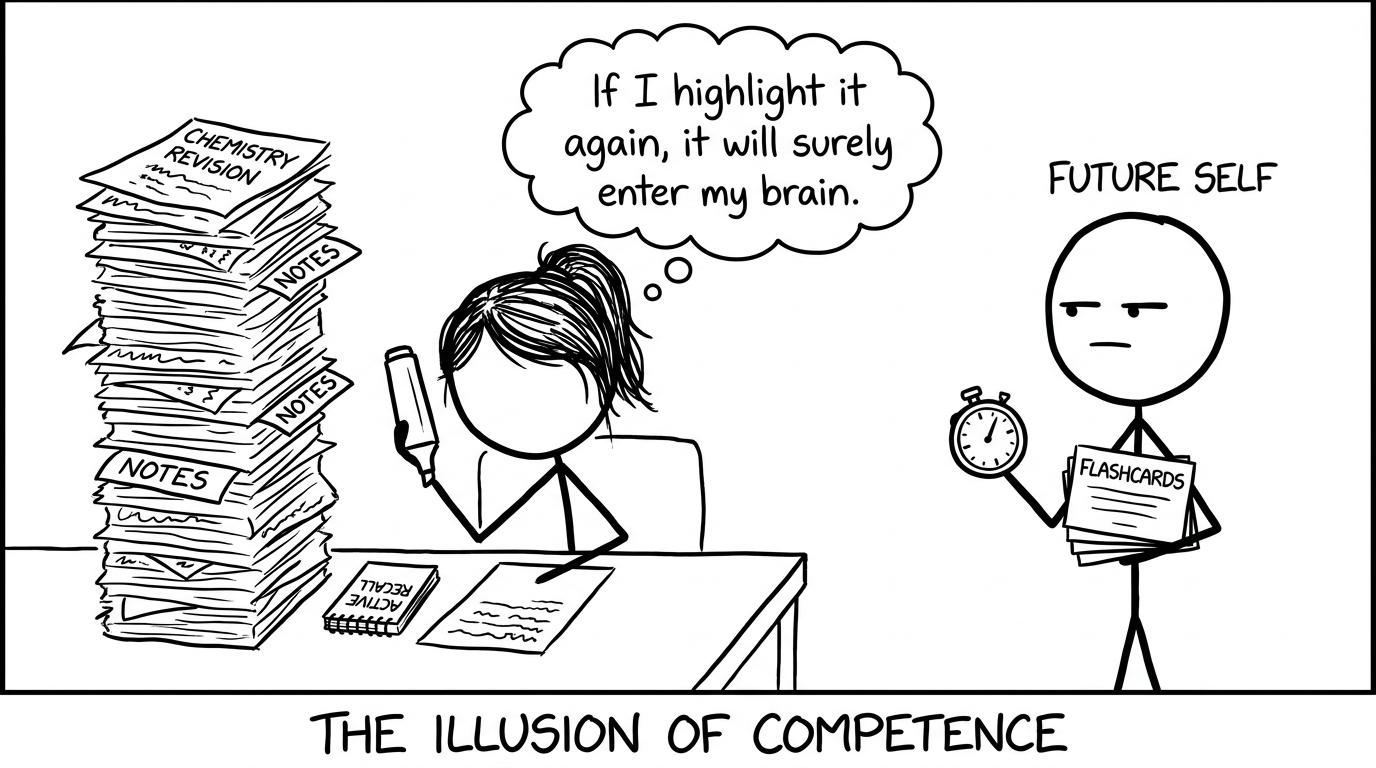 A student choosing active recall over highlighting
A quick checklist for turning notes into active recall
Use this as your “conversion kit” for any page of Chemistry notes:
- Reduce a topic to a one-page structure: definitions, key equations, required practicals, common question stems.
- Hide and retrieve: turn every line into a question you must answer without looking.
- Check with a mark scheme: add what examiners actually reward.
- Space it out: revisit after 1 day, 3 days, 7 days, then weekly.
- Interleave: mix topics so your brain learns the difference between similar ideas.
- Use timed practice to simulate exam pressure.
For the maths side of your timetable, you can mirror this structure using GCSE Maths Revision plus topic practice and exam papers.
Why active recall works (and why notes alone don’t)
Here’s the trap: rereading notes feels productive because it’s fluent. Your eyes move, the page looks familiar, and your brain mistakes familiarity for mastery.
Active recall is uncomfortable because it’s honest. If you can’t retrieve it, you don’t know it yet. That discomfort is exactly what strengthens memory.
If you’ve ever used a maths method, you’ll recognise this immediately. Reading the solution to a simultaneous equations question can feel obvious. But when you try one cold, you realise where the gaps are. Chemistry is the same.
To make this practical, we’ll use a maths-style workflow:
- Prompt (a question)
- Attempt (retrieve from memory)
- Mark (check accuracy)
- Fix (log the exact missing detail)
- Repeat (space it out)
That workflow is built into how you should use Edexcel GCSE Maths Past Papers (and the equivalent for your board): attempt, mark, fix, repeat. The subject changes, but the learning mechanism does not.
Turn WJEC Chemistry notes into question prompts
The simplest rule is this: every sentence in your notes must be convertible into a question.
The “one-line to one-question” method
Take a typical note:
- “A catalyst increases the rate of reaction without being used up.”
Convert it into prompts:
- “What is a catalyst?”
- “How does a catalyst affect rate?”
- “Is a catalyst used up? Explain.”
Now your notes become a set of retrieval tasks.
This is exactly what works in GCSE maths too. A revision guide line like “To simplify algebra, collect like terms” becomes:
- “What counts as like terms?”
- “Simplify 7x+3x−47x+3x-47x+3x−4.”
If you need that algebra refresh, build the habit with Simplifying Algebra (all resources) or the full Simplifying Algebra revision guide.
Use exam-stem prompts, not textbook prompts
WJEC Chemistry often rewards explanation phrasing. So your active recall questions should mimic the stems you’ll actually see:
- “Explain why…”
- “Describe how you would…”
- “Suggest why…”
- “Calculate…”
In GCSE maths, this is the difference between “find the gradient” and “work out the equation of the line”; same content, different demand. Practise that difference in maths with Expanding and Factorising revision guide, because it trains you to answer what’s asked, not what you hoped they asked.
Build “Chemistry flashcards” the maths way: minimal, precise, mark-scheme led
Flashcards fail when they become tiny notebooks. Active recall works when the prompt is tight and the answer is specific.
A mark-scheme-led card template
Front:
- “Explain why increasing temperature increases rate.”
Back (keep it mark-scheme style):
- “Particles have more kinetic energy.”
- “More particles have energy $
≥\geq≥ E_a$.”
- “Collision frequency increases.”
- “More successful collisions per second.”
Notice how each bullet could map to a mark. That’s the standard you want.
On the maths side, YesGenie already bakes this into your revision through exam practice, topic questions, and structured learning. Start from your board hub (for example Edexcel GCSE Maths Revision or GCSE Maths - OCR) and treat every worked example as a “mark-scheme answer” you can later retrieve.
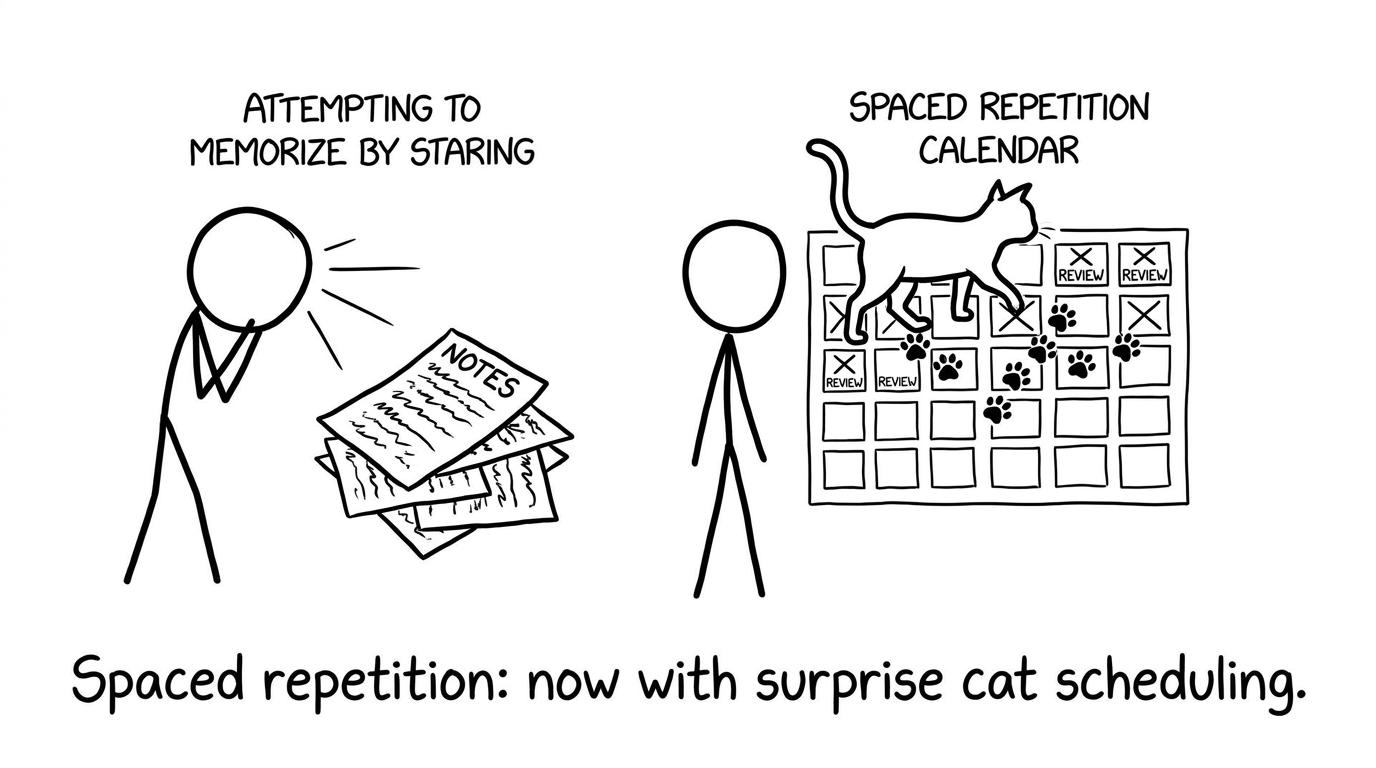 Spaced repetition with surprise cat scheduling
Spacing and interleaving: the revision timetable that makes it stick
Active recall without spacing becomes a short-term performance trick. It feels good in the moment, then vanishes a week later.
A simple spacing pattern:
- Day 0: create prompts and test once
- Day 1: test again, fix weak answers
- Day 3: test again (faster)
- Day 7: test again (mixed topics)
- Weekly: keep it alive until exams
Interleaving means mixing topics so you practise choosing the right idea under pressure. That’s the exam skill: recognising what the question is really about.
For maths, spacing and interleaving are easier when your practice is already organised. Use Edexcel GCSE Maths Mini Tests to build short, spaced bursts of retrieval that don’t take over your evening.
Worked examples: use maths-style retrieval to strengthen Chemistry calculations
Even if this post is about Chemistry notes, your GCSE performance often hinges on calculations under time pressure. The good news is that calculation confidence is transferable: the same habits you build in maths will stabilise you in Chemistry.
Example 1: Rearranging a formula (retrieval first, then method)
Suppose you need to rearrange:
pV=nRT pV = nRT pV=nRTMake the prompt: “Make nnn the subject.”
Retrieve the method: isolate nnn by dividing both sides by RTRTRT.
n=pVRT n = \frac{pV}{RT} n=RTpVThen practise the same thinking in GCSE maths with “change the subject” style questions. Even algebraic fraction work trains the discipline of legal moves and clear structure, like in Algebraic Fractions (WJEC) revision guide.
Example 2: Standard form confidence (Chemistry meets maths)
Chemistry loves very large and very small numbers. If you see 0.000560.000560.00056, convert to standard form.
Move the decimal 4 places right to get 5.65.65.6, so the power is −4-4−4:
0.00056=5.6×10⁻⁴ 0.00056 = 5.6 \times 10^{-4} 0.00056=5.6×10⁻⁴Now make the active recall prompts:
- “How do you decide if the power is negative?”
- “Convert 0.000560.000560.00056 to standard form.”
This is exactly the kind of skill that pays back marks fast in GCSE maths too, because standard form questions are often high-confidence marks once the method is automatic.
Example 3: Proportional reasoning (the hidden bridge)
Chemistry frequently uses proportional thinking: doubling a quantity, comparing rates, scaling results.
If a reaction produces 12 g12\,\text{g}12g of product from 3 g3\,\text{g}3g of reactant (in a simplified scenario), then the scale factor is
123=4 \frac{12}{3} = 4 312=4So 5 g5\,\text{g}5g of reactant would produce
5×4=20 g 5 \times 4 = 20\,\text{g} 5×4=20gTurn that into prompts:
- “What is the scale factor from 333 to 121212?”
- “Apply it to 555.”
This is the same mental muscle as ratio and proportion in GCSE maths.
How to use past papers as active recall (not just assessment)
A past paper is not just a score. It’s a machine for generating the exact prompts you should revise next.
Use this loop:
- Attempt a section timed.
- Mark it.
- For every lost mark, write a new prompt: “What did they want me to say?”
- Practise that prompt the next day.
In maths, this is why Resources is so powerful: you can move from mini tests to predicted papers to full past papers and keep refining the same loop.
Even if you’re not on Edexcel for maths, it’s still worth using the structure of the Edexcel GCSE Maths Revision Guides to see how a topic gets broken into learnable chunks, each with worked examples you can retrieve later.
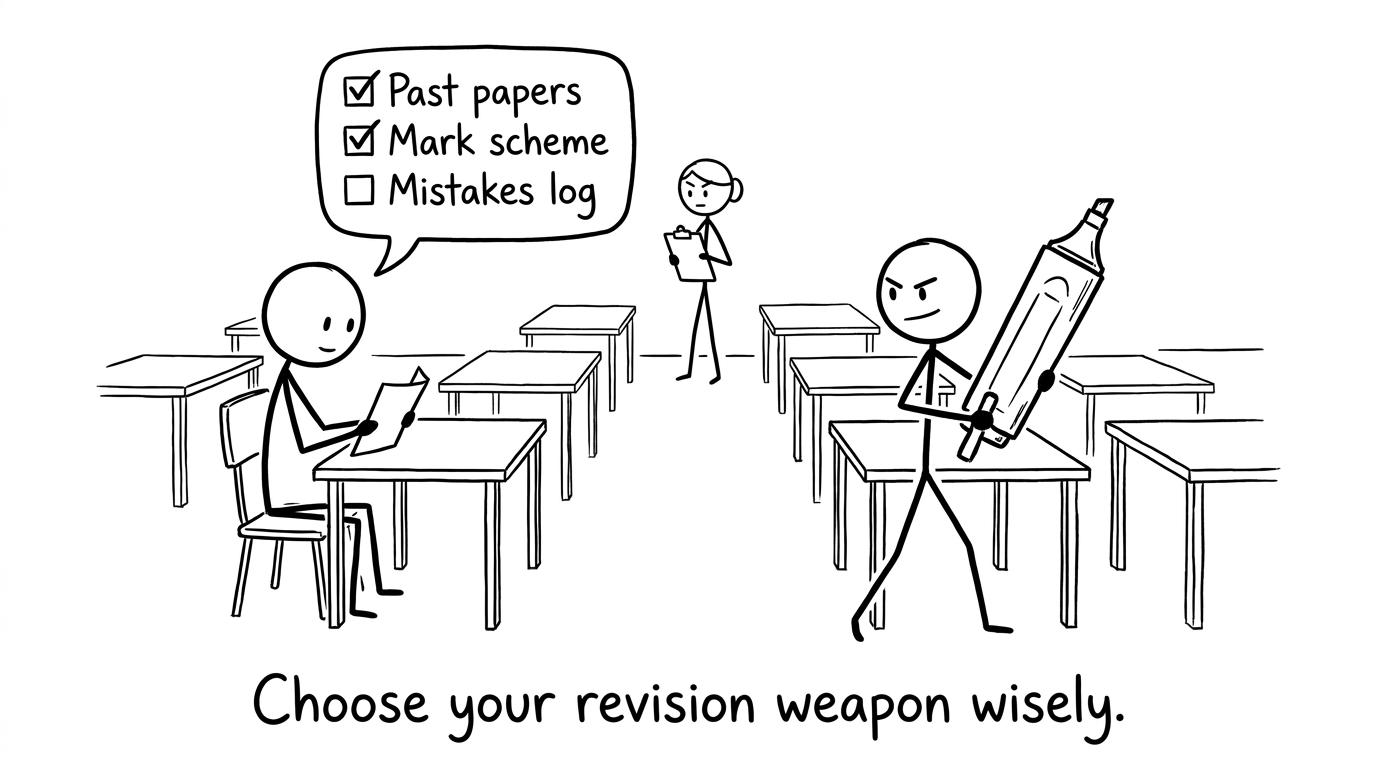 Choose your revision weapon wisely
Common mistakes WJEC students make when switching to active recall
- Keeping notes and adding flashcards on top. If your notes remain the main event, recall becomes optional. Convert notes into prompts, don’t just decorate them.
- Writing vague prompts like “rate of reaction” instead of “Explain why increasing concentration increases rate (4 marks)”. GCSE questions reward specificity.
- Not checking against mark schemes. You can recall something true but not exam-worthy. Train yourself to recall the credited phrasing.
- Cramming the same topic repeatedly. That’s recognition. Spacing is what turns retrieval into long-term memory.
- Avoiding mixed practice. Interleaving feels harder because it is more realistic. GCSE exams are mixed by design.
- In maths, stopping at ‘I understand’. Understanding is step one; retrieval under time pressure is step two. Use a mix of topic work and papers from Edexcel GCSE Maths Past Papers or your board hub to force that second step.
Bringing it back to GCSE success (and how YesGenie fits)
If you remember one thing, let it be this: notes are storage, but GCSE grades come from retrieval. WJEC Chemistry rewards students who can explain, calculate, and apply under time pressure. Active recall is the way you turn what you wrote into what you can use.
And if you want your maths revision to feel just as deliberate, build the same loop with YesGenie: learn a topic, practise it, then prove it under exam conditions. Use GCSE Maths Revision for structured coverage, Resources for mini tests and predicted papers, and Edexcel GCSE Maths Past Papers (or your board hub) to practise the real thing with mark schemes.
Turn your notes into prompts. Turn prompts into marks. And let YesGenie carry the structure when motivation feels heavy.










