GCSE: Find Your Weakest Topics (WJEC Biology)
GCSE WJEC Biology: learn how to find your weakest topics fast using a marks audit, past papers, and a simple data method GCSE students can copy.

GCSE revision has a strange way of making intelligent students feel foggy. You can read a chapter, highlight it, even make neat flashcards, and still walk out of a WJEC Biology paper thinking: why did I lose marks on the bits I ‘knew’? The truth is usually duller and kinder than it feels in the moment. Most GCSE grades aren’t held back by everything. They’re held back by a small cluster of weak topics you haven’t yet caught in the act.
This post is about how WJEC students can find those weakest topics in GCSE Biology using a simple marks audit and a bit of maths thinking. And because you’re revising maths too (or you will be soon), we’ll use YesGenie as the place you practise the method: collect evidence, find the pattern, target the fix.
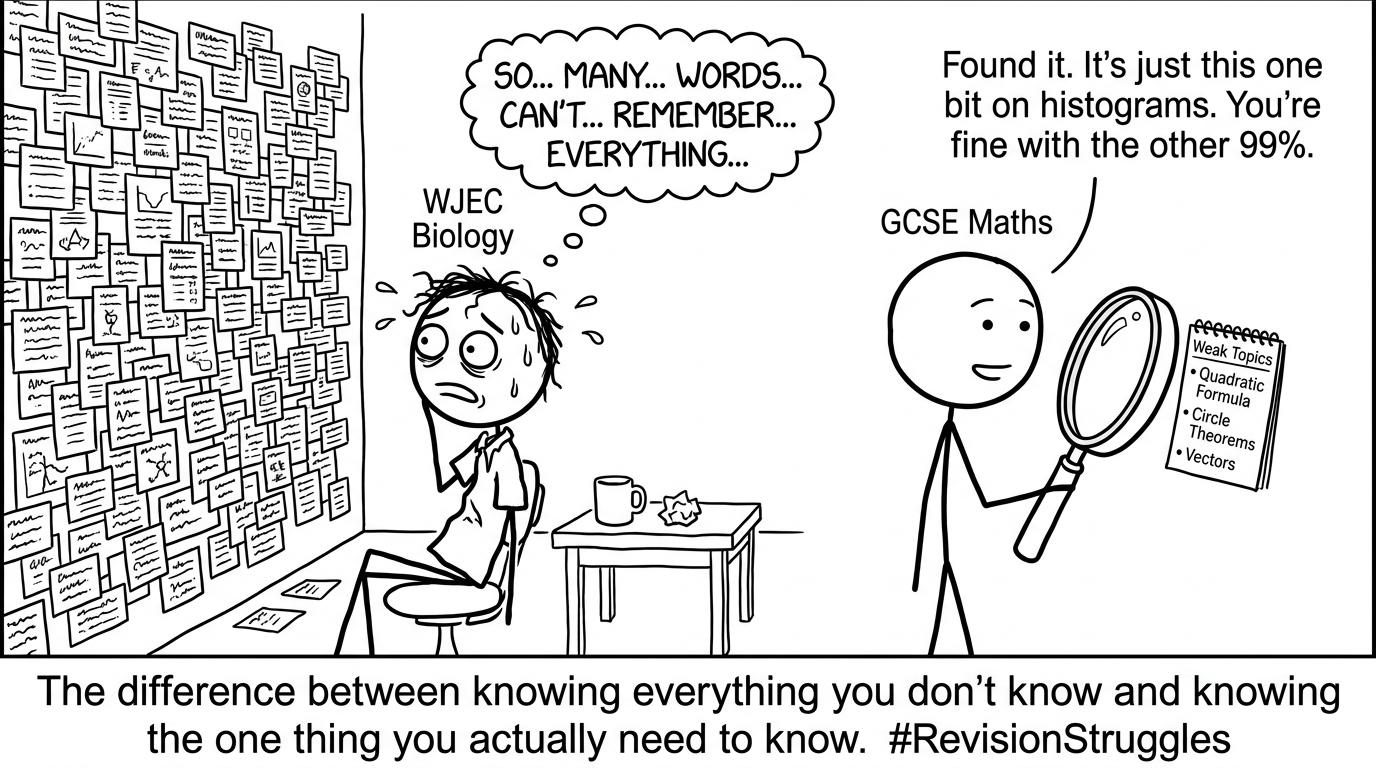 A student finding weak topics with a magnifying glass
The quick checklist (the whole method in one view)
If you want the fast version, here it is:
- Use WJEC Biology past papers (or predicted papers if you’re close to exams) and do them under timed conditions.
- Mark with the mark scheme and record exactly where marks were lost.
- Convert marks lost into topic-level totals (not paper-level feelings).
- Rank topics by either total marks lost or loss rate.
- Pick the top 333 weakest topics and repair them with focused practice.
- Re-test using new questions and repeat.
You can do the same loop for your GCSE maths revision too, using:
- WJEC GCSE Maths Revision
- GCSE Past papers
- Edexcel GCSE Maths Past Papers
- Edexcel GCSE Maths Mini Tests
- Resources (including predicted papers and mini tests)
Why “weakest topics” beats “revise everything”
In GCSE revision, “revise everything” sounds responsible. In practice, it’s a recipe for vague effort. You end up spending the same time on what you’re already good at because it feels comfortable, and avoiding what costs you marks because it feels messy.
Finding your weakest topics is a different kind of honesty. It’s not about labelling yourself as “bad at Biology”. It’s about being specific: I lose marks on required practical methods, or I confuse diffusion with osmosis when the question is worded strangely.
That specificity is also a maths skill. In maths, you don’t say “I’m bad at algebra”. You say: I’m fine at expanding, but factorising harder quadratics slows me down. Then you use targeted resources such as Edexcel GCSE Maths Lessons or a topic page like Algebraic Fractions.
So the heart of this post is a GCSE-friendly idea: treat marks like data.
Build a “marks audit” (WJEC Biology edition)
A marks audit is just a table where every lost mark has somewhere to live.
Step 1: pick the evidence
Choose two or three WJEC GCSE Biology papers (or paper-style question sets your teacher gives you). If you’re close to exams, predicted papers can help you practise under pressure, but past papers are still the cleanest evidence.
Even if you’re a maths student first, the principle is the same: real exam questions expose real gaps. That’s why YesGenie makes exam practice central for GCSE maths too, with GCSE Past papers and board-specific practice like WJEC GCSE Maths Revision.
Step 2: sit the paper like it matters
Do it timed. No notes. No pausing to “just check one thing”. GCSE exams reward recall under time constraints.
Then mark it. Be strict. If the mark scheme asks for “two reasons” and you wrote one, you lost the mark. Your future self deserves accurate information.
Step 3: record marks lost by topic
For each question you got wrong, write:
- Question reference (e.g. Q5(b)Q5(b)Q5(b))
- Topic label (e.g. “enzyme practical”, “infection and response”, “homeostasis”, “ecology”) aligned to your WJEC specification
- Marks available
- Marks scored
- Why you lost marks (knowledge gap, command word, interpretation, maths error, units)
This last part matters because sometimes the “topic” isn’t actually the topic. It’s the skill.
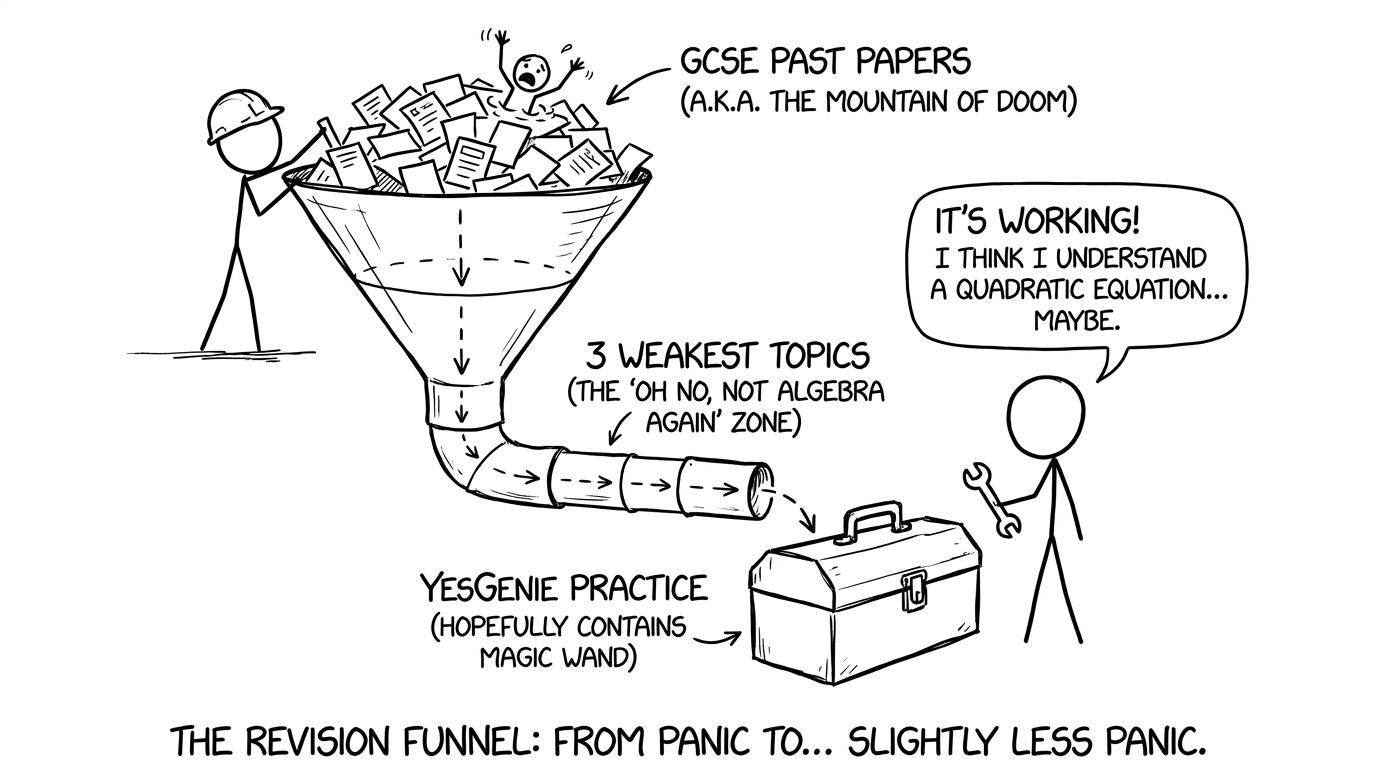 Revision funnel from past papers to weakest topics
Use a simple GCSE maths method to find the weakest topics
Once you have your audit, the next step is surprisingly mathematical. You’re going to summarise and rank.
Total marks lost (the blunt instrument)
For each topic, compute:
Marks lost=Marks available−Marks scored \text{Marks lost} = \text{Marks available} - \text{Marks scored} Marks lost=Marks available−Marks scoredThen sum the marks lost across the papers.
If “homeostasis” cost you 121212 marks and “ecology” cost you 444 marks, you know where the biggest leak is.
Loss rate (the fair comparison)
Sometimes a topic appears a lot, so it naturally has more marks. Loss rate helps you compare fairly.
Loss rate=Marks lostMarks available \text{Loss rate} = \frac{\text{Marks lost}}{\text{Marks available}} Loss rate=Marks availableMarks lostWorked example (done slowly, like a mark scheme)
Imagine your audit shows:
- Topic A (Enzymes): 181818 marks available across papers, 111111 scored.
- Topic B (Ecology): 101010 marks available across papers, 777 scored.
Marks lost:
- Enzymes: 18−11=718 - 11 = 718−11=7
- Ecology: 10−7=310 - 7 = 310−7=3
Loss rates:
Enzymes loss rate=718≈0.389 \text{Enzymes loss rate} = \frac{7}{18} \approx 0.389 Enzymes loss rate=187≈0.389 Ecology loss rate=310=0.3 \text{Ecology loss rate} = \frac{3}{10} = 0.3 Ecology loss rate=103=0.3So Enzymes is weaker on both measures. That becomes a priority.
This is exactly the kind of GCSE numeracy that shows up in science papers too: fractions, percentages, interpreting data. If those skills feel shaky, practise them in your maths revision using the structured lessons and exam questions on YesGenie, starting from GCSE Subjects and your board page like WJEC GCSE Maths Revision.
Make the “top 3” list (and keep it small)
Pick your top 333 weakest topics by loss rate or marks lost. Not 101010. Not “everything that looks ugly”. Just 333.
Small lists create action. Big lists create guilt.
Turn weak topics into a repair plan (without rewriting your notes)
A good repair plan has two phases: learn, then test.
Learn phase: tighten the understanding
For each weak topic, ask:
- What are the key definitions that earn marks?
- What are the required practical steps and variables?
- What does the mark scheme actually reward?
Then write a short “mark scheme version” of the topic: bullet points that mirror how answers are marked.
Test phase: practise like it’s a paper
Do exam-style questions on that topic and mark them strictly. In maths, that’s where YesGenie is strongest: topic-by-topic practice, then papers, then mini tests when you need speed.
Use:
- Edexcel GCSE Maths Mini Tests for quick recall (the same idea works for Biology with short question bursts)
- Resources to find predicted papers and focused revision materials
- Starters if you want a short warm-up routine before a longer session
The deeper point for GCSE students is that testing is not a punishment. It’s measurement. Measurement is what turns revision into progress.
Where WJEC Biology and GCSE maths overlap (use this to your advantage)
Even if your timetable splits science and maths into separate boxes, exams don’t. WJEC Biology will quietly assess skills that look like GCSE maths:
- Rearranging and using formulae
- Units and conversions
- Means from data tables
- Interpreting graphs
- Percentages and percentage change
If you lose Biology marks because of calculation mistakes, you can often fix that faster in maths practice than in Biology note-taking.
Worked example: percentage change (common in biology data)
Suppose a rate increases from 404040 to 525252.
Increase =52−40=12= 52 - 40 = 12=52−40=12.
Percentage increase=1240×100=30% \text{Percentage increase} = \frac{12}{40} \times 100 = 30\% Percentage increase=4012×100=30%That one method protects you across subjects. It’s worth making it automatic.
Common mistakes students make when finding weak topics
- Only looking at the final score. A GCSE score like 52/10052/10052/100 tells you nothing about where you lost marks.
- Blaming the topic when it’s really the command word. “Explain” and “describe” are not the same, and WJEC mark schemes can be picky.
- Guessing your weakest topics from memory. Memory is biased towards the questions that felt stressful, not necessarily the ones that cost marks.
- Not separating knowledge errors from maths errors. If you know the biology but drop the calculation, your fix is numeracy practise.
- Making the list too long. A long list feels thorough but usually leads to shallow revision.
- Not re-testing. If you don’t re-test, you don’t know whether the weakness has actually moved.
 Exam hall monster labelled “That one topic I ignored”
The calm finish: make GCSE progress inevitable
If you take one thing from this, let it be this: GCSE improvement isn’t mysterious. It’s usually a feedback loop you haven’t run yet. WJEC Biology students who find their weakest topics, rank them honestly, and repair them with targeted practice almost always feel a shift, not because they became “naturally better”, but because their revision finally matched the exam.
And if you want that same certainty in maths, build the same loop on YesGenie: start with your board page like WJEC GCSE Maths Revision, practise topics you’re leaking marks on, then pressure-test yourself with GCSE Past papers and quick recall using Edexcel GCSE Maths Mini Tests. Use the mark schemes. Watch the solutions. Repeat the loop.
Your weakest topics aren’t a judgement. They’re a map. Now you know where to go next, and YesGenie is built to help you get there, for free.